Indian independence · CHAPTER 2 ·
British Raj and the early Congress
Chapter 2 of Indian Independence & Partition, 1857–1964: “Congress and the Raj”
After 1858 the Raj governed India through a Viceroy, about a thousand Indian Civil Service officers and allied princes, and by 1900 railways built with Indian taxes ran to about 25,000 miles. Famines struck in 1876–78 and 1896–1900, and the Indian National Congress was founded at Bombay in December 1885.
WW2 is free in full, and chapter 1 of every atlas is free. A free account opens 3 more chapters a day. Starter, at $9 a month, opens all 21 with no daily limit — see the plans.
Free printable Indian independence study guide, sent by email ↓
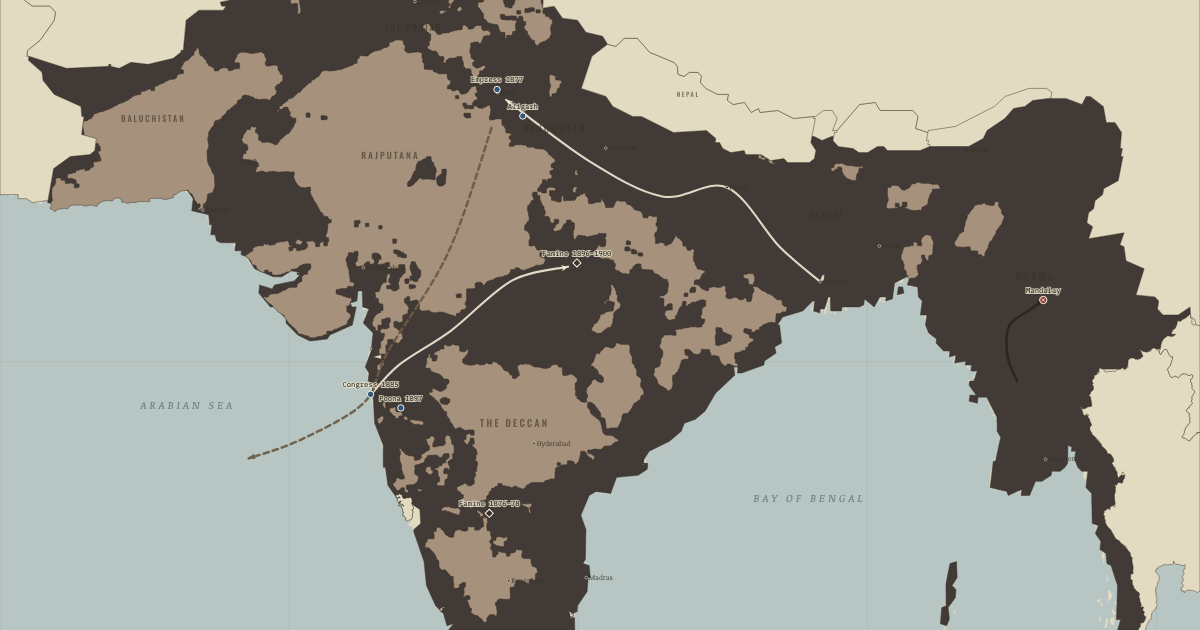
The map above is the world of India, December 1885 — Congress meets; Burma falls.
Every state on the map that year: The world in 1880 · Europe in 1880.
Part of IB History: Indian Independence and Partition →
SHORT EXPLANATION
After 1858 the Crown ruled India with a small British establishment and the help of Indian allies. The Raj, a name for Crown rule derived from the Hindi word for rule, placed a Viceroy, the monarch's representative, in Calcutta. About a thousand British officers of the Indian Civil Service (ICS), selected by examination in London, administered districts as large as small countries. More than five hundred princely states kept hereditary rulers under British supervision; their territories form the tan patchwork on the map. Railways paid for with Indian taxes connected the subcontinent and carried grain and cotton to ports. Connection did not protect everyone from hunger. When the monsoon, the summer rain on which most harvests depended, failed in 1876–78 and again in 1896–1900, millions died in famines whose management remains contested.
The government that held this vast territory also educated people who would challenge its authority. Graduates found higher offices effectively closed to them. In 1883 British residents resisted a bill that would have allowed Indian judges to try Europeans, revealing the limits of the promised equality. In December 1885, 72 lawyers, journalists and teachers met in Bombay to found the Indian National Congress. It gave them a forum from which to petition for a share in government. Dadabhai Naoroji and other economists argued that salaries, pensions and interest paid in Britain drained India's wealth year after year. By the 1890s younger leaders such as Bal Gangadhar Tilak wanted street agitation as well as petitions. Upper Burma turns charcoal on the map in 1885, showing direct British rule: imperial expansion and the organization of its opponents came in the same weeks.
The full story
The Raj could govern a vast territory with relatively few British officials because it relied on several sources of authority. The Indian Civil Service supplied about a thousand British officers to administer districts, collect land tax and act as judges. Queen Victoria had promised impartial admission to office, but the service examination was held only in London, and its age limit was cut to nineteen in 1876. Only a handful of Indians entered. The princes formed a second support: their semi-independent states and their right to adopt heirs were protected, and Mysore, governed by British commissioners since 1831, was returned to its dynasty in 1881. The third was an army rebuilt with more British troops and recruits from Punjab and Nepal. These arrangements placed power in hands the Raj considered reliable. For educated Indians, the limited access to those hands exposed the distance between the promise of equality and the practice of government.
The railways reveal another side of Crown rule. Bombay and Calcutta were joined by a through line in 1870; by 1900 India had about 25,000 miles of track. British companies built much of it with a five per cent return guaranteed from Indian taxes. The trunk lines made a national grain market possible, but a market delivers to those who can pay. When the monsoon failed in 1876, grain moved to paying buyers and wheat continued to be exported, while about 5.6 to 9.6 million people died, mostly in the south and west. Lord Lytton's government gave famine workers the “Temple wage”: one pound of grain and one anna, a small coin, per day, less than its own doctors advised. The Famine Code of 1883 set out when officials should declare famine and how they should provide relief, and it saved many lives. Millions nevertheless died in 1896–97 and 1899–1900, when prices and land tax continued to shape people's ability to buy food.
Educated Indians turned grievances about exclusion and poverty into organized politics. British residents of Calcutta had shown what organization could do in 1883, when their campaign forced the government to weaken the Ilbert Bill, which would have allowed Indian judges to try Europeans in country courts. On 28 December 1885, 72 delegates founded the Indian National Congress in Bombay. It met each year and petitioned for elected Indians on the advisory councils of the Viceroy, the Crown's representative. Moderates including Naoroji and Gopal Krishna Gokhale argued that India's wealth was being drained to Britain. In 1890 the physician Kadambini Ganguly became the first woman to address Congress. Other leaders saw different possibilities and dangers: Tilak used newspapers and festivals in Poona to reach a wider public, while Sayyid Ahmad Khan at Aligarh urged Muslims to stay out of an organization he expected Hindus to dominate. By 1905 the Raj seemed more secure than ever, even though the arguments that would undo it had already been made.
FULL EXPLANATION
Drought, markets and the famine policy debate
A climatic shock began the late-Victorian famines. The monsoon failures of 1876–77 and 1896–97 were linked to strong El Niño years that also brought famine to China, Brazil and Africa. Historians disagree about how much British policy added to the resulting death toll. Mike Davis, in Late Victorian Holocausts (2001), argues that faith in free markets, heavy land revenue and grudging relief made the disasters far deadlier than nature alone; he estimates 12 to 29 million deaths in India across the period. Demographic reconstructions are lower but still immense. Arup Maharatna estimates about 8.2 million for 1876–78; for 1896–1902 the Cambridge Economic History of India gives 6.1 million, and Maharatna and Seavoy give 8.4 million. Tirthankar Roy and other economic historians emphasize weak harvests, poor transport and the limits of relief in a poor agrarian state. David Hall-Matthews shows that officials in western India feared generous relief would create dependency and rationed it through hard labor. The policy argument draws strength from choices the government did make: exports continued, rations were cut below medical advice, and land-revenue remissions were partial. The famines killed most where the state chose to economize.
Railways for whom?
The railway guarantee protected British companies: Indian taxpayers had to cover any shortfall in their five per cent return. Routes and freight rates carried raw cotton and grain to Bombay, Calcutta and Karachi, and Lancashire cloth inland, hastening the ruin of Indian handloom weavers. Nationalist critics had good reason to ask whose interests the system served. Yet Indian consumers could gain from the same lines. Using district records in “Railroads of the Raj” (2018), Dave Donaldson found sharply lower trade costs and higher real incomes in connected districts. Robin Burgess and Donaldson also found that a failed monsoon raised a connected district's death rate far less than before, because grain could be brought in. Consider the difference between having a line and deciding how to use it. In 1876–78 grain traveled toward buyers who could pay, often away from the starving. By the early twentieth century, with relief codes in force, the same network carried food into famine districts. The benefit depended in part on the market and the state governing its use.
Who founded Congress, and why?
Allan Octavian Hume, a retired British civil servant, organized the first Congress session. His role became the center of a dispute over its origins. In 1913 his biographer William Wedderburn claimed that Hume had seen secret reports of rural discontent and, with Viceroy Lord Dufferin's approval, created Congress as a safety valve to prevent another 1857. Nationalist historians considered that account demeaning. Bipan Chandra reversed the metaphor: the Indian founders used Hume as a lightning conductor, a respectable British sponsor who could shield their organization from official hostility. Research by S. R. Mehrotra and Briton Martin showed that associations in Calcutta, Bombay, Poona and Madras had spent a decade moving toward an all-India body. Cambridge historian Anil Seal interpreted early Congress as a network of educated elites competing for patronage. The documents support a joint origin: Hume supplied timing and contacts, while the delegates, agenda and ambition were Indian. The organization soon outgrew its sponsor.
Key places on the map
On this day
Why it happened
The Crown’s promise and its limits. In her proclamation of 1858 Victoria promised that Indians would be “freely and impartially admitted” to office. The conditions for entering the ICS made that promise difficult to realize. Candidates had to sit the examination in London; in 1876 the Secretary of State, Lord Salisbury, reduced the upper age limit to nineteen, beginning with the 1878 examination. Indian graduates could scarcely compete, and only a handful entered before the century ended. Lawyers and teachers who had taken the promise seriously organized to bring practice closer to it.
The Ilbert Bill and the lesson of agitation. Viceroy Lord Ripon backed a bill in 1883 drafted by his law member, Courtenay Ilbert. It would have allowed senior Indian magistrates to try Europeans in rural courts. British planters, merchants and officials in Calcutta mounted an openly racial campaign against the measure. In the 1884 compromise, a European defendant could demand a jury at least half European. Educated Indians saw both the unequal result and the means by which it had been obtained: organized pressure had moved the government. Two years later they founded a body of their own, the Indian National Congress.
Railways, print and English made an all-India public. A movement claiming to speak across India needed people to meet and ideas to travel. Railways brought delegates from Madras, Lahore and Calcutta to the same city, allowing Congress to meet in a different place each December. Telegraphs and cheap newspapers carried arguments between provinces. English, used in the universities founded in Calcutta, Bombay and Madras in 1857, supplied Bengalis, Marathas and Tamils with a shared political language. Institutions and communications created under the Raj became resources for its critics.
Famine and the economic case against the Raj. Dadabhai Naoroji's income-per-head estimates, begun in the 1870s and collected in Poverty and Un-British Rule in India (1901), offered a way to connect colonial government to poverty. Pensions, army costs and interest sent a “drain” to Britain, he argued, leaving India poorer and less able to withstand drought. Romesh Chunder Dutt's Economic History of India (1902–04) placed direct blame for famine on heavy land revenue. The famines gave their arguments urgency: the question was not only who held office, but whether people could sustain their livelihoods.
THE TURNING POINT
Bombay, 28 December 1885. At Bombay on 28 December 1885, 72 delegates from every province met under the Indian president W. C. Bonnerjee. Local associations had acquired a body claiming to speak for India as a whole. Its resolutions to the government of India and Parliament asked for more elected Indians on legislative councils, ICS examinations in India as well as London, and lower military spending. These were modest demands, but the annual organization behind them was a lasting change. From Swadeshi to Quit India, later movements would work through Congress or against it.
What it changed
Moderates and extremists. Gokhale and other moderates trusted reasoned petitions to British liberals and expected gradual reform. Tilak concluded that the Raj needed pressure. His newspaper Kesari attacked plague searches in Poona; articles in it brought him an eighteen-month sentence for sedition in 1897. He also used the Ganapati and Shivaji festivals to bring nationalism into the streets. Within twenty years Congress was divided over method, and at Surat in 1907 the split became open. The choice between petition and pressure would return throughout the movement.
Muslim politics takes its own road. Sayyid Ahmad Khan saw a danger in elections: Muslims were about a fifth of the population and, in English education, behind Hindus. He feared they would be outvoted and urged them in 1887–88 to stay outside Congress. His college at Aligarh trained the generation that founded the All-India Muslim League in 1906. An argument had begun over whether India's Muslims needed protection as a minority or constituted a nation in their own right, half a century before anyone spoke of Pakistan.
Curzon inherits a confident empire. The empire Lord Curzon inherited as Viceroy in 1899 seemed secure. Upper Burma had been absorbed, the Raj had survived two great famines, and Congress had been contained within annual petitions. Curzon treated this record as evidence that imperial rule would last. He staged the Delhi durbar, an imperial pageant, in 1903 and partitioned Bengal in 1905 with little regard for Indian opinion. That confidence begins the next chapter; its overreach and consequences follow in the chapter after it.
The drain becomes a nationalist creed. Naoroji and Dutt's critique suggested a way to act as well as a way to explain poverty. The Swadeshi campaign, begun in 1905, urged Indians to buy goods made in India and boycott British goods. Gandhi later drew on related arguments when he made homespun cloth a symbol of independence. The famines of 1876–1900 supplied evidence for this economic nationalism: its account of the drain began with the problem of hunger.
DISCUSSION QUESTION — Did British policy cause the famines of 1876–78 and 1896–1900, or only fail to prevent them?
The harvest failures began with drought. The El Niño droughts of 1876–77 and 1896–97 were among the century's worst across the tropics. But a failed harvest does not alone determine how many people die. British policy permitted grain exports and private sales to the highest bidder, set relief rations below the advice of its own medical officers, and required hard labor because officials feared generous relief would create dependency. People who could no longer buy food faced those conditions. Early relief brought far lower death rates, and the Famine Codes after 1883 saved lives. Davis estimates 12 to 29 million deaths; Maharatna's reconstructions are lower, though both describe a catastrophe of many millions. Drought triggered famine, while policies favoring the market and the budget made it deadlier. Amartya Sen later showed how people can starve when they lose the means to buy food even where food exists; these famines offer early evidence of that problem.
An interesting fact
Congress was originally to meet in Poona, hosted by the Sarvajanik Sabha. A cholera outbreak forced a last-minute move to Bombay, where Gokuldas Tejpal Sanskrit College provided its hall. One of its leading economists later took the organization's argument to the imperial legislature itself. In 1892 Dadabhai Naoroji won the London seat of Finsbury Central for the Liberals by just five votes. During three years in the House of Commons, he pressed the drain argument on the government that ruled India.
Related
THE FREE PRINTABLE STUDY GUIDE
Get the printable study guide for Indian Independence & Partition free. I’ll send you a few short letters, then one when a new atlas opens. That’s all. — Paul
NO TRACKING · YOUR ADDRESS IS USED FOR THE DISPATCH AND NOTHING ELSE · UNSUBSCRIBE ANYTIME