Mongol Empire · CHAPTER 4 ·
Mongol invasion of Khwarazm
Chapter 4 of The Mongol Empire, 1206–1294: “The Khwarazm Catastrophe”
In 1218 the governor of Otrar killed the merchants of a Mongol caravan, and Shah Muhammad of Khwarazm executed the envoy sent to demand punishment. From 1219 Mongol armies converged from several directions, taking Otrar, Bukhara, Samarkand and Urgench and devastating Merv and Nishapur, with mass killing where cities resisted.
Chapter 4 is included with every paid plan. WW2 is free in full, and chapter 1 of every atlas is free. A free account opens 3 more chapters a day. Starter, at $9 a month, opens all 21 with no daily limit — see the plans.
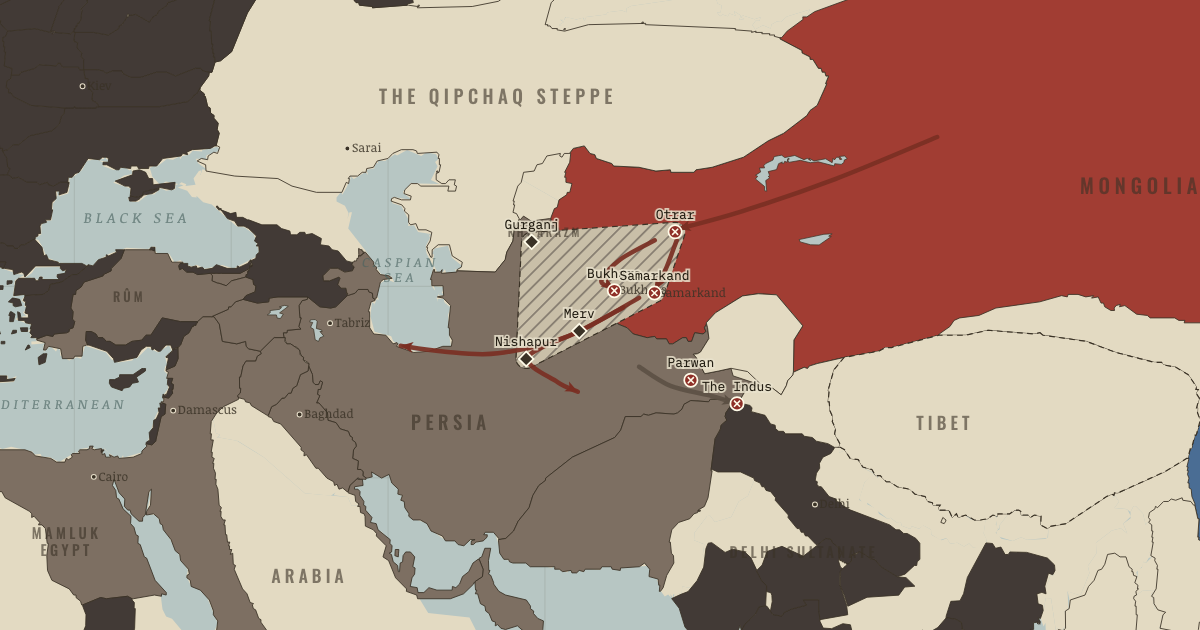
The map above is the world of The Mongol Empire, 1221 — Khwarazm annihilated.
Part of IB History: The Mongol Empire →
SHORT EXPLANATION
In 1218 a trade caravan from the Mongols reached Otrar, where the governor seized its merchants. Chinggis Khan demanded redress; Shah Muhammad refused and had the senior envoy killed. Envoys had protected standing in steppe diplomacy, so the killing was a grave offense. The dispute arose amid tensions over trade, security and rival imperial ambitions.
The Mongol invasion began in 1219. Its columns used difficult routes to reach garrisons the shah had placed apart from one another, and resistance brought mass killing and deportation. Medieval death totals are often impossible to credit, but archaeology and written accounts establish severe destruction in parts of Central Asia and Khorasan. The state collapsed; the communities caught in the campaign recovered at very different rates.
The full story
A commercial mission became the occasion for a war that destroyed a state. At Otrar in 1218, the governor Inalchuq accused the merchants in a Mongol caravan of spying, confiscated their goods and killed almost all of them. Chinggis Khan sent envoys to demand his punishment. Shah Muhammad refused and executed the senior envoy, violating the protection accorded envoys in steppe diplomacy. Chinggis had a grievance, but he also wanted secure trade routes, and his wealthy neighbor was divided.
The shah’s defense reflected those divisions. He distrusted his commanders and distributed his soldiers among cities instead of assembling a united field army. Mongol columns could consequently attack separated positions. They approached from several directions, and one crossed the Kyzylkum desert to appear behind Bukhara. Otrar, Bukhara, Samarkand and Urgench fell in turn; later columns devastated Merv, Nishapur and other centers.
Shah Muhammad’s son Jalal al-Din continued the struggle. He defeated Mongol forces at Parwan, then suffered defeat at the Indus and escaped across the river. His escape preserved a leader, but the state’s main center of resistance had been destroyed.
The destruction had a purpose beyond each city attacked. A place that surrendered might survive under taxation; massacre and deportation after resistance or revolt warned the next place what it risked. This calculation could shorten later sieges, while civilians paid for decisions often made by rulers and garrisons. Chroniclers’ enormous casualty totals cannot be used as reliable counts, but the devastation was severe. The hatched belt on the map represents an uneven experience: some cities and irrigation systems recovered, while others lost people and importance for generations.
FULL EXPLANATION
Otrar: trigger and justification
The attacks on the caravan and the envoys are agreed upon, but the reason for seizing the merchants is less certain. Their party may have carried intelligence, as merchant parties often did. Even if it did, killing accredited envoys was a serious diplomatic act. We must also ask what later accounts were trying to explain. Mongol accounts presented Otrar as a justification for punishment. Persian narratives written under Mongol rule had reasons to stress the shah’s failings when explaining the catastrophe. Otrar supplied an occasion and a justification in Mongol political language, while Chinggis already had interests in secure commerce and submission on his frontier. The wealth and divisions of the recently assembled Khwarazm state helped make conquest possible.
Reading the massacre figures
Medieval writers sometimes report hundreds of thousands, or even more than a million, deaths at a single city. Such totals can exceed plausible populations. A vast number could convey the magnitude of a moral catastrophe without recording a count. We should therefore be careful with the figures, while taking the destruction seriously. Abandoned settlements, damaged irrigation and multiple written narratives point to extensive killing and displacement. Their effects varied: some cities recovered, while other places suffered lasting losses. The violence also communicated the conquerors’ terms. People in a city still threatened could learn what had happened where resistance was offered. That was the Mongols’ calculation, and its cost fell on civilians who often had little control over their governors.
Key places on the map
Why it happened
Otrar and the decision for war. The caravan and the embassy gave Chinggis a grievance that could justify punishment in a world where envoys were protected. That explains the occasion for war, but not why conquest was attractive. He sought secure commerce and submission on his frontier, while Khwarazm was wealthy, recently assembled and divided. The incident brought these interests into a crisis; it did not create them.
A divided empire. Khwarazm’s apparent strength concealed a political problem. Shah Muhammad had recently conquered Transoxiana and Persia, quarreled with the caliph in Baghdad, who may have welcomed his defeat, and distrusted his Qipchaq generals, associated with his mother’s clan. Concentrating troops under a commander might have improved the defense, but the shah saw a threat to his own authority in doing so. Estimates sometimes put his forces at 400,000 against perhaps 150,000 Mongols. The figures are uncertain; in any case, soldiers stationed in separate garrisons could not all meet the same attacking column.
Violence as a warning. The fate of one city could influence the next. Mongol forces might spare and tax a place that surrendered; resistance or revolt could bring massacre and the deportation of artisans. News of such punishment could persuade other communities to open their gates. This was an economy of force as the attackers understood it, purchased at the expense of civilians. Chapter 7’s account of administration belongs beside that brutality.
Routes and pursuit. The Mongols made movement itself a weapon. Winter marches, a desert crossing and columns coordinated from different directions brought them to places their opponents might have thought protected by distance or terrain. Garrisons separated from one another could do little to help when attacked. After the shah fled, Jebe and Subötai pursued him across Persia with a force traditionally given as 20,000. Their westward arrow carries the campaign far beyond its first targets.
THE TURNING POINT
Bukhara, February 1220. Chinggis Khan’s crossing of the desert brought his forces to Bukhara behind the shah’s defensive line and disrupted the defense of Transoxiana. Juvayni’s Persian account gives the event another significance in a speech from the pulpit: “I am the punishment of God”. The words present the invasion as judgment, revealing how the later chronicler explained the catastrophe to his readers.
What it changed
The loss of centers of learning. Khorasan and Transoxiana had supported major centers of Islamic learning, associated with al-Khwarizmi, Avicenna and Omar Khayyam. Libraries, institutions and scholars were destroyed or scattered across the region. Persian culture survived and would later influence the conquerors (Ch. 9), but the region’s earlier primacy did not return. How far should this loss explain later changes in Islamic science? Some historians give the invasion a part in that history; others find the account too neat. The destruction of people and institutions stands apart from the dispute over its longer consequences.
The road west. Khwarazm had stood between the Mongol frontier and lands farther west. Once its state collapsed, Jebe and Subötai continued the pursuit through the Caucasus toward the Rus. Their reconnaissance gave the Mongols experience of routes and opponents for later campaigns (Ch. 5). The Qipchaq steppe would become a base for the advance of 1236.
Jalal al-Din fights on. Defeat at the Indus did not end Jalal al-Din’s career. He raised new armies in Persia and the Caucasus, and his earlier victory at Parwan had shown that Mongol forces could be beaten. Yet his own campaigns also weakened potential opponents of the Mongols: in 1225 he defeated Georgia’s army. He died in 1231 after years of victories and defeats. Resistance had continued, but no united coalition had emerged.
A pattern at Baghdad. The approach used in Khwarazm appeared again at Baghdad in 1258. Hülegü brought converging forces against the city, demanded submission and destroyed it after refusal (Ch. 8). The earlier campaign makes the pattern recognizable, although the circumstances facing each target still matter.
DISCUSSION QUESTION — Shah Muhammad had walled cities, deserts and perhaps a larger army. What is the strongest argument that his position was already weak before battle began?
His army’s size was less useful than it looked on paper. Because the shah feared the political danger of giving one commander a concentrated force, he placed soldiers in separate garrisons. The Mongols could use intelligence, coordinated movements and difficult routes to reach those positions without facing all his men together. These choices left his position vulnerable before battle, though they did not make defeat literally inevitable.
An interesting fact
Jalal al-Din escaped at the Indus in a scene recorded by both his secretary al-Nasawi and the Persian historian Juvayni. They describe the armored prince spurring his horse down the bank and swimming under fire. Chinggis, they say, held his men back and told his sons, “Such a son must a father have.” Each writer had reason to shape the scene: Nasawi served the defeated prince, and Juvayni wrote for Mongol patrons. Nasawi wrote a biography of Jalal al-Din within a decade of his death; the leap became an enduring emblem of courage and honor amid catastrophe, admired on both sides of the war.
Related
THE FREE PRINTABLE STUDY GUIDE
Get the printable study guide for The Mongol Empire free. I’ll send you a few short letters, then one when a new atlas opens. That’s all. — Paul
NO TRACKING · YOUR ADDRESS IS USED FOR THE DISPATCH AND NOTHING ELSE · UNSUBSCRIBE ANYTIME