Mongol Empire · CHAPTER 3 ·
Mongol conquest of the Jin dynasty
Chapter 3 of The Mongol Empire, 1206–1294: “The Fall of North China”
Between 1209 and 1234 the Mongols learned siege warfare by recruiting engineers and administrators from conquered peoples, first against Xi Xia and then against the Jin dynasty of north China. After the Jin field army was destroyed at Yehuling, Zhongdu fell in 1215; the Jin were finished in 1234 with Song help.
Chapter 3 is included with every paid plan. WW2 is free in full, and chapter 1 of every atlas is free. A free account opens 3 more chapters a day. Starter, at $9 a month, opens all 21 with no daily limit — see the plans.
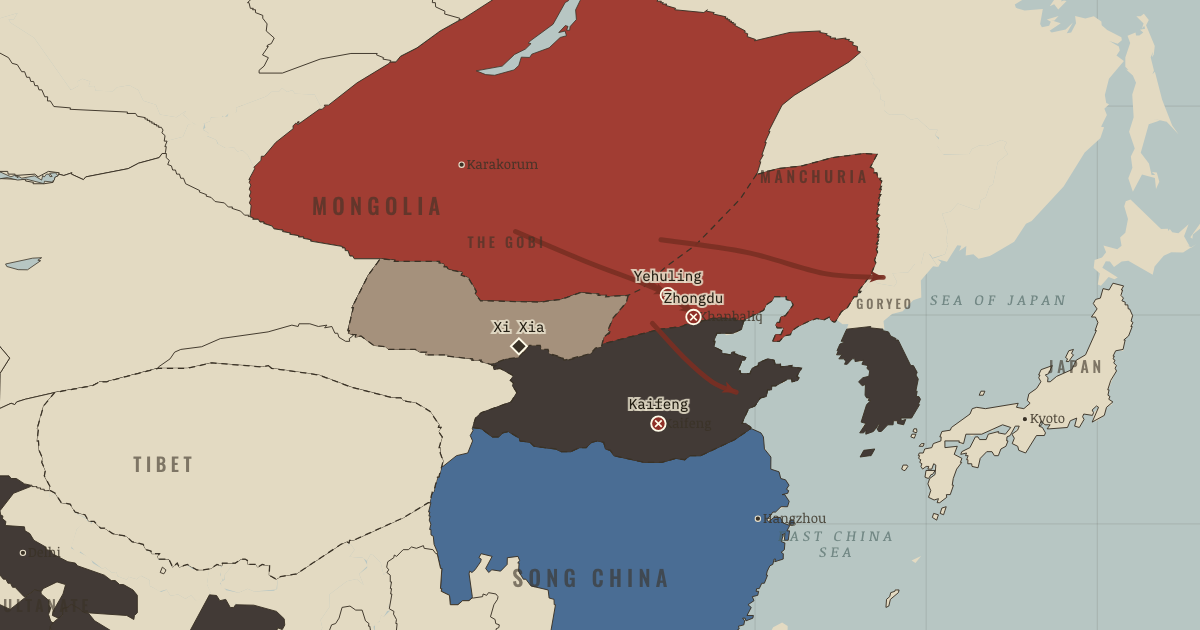
The map above is the world of The Mongol Empire, 1215 — Zhongdu falls.
Part of IB History: The Mongol Empire →
SHORT EXPLANATION
Xi Xia gave the Mongols their first hard lesson in taking fortified cities. The Tangut kingdom lay along the Gansu corridor, and its walls posed a problem that mounted raiders could not solve simply by surrounding them. The Mongols drew engineers, carpenters, gunners and administrators from conquered populations; the much larger war against the Jin supplied expertise on a greater scale.
The Jin faced a danger inside their own state as well as on its frontier. A Jurchen ruling minority governed much larger Chinese and Khitan populations through an ethnic hierarchy that bred distrust, and some commanders defected. Zhongdu fell in 1215, though the dynasty survived farther south until 1234. North China supplied the Mongols with siege specialists, revenue and clerks, giving them means both to capture settled territory and to govern it.
The full story
A mounted army could surround a city, cut its communications and threaten its inhabitants. It still had to get through the walls. The campaign against Xi Xia showed how difficult that could be: early Mongol assaults failed, and an attempt to flood the Tangut capital ended by flooding the besiegers’ own camp. The Mongols needed people who knew how to conduct a siege. They pressed captured specialists into service and carried their skills to later fronts. When the Jin war began in 1211, cavalry were becoming part of a force that also included engineers and local infantry.
The Jin had formidable resources, but their state was divided. Jurchen rulers governed large Chinese and Khitan populations, and suspicion among them weakened command. After the Jin field army was defeated at Yehuling, officers and garrisons defected. The emperor bought peace in 1214 and moved his capital from Zhongdu to Kaifeng. To the Jin, a move south could secure a better position; to Chinggis Khan, who understood the settlement as submission, it meant defiance. He renewed the war, and Zhongdu fell in 1215.
The campaign continued after Chinggis rode west. Mukhali fought with largely Chinese troops, and the Jin survived until 1234, when the Mongols finally destroyed them with Song help. The Song recovered old provinces for a time, but their victory also removed a state that had stood between them and the Mongols. They now faced the expanding empire on their own frontier.
The conquest transferred more than land. An engineer from one city could be sent to the next siege; a clerk could count households and revenue; a defecting commander brought knowledge of the country ahead. Steppe mobility was being joined to siegecraft, taxation and record-keeping. Each campaign could leave the Mongols better equipped for the next, and better able to hold the territory they took.
FULL EXPLANATION
A network of specialists
The engines used against Chinese cities were not Mongol inventions. Their commanders acquired a different advantage: they could identify people with siege skills and move them across political and geographical boundaries. Chinese engineers later served in Central Asia, while specialists from the Islamic world contributed to campaigns in China. Conquest connected bodies of knowledge that had developed in different places. The people in that network did not all enter it on the same terms. Some experts received pay or status; others were spared or compelled to serve after a city had been destroyed. Their skills mattered because the army could bring trained workers and materials to a new siege and direct their work there. The history of a weapon is therefore also a history of the people who built and operated it, and of the organization that moved them.
The Jin’s divided state
The Jurchen Jin had displaced the Khitan Liao and ruled much of north China through separate legal and military categories. These divisions gave the Mongols opportunities, but they did not make each person’s choice automatic. Many Jurchens fought hard, many Chinese served the Jin, and local interests as well as identity shaped defections. The move to Kaifeng in 1214 also looks different depending on whose problem we consider. Jin strategists gained a better supplied position, at the cost of prestige and northern pasture needed by their cavalry. Chinggis saw the earlier settlement as submission and the move as a breach. What had a strategic logic for the Jin could thus provide a reason for renewed war in Mongol diplomacy.
Key places on the map
Why it happened
The problem of the walls. A trebuchet was an old weapon, and Chinese armies already knew how to build siege towers. The Mongols’ problem was to put such knowledge at the service of a mobile steppe army. They moved specialists from settled societies between fronts, offering some pay and status and compelling others to serve. A machine alone could not bring down a city: workers, materials and transport had to arrive at the wall, and commanders had to coordinate engineers, infantry and cavalry.
Divisions within the Jin. The Jin had conquered north China after displacing the Khitan Liao. Their Jurchen rulers maintained distinctions among subjects in military service and taxation, leaving divisions that Mongol commanders could exploit. Khitan commanders defected, Chinese warlords accepted Mongol titles, and Chinese troops formed a substantial part of the forces fighting the Jin. The Khitan Yelü Chucai later became a leading Mongol administrator.
The cost of moving south. Kaifeng offered the Jin a better supplied and more defensible capital in 1214. Yet the retreat had a cost. Giving up the northern frontier also meant losing access to pastures that supplied horses for Jin cavalry. Against mounted Mongol armies, the dynasty relied more heavily on rivers for defense while facing rebellion behind its lines.
What did tribute mean?. A payment can end a war only if both sides agree what it has settled. The Jin could see the tribute of 1214 as the price of a withdrawal, like payments made to earlier nomadic opponents. Chinggis treated it as acceptance of submission. On his understanding, the emperor’s subsequent move to Kaifeng was defiance, and war resumed. Relations with the Mongols would soon become a source of conflict in Khwarazm on a larger scale.
THE TURNING POINT
Zhongdu, May 1215. Zhongdu’s fall gave the Mongols access to archives and mints as well as to clerks and engineers. The city’s destruction was part of the event; so was the transfer of people and skills. Those specialists could help armies take fortified places elsewhere, while administrative records and expertise offered the beginnings of a way to hold conquered land.
What it changed
Specialists travel. A specialist acquired in one campaign could be sent to another. Chinese engineers served in western campaigns including Samarkand and Baghdad; Muslim engineers later supplied counterweight trebuchets for Xiangyang (Ch. 10). The arrows trace armies across the map, but people carrying practical knowledge traveled with them.
Revenue and administration. The wealth of north China helped pay for further wars. Yelü Chucai’s census and tax system (Ch. 7) is associated with a famous argument over whether to destroy farming communities and turn the plains to pasture. In the familiar account, his calculation showed that cultivated land would yield more revenue. Whether land was taxed or devastated mattered to millions of people living on it.
Xi Xia and submission. The Tanguts refused troops for the western war and later broke with the Mongols. The campaign ending in 1227 destroyed Xi Xia; see the Zhongxing marker. For Mongol rulers, dependence carried obligations, and a breach could bring devastation. Korea, Rûm and the Rus principalities would also face demands from Mongol overlords.
The Song and their frontier. The Song gained old provinces briefly by helping defeat the Jin at Kaifeng. But a rival can also shield a frontier. Song strategists had warned of that danger with the proverb “lips gone, teeth cold.” With the Jin gone, the Song faced the Mongols directly, and a 45-year struggle followed. Chapter 10 follows that war.
DISCUSSION QUESTION — “The Mongols won because captured engineers gave them siege engines.” What does this explanation tell us, and what does it leave out?
The engineers supplied a capability the mounted army needed: cavalry alone struggled to take major fortifications. But the Jin had siege technology too. The question is how the Mongols assembled and used their forces. They brought specialists, defecting officers and local soldiers into their armies and moved them where they were needed; divisions within the Jin and the retreat of the capital also weakened resistance. Weapons mattered within that larger system of organization, politics and logistics.
An interesting fact
At Kaifeng in 1232, the Jin defended themselves with formidable gunpowder weapons. Their dynastic history describes “heaven-shaking thunder,” cast-iron bombs whose blast, the chronicle claims, carried for miles and whose fragments pierced iron armor. Defenders also directed fire-lances, which sent jets of flame, at sappers. These were among the earliest well-documented gunpowder weapons in war. Thunder-crash bombs appear again in this atlas at Hakata Bay in 1274, used against samurai.
Related
THE FREE PRINTABLE STUDY GUIDE
Get the printable study guide for The Mongol Empire free. I’ll send you a few short letters, then one when a new atlas opens. That’s all. — Paul
NO TRACKING · YOUR ADDRESS IS USED FOR THE DISPATCH AND NOTHING ELSE · UNSUBSCRIBE ANYTIME