MAPS OF HISTORY · IB HISTORY · THE MONGOL EMPIRE
IB HISTORY · 1206 – 1294 · 12 CHAPTERS
IB History: The Mongol Empire — notes, maps and essay questions
The Mongol Empire reached from Korea to Hungary in three generations. How was the steppe united, and why did its cities fall? Along the roads of the Mongol peace traveled silk, silver, ideas and plague.
IB notes for this atlas are in preparation. Meanwhile, this page gathers the study notes every one of its 12 chapters already carries: why each episode happened, the moment it turned on, what it changed, and the question historians still argue about. It also shows where the atlas fits the IB course.
WW2 is free in full, and chapter 1 of every atlas is free. A free account opens 3 more chapters a day. Opening a new atlas uses one of them. Membership opens all 21 — Join.
Where it fits the course
The atlas is filed under Paper 2 (Conflict) and Paper 3 for Higher Level (Asia and Oceania). Its IB notes, with evidence lists, primary sources and model essay plans, are in preparation. These are the IB History pages for the parts of the course it serves:
Why it began
The opening chapters offer explanations for how this story began. Their arguments about the causes appear here in a few sentences each, ready to test against your own reading.
Chapter 1: The World of the Steppe
Pasture and mobility. Herding suited land that supported fewer dense farming populations. A rider could bring several horses—often described as five per man—and change mounts as they tired. Mare’s milk, blood and dried curd supplied food, while felt tents could be struck quickly. Such armies depended less on wagoned grain and could travel far or campaign in winter, provided they found grass and water for their animals.
The bow and the hunt. The compact recurved composite bow gave a mounted archer a powerful weapon. In the great ring hunts, called nerge, riders also practiced moving together: an encirclement required signals and timing as well as individual skill. Temüjin later placed men from different groups in units of 10, 100, 1,000 and 10,000, putting those skills at the service of a common command.
The Jin frontier. A divided steppe was easier for the Jin to manage. The court supported some frontier groups against others, including Tatars against Mongol leaders, and could act against a group that grew too powerful. Ambaghai’s delivery to the Jin shows how a rivalry on the grassland could bring a Mongol leader into the hands of the empire. Unification would make the same policy much harder to use.
Feuds and pressure on pasture. Twelfth-century chronicles describe feuds growing more intense, as rivals fought over followers and resources and the duty of revenge renewed old injuries. Some historians, using tree-ring evidence, also argue that cooler, drier conditions strained pasture. That climatic interpretation remains debated; the recorded feuds themselves show the difficulties facing anyone who sought lasting cooperation.
Chapter 2: Temüjin Becomes Genghis Khan
Ability and inherited rank. The distinction between “white bone” and “black bone” expressed the importance of aristocratic standing on the steppe. Temüjin still needed loyalty, but ability could open a path to command. Jebe had fought against him; Subötai was a blacksmith’s son. Their rise showed capable men what service could offer. Jamukha retained aristocratic support, while some followers could find opportunities with Temüjin that lineage might otherwise deny them.
Rewards and betrayal. Temüjin’s treatment of loyalty sent a message even when it cost him an immediate advantage. Accounts describe him recruiting enemies who had remained faithful to their own leaders, but killing men who betrayed those leaders to help him. Rewards for service and punishment for treachery gave followers some grounds to anticipate how he would treat them.
A structure for command. The decimal units mixed men from different clans, and the keshig drew commanders’ families toward the center. Later the yam relay would connect distant parts of the empire. Together, such institutions gave succeeding rulers ways to command and communicate beyond the founder’s personal relationships. The empire survived his death, expanded and passed to later rulers.
A mandate from Heaven. Mongol rulers claimed that Eternal Heaven, or Tengri, had granted the khan authority over the earth. From Korea to Hungary, ultimatums could therefore present submission as an existing duty. The claim gave conquest a sacred justification and shaped the peace Mongol rulers offered: submission was the expected answer.
Chapter by chapter
These entries trace the atlas through 12 chapters, identifying the causes and turning point of each. Select a title to open its free chapter page, where the full explanation, a discussion question and the map appear together.
1. The World of the Steppe
CHAPTER 1 · THE STEPPE BEFORE 1206
Why it happened: Pasture and mobility · The bow and the hunt · The Jin frontier · Feuds and pressure on pasture
The turning point: Ambaghai’s execution, around 1156.
2. Temüjin Becomes Genghis Khan
CHAPTER 2 · 1162–1206
Why it happened: Ability and inherited rank · Rewards and betrayal · A structure for command · A mandate from Heaven
The turning point: The Onon assembly, 1206.
3. The Fall of North China
CHAPTER 3 · 1209–1234
Why it happened: The problem of the walls · Divisions within the Jin · The cost of moving south · What did tribute mean?
The turning point: Zhongdu, May 1215.
4. The Khwarazm Catastrophe
CHAPTER 4 · 1218–1223
Why it happened: Otrar and the decision for war · A divided empire · Violence as a warning · Routes and pursuit
The turning point: Bukhara, February 1220.
5. The Great Raid
CHAPTER 5 · 1221–1224
Why it happened: Reconnaissance with an army · The grassland route · Princes without one command
The turning point: The Kalka and the years that followed.
6. The Storm on the West
CHAPTER 6 · 1236–1242
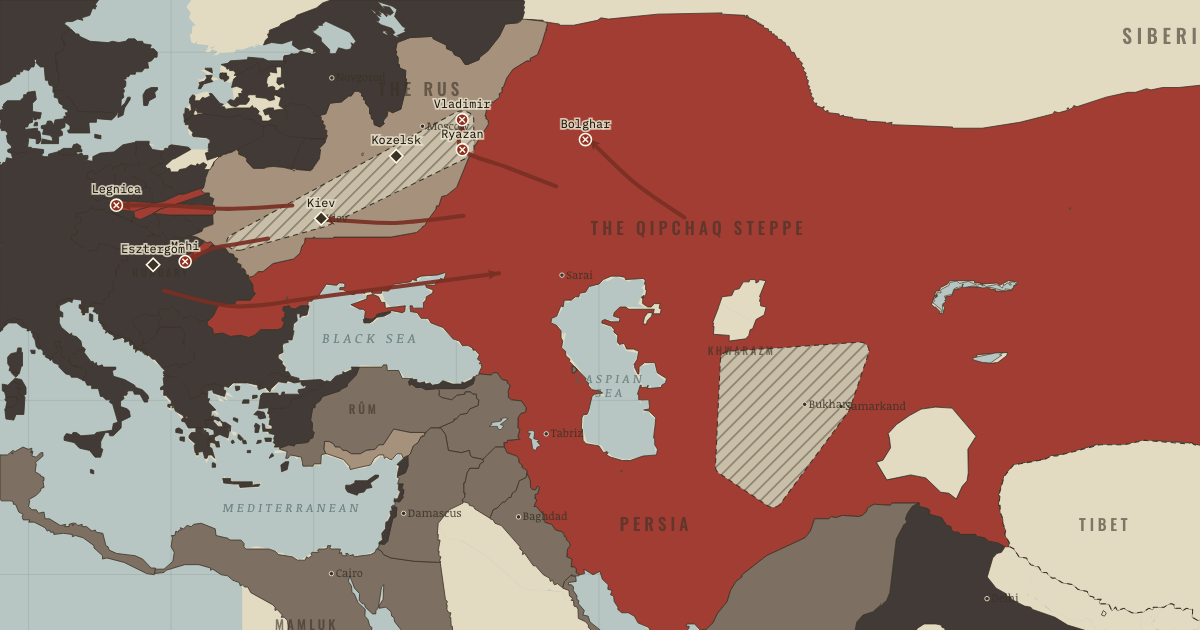
Why it happened: The resources of a dynasty · Winter made usable · Opponents divided · Refugees and the Hungarian defense
The turning point: Legnica and Mohi, 9–11 April 1241.
7. The Machinery of Empire
CHAPTER 7 · 1229–1259
Why it happened: Steppe practices on a larger scale · Religious communities and the court · The memory of conquest
The turning point: The fountain at Karakorum.
8. The Hammer on Islam
CHAPTER 8 · 1253–1260
Why it happened: The western campaign · Baghdad’s weakness · Egypt’s Mamluk army · A divided theatre
The turning point: Ain Jalut, 3 September 1260.
9. The Family War
CHAPTER 9 · 1259–1266
Why it happened: A disputed inheritance · Regional power before division · Berke and Islam
The turning point: The Terek, winter 1262–63.
10. Khubilai and the Song
CHAPTER 10 · 1234–1279
Why it happened: The problem of water · Song resources and divisions · A claim to rule China · Expertise across long distances
The turning point: Xiangyang and Fancheng, 1268–1273.
11. The Limits of the World
CHAPTER 11 · 1274–1293
Why it happened: Horses beyond the pasture · Ships and the people who built them · Defenders learned and adapted · Conquest and authority
The turning point: Hakata Bay, August 1281.
12. The Long Shadow
EPILOGUE · 1294 AND AFTER
Why it happened: How the routes were protected · Specialists and knowledge on the move · Plague travels through connections
The turning point: Caffa, 1347.
Essay questions, argued
Historians still debate the question at the end of each chapter. Before reading our brief answer, try making a plan for how you would answer it.
DISCUSSION QUESTION · CHAPTER 1
Why could steppe societies field formidable mounted armies when settled empires had more people and wealth?
A settled state had to raise and supply cavalry from its population; steppe households already kept horses and had riding skills and portable food. They could therefore furnish capable mounted fighters at relatively low cost. But those fighters had to be united politically, and their horses needed grass and water. Temüjin united the plateau in 1206. Forests, wet farmland, deserts without grazing and the sea remained obstacles.
The chapter behind it: The World of the Steppe. Every chapter’s question is on the discussion questions page.
DISCUSSION QUESTION · CHAPTER 5
What did the Mongols and the Rus princes take from the encounter in 1223?
Mongol commanders could carry what they had seen of routes, pasture and opponents into later decisions; Subötai returned with Batu. The Rus princes had witnessed a severe defeat, but their rivalries continued and no common frontier system followed. Religious accounts gave the disaster meaning without themselves organizing scouts or a united command. The difference lies in what each side could do with its experience, not in one side learning everything and the other nothing.
The chapter behind it: The Great Raid. Every chapter’s question is on the discussion questions page.
DISCUSSION QUESTION · CHAPTER 9
Was the empire’s division inevitable, or did Möngke’s death during the Song campaign determine it?
The branches already commanded their own armies, revenues and advisers, and no succession procedure obliged every claimant to accept one choice. Those conditions put strong pressure on imperial unity. Möngke’s death in 1259 brought the decision forward and helped determine which rivals faced one another. Had he lived longer, central reforms might have delayed or altered the break. Regional division was a serious possibility; the particular civil wars of 1260–64 were not predetermined.
The chapter behind it: The Family War. Every chapter’s question is on the discussion questions page.
DISCUSSION QUESTION · CHAPTER 12
With mass death and Eurasian exchange both in view, how should a student assess the Mongol Empire’s achievements?
Describe the consequences separately before trying to judge them. Mass killing, displacement and lasting regional damage deserve attention, including the ranges and limits of the sources. Political reunification, protection of some trade, the movement of specialists and successor institutions also require explanation. Exchange cannot justify atrocities, and condemnation cannot make exchange disappear. Persian, Rus, Arab, Chinese, Mongolian and modern historians work with different archives and inherit different memories. A single moral score would hide distinctions that the history needs us to examine.
The chapter behind it: The Long Shadow. Every chapter’s question is on the discussion questions page.
What it changed
Consequence questions need the end of the story. The final chapter, The Long Shadow, sets out what the period left behind:
Successor states and Mongol authority. Mongol rule ended in different places at different times, but its institutions and claims to authority continued to be used. The Yuan fell in 1368, leaving a reunified China with its capital at what is now Beijing. Muscovy grew under the Horde’s tax system and later expanded into the steppe. In India, the Mughals drew on Mongol and Timurid inheritance; on the steppe, Chinggisid descent remained a powerful source of legitimacy into the eighteenth century. Each inheritance served new rulers and ambitions.
Routes toward the sea. Overland commerce continued, although khanate wars, plague and changing costs affected it. European interest in Asian goods and accounts of Asian courts also endured. Columbus carried an annotated copy of Polo’s book as he sought a westward route to Asia, long after Khubilai’s death. Later maritime ventures grew in part from interests and knowledge sustained by those earlier overland connections.
Return to the map. Free Explore lets you follow several different outcomes. Watch Hungary change and recover, then trace Syria after Ain Jalut. Japan, Delhi and Egypt faced Mongol advances with different obstacles available to them: water, climate and capable opposing armies. Finally return to Mongolia, the homeland from which the empire grew. Its territorial color changes less than those of many conquered regions. The map shows that difference; understanding the changes in Mongolian life would require looking beyond its colors.
Revision tools
The atlas ends with a map quiz that asks you to find places and moments on the map itself (part of every plan from Starter up). The quick quiz and the discussion questions with our answers are free pages on this site, and the printable study guide gathers every chapter’s notes into one document for revision.
Read next
- The Crusades, 1095–1291 · THE CRUSADES
Maps of History is independent and is not affiliated with or endorsed by the International Baccalaureate Organization. IB course names describe alignment only; paper, theme and section names follow the new course outline and may change when the final guide is published.
THE DISPATCH
Get the printable study guide for The Mongol Empire free. I’ll send you a few short letters, then one when a new atlas opens. That’s all. — Paul
NO TRACKING · YOUR ADDRESS IS USED FOR THE DISPATCH AND NOTHING ELSE · UNSUBSCRIBE ANYTIME