Mao’s China · CHAPTER 9 ·
Cultural Revolution
Chapter 9 of The People’s Republic under Mao, 1949–1976: “The Cultural Revolution”
In 1966 Mao launched the Cultural Revolution against Communist Party leaders he accused of revisionism. Red Guards, reviewed at Beijing rallies of about twelve million in all, attacked the “Four Olds” and beat teachers and officials, and by July 1967, as the Wuhan Incident showed, the army had been drawn in.
Chapter 9 is included with every paid plan. WW2 is free in full, and chapter 1 of every atlas is free. A free account opens 3 more chapters a day. Starter, at $9 a month, opens all 21 with no daily limit — see the plans.
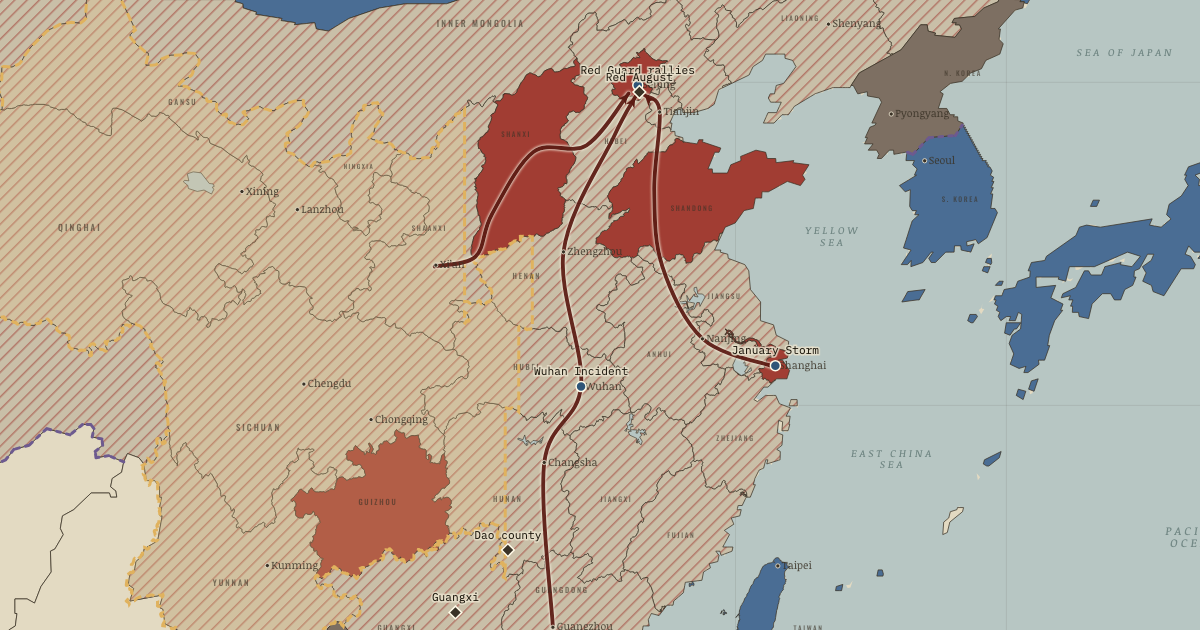
The map above is the world of China, July 1967 — Power seized: the first revolutionary committees.
Every state on the map that year: The world in 1970 · Europe in 1970.
Part of IB History: The People’s Republic under Mao →
SHORT EXPLANATION
In 1966 Mao set young people against the Communist Party that he himself chaired. The Party governed China at every level, but he believed its leaders were carrying the country back toward capitalism. His Great Proletarian Cultural Revolution would remove the “revisionists”—officials accused of abandoning revolution while keeping its name, rather as a zealot accuses priests of heresy—and change culture, education and habits of mind.
School and university students became Mao’s Red Guards, fighting groups resembling a youth militia sworn to one man. About twelve million attended his great Beijing rallies. They attacked the “Four Olds”—old ideas, culture, customs and habits—ransacking homes and temples and humiliating and beating teachers and officials. A count published in 1980 recorded at least 1,772 people killed in Beijing in August and September 1966; a later internal figure exceeds 10,000. Liu Shaoqi, the head of state, and Deng Xiaoping, the Party’s general secretary, had led the recovery, yet both were denounced and removed. Their offices offered no protection against Mao.
From January 1967 rebels tried to take control of the Party committees that governed provinces, cities and workplaces. Factions fought one another with weapons taken from the army. The map hatches provinces in upheaval, except for six where revolutionary committees were formed in the first half of 1967. These new governments combined rebels, officers and approved officials, rather like emergency administrations after a coup.
The Wuhan Incident in July 1967 exposed the danger to Mao’s own position: troops and a mass organization defied his envoys. He relied on soldiers to restore order, and by September 1968 every province had a revolutionary committee; the map turns red again. Order did not end the killing. The new authorities conducted purges in which deaths peaked. Estimates for the movement range from about 750,000 to two million or more. Memorial markers show counties where most victims came from families labeled class enemies; a label assigned at land reform could still determine who died fifteen years later.
The full story
Mao wanted to remake China and purge officials he called “revisionists”, but the Party he chaired was itself the obstacle. The opening came in November 1965, when a Shanghai critic attacked a play by Beijing’s deputy mayor. Mao read the play as a veiled defense of his critics. By May 1966 Beijing’s leaders had been purged, and a small Central Cultural Revolution Group, including his wife Jiang Qing, directed the campaign. It answered to Mao and bypassed the Party’s normal leadership.
The struggle over students made clear how this new authority would work. On 25 May a Peking University lecturer posted an attack on the university’s leaders, which Mao had broadcast across China. Liu Shaoqi and Deng Xiaoping sent work teams to contain the students; Mao condemned the teams. His poster of 5 August, “Bombard the Headquarters”, placed the enemy inside the Party leadership. On 18 August, at the first great rally, he wore the armband of the Red Guards. These student fighting groups resembled a youth militia sworn to him. The country’s highest authority was encouraging them to rebel against the authorities below him.
Teachers felt the consequences first. On 5 August pupils beat Bian Zhongyun, deputy principal of a Beijing girls’ school, to death. Police had been told not to interfere. The attack widened to the “Four Olds”—old ideas, culture, customs and habits. Red Guards searched homes, burned books and wrecked temples, including graves at Confucius’s birthplace in Qufu. Millions traveled free by train in the “great link-up”, carrying the movement along routes like the red arrows on the map.
The young people who joined did not all have the same enemies. The first Red Guards were mostly children of officials and army officers, and they attacked people whose “bad” class labels dated from land reform. Rival rebel organizations soon arose, often drawing people from families with poor labels or grievances against their bosses. They attacked the officials themselves. Each side claimed loyalty to Mao, and each could use that claim against the other.
In January 1967 rebel workers led by Wang Hongwen took power in Shanghai in the January Storm, with Mao’s blessing. Rebels elsewhere attempted to seize Party committees. The army received orders to “support the left”, but commanders chose rival factions, which armed themselves from military stores. The contest became a civil war in miniature. In July, at Wuhan, troops loyal to the regional commander seized two envoys from Beijing while Mao was secretly in the city. The institution expected to support the revolution could itself become divided.
Mao turned to the army to impose order. Revolutionary committees brought officers, rebels and surviving officials together in provincial governments, much like emergency rule after a coup; in July 1968 Mao disbanded the Red Guards. The new committees then pursued supposed hidden enemies in the “cleansing of the class ranks”, using investigations and forced confessions. Militias and officials killed most of the movement’s dead in this purge, including at Dao county in Hunan and across Guangxi. The rebellion against the party-state gave way to repression by its new authorities.
FULL EXPLANATION
Why did Mao launch the Cultural Revolution?
Why did Mao attack the Party he led? In Mao’s Last Revolution, Roderick MacFarquhar and Michael Schoenhals describe his belief that colleagues had sidelined him after the famine. He feared that after his death they would repudiate him, as Khrushchev had repudiated Stalin. Striking at Liu Shaoqi and Deng Xiaoping could protect his authority and his legacy. Maurice Meisner gives greater weight to ideology: Mao genuinely feared that a new bureaucratic class would betray the revolution, a fear he expressed in his polemics against Soviet “revisionism”. Jung Chang and Jon Halliday explain his motives through revenge and power alone. Most scholars now argue that Mao himself could not separate his authority from the revolution, so a threat to either was a threat to both. Andrew Walder’s China Under Mao and Agents of Disorder focus more on what followed than on motive. Mao attacked the party-state from within; its bureaucracy split into warring parts, helping explain both the violence and the difficulty of stopping it.
Who were the Red Guards?
Research since the 1980s has made it difficult to treat the Red Guards as a single movement. Anita Chan, Stanley Rosen and Jonathan Unger interviewed former Guards in Hong Kong and found that children of officials and army officers dominated the first groups in 1966. These students defended the existing order and attacked families bearing “bad” labels such as landlord or rightist. Students from stigmatized families, temporary workers and others with grievances joined rebel organizations that attacked officials in late 1966 and 1967. Elizabeth Perry and Li Xun showed this among Shanghai’s workers. Social position was not the whole explanation. In Fractured Rebellion, his study of Beijing’s universities, Andrew Walder found that timing and local alliances often mattered more than social interests in forming factions. Women were prominent among the students, and girls’ schools were among the sites of the worst violence in 1966. Factions shared a language of loyalty to Mao, but used it to justify attacks on one another.
Counting the dead, and who killed them
No complete count of the dead exists. County histories published in the 1980s and 1990s nevertheless record deaths, injuries and persecution in many places, giving Andrew Walder and Yang Su evidence from which to estimate the toll. They put rural deaths at 750,000 to 1.5 million, with a similar number permanently injured and some 36 million persecuted. Walder later estimated 1.1 to 1.6 million deaths nationally in 1966–69; other estimates reach two million or more. The timing changes our picture of the violence. Both studies found that most deaths occurred in 1968–71, especially 1968, after revolutionary committees had taken power. Militias and officials carried out campaigns such as the cleansing of the class ranks; rebel violence killed far fewer. Investigations in the 1980s documented collective killings of “class enemies” in Dao county, Hunan, and across Guangxi, including cannibalism. Yang Su’s Collective Killings in Rural China explains these massacres as the work of local authorities who treated a campaign against enemies as license to exterminate them.
Key places on the map
On this day
Why it happened
Mao’s fear of a Chinese Khrushchev. Mao believed after the famine that Liu Shaoqi and Deng Xiaoping were governing without him and leading China toward capitalism, as he believed Khrushchev had done in the Soviet Union. The Socialist Education Movement had failed to remove them; the men it threatened controlled the Party machine conducting it. Mao therefore looked outside that machine. Young people, mobilized with army backing, could purge “those in authority taking the capitalist road”.
A generation raised on the cult. The students Mao addressed in 1966 had been taught to place loyalty to him above family and teachers. Lei Feng, the Little Red Book and the cult of Mao had shaped their education. Their prospects were also narrowing: university places and city jobs were becoming harder to obtain, and entrance examinations were suspended in June 1966. When Mao said rebellion was justified, faith in him met frustrations of their own. Teachers represented the examinations and the order that judged students, and became early targets.
Grievances waiting for a target. Campaigns over seventeen years had left many people with reasons to resent those above them: families carried stigmatizing class labels, temporary workers held insecure jobs, purge victims remembered their treatment, and students resented privileged classmates. The Cultural Revolution briefly permitted attacks on authority. These grievances helped rebel factions spread, but they also gave a national campaign thousands of local and personal quarrels that proved hard to control.
An army ordered to take sides. The instruction to the army in January 1967 was to “support the left” during the power seizures. Which faction was the left? Commanders backed groups that suited them, while rivals took weapons from military depots. Posters and meetings gave way to armed conflict; some cities saw machine guns and even artillery used. With soldiers themselves taking sides, ending the fighting required Mao to decide which side the army should back.
THE TURNING POINT
Wuhan, 20 July 1967. On 20 July 1967 Mao was in Wuhan when troops and the mass organization “Million Heroes” seized two envoys from Beijing. He had to be flown to Shanghai. The incident showed him that the revolution could divide the army, the institution he could not afford to lose. He removed the regional commander, but also pulled back: within weeks the most radical members of the Cultural Revolution Group were arrested. The army became arbiter in every province, and the formation of revolutionary committees accelerated. The movement was turning from rebellion toward order imposed by force.
What it changed
The army becomes the government. Restoring order gave the army a commanding place in civilian government. Officers dominated the revolutionary committees; by 1969 nearly half the Central Committee wore uniform. The army ran factories, schools and ministries, and its leader Lin Biao became Mao’s designated successor. Soldiers and workers formed political work teams that took over universities, while army methods became a model for the militarized state.
The young sent away. From December 1968 Mao sent millions of urban school leavers “up to the mountains and down to the villages” to learn from peasants. Dispersing the young removed the Red Guards, the movement’s shock troops, from the cities and eased urban unemployment. By 1980 about seventeen million young people had been sent down. For most, rebellion ended in a village.
Liu Shaoqi and Deng Xiaoping destroyed. The campaign ruined both men who had led the recovery. Liu Shaoqi was expelled from the Party in October 1968 as a “renegade, traitor and scab”; denied proper medical care, he died in custody in Kaifeng in November 1969. Deng Xiaoping was sent to work in a tractor plant in Jiangxi. His son was crippled after a fall while held by Red Guards. Deng survived and would shape China after Mao.
Schools closed, heritage destroyed. The attack on the Four Olds destroyed temples, libraries, graves and private collections. Education suffered a long interruption too: secondary schools and universities stopped normal teaching in 1966, and university entrance examinations returned only in 1977. China lost a decade of trained graduates and much of its material past. Reformers in the 1980s had to rebuild universities, research institutes and professions almost from the beginning.
DISCUSSION QUESTION — Was the Cultural Revolution a revolution from below or a purge directed from above?
Mao supplied the initiative from above: he chose targets, licensed the Red Guards, called for power seizures and decided when to end the movement. But the people who responded had purposes of their own. Students resented privilege, temporary workers faced insecurity, families bore class labels and officials settled scores. Perry and Li Xun and Yiching Wu show rebels pursuing real grievances. MacFarquhar and Schoenhals emphasize the leader; social historians explain the society that responded to him. The ending matters as well. Walder finds that authorities, militias and army-backed committees caused most deaths in 1968–71, while rebel battles killed fewer. Mao opened the door to rebellion and decided when to close it, but millions of local choices shaped what happened between. The episode shows how an authoritarian leader can mobilize popular anger and how quickly the state can reclaim it.
An interesting fact
Mao made a political display of swimming on 16 July 1966. At 72, he floated down the Yangtze at Wuhan; the state news agency reported nearly 15 kilometres in 65 minutes, faster than any world record of the time. The current did most of the work. Newspapers carried photographs of the swimming chairman, and mass swims marked the anniversary for years afterward. Two days after the swim Mao returned to Beijing to condemn the work teams.
Related
THE FREE PRINTABLE STUDY GUIDE
Get the printable study guide for The People’s Republic under Mao free. I’ll send you a few short letters, then one when a new atlas opens. That’s all. — Paul
NO TRACKING · YOUR ADDRESS IS USED FOR THE DISPATCH AND NOTHING ELSE · UNSUBSCRIBE ANYTIME