Indian independence · CHAPTER 8 ·
Salt March and civil disobedience
Chapter 8 of Indian Independence & Partition, 1857–1964: “Salt”
Congress declared complete independence on 26 January 1930, and on 12 March Gandhi left Sabarmati ashram with 78 marchers, walking 240 miles to Dandi, where he lifted salt on 6 April. Mass civil disobedience and some 60,000 arrests followed, and Britain’s answer was the Government of India Act of 1935.
Chapter 8 is included with every paid plan. WW2 is free in full, and chapter 1 of every atlas is free. A free account opens 3 more chapters a day. Starter, at $9 a month, opens all 21 with no daily limit — see the plans.
Free printable Indian independence study guide, sent by email ↓
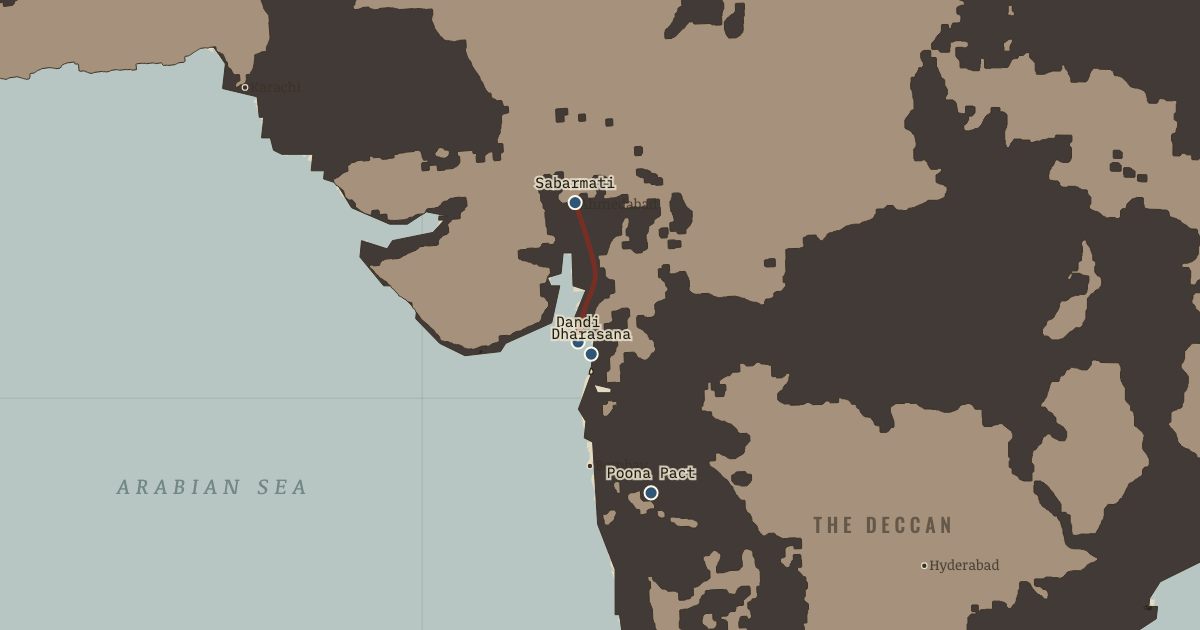
The map above is the world of India, April 1930 — Civil disobedience.
Every state on the map that year: The world in 1930 · Europe in 1930.
Part of IB History: Indian Independence and Partition →
SHORT EXPLANATION
The Raj taxed salt, a necessity almost everyone used and the sea supplied freely. Gandhi chose that everyday burden for a campaign against imperial authority. His 1930 march to Dandi invited Indians to challenge the law themselves: people made illegal salt, refused taxes and courted arrest by the tens of thousands. Foreign reporters and newsreels carried the repression abroad, making the treatment of protesters a cost to the empire’s reputation.
The campaign did not immediately win independence, but the Viceroy negotiated with Gandhi as an equal and Congress emerged as a mass claimant to power. Britain’s Government of India Act of 1935 offered provincial self-government while preserving imperial safeguards at the center. Congress faced a real choice: taking office could enlarge Indian government, yet also risk making the imperial control retained by the reforms seem normal.
The full story
On 26 January 1930 Congress declared purna swaraj, complete independence. The republic still keeps that date. A declaration alone could not bring independence, however, and Gandhi needed a form of action in which large numbers of Indians could take part. He chose civil disobedience: breaking a particular law openly and without violence to challenge the authority behind it.
The law he chose concerned salt. Every Indian ate it, yet the Raj monopolized and taxed a substance the sea made freely available. Gandhi wrote to the Viceroy in advance to explain his intentions. Then, on 12 March, he left Sabarmati ashram with 78 chosen marchers. Their journey of 240 miles took 24 days. Crowds, correspondents and newsreel cameras gathered as they passed from village to village.
At Dandi on 6 April Gandhi stooped on the shore and lifted a handful of salt mud. Others could make the same defiance their own. Illegal salt pans appeared on coasts across India; people boycotted cloth and liquor and joined no-tax campaigns. Women entered public politics for the first time in their tens of thousands. Within months some 60,000 people were arrested, and the jails became a finishing school for the movement.
The confrontation at the Dharasana salt works in May showed what the discipline of civil disobedience demanded. Columns of satyagrahis advanced into police lathis without raising an arm. American reporter Webb Miller counted the stretchers, and more than a thousand newspapers carried his dispatch. Readers abroad encountered the force used against protesters who did not strike back. The Raj’s claim to be a civilizing power suffered with each account.
The campaign brought Gandhi into negotiations with the Viceroy as an equal, a position earlier agitation had not secured. The Gandhi–Irwin Pact followed in March 1931, and Gandhi went to London as Congress’s sole representative at the Round Table Conference. There the question of separate electorates helped defeat agreement: they were demanded for the untouchables, or Depressed Classes, as well as for Muslims.
The conflict over representation continued in 1932. From jail in Poona, Gandhi fasted against a separate electorate for the Depressed Classes. Their leader, Dr B. R. Ambedkar, signed the Poona Pact, accepting reserved seats within a joint electorate. Ambedkar never forgave the method, writing that “there was nothing noble in the fast.” The settlement left a difficult question open: who spoke for India’s most oppressed, the Mahatma who called them Harijans or the leader they had raised themselves?
FULL EXPLANATION
1930: the year women entered the public square
The salt campaign opened a route into mass politics for Indian women in their tens of thousands in 1930. They made illegal salt, picketed cloth and liquor shops, and courted arrest. Sarojini Naidu took over the Dharasana column after Gandhi’s arrest; she and Kamaladevi Chattopadhyay became national figures. The form of the campaign helped make this participation possible. Gandhi described the endurance and self-suffering of satyagraha as suited to women’s moral strength. Khadi and boycott connected public action to the home economy, offering an opening electoral politics had not provided. Historians nevertheless debate the depth of the change: much of the mobilization receded after the campaigns, and leadership remained overwhelmingly male. The precedent endured. Women’s suffrage entered the nationalist program, and the 1950 constitution granted universal adult franchise without the decades of separate struggle it had taken in the West. A campaign against a salt tax had widened the field of political participation.
Gandhi and Ambedkar: the argument the nation could not resolve
For B. R. Ambedkar, independence from Britain would leave an essential question unanswered if caste oppression survived. Born into an untouchable community and a formidable Dalit intellectual, he believed Congress nationalism subordinated caste to the struggle against empire. Swaraj without the annihilation of caste, he argued, could transfer power to a Hindu upper-caste elite while leaving oppressed people under a national flag. Separate electorates for the Depressed Classes offered political independence from that elite: their representatives could be chosen by the people they represented. Gandhi approached the problem differently. He regarded untouchability as a sin to be purged from within Hinduism and feared that separate electorates would divide Hindu society permanently. His fast against them was a moral instrument to admirers, coercion to Ambedkar. The 1932 Poona Pact replaced the proposed separate electorate with reserved seats in a joint electorate, but Ambedkar never accepted the method that secured the compromise. His 1936 essay “Annihilation of Caste” remains a sharp critique of the nationalist consensus from within it. The republic later asked him to chair the drafting of its constitution. That extraordinary coda did not resolve the argument the pact had exposed, an argument the map itself cannot show.
Key places on the map
On this day
Why it happened
Why salt was the perfect target. The salt tax was small, but its reach made it a powerful target. Everyone needed salt and the poor bore the heaviest burden; the sea supplied it, yet the Raj charged for it. A person could break the law without violence or an organization, using a pan of brine. Nehru privately thought the choice quaint before seeing its effect. Gandhi had found a law whose violation could itself appear an ethical act, an example later successful civil-resistance campaigns would seek to match.
The lesson of 1922, applied. In 1922 Gandhi had halted a mass campaign because its discipline had failed at Chauri Chaura. The intervening decade of constructive work helped train cadres, and this time restraint held almost everywhere. Leaders also prepared for arrests: after Gandhi was taken, Sarojini Naidu, poet and Congress president, led the Dharasana columns. Non-violence had become a practiced technique, and the contrast with 1922 shows what the quieter years had built.
A world now watching. Gandhi’s campaign reached an audience far beyond the people who saw the march. Wire services and newsreels carried it abroad, and his showmanship helped draw their attention. Time named him Man of the Year; the Dharasana dispatch was read into the U.S. Congressional Record. The Raj could still use force, but it now did so before a worldwide audience. Repression that had been routine in 1919 became a reputational event in 1930, exposing the empire where the movement judged it weakest.
Depression squeezes the countryside. After 1929 the Depression halved agricultural prices while land revenue stayed fixed. Cultivators earned less from their crops but still faced the same demand from the state. The no-tax campaigns of 1930–31 joined that immediate economic grievance to Gandhi’s public moral challenge. Peasant interest and political symbolism reinforced each other.
THE TURNING POINT
Dandi, 6 April 1930. Gandhi was sixty-one when he picked up salt at Dandi on 6 April 1930. The statute book treated the act as petty larceny; its political consequences reached a fifth of humanity. He had selected a law whose breach appeared morally obvious and announced his intention in advance. With cameras present, a lathi could injure a protester and damage the Raj’s legitimacy before the world. Dandi changed the terms of the argument: the pact, conference and new constitution responded to initiatives begun in Gujarat. The salt was auctioned, but the challenged authority could not simply be restored.
What it changed
Negotiation as recognition. The Gandhi–Irwin Pact released prisoners and preserved only part of the march’s gains. Its terms settled little, but the meeting itself had significance. The Viceroy bargained with the leader of a movement the Raj had jailed, acknowledging its political standing. Churchill understood the implication and was nauseated. Having shared authority in this way, the Raj could not wholly recover its old claim to speak alone.
The Act of 1935 — concession as containment. The Government of India Act 1935 offered provincial self-government on a wide franchise. At the federal center, princes and reserved powers were meant to keep the balance of authority in imperial hands. Congress could therefore win office without winning full power. London intended reform to contain the movement; the next chapter follows how Congress used the provincial opening more effectively than the Act’s designers intended.
Ambedkar’s question, permanently on the table. Poona placed Dalit representation inside the general electorate, but did not remove distrust within the national coalition. Ambedkar continued to build separately through parties and colleges, and in 1936 published his indictment Annihilation of Caste. In 1947 the new state would ask him to draft its constitution. The settlement can be understood both as preserving unity and as muffling an independent voice; the argument remains open.
DISCUSSION QUESTION — Civil disobedience never militarily threatened the Raj, and the Round Table Conference failed. In what sense did the salt campaign succeed?
The campaign did not defeat the garrison, and the Round Table Conference did not secure independence. Its achievement lay in changing the political relationship. The Raj had governed while Indians petitioned; after Dandi, London responded to a sequence of Indian initiatives with a pact, a conference and an Act. Negotiation with Gandhi acknowledged the standing of the movement he led. The campaign also changed what people could see themselves doing. Peasants saw the state disobeyed, women entered politics, and an international audience saw empire enforced by the lathi. The Treasury faced the cost of governing without the consent it had relied on. The 1935 Act aimed to contain Congress, yet its provinces became a school of government for it. Satyagraha had challenged British confidence in the Raj’s civilizing legality and the Indian belief that obedience was fate. In this account, salt dissolved both: the later negotiations concerned the terms of a connection whose verdict had been delivered on a Gujarat beach.
An interesting fact
At Dandi the salt Gandhi lifted was auctioned to a Parsi supporter for 1,600 rupees, roughly a laborer’s wages for a decade. Time, which had mocked the march’s beginning, named him its Man of the Year for 1930. Eighty-one years later Dandi salt crystals traveled on the final flight of the space shuttle Endeavour. In 2005 the republic nationally re-enacted the route for the march’s 75th anniversary, politicians competing to join the column their predecessors had jailed.
Related
THE FREE PRINTABLE STUDY GUIDE
Get the printable study guide for Indian Independence & Partition free. I’ll send you a few short letters, then one when a new atlas opens. That’s all. — Paul
NO TRACKING · YOUR ADDRESS IS USED FOR THE DISPATCH AND NOTHING ELSE · UNSUBSCRIBE ANYTIME