Meiji Japan and post-Soviet Russia · CHAPTER 6 ·
Sino-Japanese and Russo-Japanese wars
Chapter 6 of Remaking the State: Meiji Japan 1600–1912 and Post-Soviet Russia 1964–2000: “A Great Power”
Japan used war to become a great power. It defeated Qing China in 1894–95 and gained Taiwan by the Treaty of Shimonoseki, then, allied with Britain from 1902, fought Russia and won the naval battle of Tsushima in May 1905. Korea and Taiwan stayed under Japanese colonial rule until 1945.
Chapter 6 is included with every paid plan. WW2 is free in full, and chapter 1 of every atlas is free. A free account opens 3 more chapters a day. Starter, at $9 a month, opens all 21 with no daily limit — see the plans.
Free printable Meiji Japan and post-Soviet Russia study guide, sent by email ↓
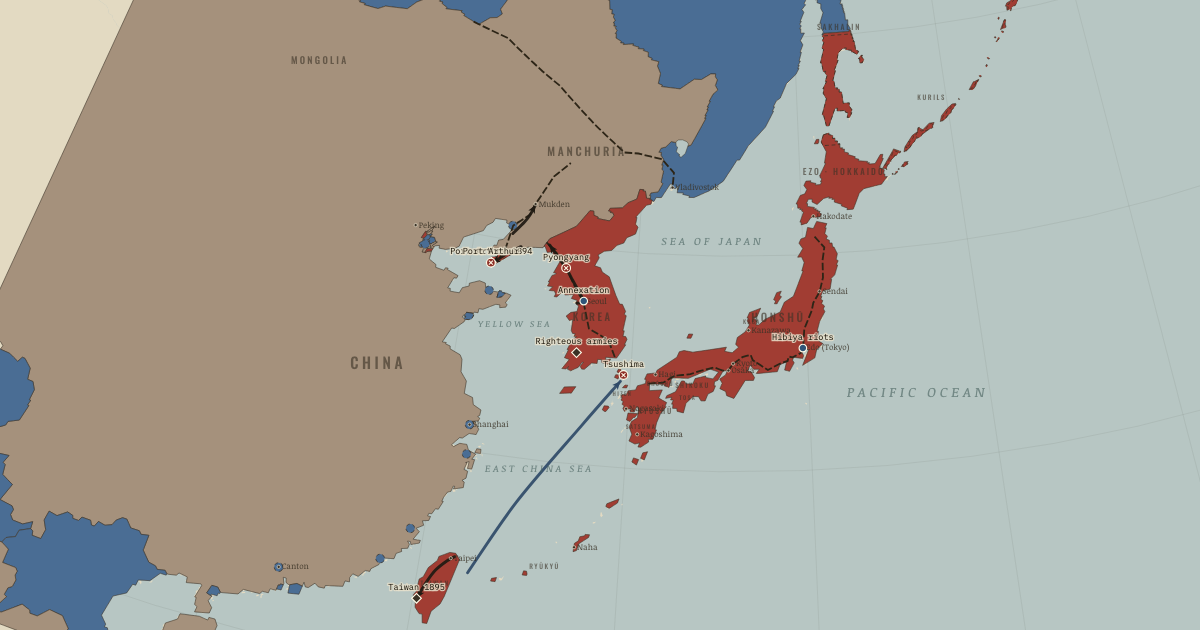
The map above is the world of Japan, August 1910 — Korea annexed.
Every state on the map that year: The world in 1910 · Europe in 1910.
Part of IB History: Meiji Japan and post-Soviet Russia →
SHORT EXPLANATION
In July 1894 Britain agreed that, from 1899, its citizens in Japan would no longer be tried only in British consular courts. This privilege, extraterritoriality, resembled diplomatic immunity. Within weeks Japan went to war over Korea with Qing China, ruled by the Manchu Qing dynasty. Victories at Pyongyang and off the Yalu brought the 1895 Treaty of Shimonoseki, Taiwan and an indemnity—a payment imposed on the defeated state, like the reparations later imposed on Germany. Yet Russia, Germany and France compelled Japan to return Liaodong, and Russia leased its tip at Port Arthur in 1898, shown as a blue patch. Japan allied with Britain in 1902, fought Russia in 1904–05, captured Port Arthur and destroyed the Russian fleet at Tsushima. It became the first Asian state in modern times to defeat a European great power.
Victory promised security against Russia and equal standing among the powers. It also made Japan a colonial empire. The 1910 map shows Taiwan, southern Sakhalin, the Kwantung lease at Liaodong’s tip and, from August 1910, Korea in red. Japan had imposed a protectorate on Korea in 1905, controlling its foreign policy and government while its ruler remained on the throne; five years later it annexed the country. Both Koreans and Taiwanese resisted. Japanese records count about 14,000 Taiwanese killed in the 1895 conquest and more than 17,000 Korean “righteous armies” fighters—volunteer soldiers, peasants and scholars—killed after 1907. Wars costing several times the national budget also burdened Japanese taxpayers, and anger erupted in the Hibiya riots in 1905. By 1911 Japan controlled its tariffs and stood among the great powers. It had escaped unequal treaties partly by imposing them on its neighbors.
The full story
Japanese leaders saw Korea as a question of security. A rival established on the peninsula would be close enough to threaten Japan itself; the image of Korea as a dagger pointed at Japan was later attributed to the Prussian adviser Jakob Meckel. In 1894 a peasant rebellion led by the Donghak religious movement prompted Korea to ask China for troops. Japan sent a larger force, seized the royal palace in Seoul and declared war on Qing China in August.
The Japanese victories were swift. The army won at Pyongyang and the navy off the Yalu in September. In November troops took Port Arthur and massacred prisoners and many civilians, an event marked on the map. The Treaty of Shimonoseki in April 1895 ended China’s claim over Korea and gave Japan Taiwan, the Pescadores and Liaodong, as well as an indemnity of 200 million silver taels—a forced payment like war reparations. The settlement did not stand intact for long. Within a week Russia, Germany and France made Japan return Liaodong. In the imperial scramble for colonies, Japan had won territory only to find stronger powers could take it away.
Japan conquered Taiwan after five months of resistance in 1895; that October Japanese agents murdered Korea’s Queen Min. Then Russia strengthened its position on the mainland. After the anti-foreign Boxer rising in northern China in 1900, Russian troops occupied Manchuria, while Russian railways advanced toward Korea. Japan allied with Britain in 1902 and attacked Port Arthur in February 1904.
The fighting with Russia showed both the strength and the cost of the new military. General Nogi’s army suffered nearly 60,000 killed and wounded in the siege of Port Arthur. At Mukden in March 1905, shown by the arrow north of the peninsula, Japan won the war’s largest land battle. In May Admiral Tōgō destroyed the Russian Baltic fleet at Tsushima. The Portsmouth peace awarded Japan southern Sakhalin, the Kwantung lease and the South Manchuria Railway, but no indemnity. Tokyo crowds rioted at Hibiya. Japan had defeated a European great power, but roughly 80,000–90,000 Japanese had died and the country carried heavy foreign debt.
Korea’s rulers had less and less room to decide their own future. In November 1905 Japan forced its ministers to accept a protectorate controlling foreign policy; Itō Hirobumi became resident-general, effectively governor. Emperor Gojong sent envoys to protest at the 1907 Hague peace conference. Japan then forced him to abdicate and disbanded the Korean army. Soldiers, peasants and scholars fought as “righteous armies”. By 1911 Japanese records counted more than 17,000 Korean fighters killed, many during the 1909 sweep through Jeolla province shown on the map.
The decision to annex Korea had already been made in Tokyo in July 1909. When the nationalist An Jung-geun shot Itō dead at Harbin that October, Japan used the killing as a pretext to move faster. Annexation followed in August 1910, and Korea was ruled as the colony of Chōsen until 1945. The state that had escaped unequal treaties at home now held two colonies by force.
FULL EXPLANATION
Security, prestige or profit? Why Japan built an empire
A state may seek territory for security, profit or standing, and Japan’s expansion brought all three into view. Historians disagree about their relative weight. In 1890 Yamagata Aritomo told the first Diet that Japan must defend a “line of sovereignty”, its own borders, and a “line of advantage” running through Korea. On this account, danger could arise before an enemy reached Japan itself. In The Abacus and the Sword, Peter Duus shows strategy and business moving together: Japanese merchants, railway builders and rice traders entered Korea before annexation, and the state protected them. Prestige mattered as well. Fukuzawa Yukichi, whose newspaper had urged Japan to “leave Asia”, celebrated the 1894 war as a contest between civilisation and backwardness; crowds cheered victories. Most historians see security fears driving decisions, economic interests following and deepening expansion, and a newly nationalist public making retreat costly. Leaders also believed, with some evidence, that a state without colonies risked becoming one.
The colonisation of Korea and its historians
Japanese officials sought Western acceptance for the takeover of Korea by presenting it in the language of treaties, protectorates and international law. Alexis Dudden’s study shows how this argument helped make annexation appear legitimate to Western powers and helps explain their muted reaction in 1910. The events described in Korean sources place coercion at the center: the 1905 treaty was signed under armed pressure, Gojong’s envoys were refused a hearing at The Hague, and righteous armies fought a guerrilla war for four years. An Jung-geun, executed in 1910, left an unfinished essay, “On Peace in East Asia”, proposing cooperation among Japan, China and Korea against Western domination. The argument extends to colonial rule after 1910. Did it modernize Korea’s economy or simply exploit it? Gi-Wook Shin and Michael Robinson describe a “colonial modernity” in which railways, schools and factories developed while Koreans were subordinated to Japanese settlers and needs. The cases for legality and coercion draw on the same documents, and the dispute over 1905–10 continues to shape relations between the countries.
Paying for victory: debt, taxes and the Hibiya riots
Japan financed victory over Russia largely by borrowing. The war cost about 1.7 to 2 billion yen, several times annual government spending. London and New York loans, arranged with help from American banker Jacob Schiff, supplied more than half the war borrowing; national debt rose from about 530 million yen before the war to some 2.4 billion afterwards. Special taxes on salt, textiles and incomes remained after peace. China had paid an indemnity in 1895, and many Japanese expected Russia to pay for their sacrifices in turn. The Treaty of Portsmouth provided none. On 5 September 1905 a Hibiya Park rally grew into three days of rioting. Crowds burned police boxes and attacked a pro-government newspaper; 17 people died and martial law was declared. Andrew Gordon sees the riots as the beginning of an “imperial democracy”, in which urban crowds wanted both a stronger empire and a voice in politics.
Key places on the map
On this day
Why it happened
Korea sat between three empires. Korea’s kingdom was weak and divided at court, and had traditionally been a tributary of China. Russia approached from the north; Japanese strategists feared that control of the peninsula by a rival would threaten Japan. Japanese merchants and officials had built influence there since the 1876 Treaty of Ganghwa. The competing ambitions of China, Russia and Japan around Korea produced two wars within ten years.
A modern state earned treaty revision. Britain demanded institutional changes before revising the treaties. Japan’s 1880s constitution, cabinet and legal codes supplied them, and on 16 July 1894 Britain agreed to end extraterritoriality from 1899. The agreement came days before war with China. Its negotiator, foreign minister Mutsu Munemitsu, saw proof that reform at home brought respect abroad. Equality with the West and expansion in Asia advanced together, each strengthening the other.
The Triple Intervention taught that only power counted. Russia, Germany and France advised Japan in April 1895 to return Liaodong. Japan could not fight all three and complied in exchange for an extra indemnity. In 1898 Russia leased the peninsula’s tip, including Port Arthur, itself. Japanese leaders and the public drew a lesson about international law: the strong could make the rules serve them. The episode encouraged rearmament and an alliance capable of matching Russia.
Russia’s railways and Britain’s alliance set the timing. The Trans-Siberian Railway and its Manchurian branch to Port Arthur threatened to bring Russian armies close to Korea within a few years. Japan’s January 1902 alliance with Britain guaranteed that no third power would join Russia against it. Japanese leaders saw an opportunity to fight before the railway was finished, and struck first in February 1904.
THE TURNING POINT
Tsushima, 27–28 May 1905. At Tsushima on 27–28 May 1905, Japan destroyed Russia’s Baltic fleet and decided the war. The victory demonstrated that the new state could defeat a European great power. Russia accepted mediation, the powers recognized Japan’s control of Korea, and Japan entered the circle of empires on equal terms. From Turkey to India, observers saw evidence that Europe could be beaten. Many Japanese also took empire to be the reward for their transition, a belief that led toward the wars of the twentieth century.
What it changed
Japan joined the great powers. The last clauses of the 1858 treaties had been undone by 1911, when Japan regained full control of tariffs and renewed its alliance with Britain. It negotiated with Western powers as an equal and held colonies like theirs. Within a lifetime it had reached the goal set in 1868: a nation “standing with the nations of the world”.
Korea and Taiwan under colonial rule until 1945. Governors-general, usually generals or admirals, ruled Taiwan from 1895 and Korea from 1910. Railways, ports and schools served Japan’s purposes. Land surveys transferred land to the state and Japanese owners, while police controlled populations and suppressed resistance. Japan held both colonies until its defeat in 1945.
An expensive empire and a restless public. The bills for empire remained: war debts, special taxes and a large standing army became permanent demands on the budget. At Hibiya, crowds had demanded both imperial strength and political influence. Urban protests helped bring down cabinets in 1913 and 1918. The Meiji state’s success had created pressures its successors would struggle to control.
DISCUSSION QUESTION — To what extent was Japan’s transition a success by 1912, and for whom?
By the founders’ own goals, the transition succeeded. Japan kept its independence, ended the unequal treaties, built industry, railways and schools, adopted a constitution and defeated China and Russia. In the 1960s modernization theorists such as Edwin Reischauer presented it as a peaceful, well-managed model. Later historians including John Dower and Carol Gluck asked who bore the costs: indebted farmers, girls in textile mills, the Ainu and Ryukyuans, and above all Taiwanese and Koreans whose lands were taken by force. Some also trace the military’s later independence and the wars of the 1930s to choices of this period. Both sides of the judgment need evidence. The state became strong, while much of the cost fell on people with no voice in it.
An interesting fact
Admiral Tōgō Heihachirō had trained as a young officer in Britain in the 1870s aboard HMS Worcester. Before Tsushima he hoisted a signal echoing Nelson’s at Trafalgar: the empire’s fate depended on the day, and every man must do his utmost. His flagship Mikasa had been built by Vickers at Barrow-in-Furness in England and launched in 1900. Weeks after the war a magazine explosion sank her at her moorings, killing hundreds of crew. Raised and repaired, she later became a memorial ship. She remains preserved in concrete at Yokosuka, south of Tokyo, one of the last surviving battleships of her era.
Related
THE FREE PRINTABLE STUDY GUIDE
Get the printable study guide for Remaking the State free. I’ll send you a few short letters, then one when a new atlas opens. That’s all. — Paul
NO TRACKING · YOUR ADDRESS IS USED FOR THE DISPATCH AND NOTHING ELSE · UNSUBSCRIBE ANYTIME