Road to WW2 · CHAPTER 5 ·
Rhineland and the Spanish Civil War
Chapter 5 of The Road to War, 1931–1941: “The Rhineland Bluff and the Spanish Rehearsal”
On 7 March 1936 a small German force entered the demilitarised Rhineland with orders to withdraw if France moved; France would not act without Britain, and the bluff succeeded. Four months later a military rising in Spain became a civil war in which Germany and Italy armed Franco while the Soviet Union armed the Republic.
Chapter 5 is included with every paid plan. WW2 is free in full, and chapter 1 of every atlas is free. A free account opens 3 more chapters a day. Starter, at $9 a month, opens all 21 with no daily limit — see the plans.
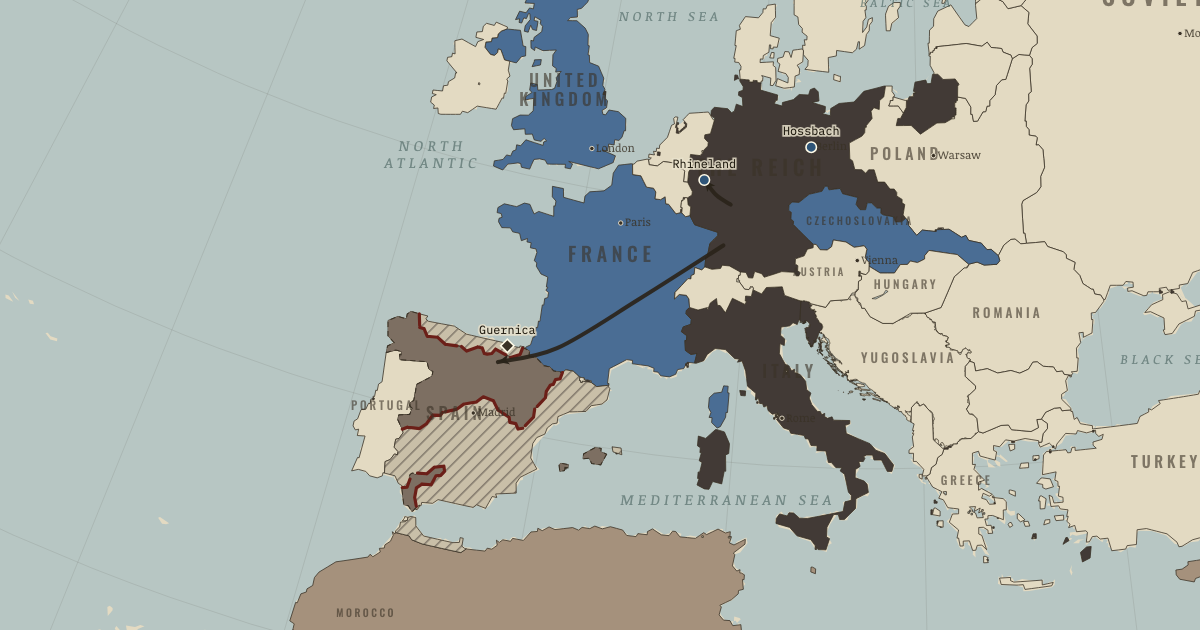
The map above is the world of Europe and Africa, July 1936 — Abyssinia annexed; Spain at war.
Every state on the map that year: The world in 1938 · Europe in 1938.
Part of IB History: The Road to War →
SHORT EXPLANATION
On 7 March 1936 German troops entered the demilitarized Rhineland. Their orders allowed for withdrawal if France resisted, and France had the strength to confront them. But French leaders feared mobilization and lacked British support. The force stayed, allowing Germany to strengthen its western frontier and giving Hitler confidence in his judgment against his cautious generals.
That July, a military rising against Spain’s elected Republic became a civil war. Germany and Italy helped Franco’s rebels; the Soviet Union supplied the Republic. Britain and France embargoed both sides, while the dictators continued to intervene. The bombing of Guernica exposed civilians to destruction from the air. At a secret conference recorded by Colonel Hossbach in November 1937, Hitler discussed taking territory by force.
The full story
The Rhineland belonged to Germany, but the postwar settlement forbade German troops and fortifications there. This gave France a way to put pressure on Germany if it attacked an ally in the east: French forces could enter the undefended zone while Germany was fighting elsewhere. On 7 March 1936 Hitler sent a small force across the Rhine. Its commanders were ready to withdraw if France resisted.
France had the strength to act, but its leaders feared that even a limited response would require general mobilization. Britain would not support military action. The German troops remained, and Germany could now fortify its western frontier. A French promise to help an eastern ally would become much harder to carry out when the route into Germany was defended. The result also strengthened Hitler’s confidence against generals who had urged caution.
In July, Spanish generals rose against the elected Republic. Their rising stalled, dividing the country in a civil war. The conflict grew from Spanish disputes over land, the Church, the army and regional autonomy; foreign powers entered a struggle that had already begun. Germany and Italy supplied Franco’s rebels, while the Soviet Union sent arms and advisers to the Republic and gained influence in its camp. International volunteers also came to fight for the Republic.
Britain and France tried to keep the war from spreading by embargoing both sides. The rule treated government and rebels alike, but the result depended on whether their suppliers obeyed it. Germany and Italy continued to help Franco, while the Republic’s access to legal supplies was restricted. Outside intervention thus changed the course of a war whose causes lay in Spain.
Spain gave German and Italian forces combat experience, including the coordination of aircraft with ground troops. At Guernica, the bombing of a Basque town showed the destruction air attack could bring to civilians. Calling Spain a rehearsal captures the learning, but its politics and fronts belonged to a civil war with conditions of its own. Later in 1937, the Hossbach meeting recorded Hitler discussing the acquisition of territory by force.
FULL EXPLANATION
Deterrence and credibility
The value of a demilitarized Rhineland lay in what France could do if Germany fought in the east. With no German fortifications in the zone, France could threaten to enter from the west in support of an ally. Remilitarization changed that prospect even before new defenses were finished. As Germany consolidated its position, enforcing France’s eastern commitments would become more costly. The immediate military imbalance favored France. Hitler’s force was small and prepared to withdraw, but French ministers received exaggerated estimates of German strength. Their military advisers said action required general mobilization, an alarming decision with an election approaching. Britain signaled that it would not support force. Hitler could hope the breach would go unanswered, while France could not count on British help to enforce the agreement. Historians have called this the last relatively cheap chance to stop Hitler. The imbalance makes the opportunity significant, though it cannot tell us whether a forced retreat would have brought down his regime. France faced political dangers in acting as well as military advantages. Once Germany strengthened its defenses, the opportunity to intervene under those conditions had passed.
Spain: local war and proxy war
The Spanish Civil War was not designed in Berlin or Moscow. Disputes over land reform, the Church, the army, regional autonomy and revolutionary violence had divided Spaniards before foreign powers intervened. The fighting was their civil war, even as outside aid changed what its armies could do. German aircraft carried Franco’s Army of Africa to the mainland; Italy sent a substantial force. Soviet supplies helped the Republic continue fighting. Britain and France’s non-intervention policy restricted both sides in form, but Germany and Italy continued supplying the rebels. The Republic lost access to legal sources of arms while its opponents received outside help. German airmen learned about bombing and cooperation with ground forces in Spain. That makes ‘rehearsal’ useful, provided we remember what it leaves out: the fronts, politics and conditions differed from those of the later war. The learning took place within a real civil conflict, at a cost borne by the people fighting and living there.
Key places on the map
On this day
Why it happened
Versailles’ last physical restraint was psychological. Hitler had reason to doubt that the Rhineland restrictions would be enforced. The Abyssinian crisis had fractured the Stresa Front, Britain had reached a naval agreement with Germany, and French planning reflected the defensive outlook of the Maginot Line. France had no simple agreed plan for a limited response. Hitler also offered a legal justification: he called the Franco-Soviet pact, ratified in February, “encirclement” and claimed that it invalidated Locarno.
France would not fight alone; Britain would not fight at all. France’s army could confront the German force, but ministers did not see the decision as a small military operation. Intelligence substantially overestimated German strength, and military leaders said action required general mobilization. With an election near, that was a grave political step. Britain, itself a Locarno guarantor, declined to support force; Foreign Secretary Eden proposed negotiation. French leaders would not accept the risks alone.
Spain’s war was internal first, international second. The Republic established in 1931 attempted reforms of landholding, the army, regional government and relations between church and state. Each made enemies. Fear and division surrounded the Popular Front’s narrow election victory in February 1936, and Spanish generals planned their July rising for Spanish reasons. German and Italian support later strengthened Franco; Soviet aid and the International Brigades helped the Republic resist. Foreign powers changed the fighting without creating its original divisions.
Non-intervention institutionalized the double standard. Britain and France feared a wider war, communist influence in Madrid and French internal division. Their arms embargo covered both the Republic and the rebels, but its consequences were unequal: Germany and Italy continued sending Franco aircraft, weapons and troops, while the democracies restricted assistance from their own countries. Léon Blum reportedly wept at the French decision. French aid nevertheless crossed the border intermittently later in the war.
THE TURNING POINT
The Rhine bridges, 7 March 1936. Some historians see the Rhine bridges as the last chance to stop Hitler cheaply. The German operation was small and its leaders expected to withdraw if France intervened. Germany was still preparing for a larger war, so a French response could have forced a retreat under relatively favorable military conditions. Whether that humiliation would have endangered Hitler’s regime is less certain. The actual result had consequences in several directions. Germany could fortify its western frontier, reducing the risk attached to action against eastern neighbors. Hitler’s cautious generals lost influence, and his confidence in his own judgment of the democracies grew. France had allowed the settlement to be broken at a moment when it had the military advantage.
What it changed
Belgium bolts, the Maginot logic breaks. Belgium watched Locarno fail and in October 1936 moved away from its French alliance, returning to neutrality. That made cooperation on France’s northern frontier harder to plan. In 1940 German forces would advance through Belgium, beyond the main fortified sectors of the Maginot Line. Belgium’s decision was one of several obstacles to cooperation against the later attack.
The Axis names itself over Spanish battlefields. German and Italian intervention in Spain gave the two governments a chance to work together in war. The “Rome–Berlin Axis” was announced in October 1936; Germany and Japan concluded the Anti-Comintern Pact the following month. These agreements and cooperation in Spain brought revisionist powers closer, although their coalition was still taking shape.
Air terror is normalized before the war begins. The bombing of Guernica and Japanese attacks on Chinese cities in 1937 exposed an international audience to air attacks on civilians. European leaders already feared bombing, and these attacks gave that fear fresh force during the Munich crisis. “the bomber will always get through” captured the anxiety. Luftwaffe crews carried experience gained in Spain into the attack on Poland.
DISCUSSION QUESTION — “The dictators intervened and the democracies did not — that is the history of the Spanish war in one sentence.” Is it fair?
As an account of government policy, the sentence identifies a real contrast. Germany and Italy sent aircraft and armor, and Italy sent an army. Britain and France embargoed both sides, restricting the Republic while Franco’s sponsors continued to help him. But several participants disappear from that account. The Soviet Union supplied the Republic with arms and advisers. Soviet security influence and repression of opponents, including Trotskyists and anarchists around the Barcelona May Days of 1937, deepened divisions in the Republican camp. Franco’s propaganda portrayed the war as Christianity against Bolshevism. About 35,000 volunteers from some fifty countries joined the International Brigades even though their governments did not send them. France’s border policy also changed: under Blum, aid crossed the Pyrenees when the border opened. Non-intervention was a state policy with uneven effects, not a complete account of foreign involvement.
An interesting fact
The Condor Legion studied its experience in Spain, including dive bombing, support for ground troops and fighter tactics. Its loose two-plane Rotte formation influenced later fighter practice. The legion’s chief of staff, Wolfram von Richthofen, a cousin of the Red Baron, later served in the campaigns over Poland, France and Crete. Rotating crews through Spain also gave the Luftwaffe a substantial group of airmen with combat experience before the Second World War.
Related
THE FREE PRINTABLE STUDY GUIDE
Get the printable study guide for The Road to War free. I’ll send you a few short letters, then one when a new atlas opens. That’s all. — Paul
NO TRACKING · YOUR ADDRESS IS USED FOR THE DISPATCH AND NOTHING ELSE · UNSUBSCRIBE ANYTIME