Mao’s China · CHAPTER 8 ·
Recovery after the Great Leap
Chapter 8 of The People’s Republic under Mao, 1949–1976: “Retreat and Recovery”
After the famine Mao stepped back, and from 1961 Liu Shaoqi, Deng Xiaoping and Chen Yun ran a pragmatic retreat, restoring private plots, rural markets and pay by results. At the Seven Thousand Cadres Conference in January 1962 Liu called the disaster mostly man-made, and Mao resented the retreat in private.
Chapter 8 is included with every paid plan. WW2 is free in full, and chapter 1 of every atlas is free. A free account opens 3 more chapters a day. Starter, at $9 a month, opens all 21 with no daily limit — see the plans.
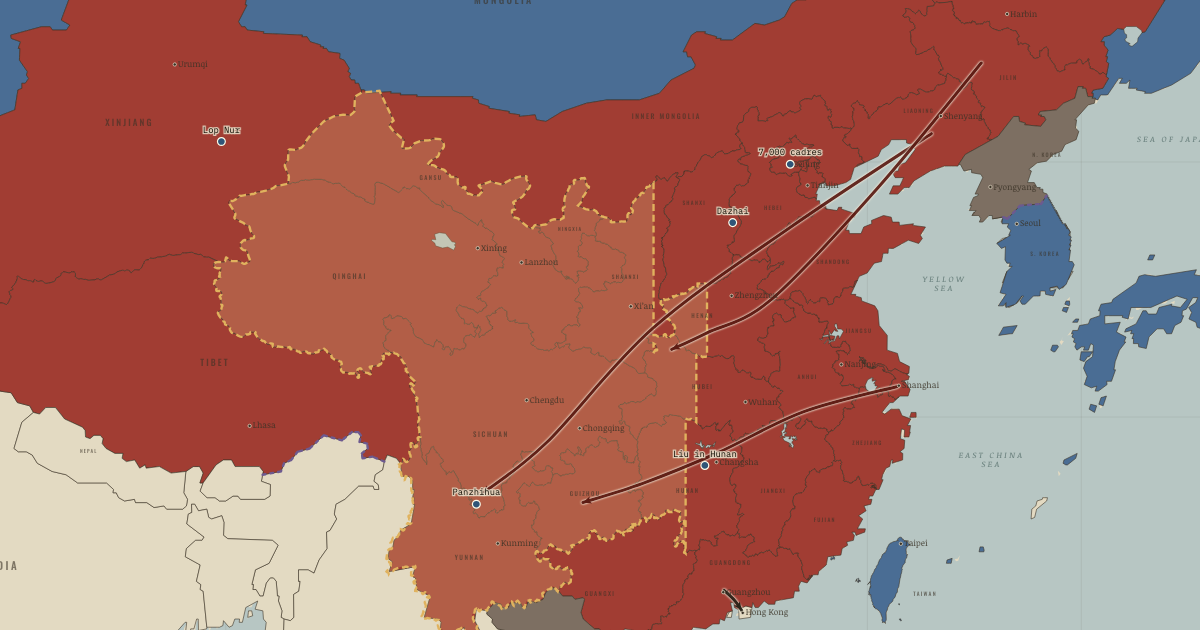
The map above is the world of China, October 1964 — The bomb, the Third Front and the Soviet rift.
Every state on the map that year: The world in 1960 · Europe in 1960.
Part of IB History: The People’s Republic under Mao →
SHORT EXPLANATION
After the famine, the Communist Party had to reverse the Great Leap Forward, Mao’s drive of 1958. Mao stepped back from daily government, leaving recovery to Liu Shaoqi, the head of state; Deng Xiaoping, the Party general secretary who managed daily business much like a chief operating officer; and the economist Chen Yun. The Party governed at every level, and these leaders could change what it demanded of the countryside. They restored private plots and markets, paid peasants by results and, in parts of Anhui, let households farm their own fields. Like a company abandoning a failed strategy, they judged the measures by whether they produced food.
At a conference of some 7,000 officials in January 1962, Liu said the disaster was mostly man-made. By 1965 grain output had returned to its 1957 level. On the map every province is solid red again because the campaigns—the Party’s bursts of mass mobilization against named enemies—had paused. Recovery strengthened the men who had reversed Mao’s policies, and their success deepened his distrust.
Mao believed the Soviet Union under Khrushchev had succumbed to “revisionism”, his term for abandoning revolution while keeping its name, a charge rather like heresy in a church. From September 1962 he urged the Party to “never forget class struggle”: enemies of revolution, he believed, remained inside society and the Party, making politics a permanent war. His Socialist Education Movement sought to purge village officials. Defense Minister Lin Biao built a cult of Mao’s thought in the army, worship of a leader like Stalin’s cult, using the Little Red Book, a pocket collection of Mao’s quotations.
Foreign dangers also shaped the recovery. With the United States escalating in Vietnam and the Soviet border growing hostile, Mao ordered the Third Front, a vast program to rebuild industry in the remote interior, outlined in bronze on the map. Britain had likewise moved factories away from bombing in wartime. China tested its first atomic bomb in October 1964. The country was growing stronger, while Mao came to regard the Party itself as an enemy.
The full story
In spring 1961 Liu Shaoqi spent 44 days in rural Hunan. Liu was head of state and second only to Mao in the Communist Party, which governed at every level. He found empty granaries and peasants who blamed officials and their orders for the disaster. The Great Leap Forward, Mao’s drive launched in 1958, had ended in famine; seeing the countryside helped persuade leaders that its policies had to change.
The new arrangements gave households more control over work and food. Mess halls closed, and farming units shrank to production teams of a few dozen households. Peasants could again raise pigs, cultivate private plots and sell in markets. In Anhui, Zeng Xisheng permitted “responsibility fields”: a household contracted to farm a plot and kept what it produced above a quota, rather like a tenant paying a fixed rent and keeping the rest. In July 1962 Deng Xiaoping defended such methods with a Sichuan proverb: it does not matter whether a cat is yellow or black, as long as it catches mice. With reasons to work hard again, peasants helped food production recover quickly.
The retreat also required the Party to face what had gone wrong. At the Seven Thousand Cadres Conference in January–February 1962, the largest working meeting of officials in its history, Mao accepted responsibility as chairman for errors at the center. Liu’s judgment was more pointed: “three parts natural disaster, seven parts man-made”. Mao accepted retreat publicly but resented it privately. By summer he was attacking household farming as a road back to capitalism.
To Mao, the danger was not confined to farming. In September he told the Central Committee—the Party’s ruling council of about two hundred, roughly its national executive—to “never forget class struggle”. Hidden enemies, he believed, could survive inside the Party as well as in society. The Socialist Education Movement of 1963–66 sent outside work teams to purify village leaderships. In January 1965 Mao identified the target as “those in authority within the Party taking the capitalist road”.
Mao had a secure source of support outside the Party machinery. Defense Minister Lin Biao built a cult of personality in the army, the organized worship of a living leader familiar from Stalin’s Soviet Union. The Little Red Book of Mao’s quotations and the model soldier Lei Feng helped give that loyalty a language and an example.
The map also shows why leaders feared attack from abroad. The Soviet Union and Mongolia are blue, as is India after the border war of 1962; in August 1964 the United States began bombing North Vietnam. Industry built on the coast and in the northeast during the 1950s seemed vulnerable. Mao ordered factories, mines and railways into an interior Third Front, “close to the mountains, dispersed and hidden”, much as Britain once moved factories away from wartime bombing.
The bronze outline marks the Third Front. Arrows trace steel moving from Anshan to Panzhihua, Shanghai plants to Guizhou and Sichuan, and car-making from Changchun to Shiyan. China exploded its first atomic bomb at Lop Nur in October 1964. Recovery from famine and preparation for war proceeded together.
FULL EXPLANATION
Two roads out of the famine
How far could the Party retreat from the commune without abandoning socialism? Roderick MacFarquhar’s third volume of The Origins of the Cultural Revolution follows this argument through 1962. Chen Yun proposed household-level output quotas; Deng Zihui reported higher yields from household contracting; and Mao’s secretary Tian Jiaying returned from Hunan recommending it. In Anhui, Zeng Xisheng’s responsibility fields spread to most production teams in 1961. Mao saw their success differently. At Beidaihe in August 1962 he condemned them as “going it alone” and a return to individual farming. Zeng and Deng Zihui lost their posts, and the fields were reversed. Collectives survived until 1978, when farmers at Xiaogang in Anhui secretly revived the idea. A solution adopted after Mao’s death had thus been known and tried by 1962, then rejected for political reasons.
Building the cult in the barracks
The cult that became conspicuous in 1966 had been assembled in the army beforehand. Daniel Leese’s Mao Cult traces its construction. Lin Biao, who replaced Peng Dehuai in 1959, made Mao’s writings central to political training. The army’s General Political Department compiled Quotations from Chairman Mao Zedong in May 1964 as a pocket book soldiers could memorize. Another instrument was a person: Lei Feng, a young soldier killed in an accident in 1962, became a model of selfless loyalty in March 1963 through a published diary and many photographs. In 1964 the country was told to “learn from the People’s Liberation Army”, and ministries and factories set up political departments on its model. This gave Mao authority apart from the Party machine controlled by Liu Shaoqi and Deng Xiaoping. When he turned on the Party, the cult supplied books, language and loyalty.
The Third Front: security and cost
The Third Front remained hidden for decades, and historians have been able to measure it only since the 1980s. Barry Naughton’s pioneering study showed a purposeful, centrally directed development program that, apart from oil, effectively constituted the government’s whole industrial policy in 1965–71. Covell Meyskens’s Mao’s Third Front uses archives and interviews to recover its human demands: millions of workers, engineers and soldiers moved to remote valleys in Sichuan, Guizhou, Shaanxi and Gansu, often living in temporary housing away from their families. A plant near mountains, dispersed or hidden in caves, was safer from bombing; distance also made it more expensive to operate. Naughton concluded that much investment was wasted because factories stood far from raw materials, markets and one another. Yet the program left railways, power stations and industrial cities, including Panzhihua and Mianyang, that still matter. Its costs and achievements remain contested.
Key places on the map
On this day
Why it happened
The famine could no longer be denied. By 1960–61 Party investigators had brought evidence of mass death from Xinyang and elsewhere to Beijing, and China had to import grain from Canada and Australia. The distress was still visible in May 1962, when some 60,000 hungry people crossed from Guangdong into Hong Kong within a few weeks, along the map’s short arrow. Most were caught and sent back. Leaders needed food production to recover quickly or risk rural collapse; that urgency gave pragmatists room to change policy faster than ideology would normally have allowed.
Pragmatists in charge of the economy. Liu Shaoqi had replaced Mao as head of state in 1959, and Mao withdrew further from daily government after the famine. Liu, Deng Xiaoping, Chen Yun and Zhou Enlai managed recovery with experts, material incentives and a concern for results. Each good harvest strengthened their authority. It also pointed to a failure of Mao’s methods, making economic success politically threatening to him.
Mao’s fear of revisionism. Mao watched Khrushchev denounce Stalin, promise Soviet citizens “goulash communism” and seek better relations with the United States. He concluded that Communist leaders themselves could restore capitalism from within the party. Chinese polemics against Moscow in 1963–64 made that argument public. Mao came to see Liu Shaoqi’s domestic policies as the same disease and launched the Socialist Education Movement as a first attempt to cure it.
Enemies on several borders. Between 1962 and 1964 China fought India, quarreled openly with the Soviet Union and watched Mongolia side with Moscow. After the Gulf of Tonkin incident in August 1964, the United States bombed North Vietnam. Mao feared American or Soviet bombers could destroy industry on the coast and in the northeast. The Third Front and the rush to build an atomic bomb answered that fear.
THE TURNING POINT
The Seven Thousand Cadres Conference, January 1962. More than 7,000 officials heard Liu Shaoqi say that the disaster was mostly man-made. Many criticized the Leap openly for the first time since Lushan, and Mao accepted responsibility in general terms. Frank discussion made recovery possible, but it also convinced Mao that colleagues might eventually repudiate him. Within months he was attacking household farming; over the next four years he built the means to fight back. By 1965 Party leaders on the “capitalist road” were his target. The Cultural Revolution’s first victims were chosen in the aftermath of the meeting.
What it changed
Mao turns on the Party. Mao’s suspicion came to rest on Party “power-holders” through the Socialist Education Movement and the Twenty-three Articles of January 1965. The following year he bypassed the Party machine and called on students to attack it. Liu Shaoqi and Deng Xiaoping, architects of recovery, became chief targets of the Cultural Revolution. Liu was expelled from the Party in 1968 and died in custody in 1969.
A cult ready to be used. By 1966 the Little Red Book was in every soldier’s pocket and Lei Feng’s diary in every school. When Red Guards rose that summer, they drew slogans, certainty and the belief that loyalty to Mao stood above loyalty to the Party from the cult Lin Biao had built in the army. Lin became its most prominent beneficiary and later its most prominent casualty.
Industry hidden in the mountains. The Third Front placed a large share of China’s new industry inland between 1965 and 1971. Steel at Panzhihua, vehicle works at Shiyan, defense plants around Chongqing and railways including the Chengdu–Kunming line remained afterward. Thousands of families were tied to remote towns for a generation. Its costs and legacies are still debated.
A baby boom after the famine. The return of food brought a surge in births. In 1963 the birth rate reached about 43 per thousand, the highest in the People’s Republic’s history; by the mid-1960s the population had passed 700 million. The boom produced the huge generation of young people who filled schools in 1966. It later pushed the state toward the birth-planning campaigns of the 1970s and the one-child policy of 1980.
DISCUSSION QUESTION — Why did the recovery of 1961–65 lead to the Cultural Revolution instead of to lasting reform?
The measures that restored food production also changed the balance of authority. Private plots, markets, smaller accounting units and household contracting helped recovery by 1965, strengthening Liu Shaoqi and Deng Xiaoping. Mao saw each as a step toward capitalism. He remained Party chairman, retained the army’s loyalty through Lin Biao and could define what counted as socialist. Historians differ over his motives. MacFarquhar and others emphasize power and fear: Mao thought colleagues would denounce him after his death as Khrushchev had denounced Stalin. Meisner and Walder place greater weight on conviction, arguing that Mao genuinely believed bureaucrats and incentives were creating a privileged class. These explanations can fit together, since Mao saw his own authority and the revolution as one. In 1966 the recovery became evidence against its managers. A leader who retains control of the army and ideology can reverse even a successful reform led by others.
An interesting fact
In June 1965 Mao complained that the Ministry of Health served only the urban fifteen percent of the population. He said it should be renamed the “Ministry of Urban Gentlemen’s Health”. The barefoot doctor offered one answer: a peasant received a few months of training and worked in the fields between patients. The name came from rice farmers working barefoot in flooded paddies. By the late 1970s more than a million served China’s villages, and the World Health Organization presented the scheme as a model of primary care at its 1978 conference in Alma-Ata.
Related
THE FREE PRINTABLE STUDY GUIDE
Get the printable study guide for The People’s Republic under Mao free. I’ll send you a few short letters, then one when a new atlas opens. That’s all. — Paul
NO TRACKING · YOUR ADDRESS IS USED FOR THE DISPATCH AND NOTHING ELSE · UNSUBSCRIBE ANYTIME