Mongol Empire · CHAPTER 9 ·
Division of the Mongol Empire
Chapter 9 of The Mongol Empire, 1206–1294: “The Family War”
Möngke’s death in 1259 produced rival elections: Khubilai claimed the great khanship from his Chinese base and Ariq Böke from Mongolia, and Khubilai won the civil war in 1264. Meanwhile Berke of the Golden Horde went to war with Hülegü’s Ilkhanate, and the khanates developed separate revenues, armies and alliances.
Chapter 9 is included with every paid plan. WW2 is free in full, and chapter 1 of every atlas is free. A free account opens 3 more chapters a day. Starter, at $9 a month, opens all 21 with no daily limit — see the plans.
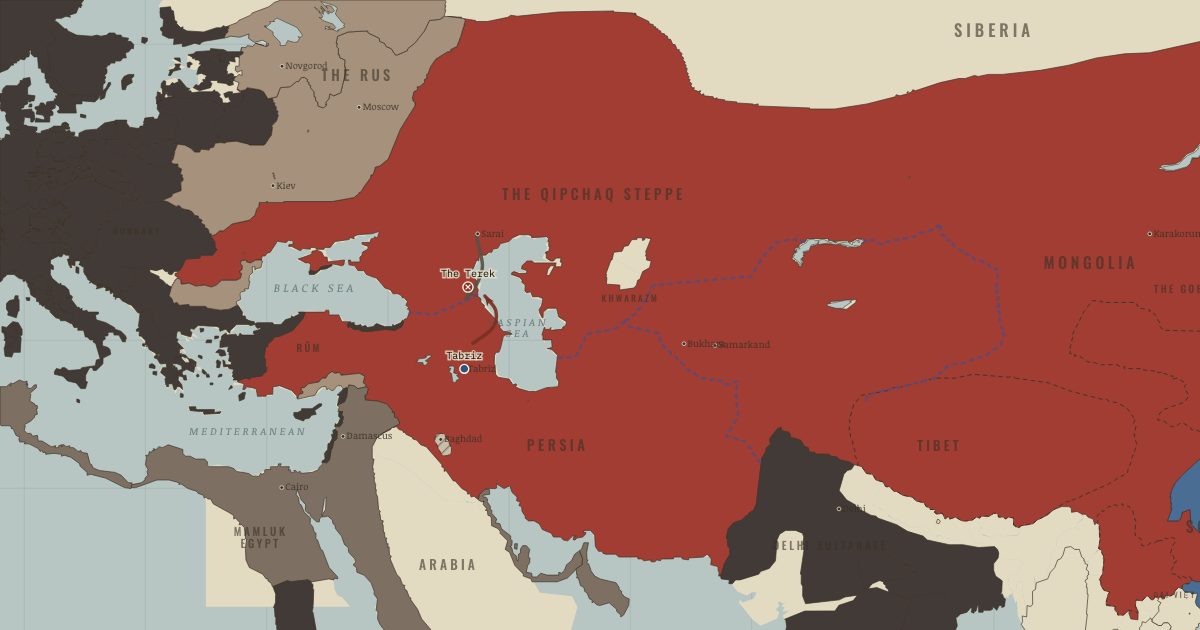
The map above is the world of The Mongol Empire, 1264 — Four empires in one.
Part of IB History: The Mongol Empire →
SHORT EXPLANATION
Möngke’s death in 1259 left the ruling family with a choice it could not make together. An assembly at Shangdu chose Khubilai; another in Mongolia chose Ariq Böke. Khubilai defeated his brother in 1264, but winning the great khanship did not bring the other family domains under his command.
A second family war crossed the Caucasus. Berke of the Golden Horde fought Hülegü’s Ilkhanate over Azerbaijan, spoils and other grievances, and found an ally in Hülegü’s Mamluk enemies. Kinship, trade and dynastic prestige still connected the Mongol rulers, but their own frontiers had become places of war.
The full story
When Möngke died in 1259, his brothers Khubilai and Ariq Böke had to secure support from a ruling family spread across an immense empire. They did not submit their claims to one gathering. Khubilai’s supporters elected him at Shangdu; another assembly in Mongolia raised Ariq Böke. Neither spoke for the whole family, and each claimant had an army with which to defend the choice.
The struggle turned on the resources the brothers could command. Khubilai had access to north Chinese grain, and by cutting off supplies he could wear down his rival in Mongolia. Ariq Böke surrendered in 1264. Khubilai now held the title of Great Khan, but defeating one brother was different from recovering effective authority over every branch of the dynasty.
Meanwhile, a separate quarrel had brought two branches to war near the Caucasus. Berke, the Muslim ruler of the Golden Horde, contested Azerbaijan and shares of campaign spoils with his cousin Hülegü. The destruction of Baghdad gave Berke another grievance, and he allied with the Mamluks, who opposed Hülegü in Egypt and Syria. Fighting near the Terek in 1262–63 was the first open war between major Chinggisid states. The dashed lines on the map mark frontiers across which members of the same family now sent armies.
The Yuan, Golden Horde, Chagatai lands and Ilkhanate had built up their own armies, revenues and partnerships. These arrangements had enabled Mongol rulers to govern distant regions; now they also gave those rulers the means to follow different interests. Envoys still traveled between the domains, and dynasty, culture and law continued to bind them. Yet there was no longer one strategy for the empire. Forces that might have faced Egypt, Europe or other outside targets were drawn into family wars, and the Mamluks could turn one Mongol state into a partner against another.
FULL EXPLANATION
Succession across an empire
A kurultai, or assembly, could give a family’s choice of ruler collective authority. That required the important contenders to meet and accept the decision. Distance made both tasks harder. Princes held commands far from one another, and a gathering on a rival’s ground could appear likely to choose its host. In 1260, assemblies in Shangdu and Mongolia chose different great khans; both choices had supporters and armies behind them. Family rights gave several branches a stake in choosing the center, but no neutral institution could compel both sides to accept one result. A flexible way of negotiating leadership now had to work across established regional commands.
Regional power before formal division
The family domains had acquired their own resources before the wars made their division conspicuous. Khubilai governed with Chinese revenues and officials; Hülegü relied on Persian administration; Berke drew on Volga commerce and Qipchaq networks. Each arrangement paid for government and supported an army. It also gave the ruler reasons to pay attention to local interests. Berke’s Muslim ties helped make a Mamluk alliance intelligible, while disputes over pasture and spoils sharpened his conflict with Hülegü. Regional government made independent action possible; war made its consequences visible. Even then, envoys and a shared dynastic identity continued to link the domains.
Key places on the map
Why it happened
A disputed inheritance. The family had more than one principle to draw on when a ruler died. Ultimogeniture associated the youngest son with the family hearth; tanistry gave weight to a ruler acclaimed by an assembly. Neither settled every claim to the empire. Succession could interrupt campaigns while princes returned or maneuvered for a decision: the atlas records pauses after 1227, 1241 and 1259, followed by rival elections in 1260. Those pauses did not by themselves decide the fate of Hungary or Syria, but they show how a question at the center could affect armies far away.
Regional power before division. Long before open division, the branches had learned to govern with different resources. Khubilai relied on north Chinese grain, generals and taxes; Berke drew on Volga trade and Muslim merchants; Hülegü worked with Persian administrators. These were practical arrangements for ruling their regions. They also meant that each branch had interests of its own and the resources to defend them when relations within the family broke down.
Berke and Islam. Berke’s conversion to Islam gave him a particular reason to condemn Hülegü’s destruction of Baghdad. It did not displace the disputes over pastures and shares of plunder. Faith helped him find common cause with the Mamluks, who faced Hülegü’s armies in Syria, while those material disputes gave him reasons of his own to oppose his cousin. In later decades Islam gained ground among Mongol rulers; three of the four major khanates eventually had Muslim rulers, at different times.
THE TURNING POINT
The Terek, winter 1262–63. The fighting at the Terek in winter 1262–63 showed what the family quarrel had become: major Chinggisid states were at war. It followed Ain Jalut in 1260, where the Mamluks had shown that an outside army could defeat a Mongol force. Hülegü now had to consider the Golden Horde to his north as well as the Mamluks in Syria. The dashed borders mark military frontiers between rulers who nevertheless shared descent from Chinggis Khan.
What it changed
An ally for the Mamluks. A campaign against the Mamluks exposed the Ilkhans to danger from the Golden Horde in the north. The Mamluks therefore gained a useful partner in Berke. Baybars corresponded with him as a fellow Muslim, and Egypt acquired enslaved people through the Horde’s steppe networks. Ain Jalut had checked an invasion (Ch. 8); the alliance gave the Mamluks a continuing diplomatic advantage, even though Ilkhan campaigns against Syria continued.
Different regional futures. Each branch’s future was shaped by the region it ruled. The Yuan acted as a Chinese dynasty (Ch. 10), while the Ilkhans patronized Persian institutions. The Golden Horde drew on Turkic and Muslim networks and the fur and slave trades, and the Chagatai lands retained strong connections to the steppe. These differences did not erase Mongol dynastic identity. They made each branch part of a distinct regional history as well (Ch. 12).
Kaidu’s prolonged challenge. Ögedei’s grandson Kaidu challenged Khubilai in Central Asia for decades; fighting continued into the 1300s. The dashed line near the Altai marks a long contest within the family. Men and resources committed there could not be used elsewhere at the same time. Khubilai’s overseas invasions in Chapter 11 thus took place alongside a war with relatives, although the precise share of the Yuan army committed to that war requires evidence.
DISCUSSION QUESTION — Was the empire’s division inevitable, or did Möngke’s death during the Song campaign determine it?
The branches already commanded their own armies, revenues and advisers, and no succession procedure obliged every claimant to accept one choice. Those conditions put strong pressure on imperial unity. Möngke’s death in 1259 brought the decision forward and helped determine which rivals faced one another. Had he lived longer, central reforms might have delayed or altered the break. Regional division was a serious possibility; the particular civil wars of 1260–64 were not predetermined.
An interesting fact
Marco Polo and Rashid al-Din, writing at opposite ends of the empire, both describe Kaidu’s daughter Khutulun as a formidable wrestler who accompanied her father in war. Polo adds that she would marry only someone who could defeat her, that she staked a hundred horses on each contest, and that she amassed ten thousand. That extraordinary total is his claim. Later retellings have also connected her story with the princess of Puccini’s Turandot.
Related
THE FREE PRINTABLE STUDY GUIDE
Get the printable study guide for The Mongol Empire free. I’ll send you a few short letters, then one when a new atlas opens. That’s all. — Paul
NO TRACKING · YOUR ADDRESS IS USED FOR THE DISPATCH AND NOTHING ELSE · UNSUBSCRIBE ANYTIME