WW2 · CHAPTER 5 ·
Balkans and North African campaigns
Chapter 5 of The War Room — WW2, 1936–1945: “Mussolini’s Parallel War”
Mussolini sought a ‘parallel war’ to win Italy a Mediterranean empire, but his invasions of Greece and British-held Egypt were driven back, and in November 1940 British carrier aircraft crippled the Italian fleet at Taranto. In spring 1941 Germany overran Yugoslavia and Greece, took Crete and sent the Afrika Korps to Libya.
WW2 is free — every chapter. No sign-up.
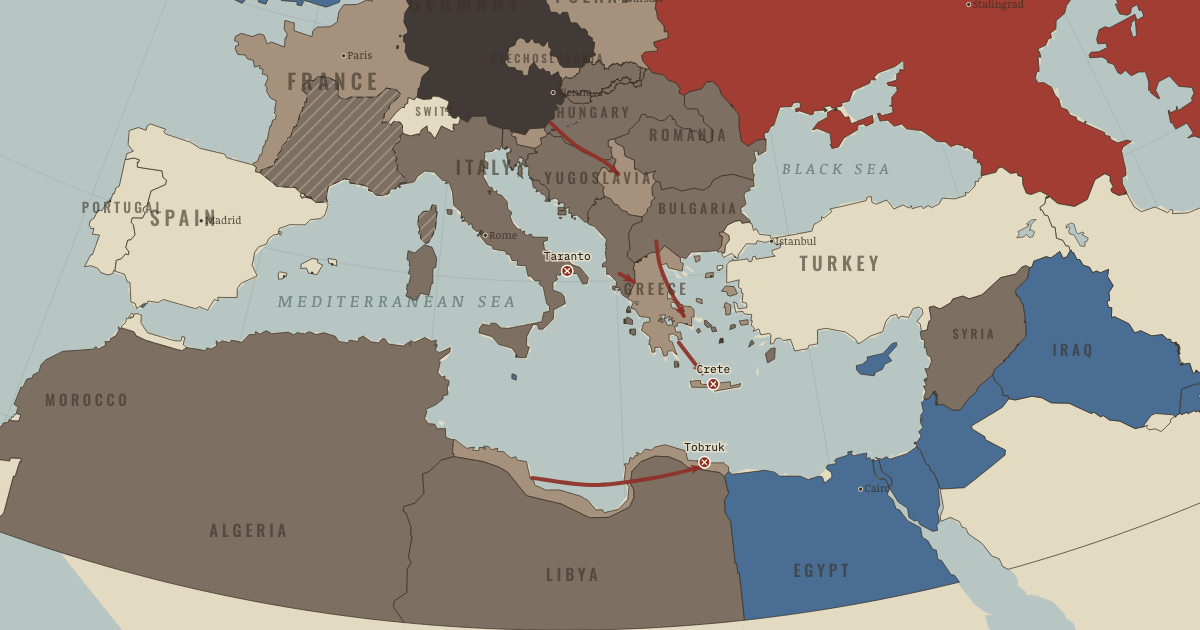
The map above is the world of Europe, May 1941 — The Balkans overrun.
Every state on the map that year: The world in 1942 · Europe in 1942.
Part of IB History: The Second World War →
SHORT EXPLANATION
Mussolini wanted Italy to win an empire around the Mediterranean and to stand beside Germany as an equal. His “parallel war” was meant to supply the victories that would give him that standing. Instead, Italian attacks on Greece and British-held Egypt were driven back. In November 1940 British carrier aircraft crippled the Italian battle fleet at Taranto, showing what naval air power could do to ships in harbor.
Germany intervened to save its ally’s campaigns. In spring 1941 German forces overran Yugoslavia and Greece, took Crete in a costly airborne assault, and sent Rommel’s Afrika Korps to Libya. Axis territory grew, but so did the work of occupying it and supplying distant armies. Resistance and long supply routes would tie down troops for years, while Britain remained in the war.
The full story
A victory won by Germany could add little to Mussolini’s claim to be Hitler’s equal. He wanted Italy to acquire territory and prestige through a Mediterranean empire of its own. The regime called this a ‘parallel war.’ Its ambitions soon met the limits of the forces sent to carry them out.
Italian troops invaded Greece from Albania, but poor supplies hampered the attack and Greek forces drove them back across the border. In North Africa, a small British force routed a much larger Italian army. Then, in November 1940, twenty-one British biplanes flew from an aircraft carrier to Taranto and disabled the Italian battle fleet in harbor. Japanese naval planners studied the raid closely before Pearl Harbor. Aircraft launched at sea had shown they could reach and damage a fleet at anchor.
The defeats left Germany with campaigns to rescue. In Belgrade a coup overturned Yugoslavia’s alignment with the Axis; in April 1941 Germany invaded both Yugoslavia and Greece. Crete fell in May to German paratroopers, though the airborne assault cost them dearly. In Libya the newly arrived Afrika Korps, under Rommel, stabilized the front and pushed the British east. Germany had diverted forces intended for other fronts to secure gains opened by its ally’s ventures.
Those gains were not self-sustaining. Britain’s lifeline ran through Suez, and Axis armies in Africa needed supplies carried by sea from Europe. Malta, the ports and the fuel that crossed the water could determine how far an army could fight. Rommel repeatedly advanced beyond the reach of his supply system: the ground he won increased the distance supplies had to travel. In the Balkans, armed resistance would tie down Axis divisions for the rest of the war.
The Balkan campaigns also delayed and wore down German forces before the invasion of the Soviet Union. Did that delay cost Germany Moscow? Historians dispute the claim; wet ground, Soviet resilience and German logistics probably mattered more. Mussolini’s war left Germany with extra commitments, while the territory gained in the Mediterranean and Balkans offered no independent route to defeating Britain or winning the war.
FULL EXPLANATION
An unequal coalition
Italy entered the Mediterranean war seeking territory and prestige of its own. Its attacks were not parts of a coordinated Axis plan, and they opened fronts Germany had not chosen. Once Italy’s armies were in difficulty, Berlin could let an ally collapse, damaging Axis credibility, or spend scarce aircraft, armor, shipping and time to rescue it. Germany chose intervention in Greece and North Africa. Success brought new demands. British-held Malta and naval pressure made the sea passage to Libya ruinously expensive, while resistance in Yugoslavia absorbed troops needed for occupation. The Axis continued to fight loosely joined separate wars; later, the Allies developed an increasingly coordinated system. That difference helps us read the map. Axis colors could cover more territory even as the resources available for other purposes diminished. Conquest added obligations as well as power.
Did the Balkans cost Germany Moscow?
Germany invaded the Soviet Union on 22 June, later than an earlier planned date. The fighting in Greece and Yugoslavia consumed fuel, equipment and airborne strength that would soon be needed in the east. It is tempting to put these facts together and conclude that the Balkans cost Germany the time needed to take Moscow. An earlier start, however, faced a problem of its own: an unusually wet spring had flooded the ground. Nor would extra time have removed the difficulties Germany encountered after crossing the frontier. Its armies had vast distances to cover, Soviet railways to convert and too few trucks. Their objectives competed for resources, while the Soviet Union mobilized rapidly and produced reserves the Germans had underestimated. Most historians treat the Balkans as a contributing burden rather than the decisive cause of failure. Five additional weeks might have mattered, but the calendar alone cannot tell us how an invasion facing those other problems would have ended.
Key places on the map
On this day
Why it happened
Prestige and war. Hitler’s conquests gave Mussolini reason to fear that Italy would have no share in the new European order. His regime prized spectacle, and he believed Italy “needed a few thousand dead” to establish its claim. He chose wars against Greece and a British Empire he assumed was finished, seeking headlines and prestige more than a sound strategy.
Britain’s route through Suez. Suez connected Britain’s war effort with India, Persian oil and the Dominions. Britain therefore had reason to commit the forces it could spare to the Mediterranean. Malta and Tobruk had small garrisons, but their positions mattered far beyond their size in the struggle over that route.
The Belgrade coup. Yugoslavia signed with the Axis. Two days later, officers overthrew its government as crowds cheered in Belgrade. Hitler was enraged and ordered the country destroyed, adding an improvised campaign only weeks before his planned invasion of Russia.
THE TURNING POINT
Crete: victory at a price. German airborne troops captured Crete in May 1941, but a third of the paratroopers were killed or wounded in ten days. Hitler concluded that large airborne operations were finished. The Allies drew the opposite lesson, a difference to remember when they land on D-Day.
What it changed
The five-week question. The Balkan detour and a late spring moved the invasion of Russia from May to 22 June. Those five weeks invite a difficult question: would Germany have taken Moscow in December with an earlier start? Historians debate the answer; Chapter 6 follows the invasion.
Resistance in the Balkans. Occupation did not pacify Yugoslavia or Greece. In Europe’s largest resistance war, Tito’s partisans would tie down dozens of Axis divisions over four years. Their struggle also helped shape postwar Yugoslavia.
The desert campaign continues. The African campaign continued for two years as Rommel’s Afrika Korps and the British 8th Army pursued each other along the coast. Its finale came at a rail halt called El Alamein.
DISCUSSION QUESTION — Was the Balkan campaign a fatal distraction from Barbarossa, or a convenient excuse for its failure?
The campaign contributed delay, equipment wear and losses, but it cannot explain the failure by itself. Wet ground also constrained the start. German logistics and intelligence errors, together with Soviet reserves and strategic depth, remained decisive problems. The Balkans were a contributing factor, not the primary cause.
An interesting fact
On 28 October each year, Greece observes Ohi Day, ‘No Day,’ remembering Prime Minister Metaxas’s rejection of Mussolini’s ultimatum before dawn in 1940. Legend gives his answer as the single word “Ochi!” According to the Italian ambassador, he spoke in the French of diplomacy: “Alors, c’est la guerre” — then it is war. Within weeks Greek soldiers had driven the invaders back into Albania, inflicting the first land defeat suffered by an Axis army.
Related
THE FREE PRINTABLE STUDY GUIDE
Get the printable study guide for WW2 free. I’ll send you a few short letters, then one when a new atlas opens. That’s all. — Paul
NO TRACKING · YOUR ADDRESS IS USED FOR THE DISPATCH AND NOTHING ELSE · UNSUBSCRIBE ANYTIME