MAPS OF HISTORY · IB HISTORY · PAPER 1 · CONFLICT AND DISPLACEMENT
IB HISTORY · PAPER 1 · FOCUSED STUDY
Paper 1: Conflict and Displacement — Europe 1945–1960 and Indochina 1975–1990
Conflict and Displacement is one of the five Paper 1 Focused Studies of the new IB History course, first examined in May 2028. Paper 1 is the source paper: its questions ask you to read primary sources closely, to judge what each can and cannot tell a historian, and to combine them with your own knowledge. This Focused Study pairs two case studies, Europe 1945–1960 and Indochina 1975–1990, and our atlas Uprooted: Refugees in Europe and Indochina covers both on linked maps, in 12 chapters with 40 primary sources.
After 1945 Europe’s borders moved and millions were made to follow them; after 1975 three million people fled Vietnam, Cambodia and Laos. Two maps, one question: what drove people out, and who took them in?
WW2 is free in full, and chapter 1 of every atlas is free. A free account opens 3 more chapters a day. Opening a new atlas uses one of them. Membership opens all 21 — Join.
What this Focused Study asks
Each source set begins with an inquiry question. Together, the questions show the work this Focused Study asks you to do. Read the sources alongside the chapters: a good answer draws on both.
Europe 1945–1960
- How much did Allied decisions contribute to the expulsion of Germans after 1945?
- Why did Allied treatment of Jewish displaced persons change in 1945?
- What lasting refugee rights did states create between 1948 and 1956?
Indochina 1975–1990
- Why did first asylum falter in Southeast Asia in 1979, and what restored it?
- How did the United States and regional governments address the Indochinese exodus in 1987–1990?
Case study 1: Europe 1945–1960
Chapters 1–6 of the atlas follow Europe 1945–1960, from 1945 to 1961. Read them in order: each chapter is a step in one argument, and the map moves with it.
- Europe UprootedCHAPTER 1 · MAY 1945
- The Expulsions of GermansCHAPTER 2 · 1945–1950
- Borders Move, People FollowCHAPTER 3 · 1944–1950
- The DP CampsCHAPTER 4 · 1945–1947
- From Relief to RightsCHAPTER 5 · 1947–1952
- Integration and the Cold WarCHAPTER 6 · 1950–1961
Evidence to use
One point from the IB notes of each chapter, written as a sentence you could use in an answer. Every chapter in the atlas carries four to six.
- By August 1944, about 7.6 million foreign civilians and prisoners of war were working in the Reich, making up more than a quarter of its labor force. When Germany was defeated, millions found themselves far from home at the same time. CH 1
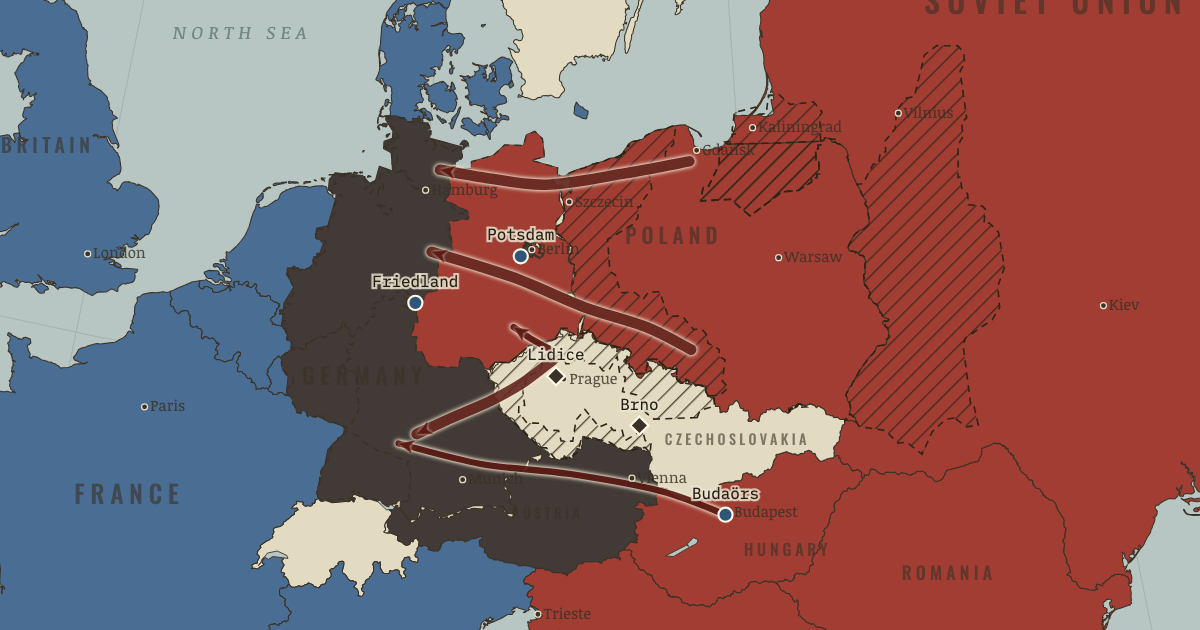
- At Potsdam, the great powers accepted the transfer of Germans from Poland, Czechoslovakia and Hungary. Section XIII of the agreement of 2 August 1945 said that it “will have to be undertaken” and asked that it be “orderly and humane”. CH 2
- The Lublin agreements of 9 and 22 September 1944 arranged an exchange across Poland’s eastern border: about 1.2 to 1.5 million Poles and Polish Jews moved from the Soviet republics to Poland, while about 482,000 Ukrainians went the other way. The exchange was voluntary on paper, but coercion played a part in practice. CH 3
- By early 1946 the Soviet Union had recovered about 5.35 million citizens from across Europe, some by force under the Yalta accords. At Dachau on 19 January 1946, eleven of 399 former Soviet soldiers killed themselves rather than board a train east. CH 4
- Relief gave way to resettlement on a large scale. Between July 1947 and December 1951 the International Refugee Organization (IRO) resettled 1,038,750 people, including 328,851 in the United States, 182,159 in Australia, 132,109 in Israel and 123,479 in Canada. CH 5
- West Germans whose property had survived the war were required by the Equalisation of Burdens law of 14 August 1952 to pay half its assessed 1948 value over thirty years into a fund for expellees. By 1986, the fund had paid out more than 130 billion marks. CH 6
Case study 2: Indochina 1975–1990
Chapters 7–11 of the atlas follow Indochina 1975–1990, from 1975 to 1990. Read them in order: each chapter is a step in one argument, and the map moves with it.
- Communist VictoryCHAPTER 7 · 1975
- Re-education and FlightCHAPTER 8 · 1975–1978
- The Boat PeopleCHAPTER 9 · 1978–1979
- Geneva and the US ResponseCHAPTER 10 · 1979–1982
- Camps, Screening and the CPACHAPTER 11 · 1980–1990
Evidence to use
One point from the IB notes of each chapter, written as a sentence you could use in an answer. Every chapter in the atlas carries four to six.
- The Geneva agreements of July 1954 divided Vietnam. More than a million people moved south, about 800,000 of them Catholics; the US Navy carried nearly 310,000. Their movement set a precedent for flight after a communist victory. CH 7
- How many people passed through Vietnam’s re-education camps? UNHCR put the number at more than a million. Gareth Porter and James Roberts estimated 200,000 to 300,000 long-term detainees in 1988. The estimates concern different groups, and Hanoi’s secrecy leaves the numbers uncertain. CH 8
- About 88,000 people arrived by boat in neighboring countries in 1978; in 1979 the number rose to about 207,000. At the peak in May and June 1979, between 54,000 and 59,000 landed in a single month. CH 9
- At the Geneva meeting on 20–21 July 1979, 65 governments raised their resettlement pledges from about 125,000 to 260,000 places and promised about $160 million. Indonesia and the Philippines also offered sites for processing centers. CH 10
- In January 1981 Thailand introduced “humane deterrence”: new boat arrivals were held in austere camps such as Na Pho and denied access to resettlement. From 2 July 1982 Hong Kong detained every arrival in closed camps. CH 11
Comparing the two case studies
The atlas ends by setting the two case studies side by side in Two Crises Compared. Comparison is where the Focused Study pays off: the same question asked of two societies shows which explanations travel and which belong to one place.
PAPER 1 · UPROOTED · CHAPTER 12
Compare and contrast how states and international organizations responded to displacement in Europe in 1945–1960 and Indochina in 1975–1990.
Both responses combined first asylum, resettlement and UNHCR coordination, and both were influenced by Cold War sympathy for people fleeing communism. The differences lay in where displaced people could settle and on what terms: the German states absorbed millions as citizens while Europe built a legal regime; Indochinese refugees depended heavily on foreign states and negotiated agreements that eventually combined screening with return.
First asylum and resettlement depended on cooperation in both crises.
Citizenship gave many displaced Europeans a route to integration on a different scale.
The legal settings and the procedures used to decide who received protection differed.
The evidence for each point, the counter-argument and the judgement are in the IB notes of chapter 12 in the atlas. Read the chapter first: Two Crises Compared.
Key concepts
The course asks you to think with six concepts. Each chapter’s IB notes name the two or three it supports best; here they are across the atlas, most used first.
- Causation · 6 CHAPTERS
Why something happened: the long-term conditions, the triggers and the choices behind it, and which of them mattered most. For example: Europe Uprooted, The Expulsions of Germans, Borders Move, People Follow, Communist Victory. - Consequence · 6 CHAPTERS
What followed from an event or decision, intended and unintended, in the short and the long term. For example: Europe Uprooted, Borders Move, People Follow, Integration and the Cold War, Communist Victory. - Change · 6 CHAPTERS
What was different afterwards, how quickly it changed, and for whom. For example: The DP Camps, From Relief to Rights, Integration and the Cold War, Geneva and the US Response. - Perspectives · 6 CHAPTERS
How people at the time, and historians since, have seen the same events differently, and why. For example: The Expulsions of Germans, The DP Camps, From Relief to Rights, Re-education and Flight. - Significance · 5 CHAPTERS
Why an event, person or idea matters, judged by its effects and by how it has been remembered. For example: The Expulsions of Germans, The DP Camps, From Relief to Rights, Geneva and the US Response. - Continuity · 4 CHAPTERS
What stayed the same through an apparent upheaval, and why it survived. For example: Borders Move, People Follow, Integration and the Cold War, Camps, Screening and the CPA, Two Crises Compared.
Source-analysis practice
This is one complete source set from the atlas, free to use. It is built around one inquiry question: How much did Allied decisions contribute to the expulsion of Germans after 1945? As you read each source, ask who made it, when, and why. These details help you judge what it can tell you. Answer the questions in writing first; then open the guide under each one to see what a strong answer does.
TEXT · CHAPTER 2
Speech in the House of Commons on Poland (extract on expulsion)
- CREATOR
- Winston Churchill, Prime Minister of the United Kingdom
- DATE
- 15 December 1944
- ORIGIN
- Hansard, House of Commons Debates, vol. 406, cols. 1483–84
Context. Churchill was urging the Polish government-in-exile in London to accept the loss of eastern Poland in return for German lands to the west and north.
UK Parliamentary copyright, expired; Hansard (historic) · original ↗
TEXT · CHAPTER 2
Protocol of the Proceedings of the Berlin (Potsdam) Conference, Section XIII: Orderly Transfer of German Populations
- CREATOR
- Governments of the United States, the United Kingdom and the Soviet Union (Truman, Attlee, Stalin)
- DATE
- 1 August 1945
- ORIGIN
- Signed protocol, printed in Foreign Relations of the United States, Conference of Berlin (Potsdam) 1945, vol. II, doc. 1383; also published in the conference communiqué of 2 August 1945
Context. Expulsions from Poland and Czechoslovakia were already under way when the conference met. Some printed versions number this section XII.
US Department of State, Office of the Historian (FRUS) · original ↗
TEXT · CHAPTER 2
Allied Control Council plan for the transfer of the German population
- CREATOR
- Allied Control Council for Germany; transmitted by Robert Murphy, US Political Adviser for Germany
- DATE
- 20 November 1945 (telegram of 30 November 1945)
- ORIGIN
- Telegram 1147 to the Secretary of State, printed in Foreign Relations of the United States 1945, vol. II, doc. 650
Context. Responding to Section XIII, the Control Council set a timetable for moving about 6.65 million people from December 1945 to summer 1946.
US Department of State, Office of the Historian (FRUS) · original ↗
PICTURE · CHAPTER 2
“Umsiedler” (expellees) at the Berlin-Pankow freight station
- CREATOR
- Otto Donath
- DATE
- 1946
- ORIGIN
- Photograph, German Federal Archives (Bundesarchiv), Bild 183-1983-0422-312
Context. “Umsiedler”, or resettlers, was the Soviet-zone official term for Germans expelled from the east. The original caption says they used the railway for their onward journey.
Picture: German expellees carrying bundles and rucksacks board railway carriages at the Berlin-Pankow freight station in 1946.
Bundesarchiv, Bild 183-1983-0422-312 / Donath, Otto / CC-BY-SA 3.0 (https://creativecommons.org/licenses/by-sa/3.0/de/deed.en) · original ↗
The questions
- QUESTION 1 · COMPREHENSION
According to Source B, what did the three governments decide about Germans in Poland, Czechoslovakia and Hungary, and what did they ask those governments to do?
What a strong answer does
The three governments accepted that transfer “will have to be undertaken”, but they also specified that it should be “orderly and humane”. They asked for further expulsions to be suspended while the Control Council examined the problem. A full answer gives both the decision and the request about what should happen next.
- Identifies acceptance of transfer
- Explains the requested humane conduct
- Identifies the requested pause pending examination
- QUESTION 2 · ANALYSIS
What do the origin and purpose of Churchill’s December 1944 speech in Source A reveal about its value and limits for a historian studying the causes of expulsion?
What a strong answer does
Churchill spoke in Parliament as British prime minister in December 1944, months before Potsdam. His speech lets a historian see an Allied leader presenting removal as a security measure, with mixed borderlands such as Alsace-Lorraine in mind. He was trying to persuade MPs and the Polish government-in-exile to accept the loss of eastern Poland, which gave him reason to make transfer sound orderly and humane. The speech cannot tell us how people were treated when removals took place.
- Connects speaker, date and setting to value
- Explains how persuasion affects the source
- Relates both to causes of expulsion
- QUESTION 3 · EVALUATION
Compare the ways Sources B and C envisaged managing the transfer of Germans.
What a strong answer does
Both texts treat transfer as a matter for central planning and recognize the burden on the occupation zones. Their jobs differ: Potsdam states principles and asks for a pause, whereas the Control Council plan four months later allocates 3.5 million people from Poland and 3.15 million from the other states among the zones. Neither describes how every person would be treated in practice. Use details from both when making each comparison.
- Identifies supported similarities
- Identifies supported differences
- Refers to both sources
- QUESTION 4 · SYNTHESIS
Using the sources and your own knowledge, how far did Allied decisions cause the expulsion of Germans after 1945?
What a strong answer does
Allied decisions matter: Churchill endorsed expulsion, Potsdam accepted transfer, and the Control Council planned numbers for the receiving zones. Yet national governments had already acted, including in the wild expulsions of May–August 1945, Czechoslovakia’s citizenship decree and Polish army clearances. Weigh those initiatives against the Allies’ role in legitimizing and organizing transfers. Six years of German occupation explain part of the context without excusing violence; Source D can bring the people moved into view. Give a cautiously stated range for deaths where relevant, and judge how responsibility was shared.
- States a supported judgment
- Combines at least three sources with own knowledge
- Explains occupation as context
- Uses death estimates cautiously when relevant
More source sets in the atlas
The atlas holds 4 more source sets for this Focused Study. Their sources sit in the IB notes of the chapters named below: open a chapter in the atlas and turn on the IB notes switch to read them.
- Why did Allied treatment of Jewish displaced persons change in 1945? EUROPE 1945–1960
Its sources are in the IB notes of chapter 1, chapter 4. - What lasting refugee rights did states create between 1948 and 1956? EUROPE 1945–1960
Its sources are in the IB notes of chapter 5, chapter 6. - Why did first asylum falter in Southeast Asia in 1979, and what restored it? INDOCHINA 1975–1990
Its sources are in the IB notes of chapter 9, chapter 10. - How did the United States and regional governments address the Indochinese exodus in 1987–1990? INDOCHINA 1975–1990
Its sources are in the IB notes of chapter 8, chapter 11.
Practice questions and essay plans
Try planning your answers before looking at ours. Each outline states a thesis and shows what each paragraph would claim. The first plan comes from chapter 2, a free chapter, and is shown in full. In the atlas, the chapters’ IB notes give the full plans, with evidence, a counter-argument and a judgement. The atlas’s own page lists those notes: IB notes for Refugees in Europe and Indochina.
PAPER 2 · UPROOTED · CHAPTER 2
How far did decisions by the Allied powers cause the expulsions of Germans from eastern Europe after 1945?
Allied acceptance gave the transfers international legitimacy, and Allied control of the receiving zones made movement on this scale possible. Polish and Czechoslovak authorities had, however, already pressed for and begun removals. The responsibility was shared, though Allied consent was decisive for scale and national policy for timing and brutality.
Allied consent made transfer an international policy and provided places to receive those expelled.
EVIDENCEChurchill endorsed a “clean sweep” in December 1944; Potsdam accepted transfer; and the Control Council planned for 6.65 million people.
LINKThe occupying powers controlled the receiving zones and organized the distribution of arrivals among them. Their consent therefore supplied capacity as well as approval: transfers on this scale depended on places to which people could be sent.
National authorities had begun to expel Germans before the Allied plan, and their actions shaped the methods used.
EVIDENCEAn estimated 700,000–800,000 Germans were driven from Czechoslovakia in the wild expulsions before Potsdam. A decree of 2 August 1945 removed citizenship from many Germans.
LINKThe Brno march of May 1945 shows the brutality of this earlier phase. National initiative produced some of the worst violence; it cannot be explained simply as the execution of a later Allied plan, though the Allies then ratified transfer.
The experience of occupation and the memory of Munich helped create support for removal.
EVIDENCEAbout six million Polish citizens had been killed, Lidice was destroyed, and many Sudeten Germans had supported Henlein’s party.
LINKFor some leaders and citizens, these experiences made German minorities appear a collective security threat and removal a way to prevent its return. This helps explain the demand for expulsion without establishing the guilt of each person removed.
R. M. Douglas gives the Allies a greater share of responsibility than formal approval alone suggests. He argues that London and Washington knew the transfers were deadly and endorsed them anyway. Section XIII requested a pause, yet that request was largely ignored and never enforced. On this reading, national actors carried out a policy decided in London, Washington and Moscow.
The expulsions became an international policy carried out by national governments. Allied decisions and receiving zones determined that millions would move and where they would go, but the will to expel did not begin with those decisions. It grew out of six years of German occupation and the lessons national leaders drew from Munich; those leaders had already sought and begun removals.
Read the chapter behind this plan: The Expulsions of Germans.
PAPER 2 · UPROOTED · CHAPTER 5
To what extent did the Cold War shape the 1951 Refugee Convention?
Cold War interests shaped the Convention’s political setting and the refugees Western governments had in mind. Its protections also answered the experience of Nazi persecution and forced returns in 1945–47. The result was a humanitarian agreement negotiated within political limits.
The definition could serve Western Cold War priorities.
The central protection also grew from experiences in the 1940s.
States placed limits on the obligations they accepted.
The evidence for each point, the counter-argument and the judgement are in the IB notes of chapter 5 in the atlas. Read the chapter first: From Relief to Rights.
PAPER 3 · UPROOTED · CHAPTER 9
Evaluate why Southeast Asian first-asylum states restricted asylum in 1979.
First-asylum states faced arrivals far greater than the number leaving for resettlement. They also suspected Vietnam of deliberately exporting its ethnic Chinese population and feared the effects on their own societies. Because they were not bound by the 1951 Convention, they could act on those fears.
The widening gap between arrivals and resettlement made a temporary burden look permanent.
For neighboring governments, the departures also raised a question about Vietnam’s intentions.
Malaysia and Thailand assessed the arrivals against different domestic and security pressures.
The evidence for each point, the counter-argument and the judgement are in the IB notes of chapter 9 in the atlas. Read the chapter first: The Boat People.
PAPER 3 · UPROOTED · CHAPTER 11
Examine why policy in Southeast Asia shifted from resettlement toward screening and return during the 1980s.
The 1979 response rested on a willingness to resettle arrivals that later weakened. As places became harder to secure, host states and Western governments increasingly viewed later departures as economic migration. The CPA offered a negotiated way to screen arrivals and encourage return, changing the incentive to leave as the Cold War sympathy behind the earlier response faded.
Resettlement places no longer kept pace with departures.
Governments treated later departures differently and sought individual screening.
Return was intended to discourage further departures.
The evidence for each point, the counter-argument and the judgement are in the IB notes of chapter 11 in the atlas. Read the chapter first: Camps, Screening and the CPA.
Revision tools
The atlas ends with a map quiz that asks you to find places and moments on the map itself (part of every plan from Starter up). The quick quiz and the discussion questions with our answers are free pages on this site, and the printable study guide gathers every chapter’s notes into one document for revision.
The same atlas for other papers
Several chapters also carry IB notes for Papers 2 and 3, and for topics of the old course examined in 2027:
- Paper 2 · Conflict · 12 CHAPTERS
- Paper 3 · Asia and Oceania · 4 CHAPTERS
- Old course · World history topic 11: Causes and effects of 20th-century wars · 2 CHAPTERS
- Old course · World history topic 12: The Cold War: superpower tensions and rivalries (20th century) · 3 CHAPTERS
Maps of History is independent and is not affiliated with or endorsed by the International Baccalaureate Organization. IB course names describe alignment only; paper, theme and section names follow the new course outline and may change when the final guide is published.
THE DISPATCH
Get the printable study guide for Uprooted free. I’ll send you a few short letters, then one when a new atlas opens. That’s all. — Paul
NO TRACKING · YOUR ADDRESS IS USED FOR THE DISPATCH AND NOTHING ELSE · UNSUBSCRIBE ANYTIME