Meiji Japan and post-Soviet Russia · CHAPTER 5 ·
Meiji Constitution and modernisation
Chapter 5 of Remaking the State: Meiji Japan 1600–1912 and Post-Soviet Russia 1964–2000: “Building the Meiji State”
Between 1877 and 1894 Japan’s leaders built a modern state in sequence, economy and army first and a constitution after. The Iwakura Mission studied the West, state factories such as the Tomioka silk mill were sold to the zaibatsu, and the constitution was promulgated on 11 February 1889.
Chapter 5 is included with every paid plan. WW2 is free in full, and chapter 1 of every atlas is free. A free account opens 3 more chapters a day. Starter, at $9 a month, opens all 21 with no daily limit — see the plans.
Free printable Meiji Japan and post-Soviet Russia study guide, sent by email ↓
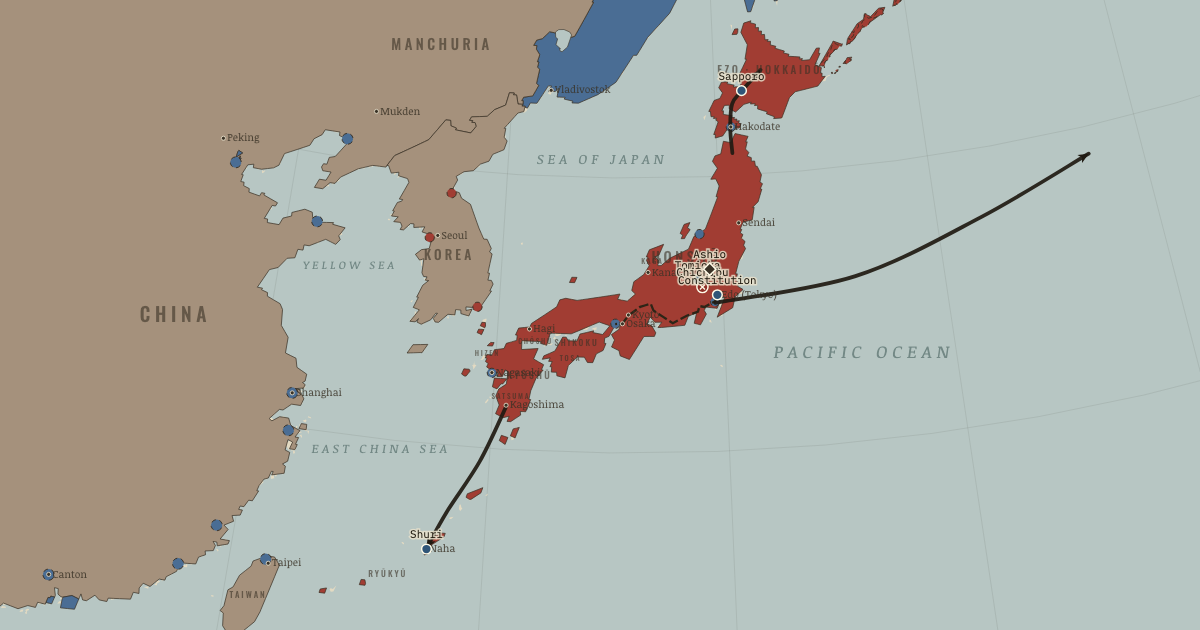
The map above is the world of Japan, February 1889 — The constitution; Ryukyu annexed.
Every state on the map that year: The world in 1880 · Europe in 1880.
Part of IB History: Meiji Japan and post-Soviet Russia →
SHORT EXPLANATION
Japan’s leaders wanted equality with the Western powers, but their experience abroad persuaded them that a stronger state had to come first. The Iwakura Mission, a government fact-finding delegation, spent 21 months in the United States and Europe from 1871; hundreds of foreign engineers, teachers and lawyers came to Japan. Public money built railways and model industries such as the Tomioka silk mill. In the 1880s the government sold most factories cheaply to business houses that became the zaibatsu, family-run groups combining banks, mines and shipping lines, much like holding companies. Finance minister Matsukata Masayoshi restored a sound currency after 1881 by reducing the money supply and bringing prices down. Farmers still owed their debts, however, while the prices they received fell. Some rose at Chichibu in 1884.
A strong state also had to decide who could speak for it. The movement for “freedom and people’s rights” wanted an elected assembly; in 1881 the leaders promised one by 1890. After studying constitutions in Berlin and Vienna, Itō Hirobumi helped frame the constitution presented as the emperor’s gift on 11 February 1889. Sovereignty and command of the armed forces remained with the emperor, and ministers answered to him. The elected lower house of the Diet, the new parliament, could refuse new budgets but could not choose the government; only about 1% of the population could vote in 1890. The Imperial Rescript on Education of 1890, a moral decree read aloud in every school like a national pledge, taught loyalty to the throne. On the map Ryukyu, today’s Okinawa, turns red in 1879, settlers fill Hokkaido, and a railway connects Tokyo to Kobe. Participation had been admitted on terms set by the leaders themselves.
The full story
In 1871 Japan sent about half its government’s leaders abroad on the Iwakura Mission. Ōkubo Toshimichi, Kido Takayoshi and the young Itō Hirobumi hoped, among other things, to revise the unequal treaties. They returned in 1873 without that agreement. Factories, schools and laws appeared to them essential if Japan was to claim equality with the powers they had visited. The government hired foreign experts and sent students overseas, taking different institutions as models: the navy from Britain, the army from France and later Germany, and schools from American and French practice.
Who would carry the program through? After Ōkubo was assassinated in 1878, an unelected circle later known as the genrō, or elder statesmen, held power. Like a permanent board of senior partners, it included Itō, Yamagata Aritomo and Matsukata. Its members took turns as prime minister over thirty years, giving successive governments a continuity of purpose.
The government used public money to build railways, telegraphs and model factories such as Tomioka. The war of 1877 left inflation behind it. To restore the currency, Matsukata cut spending, raised taxes and withdrew paper money from 1881; in 1882 he founded the Bank of Japan as a central bank. The remedy changed the position of farmers who had borrowed. Rice prices roughly halved in some regions between 1880 and 1884, leaving them less income to pay debts fixed in money. Indebted farmers lost land, and in November 1884 thousands of silk farmers took up arms at Chichibu.
Meanwhile, the government sold most of its enterprises, often below cost, to houses including Mitsui and Mitsubishi. These future zaibatsu brought banks, mines and trade together, much like modern holding companies. Private cotton mills powered the late-1880s industrial boom; their workers were mainly teenage girls whose families arranged their contracts. The costs reached beyond the mills. Pollution from the Ashio copper mine poisoned farms along the Watarase River. Japan was growing, but many of the people who paid for that growth had no vote.
From 1874 former samurai, members of the abolished warrior class, organized for an elected assembly. Itagaki Taisuke of Tosa and others used newspapers, lectures and parties to build support. The leaders answered with both a promise and repression: in 1881 they promised a constitution by 1890 while expelling their most liberal member, Ōkuma Shigenobu; in 1887 they expelled hundreds of activists from Tokyo. Itō had created a cabinet in 1885 and wrote the constitution with German advisers. It declared the emperor “sacred and inviolable” and made the army answer directly to him. The lower house of the Diet was elected by men over 25 who paid at least 15 yen in direct tax.
The restricted electorate did not make the lower house inconsequential. It could reject the government’s budget, and the genrō had to bargain with elected politicians through the 1890s. The map shows another measure of the state’s reach: Shuri Castle in annexed Ryukyu, today’s Okinawa, and Sapporo, capital of Hokkaido, taken from its native Ainu.
FULL EXPLANATION
Designing a constitution to contain participation
Itō looked for a way to establish constitutional government without handing power to an elected assembly. In 1882–83 he studied under Rudolf von Gneist in Berlin and Lorenz von Stein in Vienna; both jurists advised a strong monarchy. The German lawyer Hermann Roesler helped draft the text. Article 3 made the emperor sacred and inviolable, and Article 11 placed the army and navy under his supreme command. Later the military used that clause to claim independence from the cabinet. Yet the assembly had a means of exerting pressure. As historians such as George Akita have shown, the Diet could refuse a new budget. The government could then use the previous year’s spending level, but Japan’s ambitions required more. Within a decade the oligarchs were negotiating with parties; in 1900 Itō founded one himself. The constitution limited participation while giving it a place to grow. Its legacy led toward the party governments of the 1920s and also toward the military’s escape from civilian control in the 1930s.
Did the state build Japanese industry?
Alexander Gerschenkron argued that countries industrializing late may need the state or large banks to provide capital and skills missing from private enterprise. Meiji Japan is often offered as his best example. But what did the state actually do well? Thomas C. Smith found that most government factories lost money and were sold in the 1880s for much less than they had cost. That is a poor record for the state as factory manager. Its contribution to the conditions of business was more decisive. Railways, telegraphs and ports moved goods and information; stable currency, banking and commercial law supported transactions; compulsory schooling supplied skills. Private cotton spinning became the most dynamic industry. Founded in 1882 with backing from banker Shibusawa Eiichi, the Osaka Spinning Company ran machines day and night and demonstrated the profits available to private mills. The state opened paths and built infrastructure, while private firms supplied most growth.
Who paid: mill girls, farmers, the Ainu and Ryukyuans
Economic growth looked different from a textile dormitory. E. Patricia Tsurumi describes girls recruited from poor villages, housed by their employers, working at least twelve hours and falling ill with tuberculosis. At the Amamiya silk mill in Kōfu, women walked out over longer hours in 1886, the first recorded strike in Japanese industry. Farmers bore the land tax and the deflation of the 1880s; when indebted owners sold their fields, tenancy spread. These people largely stood outside the political nation. On the frontiers the pressure was heavier still. The state made Ainu hunting and fishing grounds public land, banned customs including women’s tattoos, and settled tens of thousands of farmers and soldier-colonists in Hokkaido. The Ainu became a small minority in their homeland. After annexing Ryukyu in 1879, Tokyo retained old taxes and institutions for decades to avoid unrest; Okinawans first sent members to the Diet in 1912. Strength at the center was built partly through pressure on the margins.
Key places on the map
On this day
Why it happened
The Iwakura Mission taught that strength must come first. The 1871 mission sought to begin revising the unequal treaties, but Western powers politely judged Japan’s laws and institutions unacceptable. Visits to Manchester’s factories, American railways and Bismarck’s Germany gave its members a picture of the strength they thought equality required. They returned convinced that economy and army must come first, and that belief shaped the order of reform.
Inflation forced financial discipline. To pay for the Satsuma Rebellion, the government had printed paper money. By 1880 prices were rising rapidly and confidence in the currency was failing. Finance minister Matsukata Masayoshi responded from 1881 with higher taxes, lower spending, a central bank and convertible notes. The yen and budget stabilized, but lower prices made farm debts harder to bear and pushed farmers into tenancy. Chichibu’s silk farmers rose in 1884.
A popular movement demanded a voice. Former samurai, rich farmers and urban journalists gave the Freedom and People’s Rights movement an organization after 1874. Meetings and dozens of privately drafted constitutions made its demand concrete; by 1880 petitions for an assembly reached Tokyo from every region. The movement could not take power, but the leaders could no longer ignore the demand for a constitution. They chose to write one themselves before their critics could do so.
Treaty revision required a legal order the West would accept. Extraterritoriality placed foreigners beyond Japan’s ordinary courts. Western governments would not surrender it until those courts and Japan’s legal codes met their standards. The constitution, cabinet, criminal code and civil code thus served a diplomatic purpose as well as a domestic one: they supplied evidence for Japan’s claim to equality.
THE TURNING POINT
The constitution, 11 February 1889. The constitution promulgated on 11 February 1889 set Japan’s political rules until 1947. It made Japan the first Asian state with a lasting written constitution and elected parliament, helping persuade Britain to give up extraterritoriality in 1894. Its distribution of authority also left consequential ambiguities: the emperor was sovereign without governing, ministers answered to him alone, and the armed forces answered to no civilian. At the ceremony in the new palace, Western dress displayed the modern state its leaders wanted the world to see, while they kept control of its institutions.
What it changed
Treaty revision became possible. Britain agreed in a July 1894 treaty to end extraterritoriality from 1899; other powers followed. Japan’s constitution, cabinet and legal codes supplied the institutional evidence Western governments had demanded. Full tariff control came in 1911, completing the escape from the unequal treaties that began with Perry’s ships.
Parties won a foothold in the state. The first Diet met in 1890, and its elected lower house used budget disputes to press the cabinet. The oligarchs needed party cooperation to govern. The franchise widened in 1900 and 1919, before all adult men gained the vote in 1925. What began as a restricted parliament gave the party governments of the 1920s a foothold.
A state ideology entered every classroom. On national holidays schools read the 1890 Rescript on Education aloud, and pupils bowed before the emperor’s portrait. The demands of this loyalty could be exacting: in 1891 the Christian teacher Uchimura Kanzō was forced from his post after hesitating to bow deeply enough before the Rescript. A literate conscript nation learned loyalty to the emperor in school; that ideology would be mobilized in later wars.
DISCUSSION QUESTION — Was the Meiji constitution a step towards democracy or a device to prevent it?
The constitution’s designers wanted to contain participation. No assembly approved the document granted from above; the emperor was sovereign, ministers answered to him, and only about 1% of the population could vote. The supreme-command clause later helped the army escape civilian control in the 1930s. But the elected Diet could refuse new budgets. Its politicians acquired leverage, and within a decade the oligarchs had to bargain with parties. The electorate grew until all men could vote in 1925. As historians such as Carol Gluck show, the document supported an ideology of obedience alongside lively public politics. A channel intended to limit participation also gave later generations a way to demand more.
An interesting fact
Tsuda Umeko was only six when she joined the Iwakura Mission, its youngest member and one of five girls sent to the United States for education at government expense. Her father, Tsuda Sen, a former shogunate interpreter turned agricultural reformer, volunteered her. She lived with an American family in Washington and returned in 1882 barely able to speak Japanese. She later studied biology at Bryn Mawr College and in 1900 founded a women’s school that became Tsuda University. In 2024 her portrait appeared on Japan’s new 5,000-yen banknote.
Related
THE FREE PRINTABLE STUDY GUIDE
Get the printable study guide for Remaking the State free. I’ll send you a few short letters, then one when a new atlas opens. That’s all. — Paul
NO TRACKING · YOUR ADDRESS IS USED FOR THE DISPATCH AND NOTHING ELSE · UNSUBSCRIBE ANYTIME