MAPS OF HISTORY · IB HISTORY · PAPER 3 · AFRICA AND THE MIDDLE EAST
IB HISTORY · PAPER 3 · HIGHER LEVEL
Paper 3: Africa and the Middle East
Paper 3 is the Higher Level paper on one region of the world, studied in depth. This page gathers what our atlases hold for Africa and the Middle East: the Paper 1 case studies set in the region, with their evidence and essay plans, and the atlases filed under it for Higher Level. In all, four atlases cover the region.
Which sections does your class study? Your teacher can tell you. The numbers here follow the provisional outline of the new course, which identifies sections by number until the final guide is published. We will add their titles then.
WW2 is free in full, and chapter 1 of every atlas is free. A free account opens 3 more chapters a day. Opening a new atlas uses one of them. Membership opens all 21 — Join.
Sections
None of our IB notes is tagged for a section of Africa and the Middle East yet. Two kinds of chapter serve the region today: the Paper 1 case studies set here, whose IB notes carry evidence and essay plans, and the atlases filed under the region for Higher Level, whose chapters carry the full study layer while their IB notes are prepared.
Paper 1 case studies set in this region
These chapters were written for a Paper 1 Focused Study, so their notes are tagged for Paper 1 and Paper 2. They are set in the region, and their evidence serves a regional essay just as well.
Kenya · Paper 1 · Independence and Identity
- The White HighlandsTWO ROADS TO INDEPENDENCE · CHAPTER 7 · 1895–1939
- War, Land and the OathTWO ROADS TO INDEPENDENCE · CHAPTER 8 · 1939–1952
- The EmergencyTWO ROADS TO INDEPENDENCE · CHAPTER 9 · 1952–1960
- The Road to UhuruTWO ROADS TO INDEPENDENCE · CHAPTER 10 · 1960–1963
- Challenges after IndependenceTWO ROADS TO INDEPENDENCE · CHAPTER 11 · 1963–1978
Beginning in June 1954, villagisation moved over a million people into some 800 guarded villages. Caroline Elkins counts 1,050,899 people. By moving them, the authorities cut the forest fighters off from food and recruits.— Two Roads to Independence, chapter 9: The Emergency
Tunisia 2010–2015 · Paper 1 · Protest and Change
- Bourguiba’s TunisiaPROTEST AND CHANGE · CHAPTER 7 · 1956–1987
- Ben Ali: Stability and SilencePROTEST AND CHANGE · CHAPTER 8 · 1987–2010
- Twenty-Eight DaysPROTEST AND CHANGE · CHAPTER 9 · DECEMBER 2010 – JANUARY 2011
- Building a DemocracyPROTEST AND CHANGE · CHAPTER 10 · 2011–2014
- Terrorism and FragilityPROTEST AND CHANGE · CHAPTER 11 · 2012–2015
Amnesty International reported that police killed at least 25 people in Kasserine, Thala and Regueb between 8 and 10 January 2011. Their funerals helped turn the regional revolt into a national one.— Protest and Change, chapter 9: Twenty-Eight Days
Practice questions and essay plans
Until a section of this region is tagged, these questions come from the Paper 1 case studies set here; each asks for the regional depth a Paper 3 essay needs. Each comes with the outline of a model plan; the full plans are in the chapters’ IB notes in the atlas.
PAPER 2 · TWO ROADS TO INDEPENDENCE · CHAPTER 7
How did colonial rule in Kenya create grievances that later fueled nationalism between 1895 and 1939?
The grievances behind later nationalism grew out of three connected features of colonial rule: land taken for settlers along the railway, taxes and passes that pushed Africans into wage labor, and a state that answered to settlers. Together, these gave scattered communities a common cause against the colonial order.
Colonial law transferred land to a settler economy.
Taxes and the kipande helped create a controlled labor force.
The colonial state served settlers and met protest with force.
The evidence for each point, the counter-argument and the judgement are in the IB notes of chapter 7 in the atlas. Read the chapter first: The White Highlands.
PAPER 2 · PROTEST AND CHANGE · CHAPTER 7
To what extent did Habib Bourguiba’s reforms (1956–1987) improve women’s position in Tunisia?
Bourguiba’s reforms changed Tunisian women’s legal position more profoundly than any comparable reforms in the Arab world. Yet the one-party state that granted these rights left women without freedom to organise independently, and their benefits reached urban, coastal women sooner than women in the rural interior.
Family law underwent a fundamental change.
Political and reproductive rights expanded as well.
Authoritarian government restricted women’s ability to act independently.
The evidence for each point, the counter-argument and the judgement are in the IB notes of chapter 7 in the atlas. Read the chapter first: Bourguiba’s Tunisia.
PAPER 2 · TWO ROADS TO INDEPENDENCE · CHAPTER 11
How far did Jomo Kenyatta rely on methods inherited from colonial rule to maintain power between 1963 and 1978?
Kenyatta relied heavily on institutions inherited from colonial rule, particularly the provincial administration and detention laws. These did not operate alone. Patronage through land and office, ethnic alliances and a carefully managed single party helped him maintain power, while Cold War support favored his pro-Western course.
Kenyatta retained and used the machinery of the colonial state.
Land patronage gave supporters a stake in the regime.
Party and ethnic strategies restricted the space for opposition.
The evidence for each point, the counter-argument and the judgement are in the IB notes of chapter 11 in the atlas. Read the chapter first: Challenges after Independence.
More atlases set in this region
These atlases are filed under Africa and the Middle East for Higher Level. Their IB notes are in preparation; meanwhile every chapter carries the study layer (why it happened, the turning point, what it changed and a discussion question), and each atlas has its own IB History page.
The Crusades 1095 – 1291
Why did half of Europe march east? Follow what they built and burned there, and what two centuries of contact changed on every shore of the Mediterranean.
A QUESTION TO ARGUE · CHAPTER 7
Richard defeated Saladin at Arsuf and Jaffa but did not try to hold Jerusalem. Was his decision a failure or a realistic judgment?
Richard made a realistic judgment about what his victories could secure. Capturing Jerusalem would have answered the religious hope that brought the kings east. Holding it required something more: a garrison, supplies and reinforcement through territory where Saladin remained powerful, while Egypt continued to support his war. Richard lacked the settlers and forces for a secure occupation. His 1192 treaty kept a coastal state that could be supported from the sea and allowed pilgrims to reach Jerusalem without possessing it. Contemporaries had reason to regret the loss of the Holy City; Richard had reason to doubt that taking it would be enough to keep it.
The chapter behind it: The Third Crusade.
The 12 chapters
- Three Civilizations, One SeaCHAPTER 1 · THE WORLD OF 1095
- The First CrusadeCHAPTER 2 · 1096–1099
- A Society on the EdgeCHAPTER 3 · OUTREMER
- Europe’s First Standing InstitutionsCHAPTER 4 · THE MILITARY ORDERS
- Zengi, Nur al-Din, and the Second CrusadeCHAPTER 5 · 1144–1149
- SaladinCHAPTER 6 · 1171–1187
- The Third CrusadeCHAPTER 7 · 1189–1192
- The Fourth Crusade — The Wrong EndingCHAPTER 8 · 1202–1204
- The Idea Turned LooseCHAPTER 9 · CRUSADING EVERYWHERE
- The Crusades of KingsCHAPTER 10 · 1218–1270
- Baibars and the EndCHAPTER 11 · 1244–1291
- What the Crusades MadeEPILOGUE · 1291 AND AFTER
The Decolonization of Africa 1945 – 1994
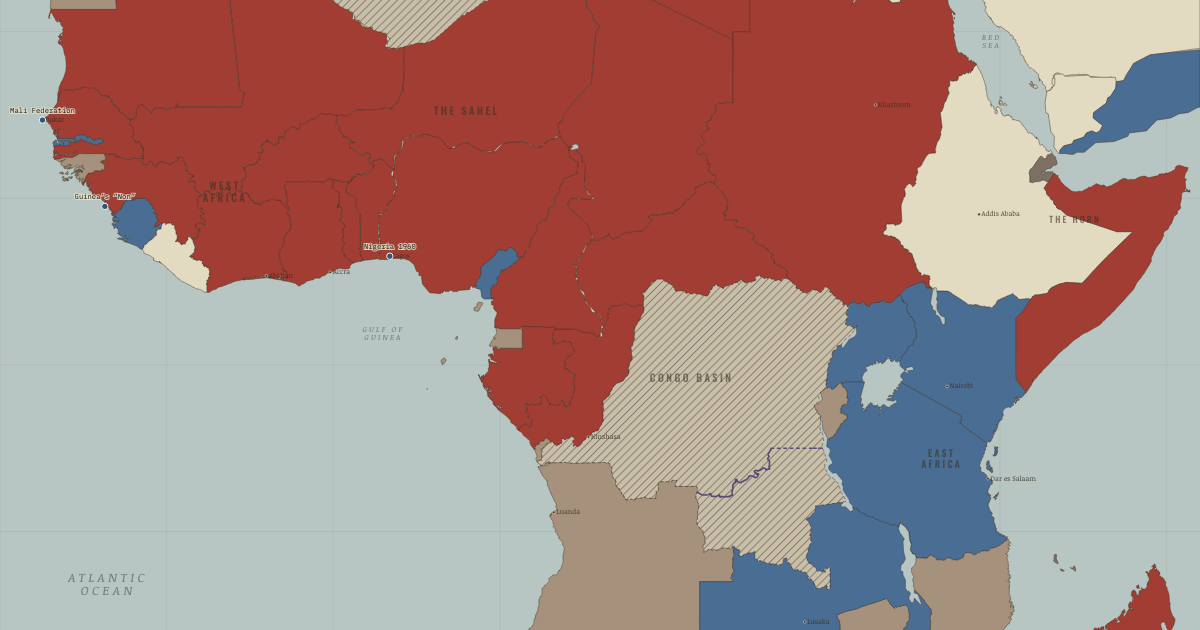
The half-century in which the most bordered continent on earth drew its own map — negotiated in some capitals, fought for in others.
A QUESTION TO ARGUE · CHAPTER 7
The OAU’s decision to keep colonial borders is defended as the guarantor of African peace and attacked as the freezing of colonial injustice. Weigh the case.
The case for keeping the borders begins with the danger of changing them. Katanga and Biafra, the era's two great secession attempts, were catastrophic; inter-state and secessionist wars have been strikingly rare given the arbitrariness of many lines. Fixed frontiers gave fragile states a frame in which to build and denied other ethnic claims the precedent of a successful breakaway. The case against begins with what those frontiers enclosed and divided. Europeans had drawn them for their convenience, splitting nations such as the Somalis across five states and placing hostile peoples together. The resulting problems of legitimacy, internal conflict and the “artificial state” endured, while non-interference could shield dictators. The decision probably prevented worse chaos in border wars, but it also locked in injustices whose costs were paid within states through civil wars and state failure. The leaders' choice was understandable and carried a heavy price.
The chapter behind it: Building States from Colonies.
The 12 chapters
- How Thin the Empire Really WasCHAPTER 1 · THE COLONIAL MAP OF 1945
- The First DoorsCHAPTER 2 · 1951–1956
- Ghana — The ModelCHAPTER 3 · 1947–1957
- Algeria — The ExceptionCHAPTER 4 · 1954–1962
- The Year of AfricaCHAPTER 5 · 1960
- The Congo CrisisCHAPTER 6 · 1960–1965
- Building States from ColoniesCHAPTER 7 · 1963–1979
- The Portuguese Empire Falls LastCHAPTER 8 · 1961–1975
- The Settler RedoubtCHAPTER 9 · 1965–1990
- Apartheid’s Long FallCHAPTER 10 · 1948–1990
- The Four Years That Decided ItCHAPTER 11 · 1990–1994
- What Independence Achieved, and Could NotEPILOGUE · THE LEDGER OF FREEDOM
Revision tools
Test yourself on every atlas set in the region. Each atlas ends with a map quiz that asks you to find places and moments on the map itself; the quick quiz and the printable study guide are free pages on this site.
- Two Roads to Independence: Haiti and Kenya
MAP QUIZ · QUICK QUIZ · PRINTABLE STUDY GUIDE - Protest and Change
MAP QUIZ · QUICK QUIZ · PRINTABLE STUDY GUIDE - The Crusades
MAP QUIZ · QUICK QUIZ · PRINTABLE STUDY GUIDE - The Decolonization of Africa
MAP QUIZ · QUICK QUIZ · PRINTABLE STUDY GUIDE
Maps of History is independent and is not affiliated with or endorsed by the International Baccalaureate Organization. IB course names describe alignment only; paper, theme and section names follow the new course outline and may change when the final guide is published.
THE DISPATCH
Get the printable study guide for The Decolonization of Africa free. I’ll send you a few short letters, then one when a new atlas opens. That’s all. — Paul
NO TRACKING · YOUR ADDRESS IS USED FOR THE DISPATCH AND NOTHING ELSE · UNSUBSCRIBE ANYTIME