Crusades · EPILOGUE ·
Legacy of the Crusades
Chapter 12 of The Crusades, 1095–1291: “What the Crusades Made”
By 1291 mainland Outremer was gone, Cyprus alone remained Latin and Muslim Iberia had shrunk to Granada; a Christian-held Jerusalem had lasted less than a lifetime. Their legacies include the Rhineland massacres of 1096, the weakening of Byzantium in 1204, a lasting Catholic–Orthodox grievance and a portable model of holy war.
Chapter 12 is included with every paid plan. WW2 is free in full, and chapter 1 of every atlas is free. A free account opens 3 more chapters a day. Starter, at $9 a month, opens all 21 with no daily limit — see the plans.
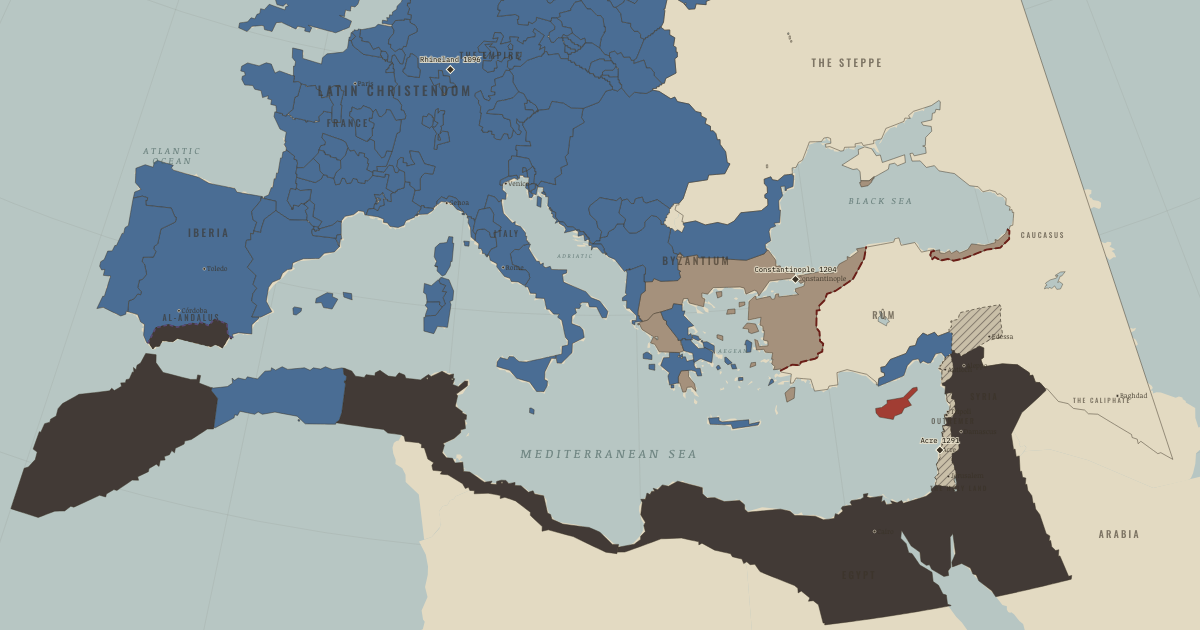
The map above is the world of The Crusades, 1291 — Acre falls — Outremer ends.
Every state on the map that year: The world in 1300 · Europe in 1300.
Part of IB History: The Crusades →
SHORT EXPLANATION
The final map records a failure of the crusades’ central ambition. By 1291 the mainland states had disappeared, though Cyprus remained Latin, and Granada was the surviving Muslim kingdom in Iberia. Jerusalem had been under Latin Christian rule for less than one lifetime during the two centuries since the First Crusade. The expeditions had not secured lasting Christian possession of the city.
Their effects reached beyond the territory they held. Crusading changed institutions and political language, while its violence harmed communities from the Rhineland to the eastern Mediterranean. Trade and learning crossed these regions too. Since merchants and translators already had routes of their own, we must distinguish contacts the wars created or accelerated from exchange that was already taking place.
The full story
The final map shows mainland Outremer gone, Cyprus still Latin and al-Andalus reduced to Granada. Jerusalem, the object of the First Crusade, had been under Latin Christian rule for less than a lifetime across two centuries. The expeditions failed to secure it permanently. Those centuries may also have cost a million lives, but medieval death tolls are exceptionally uncertain; the cost chart must be read with that uncertainty in mind.
What else did the crusades make? Italian republics profited from trade in the Levant, and Greek and Arabic learning reached the Latin West. These gains matter, but the question of cause requires a closer look. Venice and Genoa traded east before the expeditions, and translators worked in Toledo and Sicily in political settings with their own histories. The crusades opened or accelerated particular contacts within a much larger movement of goods and ideas. That movement cannot simply be credited to them, and an incidental benefit cannot justify the suffering that accompanied war.
Some consequences can be traced more directly to the violence. In 1096 crusading armies and crowds massacred Jewish communities at Mainz and elsewhere in the Rhineland. Expulsions, blood libels and confinement in ghettos continued long afterward, in a wider history of persecution that cannot be reduced to one expedition. In 1204 the sack of Constantinople gravely weakened Byzantium and deepened the division between Catholic and Orthodox Christians. The restored empire survived for more than two centuries, facing further political and military pressures before the Ottoman conquest of 1453. Repeated killings of civilians and wars in the eastern Mediterranean also left grievances between Muslims and Christians.
There was no single crusading outcome. In the Levant a small settler society endured for two centuries before losing the mainland. In Iberia and the Baltic, rulers linked crusading to sustained conquest and settlement. Within Latin Christendom, privileges were directed against heretics and the papacy’s political enemies, while crusaders attacked Jews as well. Popes could attach spiritual rewards and legal privileges to different campaigns. That flexibility helped the institution survive the fall of Acre in 1291, even as its uses moved far from the First Crusade’s language of aid and pilgrimage.
Today “crusade” can mean a civilizational war, as though the medieval campaigns had one unchanging purpose. The history is more specific: crusading was a penitential and legal undertaking that could be redirected. Its institutions, victims and contested memory are part of its legacy as surely as the territories on the map.
FULL EXPLANATION
Did Crusading Cause Cultural Exchange?
Ports, migration, diplomacy and war brought Latin Christians into contact with people and goods in the eastern Mediterranean. Italian cities gained commercial privileges, and settlers, travelers and combatants encountered unfamiliar practices. These contacts were real. To decide what crusading caused, however, we must ask what was already happening. Venetian, Genoese and Muslim merchants connected Mediterranean markets before the expeditions. Greek and Arabic works also reached Latin Europe through translation in Sicily and Iberia, each with its own political setting. Crusading opened particular channels and communities and may have accelerated some exchanges; violence and embargoes could interrupt them. A Levantine privilege granted to an Italian city can be connected to conquest, but it cannot show that the broader movement of learning depended on the crusades. Nor does a benefit that followed war compensate its victims.
Why Interpretations Changed
Steven Runciman’s influential mid-twentieth-century narrative presented the crusades as a destructive Western assault on a more sophisticated East. It shaped popular memory for generations. Jonathan Riley-Smith and others later turned to charters, family records and religious practice to understand why participants went. Their evidence showed that many accepted great costs out of sincere penitential belief, challenging an explanation based on greed alone. Sincerity does not erase conquest or atrocity: someone seeking salvation could also take part in violence. More recent scholarship has examined crusading as an institution used in Iberia, the Baltic, southern France and political conflicts long after 1291. These accounts ask different questions about consequences, motives and institutional reach. Modern rhetoric often uses “crusade” for a single civilizational conflict, but medieval campaigns had specific legal forms and changing ends. Later uses of the word reveal the concerns of the societies that inherited the history as well as the history itself.
Key places on the map
Why it happened
The states were always demographically hollow. The Latin states depended on a comparatively small settler population and on outside support. Divisions among neighboring powers gave them opportunities, while diplomacy, fortresses and Western expeditions helped them survive. Zengi, Nur al-Din, Saladin and later the Mamluks assembled power in different ways. As the balance changed, the coast had fewer resources of its own with which to respond.
Islam unified; Christendom did not. Muslim rulers were not one permanently united bloc. Nevertheless, successive powers assembled substantial resources in Syria and Egypt. Western expeditions came at intervals and could be divided by rivalry. In the final campaigns, the Mamluks could draw on regional revenue and armies repeatedly, a capacity the coastal states could not match.
The idea outgrew the place. The Holy Land had ceased to be crusading’s only destination before the mainland states fell. By 1300 campaigns had also been directed toward Iberia, the Baltic, heresy and the papacy’s political enemies (Ch. 9). Because spiritual incentives and legal privileges could be attached to different wars, the institution could continue after Outremer was lost.
THE TURNING POINT
Acre, 18 May 1291 — the end, and the beginning of memory. On 18 May 1291 Acre fell, ending the mainland crusader states. The loss prompted mourning and plans for recovery. Later generations would argue over martyrdom, conquest and what the enterprise had made. The political states were gone, but crusading and the dispute over its history continued.
What it changed
A catastrophe for Europe’s Jews. Jewish communities suffered devastating massacres in 1096 and later attacks. Christian Europe’s persecution continued long after those expeditions, through expulsions, blood libels and ghettoization. Crusading violence formed part of that wider history.
A maimed Byzantium, an advancing Islam. The Fourth Crusade’s sack in 1204 weakened Byzantium and deepened the Catholic–Orthodox divide. The restored empire survived, but later political and military developments added to its difficulties before the Ottomans conquered Constantinople in 1453. The frontier between Christian and Muslim powers moved into Europe.
A word that would not die. “Crusade” remains a metaphor in politics and ordinary speech. Its medieval meaning was more specific: an authorized campaign associated with spiritual rewards and legal privileges, directed at a changing range of places and enemies.
DISCUSSION QUESTION — Were the crusades “worth it,” and what can that question tell us?
We can judge particular acts, but a single balance sheet has difficulty capturing what the participants thought they were doing. Many undertook a penitential act in obedience to God, hoping to save their souls, rather than investing for a worldly return. Taking that belief seriously does not prevent us from judging their violence. The expeditions failed to secure a lasting Christian-held Jerusalem. Trade and learning crossed regions, although other routes existed already; Jewish communities, Byzantium and many civilians suffered grievously. The estimate of perhaps a million deaths is uncertain. Alongside judgment, the historian has other questions: why people went, how a fragile settler society survived so long, and why it eventually fell.
An interesting fact
Saladin’s reputation has traveled across cultures. Kaiser Wilhelm II visited his Damascus tomb in 1898, laid a gilded bronze wreath and paid for a new marble sarcophagus. Western chivalric stories helped shape modern interest in the sultan, while his reputation in Muslim traditions had its own history. In 1918, twenty years after the Kaiser’s visit, Ottoman Damascus fell and T. E. Lawrence took the wreath. It is now in London’s Imperial War Museum. The object shows later visitors taking up a medieval ruler’s memory for purposes of their own.
Related
THE FREE PRINTABLE STUDY GUIDE
Get the printable study guide for The Crusades free. I’ll send you a few short letters, then one when a new atlas opens. That’s all. — Paul
NO TRACKING · YOUR ADDRESS IS USED FOR THE DISPATCH AND NOTHING ELSE · UNSUBSCRIBE ANYTIME