Feminism and the Tunisian Revolution · CHAPTER 8 ·
Tunisia under Ben Ali
Chapter 8 of Protest and Change: Second-Wave Feminism and Tunisia, 1945–2015: “Ben Ali: Stability and Silence”
Zine el-Abidine Ben Ali took power on 7 November 1987 by having doctors declare Bourguiba unfit to govern, then ruled for 23 years through a police state, economic growth and patronage. After Ennahda’s strong showing in 1989 thousands of Islamists were arrested, and the 2008 Redeyef revolt in the Gafsa mining basin failed.
Chapter 8 is included with every paid plan. WW2 is free in full, and chapter 1 of every atlas is free. A free account opens 3 more chapters a day. Starter, at $9 a month, opens all 21 with no daily limit — see the plans.
Free printable Feminism and the Tunisian Revolution study guide, sent by email ↓
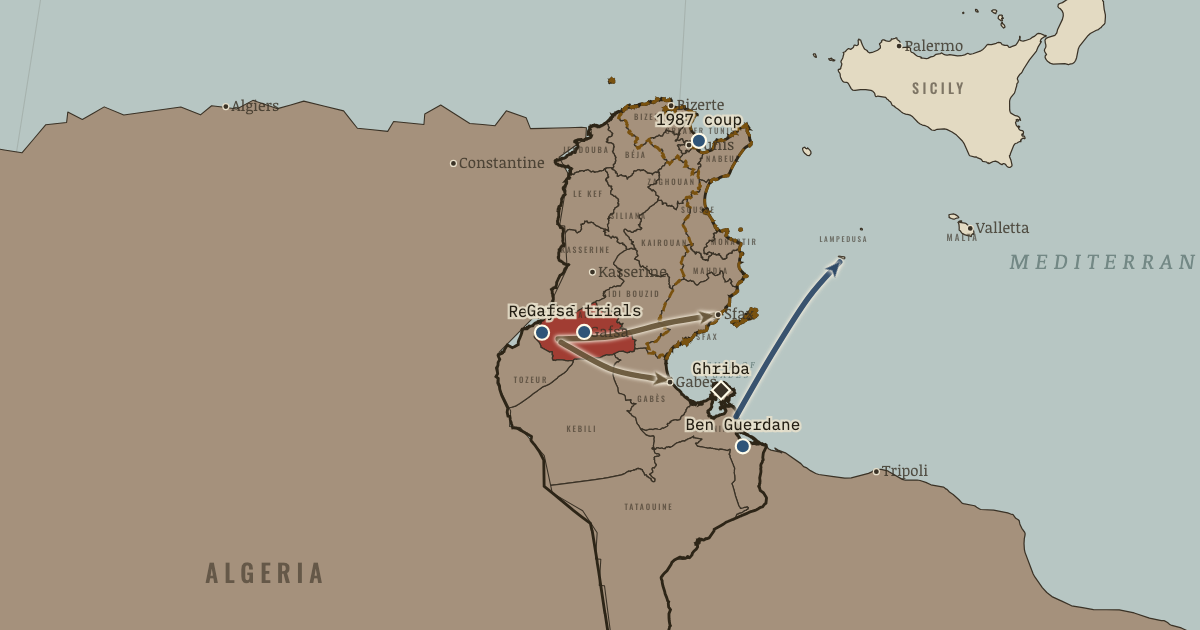
The map above is the world of Tunisia, April 2008 — One-party rule; the mining basin rises.
Every state on the map that year: The world in 2010 · Europe in 2010.
Part of IB History: Second-wave feminism and Tunisia →
SHORT EXPLANATION
On 7 November 1987 doctors declared the 84-year-old Bourguiba unfit to govern, and Zine el-Abidine Ben Ali took power. He promised pluralism, or open competition among several parties. But when Ennahda, an Islamist movement seeking to shape law and public life through politics according to Islam, demonstrated its strength in the 1989 elections, he crushed it. Ben Ali would rule for 23 years.
His government combined a police state with growth and patronage. Security forces watched, intimidated and punished citizens without effective legal limits; imagine an online surveillance system whose operators can also arrest the person they monitor. Patronage meant rewards such as jobs, loans and favors for loyal supporters, as in a modern city’s political machine. The ruling Constitutional Democratic Rally (RCD) controlled jobs, credit and permits, and Ben Ali won four re-elections with between 89 and 99 per cent of the vote. Western governments praised a stable, secular and growing Tunisia that protected women’s rights. Their support protected the regime abroad and made its repression easy to overlook.
The ‘Tunisian miracle’ was real on the coast and absent in the interior. By 2010 about 13 per cent of Tunisians and 23 per cent of university graduates were unemployed, while families close to the president, particularly his wife Leila Trabelsi’s relatives, captured a large share of private-sector profits.
On the map of April 2008, tan marks one-party rule across the country; the Gafsa mining basin is red. Young unemployed people and local unionists revolted there for six months after state phosphate company hiring results appeared to reward connections. Arrows trace phosphate traveling by rail to coastal factories and young people leaving by boat for Italy. The government crushed the revolt and jailed its leaders, but Gafsa had shown that the system could be challenged.
The full story
Ben Ali’s arrival offered reasons for hope. Under Article 57 of the constitution, power could pass to a successor if the president was incapacitated; seven doctors signed the certificate used in the ‘medical coup’ of 7 November 1987. Ben Ali released political prisoners. In 1988 he signed a National Pact with opposition figures, Islamist leaders and the UGTT, the General Tunisian Labour Union. The UGTT was a national trade-union federation, like a national union congress elsewhere, large enough to call a general strike.
The elections of April 1989 exposed the difficulty of his promise. Ennahda was not allowed to register, so its candidates stood as independents. They won around 14 per cent by the official count, and possibly more. The regime took their strength as a danger in open competition. From 1990 thousands of Islamists were arrested, tortured and tried; Ennahda leader Rached Ghannouchi went into exile in London. Newspapers, opposition parties and human-rights groups could continue only while they remained harmless. The promised competition had given way to a system in which silence was safer.
The regime offered a different bargain: prosperity and order in return for political obedience. For many years there was something to show for it. The economy grew by about five per cent a year, tourism and export factories expanded on the coast, and girls’ education and women’s legal rights advanced. Ben Ali presented himself to Europe and the United States as a bulwark against Islamism.
The benefits were uneven. Education produced graduates faster than the economy created skilled jobs, which were concentrated around Tunis, Sousse and Sfax in the coastal regions outlined on the map. In 2010 poverty was about 32 per cent in the Centre-West around Kasserine and Sidi Bouzid, compared with about 8 per cent in the coastal Centre-East. At the same time the Ben Ali and Trabelsi families took over banks, telecoms and import licences. A 2008 US embassy cable, published by WikiLeaks in December 2010, described them as a “quasi-mafia”. Growth could win consent most readily where people shared in it.
In the Gafsa mining basin, a contest for jobs brought these grievances together. On 5 January 2008 the Gafsa Phosphate Company, the region’s main employer, published results for 380 positions. Unemployed young people in Redeyef judged the results rigged for insiders. Sit-ins, marches and hunger strikes spread to Moularès, M’dhilla and Métlaoui. Local union activists, including schoolteacher Adnane Hajji, led the movement, while the UGTT’s national leadership remained close to the regime and held back.
Security forces sealed off the basin. Police shot Hafnaoui Maghzaoui dead in Redeyef on 6 June, and in December 38 people were sentenced to as much as ten years in prison. Phone videos circulated online, but national media stayed silent and the protest did not leave the basin. Gafsa had grievances, leadership, martyrs and images. The next revolt would also find a way to carry them beyond their place of origin.
FULL EXPLANATION
Repression or consent?
Police repression was unmistakable under Ben Ali, but Béatrice Hibou argues in The Force of Obedience that it cannot by itself explain how rule endured. Loans, subsidies, licences and jobs passed through the party and its networks, tying ordinary economic life to the state. The National Solidarity Fund, a supposedly voluntary charity known by postal account number 26-26, collected “donations” that few dared refuse. Dependence and the desire for security produced a kind of negotiated obedience alongside the prisons and torture used against thousands of Islamists and leftists. Critics raise a difficulty: how can consent be measured when surveillance gives people a reason to appear loyal? The rapid collapse in 2011 suggests that support was thinner than it looked. The two accounts can be reconciled if support was conditional. People accepted the bargain while it brought order and rising living standards, then withdrew support when it delivered neither. On this reading the regime was strongest on the coast and weakest in the interior.
Why Gafsa did not spread
Larbi Chouikha and Éric Gobe studied Gafsa as the revolt unfolded and called it Tunisia’s most important social movement since the nationwide bread riots of 1983–84. Yet it remained local. Geography helped the police: mining towns lay at the end of a single road and railway, allowing officers to cordon them off and arrest leaders one by one. Organization mattered as well. The UGTT’s national officials depended on the regime, negotiated quietly and called no solidarity strikes; local union organizers lacked the federation’s national support. Activists filmed demonstrations and journalist Fahem Boukadous broadcast reports, for which he was sentenced to prison. Relatively few Tunisians saw the images, however, and no major television channel made the story its own. In December 2010 regional union federations joined protests, Al Jazeera broadcast amateur footage daily, and demonstrations began in many towns at once, faster than police could contain them. The comparison holds much of the underlying grievance constant while showing how organization, media and geography affected the movement’s reach.
Measuring the miracle and the grievance
International institutions had good-looking figures to cite when they praised Tunisia: steady growth, a rising middle class and falling official poverty. The country regularly ranked among Africa’s most competitive economies. But the state controlled publication of statistics, and official poverty figures were revised sharply upward after the revolution. The distribution of gains also mattered. World Bank economists Bob Rijkers, Caroline Freund and Antonio Nucifora found that by 2010 firms connected to the Ben Ali and Trabelsi families earned about 21 per cent of all private-sector profits while producing a small fraction of output. Restrictions on investment in telecoms, transport and other sectors had been written to protect those firms. The same economy could look like a miracle in national totals and a locked door to a graduate in Sidi Bouzid without connections. An average describes the country as a whole; it does not tell us who received the gains.
Key places on the map
On this day
Why it happened
A coup that promised freedom. Many Tunisians, including Bourguiba’s opponents, welcomed Ben Ali in 1987. He had removed a senile president constitutionally and without bloodshed, released prisoners and promised democracy. An amnesty, abolition of the state security court and a new political-parties law followed in his first months. The welcome gave him time to take control of the party, police and media. When he withdrew his promise after 1989, the opposition was divided and exhausted, helping explain two decades of weak resistance.
The Islamist threat as justification. Ennahda’s 1989 showing helped Ben Ali present repression as protection. The civil war that began in neighboring Algeria in 1992, after Islamists won an election there, strengthened that appeal. Many secular Tunisians, including some feminists and leftists, feared an Islamist government more than a police state; Western governments accepted the same trade. The regime could use the claim of defending stability against critics both religious and secular.
Education outrunning jobs. Universities expanded rapidly, but skilled jobs did not keep pace. By 2010 about 23 per cent of graduates were unemployed, and graduates made up a growing share of the jobless. Young people had studied as the state encouraged them to do, only to find jobs requiring connections or bribes. Graduate unemployment was highest in the interior, where private firms were fewest. The gap between education and opportunity made blocked hopes a source of anger: protest can grow from frustrated expectations as well as poverty.
A family that owned the economy. From the 1990s the president’s relatives and his wife’s family seized stakes in banks, airlines, car imports, telecoms and property. Their greed was visible to ordinary Tunisians and offended even the coastal business class that had supported the regime. A government claiming to provide order came to look like one that simply stole, weakening support within its own elite. US diplomatic cables published by WikiLeaks in December 2010 gave written evidence of what Tunisians had long whispered.
THE TURNING POINT
Redeyef, January–June 2008. For six months union activists and unemployed graduates organized the mining basin against a police state. The revolt broke twenty years of silence and made the interior’s grievances visible. The government isolated the basin and jailed its leaders, demonstrating that a local uprising could still be contained. Yet activists, lawyers and union officials who defended Gafsa prisoners in 2008 and 2009 formed networks that helped spread the revolt of 2010. Defeat left experience and connections for later protest to draw on.
What it changed
A template for revolt. The actions used at Gafsa appeared again two years later: sit-ins outside local government buildings, hunger strikes, marches led by unemployed graduates, local union support and phone videos. Protesters in Sidi Bouzid and Kasserine knew the basin’s story, and some of the same activists joined them. The next chapter follows the movement beyond the local limits that had contained Gafsa.
A divided union federation. Gafsa widened the distance between the UGTT’s regime-friendly national leaders and its militant local and regional branches. In January 2011 regional unions pushed the national leadership to authorize strikes. The federation helped turn scattered protests into a national movement and later brokered the democratic transition. Its connections to both the regime and a popular movement made it an intermediary between street and state.
Exit by sea. For some young people in the south and interior, departure was an alternative to revolt. The often illegal boat journey to Lampedusa or Sicily was called the harga, literally ‘burning’ the border. After the police state collapsed in 2011, about 20,000 Tunisians crossed to Lampedusa in three months, showing how many had been waiting to leave. For many young men the boat was a private answer to a public failure.
DISCUSSION QUESTION — Was Ben Ali’s regime maintained more by repression or by consent?
Repression was systematic: thousands of Islamists and leftists were imprisoned and tortured, the press and internet were censored, and police crushed Gafsa with bullets and long prison sentences. Yet fear alone is a poor explanation for 23 years of stability in a country without a large army. Hibou shows how credit, subsidies, licences and party networks made people dependent on the state and gave many a stake in it. Growth, education and women’s rights also won approval among the coastal middle class and Western governments. Protest suggests that consent was conditional and uneven: strongest where the economy delivered, weakest in the interior, where police mattered more. Consent did more to maintain the regime on the coast, repression in the interior. When growth stalled and corruption became visible, the material bargain weakened where fear had already carried much of the burden.
An interesting fact
Tunisians nicknamed their internet censor “Ammar 404” after the “Error 404, page not found” message shown when a blocked website was requested, as if an official named Ammar had switched it off himself. YouTube and Dailymotion were blocked for long periods under Ben Ali, and police were reported to hack dissidents’ email and Facebook accounts. In November 2005 the government hosted the second phase of the United Nations World Summit on the Information Society in Tunis, a meeting about the free flow of information. Human-rights activists attempting a parallel meeting in the city were harassed and beaten.
Related
THE FREE PRINTABLE STUDY GUIDE
Get the printable study guide for Protest and Change free. I’ll send you a few short letters, then one when a new atlas opens. That’s all. — Paul
NO TRACKING · YOUR ADDRESS IS USED FOR THE DISPATCH AND NOTHING ELSE · UNSUBSCRIBE ANYTIME