Crusades · CHAPTER 1 ·
Causes of the First Crusade
Chapter 1 of The Crusades, 1095–1291: “Three Civilizations, One Sea”
In 1095 Latin Christendom, Byzantium and a divided Islamic world met around the Mediterranean. Byzantium had lost most of Anatolia after Manzikert in 1071, Seljuk authority fractured after Malik-Shah died in 1092, and Emperor Alexios I appealed to the West; Pope Urban II answered at the Council of Clermont in November 1095.
WW2 is free in full, and chapter 1 of every atlas is free. A free account opens 3 more chapters a day. Starter, at $9 a month, opens all 21 with no daily limit — see the plans.
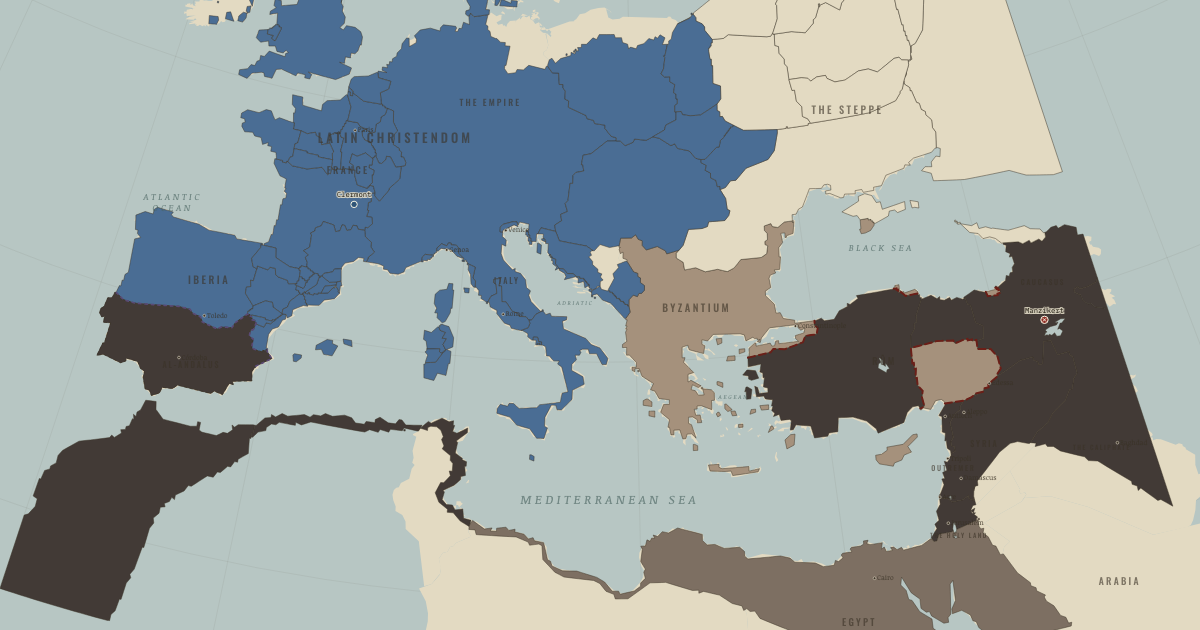
The map above is the world of The Crusades, 1095 — The eve of the crusade.
Every state on the map that year: The world in 1100 · Europe in 1100.
Part of IB History: The Crusades →
SHORT EXPLANATION
In 1095, the Mediterranean joined three great regions whose rulers faced very different problems. Western Europe was a patchwork of kingdoms, only loosely obedient to a reforming papacy. Byzantium had lost much of Anatolia after its defeat at Manzikert in 1071. From Iberia to Iraq, Islamic rulers held extensive lands, but the Sunni Seljuks, Egypt’s Shia Fatimids and the emirs of Syria were divided. These divisions would help a Western expedition establish Christian states on the far shore of the sea.
Pope Urban II gave the expedition its religious purpose at Clermont in 1095. He called Western Christians to aid Eastern Christians on an armed pilgrimage, making warfare a form of penance. Those who went received an indulgence: remission of the Church-imposed penalty for confessed sin, rather as an amnesty cancels a debt owed to an authority. Salvation, defense of fellow Christians, honor and the hope of land could all draw a knight to the same undertaking.
The full story
The Near East that the crusaders approached had no single ruler able to summon all its forces against them. The Sunni Seljuk sultans governed in the name of the Abbasid caliph in Baghdad, whose remaining authority was largely religious. In Egypt, the Shia Fatimid caliphs were their political rivals and, in Seljuk eyes, heretics. Syria lay between these powers, divided among competing emirs. After Sultan Malik-Shah died in 1092, his heirs fought for control of his realm. A united power might have crushed a Western expedition at the frontier; instead, an attack on one ruler did not automatically unite his neighbors in defense.
The immediate appeal for help came from Byzantium. Following its defeat at Manzikert, Turkish emirs had advanced across Anatolia almost to the Aegean. The empire had depended on that heartland for food and soldiers, and Emperor Alexios I wanted Western mercenaries to help recover it. Urban’s answer at Clermont in November 1095 was much larger than a force of hired men. He summoned Western Christians to an armed journey east with a spiritual reward. Five surviving accounts of his speech were written after the expedition succeeded and disagree about his exact words. Jerusalem, already central to the medieval Christian map and attracting growing numbers of pilgrims, soon became the movement’s declared destination.
Urban’s appeal could gather people whose purposes did not coincide. A nobleman might seek salvation and honor, hope for wealth and act for his family’s advantage without seeing a contradiction among them. Each lord, however, raised his own force and chose his route; the vow bound the individual, not an army directed by a state. There was no single commander, shared budget or agreed plan. Religious commitment could sustain the travelers through hardship, but it could not decide how they would obtain supplies, divide conquered land or deal with Byzantium. The movement’s breadth was a source of energy and a continuing problem of coordination.
FULL EXPLANATION
What We Can Actually Know Urban Said
We cannot read a transcript of Urban’s sermon. The four fullest accounts were composed after Jerusalem fell, by Fulcher of Chartres, Robert the Monk, Baldric of Dol and Guibert of Nogent. They preserve memories shaped by knowledge of the crusade’s outcome. Historians can compare their recurring themes: aid to Eastern Christians, an expedition east and remission of sins. The familiar emphasis on Jerusalem, and the cry “God wills it” in the form remembered today, are less certain. Once the Holy City had been captured, it was easy to tell the beginning as if that destination had been inevitable. Urban’s initial appeal was probably broader and less precise than the triumphant later versions suggest.
Why Layered Motives Explain More Than One
The charters left by crusaders make a simple account of their motives difficult. Many sold or mortgaged land to pay for the journey; they risked substantial possessions before they could gain anything in the East. The records also contain gifts to monasteries for the good of their souls. Neither action reveals every hope a participant held. A nobleman could serve God, seek honor and protect his lineage at the same time. Nor should the cost of departure make us forget what followed: conquest brought lordships, plunder and coercion. Urban’s institutional achievement was to place an armed journey under Church authority and attach a spiritual reward to it. This allowed different ambitions to sustain one enterprise, though it could not prevent disputes over the gains.
Key places on the map
On this day
Why it happened
Manzikert and the Byzantine appeal. The defeat at Manzikert in 1071 was followed by the loss of much of Anatolia, a region that had supplied Byzantium with food and soldiers. Alexios I Komnenos sought Western mercenaries to recover it. Urban’s appeal brought tens of thousands east, pursuing a holy war with aims of their own. The emperor had asked for troops to employ; the movement he received was far harder to direct.
The Seljuk fracture. After Malik-Shah died in 1092, his heirs and their atabegs fought over his realm. Rival emirs held Syria, while the Sunni-Shia division set Baghdad apart from Fatimid Cairo. These rulers had reasons to distrust one another when the expedition arrived. A united defense might have stopped it at the frontier; their divisions made such a response harder to organize.
The reform papacy and the Peace of God. Gregorian reform had strengthened a papacy able to make demands on kings. The Peace and Truce of God movements, meanwhile, tried to limit knights’ private wars. Urban joined papal authority to a new purpose for those warriors: fighting eastward could become an act of penance.
Jerusalem and the pull of pilgrimage. Pilgrims already traveled in growing numbers to Jerusalem, the center of the medieval Christian map. Urban’s armed journey drew on that practice as well as apocalyptic expectations and the promise of remission of sins for those who died on the road. These hopes gave the expedition a religious force beyond an ordinary call to political service.
THE TURNING POINT
Clermont, 27 November 1095. At Clermont, Urban offered lay warriors a way to make their fighting an act of penance, with a reward in heaven and, some hoped, on earth. Five later accounts differ over his exact words. The idea they describe would take on uses far beyond this first expedition.
What it changed
An armed pilgrimage, not an army. The people who set out were bound by vows rather than organized as a single state army. Lords raised forces and often sold or mortgaged land to fund the journey; poorer people went with them. Their commitment helped sustain the movement, while the absence of a common commander and budget made supply and coordination difficult.
A new spiritual technology. Crusading helped develop the indulgence, the remission of the temporal penalty for sin. Later appeals would turn the idea against heretics, pagans and the pope’s political enemies (Ch. 9). The sale of indulgences later became a dispute associated with the Reformation.
A blow the target barely felt. The first Islamic responses to the invaders were slow and largely local. Over roughly fifty years, leaders including Zengi and Nur al-Din built a broader campaign against the Latin states. Before such coalitions formed, the Latins had time to establish small possessions.
DISCUSSION QUESTION — How did religious and material motives contribute to the First Crusade?
The choice between faith and material interest conceals how the two could work together. Participants spent money and risked death; some sold or mortgaged land to depart, hardly an easy route to profit. Yet honor, adventure, land and an outlet for a warrior culture’s aggression also attracted people, and conquest produced plunder, settlement and coercion. Urban’s appeal made fighting part of a religious undertaking. A man could seek salvation while advancing his family’s interests, and both purposes could help explain his decision.
An interesting fact
Urban II died in Rome on 29 July 1099, fourteen days after Jerusalem fell on 15 July. News of the capture had not yet crossed the Mediterranean, so the pope who helped launch the expedition never learned of its victory.
Related
THE FREE PRINTABLE STUDY GUIDE
Get the printable study guide for The Crusades free. I’ll send you a few short letters, then one when a new atlas opens. That’s all. — Paul
NO TRACKING · YOUR ADDRESS IS USED FOR THE DISPATCH AND NOTHING ELSE · UNSUBSCRIBE ANYTIME