MAPS OF HISTORY · IB HISTORY · PAPER 1 · PROTEST AND CHANGE
IB HISTORY · PAPER 1 · FOCUSED STUDY
Paper 1: Protest and Change — Second-wave feminism and Tunisia 2010–2015
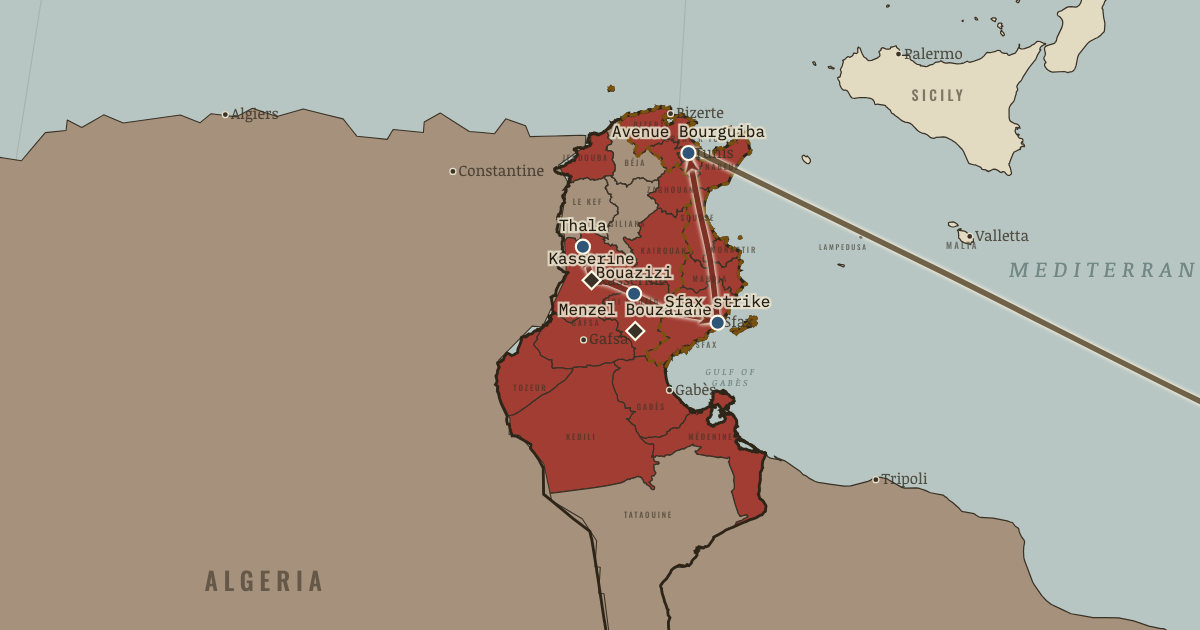
Protest and Change is one of the five Paper 1 Focused Studies of the new IB History course, first examined in May 2028. Paper 1 is the source paper: its questions ask you to read primary sources closely, to judge what each can and cannot tell a historian, and to combine them with your own knowledge. This Focused Study pairs two case studies, Second-wave feminism and Tunisia 2010–2015, and our atlas Protest and Change covers both on linked maps, in 12 chapters with 35 primary sources.
Women’s rights advanced from the jury box to the UN; in Tunisia, twenty-eight days toppled a dictator. Why do movements emerge, how do they change the law, and whom do they leave behind?
WW2 is free in full, and chapter 1 of every atlas is free. A free account opens 3 more chapters a day. Opening a new atlas uses one of them. Membership opens all 21 — Join.
What this Focused Study asks
Each source set begins with an inquiry question. Together, the questions show the work this Focused Study asks you to do. Read the sources alongside the chapters: a good answer draws on both.
Second-wave feminism
- Why did second-wave feminism emerge in the United States in the early 1960s?
- How far did the law change women’s position in the United States, 1964–1982?
- How far did second-wave feminism speak for all American women?
Tunisia 2010–2015
- Why did the Tunisian revolution begin in the interior of the country?
- How far did the Tunisian revolution create lasting change, 2011–2015?
Case study 1: Second-wave feminism
Chapters 1–6 of the atlas follow Second-wave feminism, from 1945 to 1985. Read them in order: each chapter is a step in one argument, and the map moves with it.
- The Problem That Has No NameCHAPTER 1 · 1945–1963
- Organising for EqualityCHAPTER 2 · 1963–1970
- The Personal Is PoliticalCHAPTER 3 · 1968–1975
- Who Was Left Out?CHAPTER 4 · 1970–1981
- The ERA and the BacklashCHAPTER 5 · 1972–1982
- A Global MovementCHAPTER 6 · 1975–1985
Evidence to use
One point from the IB notes of each chapter, written as a sentence you could use in an answer. Every chapter in the atlas carries four to six.
- In Hoyt v. Florida (1961), the Supreme Court upheld a law under which women appeared on Florida’s jury lists only if they volunteered. The Court’s reasoning placed them at home: woman was “still regarded as the center of home and family life”. CH 1
- Women gained a federal ban on job discrimination when an amendment to Title VII of the Civil Rights Act passed by 168 votes to 133. Howard Smith of Virginia had proposed adding “sex” to the law on 8 February 1964. CH 2
- Consciousness-raising groups gave women a place to compare experiences of sex, marriage and housework. Kathie Sarachild described the groups in 1968, and Carol Hanisch defended them in “The Personal Is Political”. What had seemed private could now be understood as a shared political grievance. CH 3
- In “Double Jeopardy” (1969), Frances Beal argued that Black women experienced racism and sexism together. She challenged the idea of housework as women’s prison: Black women, she pointed out, had always worked for wages. CH 4
- The Equal Rights Amendment passed the Senate by 84 votes to 8 on 22 March 1972. Hawaii ratified it that same day, and within nine months the number of ratifying states had reached 22. CH 5
- From 19 June to 2 July 1975, delegations from 133 governments gathered in Mexico City for the first UN World Conference on Women. It opened a Decade for Women that continued until 1985. CH 6
Case study 2: Tunisia 2010–2015
Chapters 7–11 of the atlas follow Tunisia 2010–2015, from 1956 to 2015. Read them in order: each chapter is a step in one argument, and the map moves with it.
- Bourguiba’s TunisiaCHAPTER 7 · 1956–1987
- Ben Ali: Stability and SilenceCHAPTER 8 · 1987–2010
- Twenty-Eight DaysCHAPTER 9 · DECEMBER 2010 – JANUARY 2011
- Building a DemocracyCHAPTER 10 · 2011–2014
- Terrorism and FragilityCHAPTER 11 · 2012–2015
Evidence to use
One point from the IB notes of each chapter, written as a sentence you could use in an answer. Every chapter in the atlas carries four to six.
- Tunisia’s Personal Status Code changed the terms of marriage and divorce. Decreed on 13 August 1956 and effective from 1 January 1957, it abolished polygamy and repudiation by husbands, while allowing either spouse to seek a divorce in court. CH 7
- On 7 November 1987, Ben Ali took power after seven doctors certified Bourguiba unfit under Article 57 of the constitution. He went on to win re-election four times, receiving between 89 and 99 per cent of the vote. CH 8
- Mohamed Bouazizi was a 26-year-old street vendor in Sidi Bouzid. After an inspector confiscated his scales, he set himself on fire outside the governorate building on 17 December 2010. He died on 4 January 2011. CH 9
- Young people from Tunisia’s interior arrived in Tunis on 23 January 2011 as the Caravan of Liberation. Their arrival was followed by the Kasbah sit-ins, which forced Prime Minister Mohamed Ghannouchi to resign on 27 February 2011. CH 10
- Supporters of Ansar al-Sharia attacked the US embassy in Tunis on 14 September 2012, and four people died. The government did not designate the group a terrorist organisation until 27 August 2013. CH 11
Comparing the two case studies
The atlas ends by setting the two case studies side by side in Two Movements Compared. Comparison is where the Focused Study pays off: the same question asked of two societies shows which explanations travel and which belong to one place.
PAPER 1 · PROTEST AND CHANGE · CHAPTER 12
Compare and contrast how second-wave feminism and the Tunisian revolution brought about change.
Both movements turned grievances into law, drawing on existing networks and openings from above. Yet they worked at different speeds and aimed at different targets. Over decades, feminism changed laws and attitudes within a stable democracy; in Tunisia, revolution replaced a regime in weeks, and negotiation then rebuilt the state.
Both movements needed a catalyst and networks already in place.
Both used law to make change durable.
The movements differed in their pace and their targets.
The evidence for each point, the counter-argument and the judgement are in the IB notes of chapter 12 in the atlas. Read the chapter first: Two Movements Compared.
Key concepts
The course asks you to think with six concepts. Each chapter’s IB notes name the two or three it supports best; here they are across the atlas, most used first.
- Change · 5 CHAPTERS
What was different afterwards, how quickly it changed, and for whom. For example: Organising for Equality, The Personal Is Political, A Global Movement, Bourguiba’s Tunisia. - Perspectives · 5 CHAPTERS
How people at the time, and historians since, have seen the same events differently, and why. For example: Organising for Equality, Who Was Left Out?, The ERA and the Backlash, A Global Movement. - Causation · 4 CHAPTERS
Why something happened: the long-term conditions, the triggers and the choices behind it, and which of them mattered most. For example: The Problem That Has No Name, The ERA and the Backlash, Ben Ali: Stability and Silence, Twenty-Eight Days. - Significance · 4 CHAPTERS
Why an event, person or idea matters, judged by its effects and by how it has been remembered. For example: The Problem That Has No Name, Who Was Left Out?, Twenty-Eight Days, Two Movements Compared. - Consequence · 3 CHAPTERS
What followed from an event or decision, intended and unintended, in the short and the long term. For example: The Personal Is Political, Building a Democracy, Terrorism and Fragility. - Continuity · 3 CHAPTERS
What stayed the same through an apparent upheaval, and why it survived. For example: Bourguiba’s Tunisia, Ben Ali: Stability and Silence, Terrorism and Fragility.
Source-analysis practice
This is one complete source set from the atlas, free to use. It is built around one inquiry question: Why did second-wave feminism emerge in the United States in the early 1960s? As you read each source, ask who made it, when, and why. These details help you judge what it can tell you. Answer the questions in writing first; then open the guide under each one to see what a strong answer does.
TEXT · CHAPTER 1
The Feminine Mystique, opening lines
- CREATOR
- Betty Friedan
- DATE
- 19 February 1963
- ORIGIN
- First lines of chapter 1, “The Problem That Has No Name”, published by W. W. Norton, New York
Context. For the book, Friedan drew on a 1957 questionnaire of her Smith College classmates and interviews with suburban wives.
© Betty Friedan estate / W. W. Norton; quoted for criticism and instruction
TEXT · CHAPTER 1
Hoyt v. Florida: why a state may excuse women from juries
- CREATOR
- Justice John Marshall Harlan II, for a unanimous Supreme Court
- DATE
- 20 November 1961
- ORIGIN
- Opinion of the US Supreme Court, 368 U.S. 57 (1961), upholding the murder conviction of Gwendolyn Hoyt by an all-male Florida jury
Context. Women entered Florida’s jury lists only if they registered to serve. The ruling stood until Taylor v. Louisiana (1975).
US Supreme Court opinion (US government work) · original ↗
TEXT · CHAPTER 1
Remarks upon signing the Equal Pay Act
- CREATOR
- President John F. Kennedy
- DATE
- 10 June 1963
- ORIGIN
- Remarks at the White House, published in the Public Papers of the Presidents
Context. Kennedy spoke four months after The Feminine Mystique appeared, and four months before his Commission on the Status of Women reported.
US government work; text from the American Presidency Project · original ↗
PICTURE · CHAPTER 2
Women’s pay as a share of men’s, United States, 1960–1985
- CREATOR
- Maps of History
- DATE
- Data 1960–1985
- ORIGIN
- Line chart drawn from US Census Bureau Historical Income Tables, Table P-40
Context. These figures compare women and men who worked full time all year. They leave out part-time work, where women were concentrated.
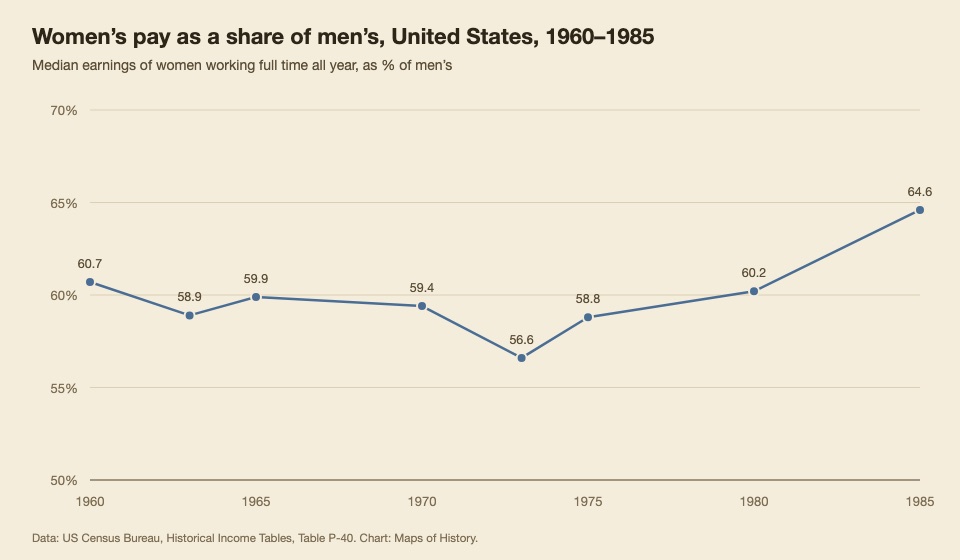
Chart: Maps of History. Data: US Census Bureau, Table P-40 · original ↗
The questions
- QUESTION 1 · COMPREHENSION
According to Source C, why did the Equal Pay Act matter?
What a strong answer does
Kennedy gives several reasons for the Act’s importance. It banned “arbitrary discrimination against women in the payment of wages” and gave women rights at work comparable to those they had “at the polling place”. He also calls it a first step: women earned “only 60 percent” of men’s average wage. Choose two or three of these points, using brief quotations and evidence from the source itself.
- Identifies at least two distinct points from the source
- Uses short quotations or close paraphrase
- Keeps to what the source says
- QUESTION 2 · ANALYSIS
What does Source D suggest about the effectiveness of the Equal Pay Act of 1963?
What a strong answer does
In 1963 women earned about 59–60 per cent of men’s pay; in 1980 the figure was still about 60 per cent, after falling to 56.6 per cent in 1973. The little movement across two decades suggests that the Act did little to close the gap. The chart covers only full-time workers, and sex-segregated jobs may have fallen outside the Act’s “equal work” test.
- Reads specific values from the chart
- Draws an inference about effectiveness
- Notes a limitation of the data
- QUESTION 3 · EVALUATION
With reference to its origin, purpose and content, assess the value and limitations of Source A for a historian studying why women’s discontent became political.
What a strong answer does
This passage opens Friedan’s 1963 bestseller. Friedan, a journalist with a labour-left past, sought to persuade educated readers that their unhappiness had social causes. A historian can see how she gave private discontent a public language; the book reached over a million readers. Its account nevertheless speaks for white, middle-class suburban women and uses rhetoric without statistics, limitations identified in Meyerowitz’s and hooks’s critiques.
- Uses origin, purpose and content explicitly
- Gives at least one value and one limitation
- Links the evaluation to the stated question
- QUESTION 4 · SYNTHESIS
Using the sources and your own knowledge, evaluate the reasons why second-wave feminism emerged in the United States in the early 1960s.
What a strong answer does
An answer needs to compare the causes, not just list them. Married women’s rising employment and Source D point to economic change; jury exclusion in three states and Source B point to legal second-class citizenship. Sources A and C, the Commission and NOW in 1966 show the importance of naming discontent and building institutions. Add relevant knowledge, such as the civil-rights movement and the Pill, and explain which cause mattered most.
- Uses all four sources
- Adds relevant own knowledge
- Weighs causes and reaches a judgement
More source sets in the atlas
The atlas holds 4 more source sets for this Focused Study. Their sources sit in the IB notes of the chapters named below: open a chapter in the atlas and turn on the IB notes switch to read them.
- How far did the law change women’s position in the United States, 1964–1982? SECOND-WAVE FEMINISM
Its sources are in the IB notes of chapter 2, chapter 3, chapter 5. - How far did second-wave feminism speak for all American women? SECOND-WAVE FEMINISM
Its sources are in the IB notes of chapter 4, chapter 5. - Why did the Tunisian revolution begin in the interior of the country? TUNISIA 2010–2015
Its sources are in the IB notes of chapter 7, chapter 8, chapter 9. - How far did the Tunisian revolution create lasting change, 2011–2015? TUNISIA 2010–2015
Its sources are in the IB notes of chapter 7, chapter 10.
Practice questions and essay plans
Try planning your answers before looking at ours. Each outline states a thesis and shows what each paragraph would claim. The first plan comes from chapter 2, a free chapter, and is shown in full. In the atlas, the chapters’ IB notes give the full plans, with evidence, a counter-argument and a judgement. The atlas’s own page lists those notes: IB notes for Second-wave feminism and Tunisia.
PAPER 2 · PROTEST AND CHANGE · CHAPTER 2
How effective were the methods women’s organisations used to seek equal treatment at work in the United States and Britain between 1963 and 1970?
The most effective methods differed between the two countries. In the United States, lobbying and litigation made use of Title VII, a legal weapon the courts would enforce; in Britain, industrial action was decisive. Spectacular direct action attracted publicity but brought few concrete gains. The question is whether a method could make an institution act.
Lobbying and litigation made a neglected legal clause enforceable.
EVIDENCENOW, founded in June 1966, pressed the EEOC to act; in 1968 the commission ruled against sex-segregated job advertisements. NOW also backed Weeks v. Southern Bell, which was won in 1969.
LINKThe law had already placed obligations on institutions. By pressing them to carry those obligations out, a small organization of lawyers and lobbyists could change rules affecting millions of workers.
Strikes put equal pay on the British agenda.
EVIDENCEThe 187 Dagenham machinists halted car production for three weeks in June 1968 and secured an increase from 85 to 92 per cent of the male rate. Barbara Castle’s Equal Pay Act followed on 29 May 1970.
LINKStopping production gave the women bargaining power. Unequal pay had become a problem for employers and ministers alike, and this produced legislation more quickly than lobbying alone could have done in Britain.
Direct action had more effect on public opinion than on law.
EVIDENCEThe protest at Miss America on 7 September 1968 brought women’s liberation into the national news. Nothing was burned, but the hostile “bra-burner” stereotype followed.
LINKThe publicity helped recruit supporters and spread consciousness-raising groups. It also supplied opponents with an image to ridicule, while publicity alone changed neither pay nor employment rules.
Radical feminists had a different measure of success. Legal victories left sex-segregated jobs and unequal housework, among the deeper sources of inequality, in place. The US pay gap barely moved during the 1960s; by this measure, no method had yet been effective.
Legal and industrial methods achieved the most concrete changes at work because they compelled courts, employers and governments to act. The continuing pay gap, however, shows the limits of changing law when inequality was also rooted in the division of work. Radical critiques gained ground after 1968 for that reason.
Read the chapter behind this plan: Organising for Equality.
PAPER 2 · PROTEST AND CHANGE · CHAPTER 5
To what extent was the failure of the Equal Rights Amendment the result of the campaign led by Phyllis Schlafly?
Schlafly’s STOP ERA campaign made a measure that had commanded broad agreement into a source of controversy. Ratifications fell sharply after the campaign began, suggesting that it had an effect. But the campaign worked within a constitutional process that required a supermajority: a determined minority in thirteen states could block a change supported by most Americans.
STOP ERA changed how legislators understood the amendment.
The amendment process gave opponents in a minority of states power to block ratification.
Political changes beyond STOP ERA added strength to the opposition.
The evidence for each point, the counter-argument and the judgement are in the IB notes of chapter 5 in the atlas. Read the chapter first: The ERA and the Backlash.
PAPER 2 · PROTEST AND CHANGE · CHAPTER 9
To what extent was the role of the trade unions the most important reason for the fall of Ben Ali in January 2011?
The UGTT’s regional unions supplied the decisive organising force: their strikes helped turn scattered protests in the interior into a national movement reaching the coast and capital. Union organisation worked alongside outrage at repression, images spread through new media, and the army’s refusal to defend the president.
Union strikes carried the revolt across the country.
Repression brought more people into the protest.
The army’s neutrality determined the outcome.
The evidence for each point, the counter-argument and the judgement are in the IB notes of chapter 9 in the atlas. Read the chapter first: Twenty-Eight Days.
PAPER 2 · PROTEST AND CHANGE · CHAPTER 11
Discuss how terrorism affected Tunisia’s democratic transition between 2012 and 2015.
Terrorism put the transition under pressure on several fronts. It sharpened political divisions in 2013, devastated the tourist economy in 2015 and prompted governments to revive emergency powers. Democratic institutions survived in these years, but the economic and civil-liberties foundations on which they depended grew weaker.
Political violence brought the transition close to breaking in 2013.
The attacks of 2015 dealt a severe blow to the economy.
The response to terrorism brought back powers associated with the old order.
The evidence for each point, the counter-argument and the judgement are in the IB notes of chapter 11 in the atlas. Read the chapter first: Terrorism and Fragility.
Revision tools
The atlas ends with a map quiz that asks you to find places and moments on the map itself (part of every plan from Starter up). The quick quiz and the discussion questions with our answers are free pages on this site, and the printable study guide gathers every chapter’s notes into one document for revision.
The same atlas for other papers
Several chapters also carry IB notes for Papers 2 and 3, and for topics of the old course examined in 2027:
- Paper 2 · Authoritarian Rule · 3 CHAPTERS
- Paper 2 · Popular Movements · 11 CHAPTERS
- Paper 3 · The Americas · 5 CHAPTERS
- Old course · Prescribed subject 4: Rights and protest · 2 CHAPTERS
- Old course · World history topic 10: Authoritarian states (20th century) · 2 CHAPTERS
Maps of History is independent and is not affiliated with or endorsed by the International Baccalaureate Organization. IB course names describe alignment only; paper, theme and section names follow the new course outline and may change when the final guide is published.
THE DISPATCH
Get the printable study guide for Protest and Change free. I’ll send you a few short letters, then one when a new atlas opens. That’s all. — Paul
NO TRACKING · YOUR ADDRESS IS USED FOR THE DISPATCH AND NOTHING ELSE · UNSUBSCRIBE ANYTIME