Crusades · CHAPTER 2 ·
First Crusade
Chapter 2 of The Crusades, 1095–1291: “The First Crusade”
The First Crusade (1096–1099) began with the murder of thousands of Jews in Speyer, Worms and Mainz, and the People’s Crusade was destroyed near Nicaea. The princely armies, aided by Byzantium and Italian ships, survived a siege at Antioch in 1098 and stormed Jerusalem in 1099, massacring many Muslim and Jewish inhabitants.
WW2 is free in full, and chapter 1 of every atlas is free. A free account opens 3 more chapters a day. Starter, at $9 a month, opens all 21 with no daily limit — see the plans.
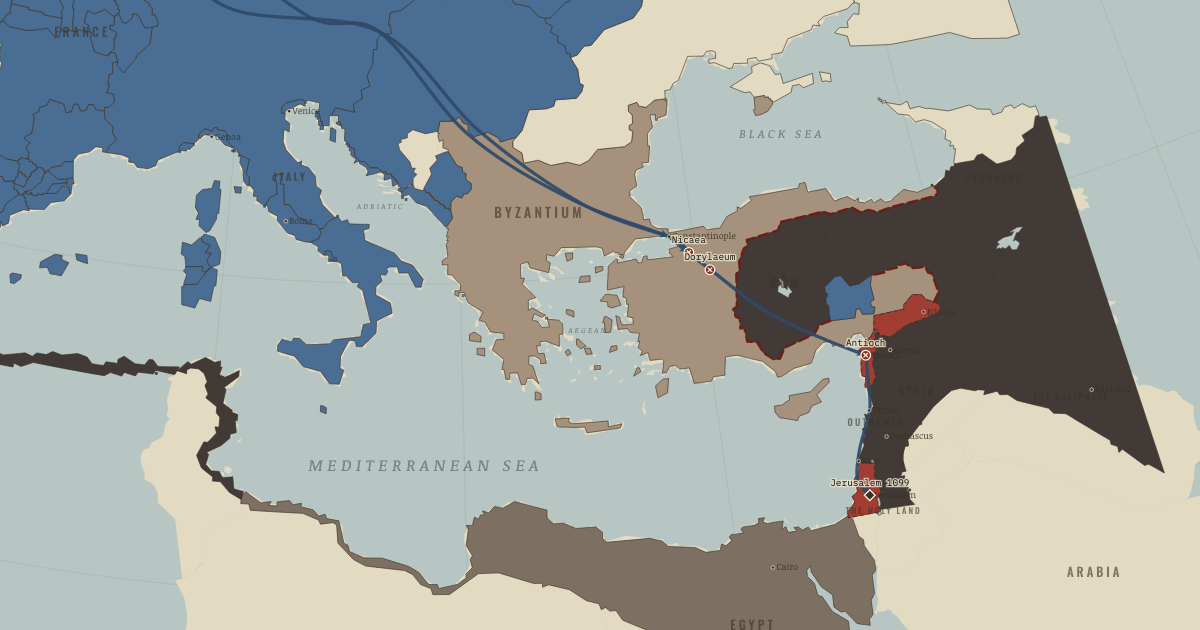
The map above is the world of The Crusades, 1099 — The four states appear.
Every state on the map that year: The world in 1100 · Europe in 1100.
Part of IB History: The Crusades →
SHORT EXPLANATION
Before the crusading armies reached the eastern Mediterranean, people in Europe became their victims. In 1096 bands moving through the Rhineland attacked Jewish communities at Speyer, Worms and Mainz, killing thousands, including people who refused baptism. Some bishops tried to shelter their Jewish neighbors, often without success. The victims were civilians. The popular forces known as the People’s Crusade then traveled ahead of the lords and were destroyed by Turkish forces near Nicaea.
The princes’ armies followed, better led and supplied, with Byzantine transport and markets helping them into Asia. They survived a desperate siege at Antioch and took Jerusalem in 1099, massacring many Muslim and Jewish inhabitants. Four Latin states emerged, collectively called Outremer, “the land beyond the sea.” The victory required endurance and assistance from outside; it also came at a moment when the crusaders’ opponents were deeply divided.
The full story
The call to fight enemies of Christ in the East gave some listeners a reason to attack Jews much closer to home. In spring 1096 armed bands descended on the communities of Speyer, Worms and Mainz, demanding conversion and killing thousands. Local bishops sometimes attempted to shelter Jewish residents, but their protection often failed. The victims were defenseless neighbors, not combatants. Understanding how the language of holy war was turned against them does nothing to justify the killings. The People’s Crusade continued east ahead of the princes and was destroyed by Turkish forces near Nicaea.
The armies that followed depended on allies as well as their own determination. Emperor Alexios ferried them into Anatolia, guided them and provided supplies. Later, Genoese and Pisan ships brought food and timber for the sieges. Cooperation with Byzantium nevertheless produced grievances. In 1097 Nicaea surrendered to the Byzantines by a private arrangement, depriving crusaders of the plunder they had expected after paying heavily for the expedition. They needed Alexios’s help and increasingly distrusted him.
After fighting at Dorylaeum, the crusaders spent eight months besieging Antioch. Taking the city did not end their ordeal. Within days Kerbogha arrived with a much larger relief army, leaving the hungry crusaders trapped inside the walls they had just captured. Their breakout succeeded partly because Kerbogha’s emirs mistrusted one another and failed to fight effectively together. The crusaders’ endurance brought them to the battle; divisions in the opposing coalition helped them win it.
On 15 July 1099 the crusaders stormed Jerusalem, killing many Muslim and Jewish inhabitants. Later descriptions of blood reaching horses’ bridles draw on biblical imagery and are not literal measurements; the massacre itself is well established. Four states of Outremer grew from the conquest. The conditions that made victory possible offered no lasting guarantee of security: Seljuk rulers had fought one another, Fatimid Egypt had recently retaken Jerusalem and initially considered the Franks a possible counterweight to Sunni rivals, and Kerbogha’s coalition had broken down. Few settlers now had to defend a long frontier. Their relations with Byzantium, the land connection to Europe, had also worsened as crusader lords kept cities they had sworn to return.
FULL EXPLANATION
The First Victims
The evidence for the Rhineland attacks comes from Hebrew chronicles, Latin accounts and legal records. Though they differ in detail, they describe organized killing, forced conversion and, in some communities, suicide under threat of conversion at Speyer, Worms, Mainz and other towns in 1096. Bishops sometimes tried to protect Jewish residents, often unsuccessfully. Several forces contributed: anti-Jewish preaching, resentment of debt and the prospect of plunder. The crusading appeal also gave some attackers a rationale for turning on people they considered enemies of Christ at home. Their victims were not soldiers in the eastern war. Their experiences deserve attention on their own terms, and memory of the killings became a foundational trauma in Ashkenazi Jewish history.
Why 1099 Was Not a Formula
What did the victory of 1099 prove? Later Christians could see it as a reward for faith, then interpret defeat on subsequent expeditions as punishment for sin. But the first army had benefited from circumstances that devotion alone could not reproduce. Seljuk succession disputes divided Anatolia and Syria; Fatimid Egypt retook Jerusalem from the Seljuks in 1098 and initially saw the Franks as a possible counterweight to Sunni rivals. At Antioch, Kerbogha’s coalition failed to hold together. Byzantine transport and supplies and Italian shipping kept the expedition moving and equipped for sieges. Belief and endurance mattered, but they do not explain either the supplies or the failure of opposing rulers to unite. The victory came through a particular combination of conditions, not a guarantee that the same commitment would always produce the same result.
Key places on the map
On this day
Why it happened
Muslim disunity, above all. The crusaders entered a region where potential opponents had their own conflicts. Seljuk heirs fought each other, Syrian emirs competed, and Fatimid Egypt retook Jerusalem from the Seljuks in 1098. Some emirs even sold supplies to the expedition. These divisions made a common defense difficult and gave the invaders an opening that a more united opposition might have closed.
Byzantine logistics and Italian fleets. Alexios transported the armies across the water, guided and fed them, even as distrust grew. Genoese and Pisan ships supplied food, timber and siege engines. The expedition needed these practical resources to reach and take Antioch and Jerusalem; conviction could not supply them on its own.
Zeal and the refusal to turn back. Many participants believed they were doing God’s work and continued despite starvation, disease and desertion. At Antioch the discovery of the Holy Lance strengthened morale in a desperate situation. Belief helped people endure, though it could not resolve the army’s problems of supply and command.
THE TURNING POINT
Antioch, June 1098 — the siege within a siege. The capture of Antioch in June 1098 reversed the siege without ending it. After eight months outside the city, the crusaders were themselves trapped inside, short of food, while Kerbogha’s much larger army waited beyond the walls. They broke out and won partly because his emirs mistrusted one another and did not fight effectively together. Their survival depended on both their own endurance and the weakness of the coalition facing them.
What it changed
Four states are born. The four Latin states emerged at different times: Edessa and Antioch in 1098, Jerusalem in 1099, and Tripoli consolidated by 1109. Together they formed Outremer, “the land beyond the sea,” shown on the map. The next chapter considers how a few thousand settlers governed these territories.
An impossible standard. Later expeditions were measured against the victory of 1099, and some contemporaries blamed defeat on the participants’ sins. Yet the political and military conditions of the first victory had changed. Treating success as proof of purity encouraged people to seek wrongdoing when a later army faced different enemies and alliances.
The Greek rupture deepens. Bohemond kept Antioch despite his oath to Alexios. His decision added to Latin and Byzantine grievances at a time when cooperation had already become strained. Relations worsened further before a later crusade turned against Constantinople.
A memory of blood. Over time, the massacre at Jerusalem entered Muslim memory and became part of the argument for resistance to the Latin states. Its consequences lay both in the lives destroyed and in the place the killing acquired in later accounts of the struggle.
DISCUSSION QUESTION — Why did the First Crusade succeed, and why did later expeditions face different conditions?
The first expedition reached the East when Seljuk heirs, Syrian emirs and the Fatimids were divided. It also benefited from surprise, Byzantine help and maritime supplies, while its participants endured immense hardship. Later expeditions faced different opponents and alliances. Zengi and Nur al-Din, followed by Saladin and the Mamluks, brought greater resources against the Latin states. Determination could not make a more coordinated defense disappear. Later campaigns had different aims and results, but distance from western Europe and the small settler population remained serious problems. The first crusade exploited an opportunity; it did not discover a repeatable formula.
An interesting fact
At Antioch the discovery of the Holy Lance encouraged believers, but the papal legate Adhémar was skeptical from the first. The dispute continued. In April 1099 at Arqa, Peter Bartholomew, who had found the relic, carried it between burning piles of wood to prove his claim. He died of his burns within a fortnight. Raymond of Aguilers, a chronicler who supported Peter, recorded the injuries.
Related
THE FREE PRINTABLE STUDY GUIDE
Get the printable study guide for The Crusades free. I’ll send you a few short letters, then one when a new atlas opens. That’s all. — Paul
NO TRACKING · YOUR ADDRESS IS USED FOR THE DISPATCH AND NOTHING ELSE · UNSUBSCRIBE ANYTIME