Decolonization of Africa · CHAPTER 7 ·
Africa after independence
Chapter 7 of The Decolonization of Africa, 1945–1994: “Building States from Colonies”
In 1963–64 the new Organisation of African Unity resolved to keep colonial borders as they stood. In Nigeria two coups in 1966 and anti-Igbo violence preceded Biafra’s secession in 1967, and the war that followed left perhaps a million dead, while across Africa coups multiplied as civilian governments failed to deliver.
Chapter 7 is included with every paid plan. WW2 is free in full, and chapter 1 of every atlas is free. A free account opens 3 more chapters a day. Starter, at $9 a month, opens all 21 with no daily limit — see the plans.
Free printable Decolonization of Africa study guide, sent by email ↓
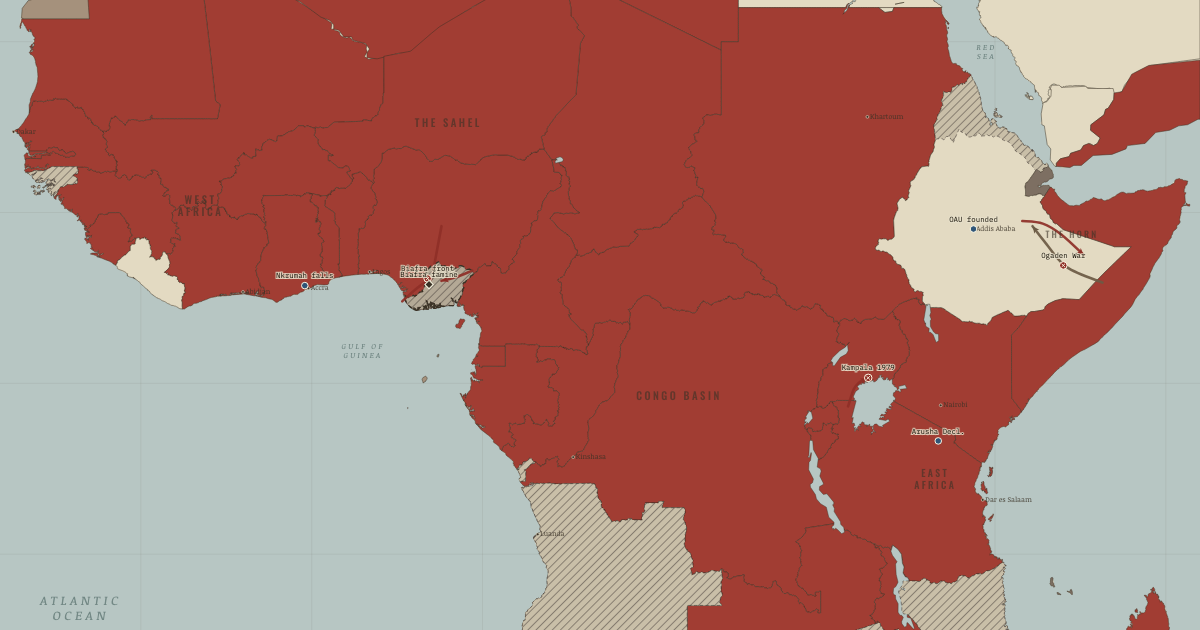
The map above is the world of Africa, 1966–68 — The enclaves — and Biafra.
Every state on the map that year: The world in 1970 · Europe in 1970.
Part of IB History: The Decolonization of Africa →
SHORT EXPLANATION
Independence left African governments with a difficult inheritance. European powers had drawn the borders and organized economies to serve Europe; the new leaders now had to make functioning countries within that framework. The Organisation of African Unity decided to keep the colonial frontiers, fearing that a change to one would invite claims against others. This offered states a fixed basis for building, while leaving divided peoples apart and millions in countries they had never agreed to form.
The danger within those borders became plain in Nigeria. Two coups in 1966 and pogroms against the Igbo preceded the secession of the oil-rich east as Biafra. Federal forces closed off the territory over three years; perhaps a million people, many of them children, starved behind the blockade. Elsewhere armies repeatedly seized power, and leaders such as Nyerere defended one-party rule as a way to prevent fragmentation. The results varied. Independence had brought both the opportunity to govern and hard choices about stability, justice and the capacity to govern.
The full story
The borders African leaders inherited had little claim to justice. Colonial powers had divided communities and joined others in states their inhabitants had not chosen. Yet the leaders who met in 1963–64 also had to consider what might happen if governments began to redraw those lines. Katanga had shown how destructive a secession could be; disputes over other frontiers might multiply such conflicts. They chose to protect the inherited borders. Most international frontiers held, even when governments were overthrown, and wars between African states remained rare. The decision left the pressures inside those frontiers for the new governments to confront.
The Organisation of African Unity expressed the decision through uti possidetis: colonial borders were to be inviolable. Its supporters hoped to prevent secessionist and irredentist claims from spreading into war across the continent. Its cost was also visible on the map. Somalis across five states, the Igbo and the Ewe remained divided by colonial lines, while citizens remained in states they had not consented to form. The bargain favored stability over justice, and its wisdom remains disputed.
Nigeria put the principle to a terrible test. Coups and anti-Igbo violence preceded Biafra's secession in 1967. Most African states backed the federation, whose forces gradually closed the enclave off over three years. The blockade was defended as a means of preserving unity; perhaps a million people died, many of them children who starved. Their famine deserves remembrance in its own right. The war also established a precedent against recognizing secession that lasted until Eritrea and South Sudan decades later.
Elsewhere the struggle to govern took different forms. Civilian governments faced expectations they could not readily fulfill, while armies were often the strongest national institutions colonial rule had left. Soldiers seized power repeatedly. Some leaders believed sincerely that competing parties would divide fragile nations and defended one-party government as a route to unity. Under Nyerere, Tanzania achieved unusual cohesion, but coercive villagization and a weak economy imposed serious costs. Neither the argument for unity nor the abuses committed in its name yields a single verdict on every country.
FULL EXPLANATION
Stability and justice at the border
The OAU's border principle, later summarized as uti possidetis, asked new states to retain their inherited administrative boundaries. Its attraction becomes clearer if we imagine the alternative confronting the leaders: almost any frontier could be challenged, and a successful secession might invite overlapping claims, mass expulsions and interstate war. Keeping the lines gave each government a known territory within which to build. Those lines were nevertheless products of imperial bargaining. They cut through communities such as the Somalis and enclosed groups that had never agreed to share a state. A fixed frontier could therefore leave a government with weak legitimacy, while non-interference protected rulers from outside challenge. International borders changed remarkably little, but civil wars and centralized repression imposed heavy costs within them. The architects accepted the harder work of nation-building inside inherited borders in exchange for far fewer wars to redraw them. Both the stability and its price belong in the assessment.
Why military takeovers became common
When civilian authority faltered, an army often possessed the means to act nationally: transport, communications, regular salaries and a chain of command. Civilian governments had thin revenues and faced enormous expectations. Commodity shocks and regional rivalries weakened them further, and where ruling parties closed constitutional routes to changing power, officers could claim that a coup was the only way to restore order. Each successful takeover lowered the threshold for another. This was a pattern of institutions, not evidence of an African disposition toward disorder. Outside patrons could reinforce it by rewarding strategically aligned rulers; Mobutu offers the clearest Cold War example. The one-party alternative also had a rationale: leaders feared that competing parties would follow ethnic and regional divisions. Tanzania shows what deliberate nation-building and a shared language could achieve, as well as how centralized development schemes could become coercive. Comparing those results tells us more than a single verdict on one-party rule.
Key places on the map
On this day
Why it happened
The border decision of 1964. In 1964 the OAU chose to protect inherited colonial borders under uti possidetis. The reasoning was preventive: once one frontier was reopened, other governments and movements might press rival claims, bringing secession and irredentist war. Keeping the lines had consequences of its own. Somalis across five states, the Igbo and the Ewe remained divided, and citizens stayed in countries they had never agreed to form. The choice put stability ahead of justice; whether that bargain was wise remains unsettled.
Economies shaped for export. A government could change the flag at independence more quickly than it could change the economy beneath it. Many states relied on a single commodity whose price was set in London or New York. They had no manufacturing, few skilled workers, and transport routes designed to carry resources to the coast. The 1960s “development decades” brought ambitious efforts to alter this inheritance: Nkrumah's Volta dam, Tanzania's villagization and Senegal's groundnuts. Many schemes failed or disappointed. Falling commodity prices then reduced government revenue, making political stability harder to maintain.
Why armies took power. More than forty coups had taken place by 1970. Armies could intervene because colonial governments had often left them better organized and resourced than other national institutions. Civilian politicians lost standing when economies failed, while single-party rule removed peaceful routes to a change of government. Ethnic and regional rivalries contained within colonial borders found no other outlet. Officers could present a takeover as a way “to restore order”. Some sought reform; more often the result was another strongman.
Françafrique and dependence. A formally independent government could still depend heavily on a former colonial power. France maintained influence through the CFA franc, defense pacts, troops and the personal networks known as “Françafrique”. These connections helped install and protect friendly rulers and allowed intervention against unfriendly ones. Nkrumah called the wider condition neo-colonialism: a country had a flag of its own while remaining economically subordinate. Several “independent” states were clients in practice, a relationship the map's red cannot show.
THE TURNING POINT
Addis Ababa & Cairo, 1963–64 — the borders are frozen. African leaders founded the OAU at Addis Ababa in 1963 and resolved at Cairo in 1964 to respect inherited frontiers. Few decisions did more to shape the structure of post-independence Africa. Wars over borders between African states have been remarkably rare, and the decision almost certainly prevented a continent of Katangas and Biafras. Yet the same settlement preserved colonial states, leaving their governments to forge unity inside boundaries they had not chosen. That work was often difficult and bloody, and the choice to hold the lines shaped nearly every conflict shown later on this map.
What it changed
Biafra and the cost of unity. When Biafra seceded, most African states supported the Nigerian federation. Defenders of the blockade presented it as the price of national unity; a million people starved. The war set a precedent against recognizing secession that held until Eritrea and South Sudan decades later. That political outcome cannot diminish the suffering of the children of Biafra.
The one-party argument. Nyerere, Kaunda and other leaders saw a danger in parties competing along the divisions of fragile new nations. They argued that one movement could provide the unity needed to govern. Some offered that argument in good faith; others used it to justify dictatorship for its own sake. Tanzania held together where other countries fractured, yet one-party states mostly failed to provide the development or unity they had promised.
Frontiers that largely held. Despite violence within states, Africa's international borders changed remarkably little after independence. The Somalia-Ethiopia and Uganda-Tanzania wars ended with frontiers restored rather than redrawn. The 1964 bargain thus helped preserve the boundaries its makers wanted to protect, even as conflict continued within them. Those boundaries also preserved injustices inherited from the colonial map.
DISCUSSION QUESTION — The OAU’s decision to keep colonial borders is defended as the guarantor of African peace and attacked as the freezing of colonial injustice. Weigh the case.
The case for keeping the borders begins with the danger of changing them. Katanga and Biafra, the era's two great secession attempts, were catastrophic; inter-state and secessionist wars have been strikingly rare given the arbitrariness of many lines. Fixed frontiers gave fragile states a frame in which to build and denied other ethnic claims the precedent of a successful breakaway. The case against begins with what those frontiers enclosed and divided. Europeans had drawn them for their convenience, splitting nations such as the Somalis across five states and placing hostile peoples together. The resulting problems of legitimacy, internal conflict and the “artificial state” endured, while non-interference could shield dictators. The decision probably prevented worse chaos in border wars, but it also locked in injustices whose costs were paid within states through civil wars and state failure. The leaders' choice was understandable and carried a heavy price.
An interesting fact
Julius Nyerere was known to Tanzanians as “Mwalimu,” the teacher. While leading the country, he translated Shakespeare into Swahili: Julius Caesar became Juliasi Kaizari in 1963, and The Merchant of Venice followed in 1969 as Mabepari wa Venisi, “The Capitalists of Venice.” The translations served a political as well as a literary purpose. Nyerere used Swahili to bring together more than a hundred language groups, and his work showed that the language could carry anything Europe's languages could.
Related
THE FREE PRINTABLE STUDY GUIDE
Get the printable study guide for The Decolonization of Africa free. I’ll send you a few short letters, then one when a new atlas opens. That’s all. — Paul
NO TRACKING · YOUR ADDRESS IS USED FOR THE DISPATCH AND NOTHING ELSE · UNSUBSCRIBE ANYTIME