MAPS OF HISTORY · IB HISTORY · TWO ROADS TO INDEPENDENCE
IB HISTORY · 1789 – 1978 · 12 CHAPTERS
IB History: Haiti and Kenya — notes, maps and essay plans
Haiti was made by the enslaved people of the richest colony on earth. Colonised Kenyans lost a war but won independence. The two cases ask how independence was won and what the manner of victory meant afterwards.
This page gathers the atlas’s IB notes: where each of its 12 chapters fits the syllabus, the concepts and evidence it supports, practice questions with model essay plans, primary sources, and starting points for the Internal Assessment.
WW2 is free in full, and chapter 1 of every atlas is free. A free account opens 3 more chapters a day. Opening a new atlas uses one of them. Membership opens all 21 — Join.
Where it fits the course
Every chapter’s IB notes name the parts of the course it serves. Across the atlas they add up to this: It is the paired atlas for the Paper 1 Focused Study Independence and Identity, whose page holds a free source-question set.
- Paper 1 · Independence and Identity · 12 CHAPTERS
- Paper 2 · Authoritarian Rule · 2 CHAPTERS
- Paper 2 · Conflict · 4 CHAPTERS
- Paper 2 · Popular Movements · 4 CHAPTERS
- Old course · World history topic 8: Independence movements (1800–2000) · 5 CHAPTERS
Chapter by chapter
Across its 12 chapters, the atlas holds 67 points of evidence and 40 primary sources. Here you can read all the evidence for chapters 1 and 2. For each later chapter there is one point and the practice question; the rest is in the atlas. Select a chapter title to open its free page and read the full explanation.
1. Saint-Domingue: The Richest Colony
CHAPTER 1 · 1789 · CONCEPTS: CAUSATION, PERSPECTIVES
EVIDENCE TO USE · ALL 6 POINTS (A FREE CHAPTER)
- In 1789 Saint-Domingue had about 465,000 enslaved people, alongside some 31,000 whites and 28,000 free people of colour. The enslaved outnumbered the free by roughly eight to one. Terror could enforce slavery, but it could not make that balance secure.
- Saint-Domingue was France’s most valuable colony. In 1789 it supplied roughly two-fifths of the sugar and three-fifths of the coffee consumed in Europe; its sugar production exceeded that of all Britain’s Caribbean islands combined.
- On the sugar estates, more enslaved people died than were born. To replace and expand their labor force, planters bought about 30,000 Africans a year in the late 1780s. Well over half the enslaved population, and perhaps two-thirds of its adults, had been born in Africa.
- The Code Noir of March 1685 treated enslaved people as movable property and prescribed branding and mutilation for runaways. It also promised food and clothing, but those provisions were rarely enforced. In practice, the law served the planters’ interests.
- About 28,000 free people of colour lived in the colony, and many owned land. Yet racial laws passed after the 1760s excluded them from many offices and professions. Their prosperity did not protect them from white rule, against which they had grievances of their own.
- John Thornton (1993) argues that many captives landed in the 1780s came from the Kingdom of Kongo, where civil war was underway. On this account, thousands of men on the plantations brought military experience and political ideas of their own.
2. The Revolution Crosses the Atlantic
CHAPTER 2 · 1789–1791 · CONCEPTS: CAUSATION, PERSPECTIVES, SIGNIFICANCE
EVIDENCE TO USE · ALL 5 POINTS (A FREE CHAPTER)
- Who gained rights under the National Assembly’s decree of 15 May 1791? Only men of colour born to a free father and a free mother: a few hundred people. Even that grant was cancelled on 24 September 1791.
- After returning from Paris, Vincent Ogé demanded rights for free men of colour. He led a few hundred armed men near Grande-Rivière in October 1790 and was broken on the wheel at Le Cap in February 1791.
- On 14 August 1791, enslaved drivers met on the Lenormand de Mézy estate. Tradition holds that a ceremony at Bois Caïman, probably on 21 August, bound the leaders together before the rising began on 22–23 August.
- By the end of 1791, the northern plain’s insurgents held the mountains around Le Cap and had destroyed more than a thousand sugar and coffee estates. Estimates of whites killed differ, ranging from some 400 to 2,000.
- The insurgent leaders Jean-François and Georges Biassou offered in December 1791 to help restore order in exchange for freedom for a few hundred of their officers. The offer gives us a measure of how limited the leadership’s early aims were.
3. Toussaint Louverture
CHAPTER 3 · 1793–1801 · CONCEPTS: CHANGE, SIGNIFICANCE, PERSPECTIVES
EVIDENCE TO USE · 1 OF 6
- On 29 August 1793, Commissioner Sonthonax proclaimed general emancipation in the North. The National Convention followed on 4 February 1794, abolishing slavery in all French colonies. The previous day it had seated Jean-Baptiste Belley, a formerly enslaved deputy.
Practice question: How important was Toussaint Louverture’s leadership to the defeat of Spain and Britain in Saint-Domingue between 1794 and 1798? Evaluate its importance.
5 more points of evidence, 4 primary sources and the model plan for this question are in the IB notes of chapter 3 in the atlas.
4. Napoleon’s Expedition
CHAPTER 4 · 1802–1803 · CONCEPTS: CAUSATION, CONSEQUENCE
EVIDENCE TO USE · 1 OF 6
- General Leclerc left Brest on 14 December 1801. In 1802–03, about 31,000 French soldiers landed in Saint-Domingue. Their orders were to disarm the colony’s Black army and send its generals to France.
Practice question: “Disease, not the Haitian army, defeated Napoleon’s expedition to Saint-Domingue.” How far do you agree with this assessment?
5 more points of evidence, 3 primary sources and the model plan for this question are in the IB notes of chapter 4 in the atlas.
5. Dessalines and the Making of Haiti
CHAPTER 5 · 1804–1820 · CONCEPTS: CHANGE, PERSPECTIVES, SIGNIFICANCE
EVIDENCE TO USE · 1 OF 6
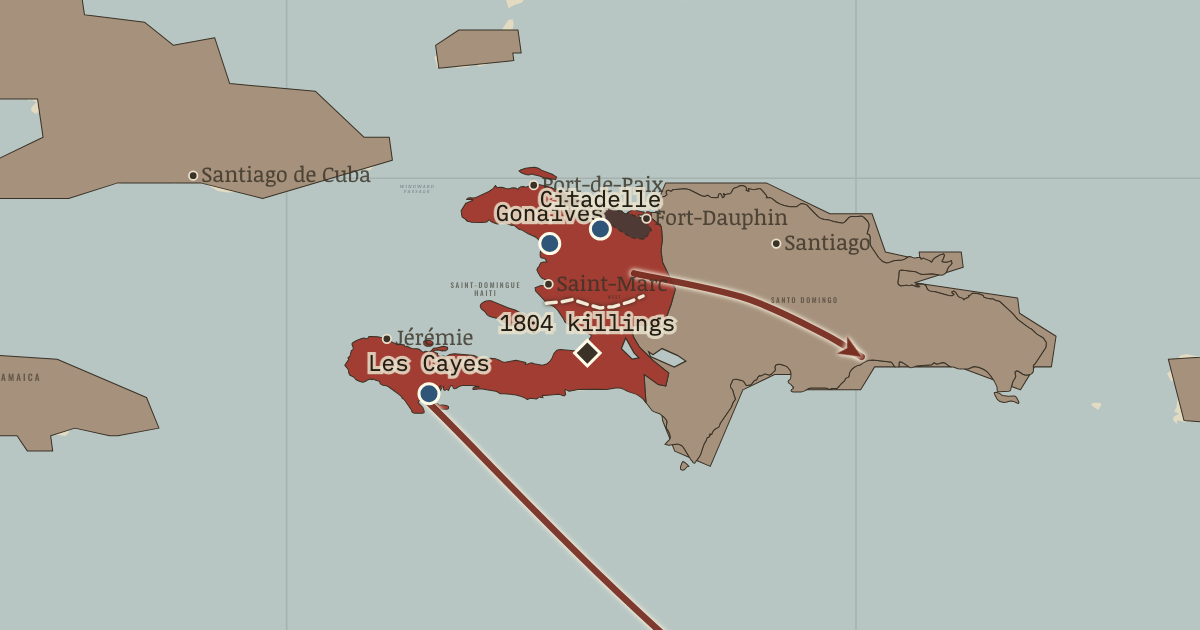
- At Gonaïves on 1 January 1804, Dessalines and his generals declared independence, renounced France for ever and gave the country the name Haiti. The new state was the first in the Americas founded by people who had freed themselves from slavery.
Practice question: Using the sources and your own knowledge, examine how Haiti’s founders defined membership of the new nation between 1804 and 1816.
5 more points of evidence, 4 primary sources and the model plan for this question are in the IB notes of chapter 5 in the atlas.
6. The Price of Recognition
CHAPTER 6 · 1825–1947 · CONCEPTS: CONSEQUENCE, CONTINUITY, SIGNIFICANCE
EVIDENCE TO USE · 1 OF 6
- On 17 April 1825, Charles X issued an ordinance granting Haiti “full and complete independence” if it paid 150 million francs in five yearly instalments and cut customs duties on French goods by half.
Practice question: How far did the indemnity of 1825 shape the development of the Haitian state up to 1915?
5 more points of evidence, 3 primary sources and the model plan for this question are in the IB notes of chapter 6 in the atlas.
7. The White Highlands
CHAPTER 7 · 1895–1939 · CONCEPTS: CAUSATION, CONSEQUENCE
EVIDENCE TO USE · 1 OF 6
- The Uganda Railway cost about £5.5 million, far more than the estimates presented to Parliament. Built from 1896 to 1901 by 31,983 workers recruited in British India, it needed to pay for itself; officials invited settlers to the highlands with that purpose in mind.
Practice question: How did colonial rule in Kenya create grievances that later fueled nationalism between 1895 and 1939?
5 more points of evidence, 4 primary sources and the model plan for this question are in the IB notes of chapter 7 in the atlas.
8. War, Land and the Oath
CHAPTER 8 · 1939–1952 · CONCEPTS: CAUSATION, CHANGE
EVIDENCE TO USE · 1 OF 5
- About 98,000 Kenyan Africans served in the Second World War. Among them were men of the 11th (East Africa) Division, which fought in Burma in 1944–45. Waruhiu Itote, later known as “General China”, was one of those who learned there that colonisers could be beaten.
Practice question: Why did constitutional nationalism in Kenya fail to prevent the turn to armed resistance between 1945 and 1952? Discuss.
4 more points of evidence, 3 primary sources and the model plan for this question are in the IB notes of chapter 8 in the atlas.
9. The Emergency
CHAPTER 9 · 1952–1960 · CONCEPTS: CONSEQUENCE, PERSPECTIVES, SIGNIFICANCE
EVIDENCE TO USE · 1 OF 6
- Kenyatta and five KAU leaders stood trial at Kapenguria from December 1952 to April 1953. They received sentences of seven years’ hard labour. In 1958, the key witness, Rawson Macharia, swore that he had been bribed.
Practice question: Evaluate the effects of the Kenya Emergency (1952–1960) on the people of central Kenya.
5 more points of evidence, 4 primary sources and the model plan for this question are in the IB notes of chapter 9 in the atlas.
10. The Road to Uhuru
CHAPTER 10 · 1960–1963 · CONCEPTS: CHANGE, CAUSATION
EVIDENCE TO USE · 1 OF 5
- At the first Lancaster House conference, held from January to February 1960, Kenya received a 65-seat Legislative Council with an elected African majority. Settlers would no longer dominate its politics.
Practice question: “Kenya’s independence was granted by Britain, not won by Kenyans.” Discuss.
4 more points of evidence, 3 primary sources and the model plan for this question are in the IB notes of chapter 10 in the atlas.
11. Challenges after Independence
CHAPTER 11 · 1963–1978 · CONCEPTS: CONTINUITY, CONSEQUENCE
EVIDENCE TO USE · 1 OF 5
- In 1962, Somali-speaking northerners told a British commission that they wanted to join Somalia. They went on to fight the Shifta War of 1963–67, which ended with the Arusha Memorandum of 28 October 1967.
Practice question: How far did Jomo Kenyatta rely on methods inherited from colonial rule to maintain power between 1963 and 1978?
4 more points of evidence, 3 primary sources and the model plan for this question are in the IB notes of chapter 11 in the atlas.
12. Two Independences Compared
EPILOGUE · 1804–2025 · CONCEPTS: PERSPECTIVES, CONSEQUENCE, CONTINUITY
EVIDENCE TO USE · 1 OF 5
- Haiti’s army destroyed French power in 1803. Yet recognition from France came only in 1825, after Haiti accepted an indemnity of 150 million francs. Kenya, by contrast, joined the United Nations days after independence in December 1963.
Practice question: Compare and contrast the ways in which Haiti and Kenya achieved independence.
4 more points of evidence, 3 primary sources and the model plan for this question are in the IB notes of chapter 12 in the atlas.
Practice questions and essay plans
Each chapter closes with a practice question and a model plan. The plan gives a thesis, three points with evidence and a link back to the question, a counter-argument and a judgement. Chapter 1’s plan appears here in full. The other plans are outlined here and given in full in the atlas.
PAPER 2 · TWO ROADS TO INDEPENDENCE · CHAPTER 1
Why was Saint-Domingue vulnerable to revolution by 1789? Examine the reasons.
Saint-Domingue’s wealth depended on a vast, mainly African-born enslaved population held under extreme violence. The same system left the colony vulnerable, while racial divisions and resentment of France divided free society. Those divisions later created an opening for the enslaved to use.
The sugar economy created a population that the colony could not securely control.
EVIDENCEMore enslaved people died than were born, and planters bought about 30,000 Africans a year. Of the approximately 465,000 enslaved people, well over half—and perhaps two-thirds of the adults—were African-born. Many had military experience from Kongo’s wars.
LINKAgainst about 59,000 free people stood a majority with memories of freedom and war. For the free minority, this was a permanent danger.
Law and violence sustained slavery, while giving people reasons to resist it.
EVIDENCEThe Code Noir of 1685 classified the enslaved as movable property and prescribed mutilation for runaways. Yet maroon communities survived in the mountains, and the Makandal conspiracy of the 1750s showed that resistance could be organized.
LINKThe regime relied on terror rather than consent. If its armed defenders became divided, it had no reserve of consent to fall back on.
Free people were divided both by color and by resentment of France.
EVIDENCERacial laws passed after the 1760s barred about 28,000 free people of colour from many offices. White planters had a different grievance: they resented the exclusif, the law that forced them to trade with French merchants.
LINKThe crisis in France in 1789 gave each free group grievances to press, but left none able to rely on the others.
The planters’ wealth could also pay for the suppression of revolt, as in Jamaica. Vulnerability did not make revolution inevitable. Saint-Domingue had survived earlier conspiracies, and its divisions might have remained manageable for decades without the French Revolution.
The deepest vulnerability lay in a wealthy system that depended on an African-born majority held down by terror. Revolution came when the crisis in France divided the free and created an opening. A strong answer should therefore give the structural danger priority while treating those divisions as the trigger.
Read the chapter behind this plan: Saint-Domingue: The Richest Colony.
PAPER 2 · TWO ROADS TO INDEPENDENCE · CHAPTER 3
How important was Toussaint Louverture’s leadership to the defeat of Spain and Britain in Saint-Domingue between 1794 and 1798? Evaluate its importance.
Toussaint’s leadership was the most important single factor. He built an army and made alliances that gave French emancipation the force of a military victory. Yet he relied on conditions he had not created: yellow fever, Spain’s departure from the war, and the emancipation policy that secured his army’s loyalty to the Republic.
Toussaint created a disciplined army and kept it together.
Toussaint used diplomacy to deal with his rivals.
His opponents were also weakened by forces outside his control.
The evidence for each point, the counter-argument and the judgement are in the IB notes of chapter 3 in the atlas. Read the chapter first: Toussaint Louverture.
PAPER 2 · TWO ROADS TO INDEPENDENCE · CHAPTER 10
“Kenya’s independence was granted by Britain, not won by Kenyans.” Discuss.
Britain did control the timing and setting of decolonization, but that is only part of the story. Kenyans created pressures under which Britain decided to leave, and their parties helped determine the settlement, from Kenyatta’s release to majimbo. The statement gives too little weight to their actions.
Britain controlled the process.
Kenyans made staying too costly.
Kenyan parties shaped the terms.
The evidence for each point, the counter-argument and the judgement are in the IB notes of chapter 10 in the atlas. Read the chapter first: The Road to Uhuru.
PAPER 2 · TWO ROADS TO INDEPENDENCE · CHAPTER 4
“Disease, not the Haitian army, defeated Napoleon’s expedition to Saint-Domingue.” How far do you agree with this assessment?
Disease destroyed the French army, but the war continued because French policy convinced people in Saint-Domingue that they faced re-enslavement. The political turn of 1802 was decisive: former slaves and free people of colour united under Dessalines, giving fever and the blockade time to complete the defeat.
Yellow fever took a devastating toll on the French.
French policy brought together the resistance needed to continue the war.
The Haitian army secured victory in the final battles.
The evidence for each point, the counter-argument and the judgement are in the IB notes of chapter 4 in the atlas. Read the chapter first: Napoleon’s Expedition.
Primary sources
Before reading a primary source, it helps to know where it came from and its context. Each chapter’s IB notes provide both. Here are the sources from chapter 1 in full.
TEXT · CHAPTER 1
The Code Noir (Edict on the policing of the islands of French America)
- CREATOR
- Louis XIV, King of France
- DATE
- March 1685
- ORIGIN
- Royal edict, registered in Saint-Domingue in 1687; articles 38 and 44
Context. The Code Noir was the royal law governing slavery in the French colonies for a century. Historians debate how far its few protections, including rations and limits on punishment, were applied.
Translation: Maps of History, from the French text of 1685 · original ↗
TEXT · CHAPTER 1
Declaration of the Rights of Man and of the Citizen, Articles 1, 2 and 17
- CREATOR
- National Constituent Assembly of France
- DATE
- 26 August 1789
- ORIGIN
- Declaration adopted by the Assembly in Versailles; printed and circulated throughout France and its colonies
Context. News of the Declaration reached Saint-Domingue in autumn 1789. It mentioned neither the colonies nor slavery. Planters could cite its defence of property; the enslaved and free people of colour could cite liberty, equality and resistance to oppression.
Translation: Maps of History, from the French text of 1789 · original ↗
DATA · CHAPTER 1
Saint-Domingue in numbers, c. 1789
- CREATOR
- Maps of History, compiled from published data
- DATE
- Figures for 1784–1791
- ORIGIN
- Census figures published by Moreau de Saint-Méry (1797) and the Slave Voyages database, as analysed by James Sweet (2024)
Context. Colonial officials and planters collected the census figures. They had reasons to under-report the enslaved population to reduce a head tax.
| Group or measure | Figure |
|---|---|
| Enslaved people (official count) | c. 465,000 |
| Enslaved people (Geggus reconstruction, 1791) | c. 510,000 |
| Whites | c. 31,000 |
| Free people of colour | c. 28,000 |
| Africans landed, 1784–1791 | c. 263,000 (about 33,000 a year) |
| Share of arrivals from West Central Africa, 1784–1791 | c. 44% |
Data: Moreau de Saint-Méry 1797; slavevoyages.org; Sweet, The Americas 81:2 (2024) · original ↗
Every other source in the atlas (37)
- Chapter 2: The Revolution Crosses the Atlantic
- View of the forty days of fire on the plantations of the plain of Cap-Français Jean-Baptiste Chapuy, after a drawing by Jean-Louis Boquet · 1795
- Who counted as a citizen? French decisions on the colonies, 1790–1794 Maps of History, compiled from the decrees · 1790–1794
- Declaration of the Rights of Man and of the Citizen, Article 6 (as cited by free people of colour) National Constituent Assembly of France · 26 August 1789
- Chapter 3: Toussaint Louverture
- Proclamation of general emancipation in the North Léger-Félicité Sonthonax, Civil Commissioner of the French Republic · 29 August 1793
- Proclamation from Camp Turel Toussaint Louverture · 29 August 1793
- Constitution of the French colony of Saint-Domingue, Articles 3, 4, 5 and 14 Central Assembly of Saint-Domingue, convened by Toussaint Louverture · Adopted 9 May 1801; proclaimed 7–8 July 1801
- Title page and portrait from Histoire de Toussaint-Louverture Cousin d’Avallon (author); engraver unnamed · 1802 (Year XI)
- Chapter 4: Napoleon’s Expedition
- Toussaint Louverture’s words on boarding Le Héros, as recorded by a French general Pamphile de Lacroix (memoir); words attributed to Toussaint Louverture · June 1802 (published 1819)
- Law on the maintenance of slavery in the colonies restored by the Treaty of Amiens, Articles 1 and 3 French Legislative Body under the Consulate of Napoleon Bonaparte · 20 May 1802 (30 Floréal Year X)
- Legionaries at San Domingo January Suchodolski · Painted in the nineteenth century (dated 1854 on the museum record)
- Chapter 5: Dessalines and the Making of Haiti
- Act of Independence and Proclamation of the General-in-Chief to the people of Haiti Jean-Jacques Dessalines and the generals of the Indigenous Army; drafted by Louis Boisrond-Tonnerre · 1 January 1804
- Imperial Constitution of Haiti, Articles 12, 13 and 14 Jean-Jacques Dessalines, Emperor, and the generals of the army · 20 May 1805
- Constitution of the Republic of Haiti, Articles 38 and 44 Constituent assembly of Alexandre Pétion’s republic · 2 June 1816
- Printed broadside of the Haitian Declaration of Independence Government press, Port-au-Prince · 1804
- Chapter 6: The Price of Recognition
- Royal ordinance concerning the French part of Saint-Domingue, Articles 1–3 Charles X, King of France; countersigned by the Comte de Chabrol, Minister of the Navy · 17 April 1825
- His Majesty Charles X the Well-Beloved recognising the independence of Saint-Domingue Anonymous French engraver · 1825
- Measuring the indemnity: what each estimate counts Maps of History, compiled from published estimates · Estimates published 2003–2023
- Chapter 7: The White Highlands
- Crown Lands Ordinance, 1915, section 86(1), as quoted by the Kenya Land Commission East Africa Protectorate (ordinance); Kenya Land Commission (report) · Ordinance of 18 May 1915; report of September 1933, published 1934
- The Native Registration Ordinance (Bill), sections 2, 3 and 12 Government of the East Africa Protectorate · Published 6 January 1915; enacted as Ordinance No. 15 of 1915 and enforced from 1919–20
- Indians in Kenya: Memorandum (the Devonshire Declaration) British Government (Duke of Devonshire, Colonial Secretary) · July 1923
- Paying coolies at railhead; Railhead mile 141½; Tsavo bridge (Uganda Railway album) Unknown photographer for the Uganda Railway · 1898 (one view dated 31 March 1898)
- Chapter 8: War, Land and the Oath
- Report of the Kenya Land Commission on the legal position of African land Kenya Land Commission (chaired by Sir Morris Carter) · September 1933; published May 1934
- The Emergency Powers Order in Council, 1939, sections 3(1) and 6 British Government (Order made by the King in Council) · 9 March 1939 (amended 1952)
- Statement on the State of Emergency in Kenya Oliver Lyttelton, Secretary of State for the Colonies · 21 October 1952
- Chapter 9: The Emergency
- Historical Survey of the Origins and Growth of Mau Mau (the Corfield Report), Summary of Conclusions F. D. Corfield, for the Government of Kenya · May 1960
- Emergency statistics to the end of 1956 (official) set beside later estimates Maps of History, compiled from the Corfield Report and later scholarship · Official figures 1960; estimates 2005–2007
- Speech in the Commons debate on the Hola camp report Enoch Powell, Conservative MP for Wolverhampton South West · 27 July 1959
- King’s African Rifles on patrol during the Kenya Emergency British official photographer (Ministry of Defence) · Between 1952 and 1956
- Chapter 10: The Road to Uhuru
- Kenya (Annexation) Order in Council, 1920 British Government (Order made at Buckingham Palace, 11 June 1920) · Made 11 June 1920; published 23 July 1920
- Tanganyikan children holding signs demanding the release of Kenya’s Jomo Kenyatta Photographer for the Colonial Office information service · March 1961
- Kenya’s constitutional steps, 1957–1964 Maps of History, compiled from Hansard and electoral records · 1957–1964
- Chapter 11: Challenges after Independence
- President Jomo Kenyatta at State House, Nairobi Photography department, Israel Government Press Office · 15 June 1966
- Land after independence: the White Highlands and the Million-Acre Scheme Maps of History, compiled from published figures · 1939–1971
- From independence to one-party rule, 1963–1982 Maps of History, compiled from published histories · 1963–1982
- Chapter 12: Two Independences Compared
- Statement on the settlement of Mau Mau claims William Hague, Secretary of State for Foreign and Commonwealth Affairs · 6 June 2013
- Citadelle Laferrière, northern Haiti, from the air SPC Gibran Torres, United States Army · 28 April 2010
- Two independences compared Maps of History, compiled from the chapters of this atlas · 1791–1978
Internal Assessment starting points
Each starting point is an idea for an investigation: a question, the concept it tests, the kinds of sources you could use and where they are held, and one caution. The investigation must be your own work, and your teacher approves the question.
How far did payments on the 1825 indemnity shape Haitian state finances from 1825 to 1883?
CONCEPTConsequence
SOURCESTreaties and ordinances; Haitian budget statements; French bondholder records; the New York Times data set of 2022.
WHERE TO FIND THEMGallica (Bibliothèque nationale de France) for the Moniteur and pamphlets; Archives nationales and Caisse des dépôts archives, Paris; Digithèque MJP for treaties.
CAUTIONDistinguish the payments Haiti made from estimates of what it might have earned. Estimates of the latter depend on assumptions about counterfactual growth.
How reliable is Pamphile de Lacroix’s 1819 memoir as evidence for the French expedition of 1802–1803?
CONCEPTPerspectives
SOURCESLacroix’s Mémoires; letters of Leclerc to Napoleon (published editions); Haitian accounts by Madiou and Ardouin.
WHERE TO FIND THEMInternet Archive and Gallica for the 1819 edition; Service historique de la Défense, Vincennes, for military correspondence.
CAUTIONSet the memoir beside documents written at the time. Identify where Lacroix was not an eyewitness, since those passages require a different assessment.
How did British officials and newspapers report Haiti’s independence in 1804?
CONCEPTPerspectives
SOURCESColonial Office correspondence from Jamaica; London newspapers of 1804; the printed declaration found by Julia Gaffield.
WHERE TO FIND THEMUK National Archives, Kew (CO 137); British Newspaper Archive; Gale Burney Collection.
CAUTIONBritish reports served Britain’s interests in the war with France. Consider that perspective when using them for the facts they report.
How far did the Kenya Land Commission of 1932–1934 respond to Kikuyu claims to alienated land?
CONCEPTCausation
SOURCESThe Commission’s report (Cmd. 4556) and evidence volumes; KCA petitions; later testimony.
WHERE TO FIND THEMInternet Archive (Cmd. 4556); Kenya National Archives, Nairobi; UK National Archives (CO 533).
CAUTIONThe Commission framed claims in colonial legal terms. Compare that framing with the claimants’ own descriptions of their losses.
Why did the Hola killings in March 1959 cause a crisis in the British Parliament?
CONCEPTSignificance
SOURCESHansard debates of June–July 1959; newspaper reports; the Fairn and Cowan papers where available.
WHERE TO FIND THEMHistoric Hansard (Open Parliament Licence); UK National Archives (FCO 141 migrated archives; CO 822).
CAUTIONThis is a memorial subject. Treat the victims with care, and avoid sensational detail.
How far did the Swynnerton Plan reward loyalists in Kenya’s Central Province between 1954 and 1960?
CONCEPTConsequence
SOURCESThe Swynnerton Plan (1954); district land consolidation reports; published oral histories.
WHERE TO FIND THEMKenya National Archives; UK National Archives (FCO 141); university oral-history collections.
CAUTIONLand records may conflict with oral memories. Where they do, explain how you weigh the evidence.
How has Kenya’s public memory of Mau Mau changed since 1963?
CONCEPTChange
SOURCESSpeeches of Kenyan presidents; memorials (Kimathi statue, 2007; Uhuru Park memorial, 2015); newspapers; school textbooks.
WHERE TO FIND THEMDaily Nation and Standard digital archives; Kenya Gazette for the 2003 lifting of the ban; Hansard for the 2013 statement.
CAUTIONPublic memory is political. Ask who shaped each version and why.
Revision tools
The atlas ends with a map quiz that asks you to find places and moments on the map itself (part of every plan from Starter up). The quick quiz and the discussion questions with our answers are free pages on this site, and the printable study guide gathers every chapter’s notes into one document for revision.
Read next
- The Haitian Revolution in the Age of Revolutions · THE AGE OF REVOLUTIONS
- The decolonization of Africa, 1945–1994 · THE DECOLONIZATION OF AFRICA
Maps of History is independent and is not affiliated with or endorsed by the International Baccalaureate Organization. IB course names describe alignment only; paper, theme and section names follow the new course outline and may change when the final guide is published.
THE DISPATCH
Get the printable study guide for Two Roads to Independence free. I’ll send you a few short letters, then one when a new atlas opens. That’s all. — Paul
NO TRACKING · YOUR ADDRESS IS USED FOR THE DISPATCH AND NOTHING ELSE · UNSUBSCRIBE ANYTIME