Haiti and Kenya independence · CHAPTER 8 ·
Origins of the Mau Mau uprising
Chapter 8 of Two Roads to Independence: Haiti 1789–1838 and Kenya 1895–1978: “War, Land and the Oath”
Between 1939 and 1952 Kenyan politics turned from petitions to a secret oath of loyalty to the land and freedom movement officials called Mau Mau. Nearly 100,000 Kenyan Africans served in the Second World War, while settler-run councils cut squatters’ plots and herds and pushed thousands back to the reserves.
Chapter 8 is included with every paid plan. WW2 is free in full, and chapter 1 of every atlas is free. A free account opens 3 more chapters a day. Starter, at $9 a month, opens all 21 with no daily limit — see the plans.
Free printable Haiti and Kenya independence study guide, sent by email ↓
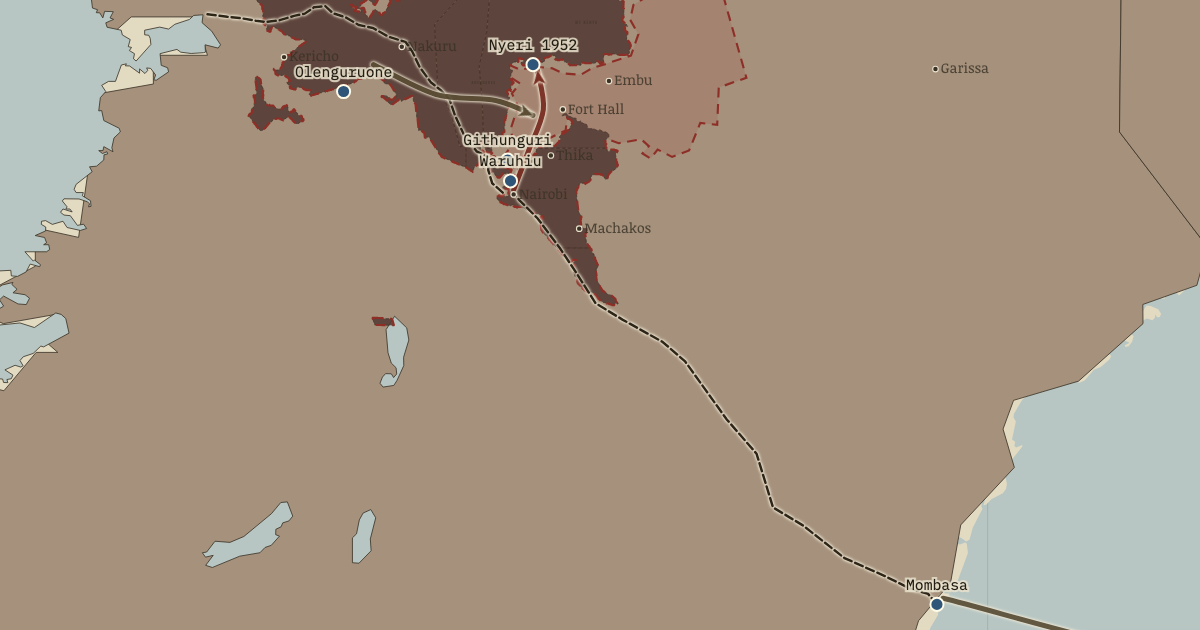
The map above is the world of Kenya, 1950–52 — The oath spreads.
Every state on the map that year: The world in 1950 · Europe in 1950.
Part of IB History: Haiti and Kenya →
SHORT EXPLANATION
After the Second World War, the question of Kikuyu land grew more urgent. The Kikuyu, Kenya’s largest people, farmed the central highlands around Mount Kenya and had lost more land to settlers than any other community. Nearly 100,000 Kenyan Africans had served in the war, some as far away as Burma, and returned with raised expectations. Yet settler-run councils in the Rift Valley, the great valley west of Nairobi lined with European farms, were reducing the plots and herds of squatters. These Kikuyu families worked on farms in return for plots, much like sharecroppers. Thousands were sent back to reserves—lands set aside for African farming, much like Native American reservations—which were already too crowded to feed them. The squeeze reached every Kikuyu family.
There was a peaceful political route. Jomo Kenyatta returned from Britain in 1946 and soon led the Kenya African Union (KAU), which petitioned for land and elected seats much as a modern civil-rights organization might petition a government. Settlers dominated the Legislative Council, the colony’s parliament-like law-making body. Africans had a few appointed members and no elected seat until 1957, and KAU’s petitions won almost nothing.
Another commitment was taking hold: the oath, a secret pledge of loyalty to the movement for land and freedom that officials would call Mau Mau. Sworn in a Kikuyu ceremony, it bound members much as a soldier’s enlistment oath does. From 1951 Nairobi union militants spread it through the reserves; the breathing red perimeter shows its reach by 1952. Gunmen killed Waruhiu, the leading government-appointed Kikuyu chief, on 7 October. Two weeks later the new governor declared a State of Emergency, suspending normal law much like martial law. The failure to secure change through petitions had helped those prepared to fight gain the initiative.
The full story
The Second World War took Kenyan soldiers far beyond the colony. About 98,000 Kenyan Africans enlisted, most in the King’s African Rifles, Britain’s East African regiment. The 11th (East Africa) Division fought into Burma in 1944–45, following the route shown by the arrow leaving Mombasa, Kenya’s main port. Waruhiu Itote, later the forest commander known as “General China”, fought beside British soldiers. Veterans had seen their colonizers frightened and beaten; the claim that Europeans were naturally invincible had become harder to sustain.
Homecoming brought a different lesson. Every African man still had to carry the kipande, an identity document like an internal passport. The Kikuyu, the largest people in Kenya and the highland farmers who had lost most land to settlers, had lost an organized political voice when the government banned the Kikuyu Central Association in 1940. Wartime experience had widened expectations, while colonial rules remained in place.
Meanwhile the bargain on settler farms was breaking down. Around 200,000 people lived in Kikuyu squatter families in 1945, working as labor tenants in return for land, much like sharecroppers. Settlers enriched by wartime prices wanted their farms back. Under a 1937 law, settler-run councils could reduce squatters’ cattle and crops; after the war thousands were sent along the arrow from Rift Valley farms into the reserves. These lands set aside for Africans, much like Native American reservations, were already overcrowded. A family removed from a farm could not assume that enough land awaited it there.
At Olenguruone, a government settlement on the Mau escarpment—the Rift Valley’s forested western wall—Kikuyu families had been placed on land claimed by the Maasai. They resisted rules that treated them as tenants on probation. Around 1943 the oath of unity was administered there to women and children for the first time, binding members to their movement as firmly as an enlistment oath. Holdouts were evicted in 1948–49 and deported in 1950 to Yatta, a dry plateau east of Nairobi. Olenguruone showed that displaced families could be moved again, even from a government settlement; its oath also supplied a way to bind a movement together.
Constitutional nationalism offered another course: pursue self-rule through parties, petitions and elections. The Kenya African Union sought land and elected seats and made Kenyatta president in June 1947. He also ran the teachers’ college at Githunguri, built by Kikuyu parents independently of Christian missions. But a land petition taken to London in 1951 won nothing. As constitutional demands went unanswered, the oath spread faster.
In June 1951 trade unionists Fred Kubai and Bildad Kaggia captured KAU’s Nairobi branch and formed a secret committee called Muhimu (“important”). Along the red arrow, it carried the oath into Kiambu, Fort Hall and Nyeri. Officials and the press called the movement Mau Mau. At Nyeri on 26 July 1952 Kenyatta told a huge crowd that KAU was not Mau Mau, although many listening had already taken the oath. Then, on 7 October, Senior Chief Waruhiu, the most prominent government-appointed chief, was shot dead. The government concluded that it faced rebellion; the room for moderates to stand between the sides was disappearing.
FULL EXPLANATION
Did the veterans make Mau Mau?
Veterans appear prominently in early accounts of Mau Mau, and some certainly helped lead it. Nairobi’s Forty Group, the Anake a 40 (“young men of 1940”), took its name from the year in which many members underwent circumcision—the initiation making a Kikuyu boy an adult—or were called up. Waruhiu Itote described how Burma changed his understanding of race and empire in “Mau Mau” General (1967). But prominent examples do not tell us what most veterans did. Timothy Parsons in The African Rank-and-File (1999), and David Killingray with Martin Plaut in Fighting for Britain (2010), point out that most of the 98,240 Kenyans who enlisted returned home and stayed out of politics. Some joined the Home Guard, the loyalist Kikuyu militia fighting the rebels. Veterans supplied some commanders, military skills and a sharp sense of injustice. The movement’s mass base was young and landless: evicted squatters, unemployed Nairobi men and families in crowded reserves. War intensified grievances that were already present.
The squatters’ road to rebellion
Before 1945, Tabitha Kanogo argues in Squatters and the Roots of Mau Mau (1987), squatters were partly independent farmers. Settlers needed their labor and squatters needed land; each had something the other wanted. After the war councils used the Resident Native Labourers Ordinance of 1937 to cut cattle and cultivation and turn the families into wage workers. Those who refused were sent to reserves where they had no land rights. What awaited them there? David Throup’s Economic and Social Origins of Mau Mau (1987) describes another squeeze. Officials imposed conservation rules on overcrowded farms, including compulsory terracing—earth steps dug across hillsides to keep rain from washing away soil. Much of this unpaid work fell on women, making the state hated in Fort Hall and Kiambu. Kanogo’s and Throup’s accounts meet at the reserves: people pushed off settler farms encountered people already under pressure there, and the oath linked them.
What the oath meant, and what the name hides
The movement’s own words bring its ambitions into view. Fighters seldom called themselves Mau Mau; they preferred Kenya Land and Freedom Army and the slogan ithaka na wiyathi, land and freedom. In “The Moral Economy of Mau Mau” (1992), John Lonsdale reads wiyathi as self-mastery: the standing of an adult who has earned land through work. Landlessness, on this interpretation, denied that adult standing itself. The oath organized loyalty in stages, with a unity oath for the mass of members and the batuni, or platoon, oath for fighters. Its power was not always voluntary: many were forced to swear, planting civil war within the rebellion. The origin of the name Mau Mau is unknown; suggestions include a children’s word game and a mishearing of muma (oath). Detainee J. M. Kariuki argued that colonial authorities chose a savage-sounding label that denied the movement a cause. The name appeared in official reports around 1948, and the movement was banned in August 1950.
Key places on the map
On this day
Why it happened
Petitions that won nothing. KAU asked for elected African seats and the return of alienated land—the colonial term for African land taken for European settlement. Its ability to show results was limited. Settlers dominated the Legislative Council, African elections did not come until 1957, and a petition taken to London in 1951 was rebuffed. A landless family asked to wait could see little reward for patience. Younger men began looking elsewhere for a way to change their position.
The squatters’ bargain broke. For thirty years squatters had exchanged labor for land on settler farms. After 1945 councils reduced their cattle and cultivation, and settlers evicted those who resisted; thousands went to reserves where they held nothing. Even families already displaced to Olenguruone were evicted again in 1948–50. Their experience came to symbolize a government that could move people at will. With no secure land in sight, rebellion carried less to lose.
Crowded reserves and compulsory work. Returning squatters found little room in the reserves, where Kikuyu farms had been divided into ever smaller plots. Officials trying to combat erosion imposed terracing—earth steps across hillsides—and other rules. Women often performed the required work without pay. In Fort Hall and Kiambu conservation became a source of resentment, and chiefs who enforced the rules and often prospered became targets. Families whose sons had gone to war now faced closer policing in the countryside.
A generation that had seen the world. Nearly 100,000 Kenyan Africans served in Ethiopia, Madagascar, Ceylon and Burma. Abroad they saw that their rulers could be frightened and defeated; at home they encountered the same pass and land laws. Most veterans stayed out of politics. Some, including Waruhiu Itote, brought organizing skills to Nairobi militant groups, contributing confidence and discipline that officials had not expected.
THE TURNING POINT
The Kiambu road, 7 October 1952. On 7 October 1952 Senior Chief Waruhiu was killed in his car near Gachie, seven miles from Nairobi. He was the government’s most prominent Kikuyu ally. Sir Evelyn Baring, who had arrived as governor only on 30 September, took the killing as evidence that rebellion was under way. He declared a State of Emergency on 20 October; that night Operation Jock Scott began arresting Kenyatta and some 180 suspected leaders on a list. The killing pushed both sides toward violence and revealed a division within Kikuyu society itself. Loyal chiefs and oath-takers would confront one another in a civil war within the wider conflict.
What it changed
The Emergency begins. The Emergency of 20 October 1952 gave the government powers resembling martial law: it could detain people without trial, ban meetings and, later, shoot on sight in forest areas. British troops arrived by air within days. Officials expected the emergency to last weeks; it continued until January 1960. The resulting counter-insurgency—a war against a guerrilla movement—became the largest in Britain’s African empire. The next chapter follows it.
Kenyatta becomes a prisoner and a symbol. The government arrested Kenyatta on the first night and tried him at Kapenguria for managing Mau Mau. He always denied the charge, which historians now doubt. Prison removed him from the movement’s decisions, but gave Kenya’s factions a leader each could claim. Nine years later the man presented by the government as the rebellion’s organizer emerged as the only figure able to unite the nationalists and negotiate an end to colonial rule.
Kikuyu turned against Kikuyu. The oath had already divided Kikuyu communities: those who swore, willingly or under force, stood against chiefs, Christians and landholders who refused. After October 1952 these divisions hardened into armed opposition between forest fighters and the Home Guard. Daniel Branch’s account of a Kikuyu civil war within a colonial war has shaped historians’ understanding of the Emergency.
DISCUSSION QUESTION — Why did constitutional nationalism fail to contain the oath between 1946 and 1952?
KAU asked people to pursue change through constitutional politics, but had little success to show them. Settlers dominated the Legislative Council, London moved slowly, and petitions for land and elected seats returned empty. Officials treated the oath as a crime without addressing the land crisis that fed it. Evicted squatters, families in crowded reserves and unemployed young men in Nairobi formed a constituency with little to lose. Kenyatta faced a further difficulty inside KAU: he needed militant energy and could not afford a break. His denunciations of Mau Mau at Nyeri and Kiambu were too guarded for the government and too hostile for the movement. Historians emphasize different parts of this story: Throup stresses colonial misgovernment, Kanogo the squatters’ crisis, and Branch divisions within Kikuyu society. Together they show why men promising to take change could gain support when moderate leaders could not deliver it.
An interesting fact
Kikuyu parents invested in schools as well as land claims. Their independent schools grew from the quarrel with missions over female circumcision in 1929–31. In 1939 the American-educated Peter Mbiyu Koinange founded the Kenya Teachers College at Githunguri to train their teachers; Kenyatta later ran it. That year 63 schools taught 12,964 pupils. By 1952 parents were paying for more than 400 schools. The government closed every one when the Emergency began.
Related
THE FREE PRINTABLE STUDY GUIDE
Get the printable study guide for Two Roads to Independence free. I’ll send you a few short letters, then one when a new atlas opens. That’s all. — Paul
NO TRACKING · YOUR ADDRESS IS USED FOR THE DISPATCH AND NOTHING ELSE · UNSUBSCRIBE ANYTIME