Crusades · CHAPTER 5 ·
Second Crusade
Chapter 5 of The Crusades, 1095–1291: “Zengi, Nur al-Din, and the Second Crusade”
In 1144 Zengi of Mosul and Aleppo captured Edessa, the most exposed crusader state, and his son Nur al-Din invoked jihad to unite Syria. The Second Crusade, preached by Bernard of Clairvaux in 1146 and led by Conrad III and Louis VII, was worn down in Anatolia and abandoned its siege of Damascus after four days in 1148.
Chapter 5 is included with every paid plan. WW2 is free in full, and chapter 1 of every atlas is free. A free account opens 3 more chapters a day. Starter, at $9 a month, opens all 21 with no daily limit — see the plans.
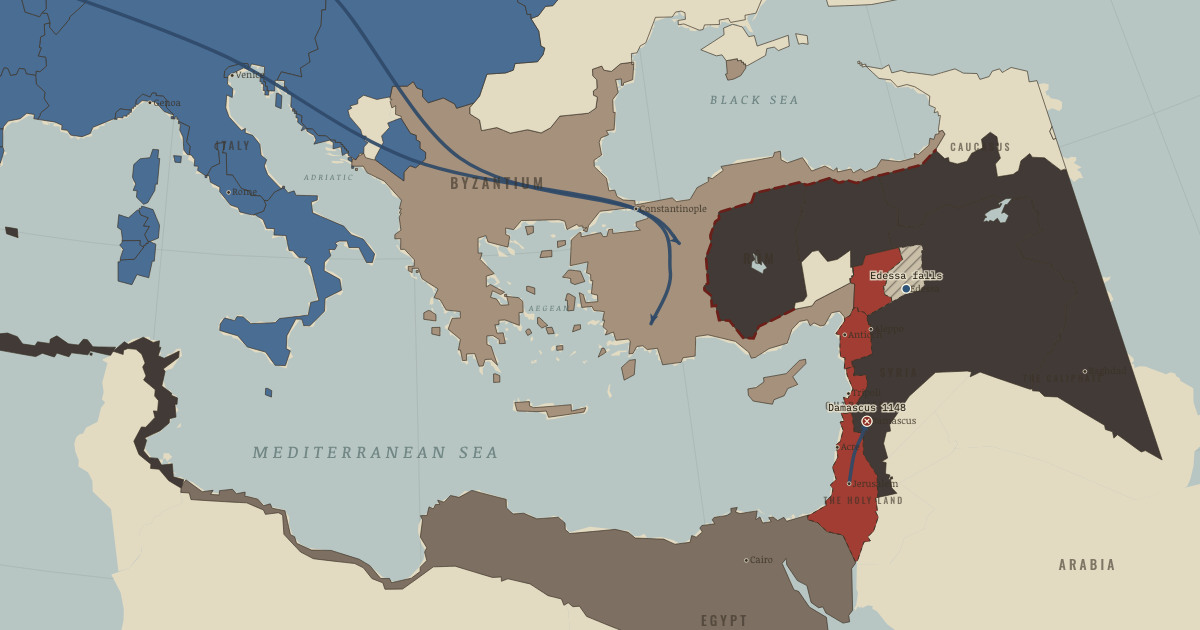
The map above is the world of The Crusades, 1144 — Edessa falls to Zengi.
Part of IB History: The Crusades →
SHORT EXPLANATION
In 1144 Zengi, the Turkish ruler of Mosul and Aleppo, captured Edessa. The county stood farther inland than the other crusader states, beyond easy help from the Italian fleets. Its loss removed a Latin state and gave Muslim rulers a victory to rally around. Zengi’s son Nur al-Din would tie the recovery of Jerusalem to his own rule in Syria, using the language of jihad, a religiously sanctioned struggle.
The Second Crusade brought two reigning kings east for the first time, but their armies suffered heavily in Anatolia. In 1148 the survivors attacked Damascus, an independent power that had helped contain Nur al-Din. They withdrew after four days. Damascus subsequently sought his protection, and he took the city in 1154. The expedition had left Outremer in a weaker political position.
The full story
The county of Edessa occupied an exposed place among the four crusader states. It lay deep inland, far from the coast where Italian fleets could bring relief, and its security depended heavily on divisions among its Muslim neighbors. When Zengi captured the city on Christmas Eve 1144, the Franks lost a northern stronghold and the emerging Muslim counter-crusade gained a victory to proclaim. The capture of the city and the loss of the county were distinct events, but together they exposed the vulnerability of the northern frontier.
A common campaign against the Franks had to be built. Muslim rulers had interests of their own, and rivalry among them had sometimes brought them into alliance with the Franks. Nur al-Din, Zengi’s son, supported scholars and preachers and commissioned monuments that linked the defense of Islam and the recovery of Jerusalem to his expansion. Poets, jurists and rulers gave religious meaning to the struggle. That meaning could attract support for war against the Franks and strengthen Nur al-Din’s claim to rule over Muslim rivals.
The news of Edessa also brought a response from Europe. Bernard of Clairvaux preached the Second Crusade at Vézelay in 1146, and Conrad III of Germany and Louis VII of France led their armies east. Two kings brought prestige and substantial forces, but they did not provide a single command. In Anatolia, Seljuk attacks struck the long columns, hunger weakened them, and mutual suspicion complicated relations with the Byzantines whose lands they crossed. Both armies suffered badly before reaching the Levant.
There the surviving leaders had to choose where to fight. In 1148 they besieged Damascus, a wealthy and apparently reachable city. Yet Damascus was also hostile to Nur al-Din, and its independence had helped balance his power. Western leaders knew little of local diplomacy, while the barons of Outremer had interests and rivalries of their own. The sources disagree about why the siege ended after four days. Afterward Damascus sought Nur al-Din’s protection; in 1154 he took it.
The contrast with the First Crusade is striking. The earlier expedition had benefited from divisions among its enemies; the second struggled to combine its own forces and damaged a relationship useful to the kingdom it had come to help. Some crusaders understood the defeat as God’s punishment for their sins. The campaign also shows what military strength could cost when its commanders failed to coordinate and misread the alliances around them.
FULL EXPLANATION
Jihad as State-Building
The crusaders did not encounter a single Muslim response in 1099. Rulers competed with one another, and some found it useful to ally with Franks against Muslim rivals. Zengi and, more deliberately, his son Nur al-Din worked to change those conditions. They sought power within the Muslim world as well as victories against the crusader states. Court historians, jurists, preachers and public works connected that expansion with the defense of Islam and the recovery of Jerusalem. Fighting the Franks could thus become part of a ruler’s claim to legitimate authority. The word jihad had older and broader meanings, including inner moral struggle; in this setting it also served a war of unification. There is a resemblance to Urban’s appeal, though the circumstances were different: a sacred purpose could give political conquest the force of religious duty. This language did more than conceal ambition. It recruited support and made it possible to portray Muslim rivals as obstacles to a holy cause. Saladin later inherited both the institutions and the account of their purpose.
Why Attack Damascus?
Damascus presented the crusaders with a difficult choice. It was wealthy, and conquest may have seemed both profitable and attainable. Yet it was also a major Muslim power hostile to Nur al-Din, whose independence helped check him. Why, then, did the leaders attack it? Latin and Arabic sources are partial and often contradict one another. Proposed explanations include factional politics in Jerusalem, distrust of Damascus, hopes of an easy conquest, and confusion after the besiegers changed position. Hostile accounts also allege bribery, a charge difficult to establish. No single secret cause can safely be selected from these accounts. Western commanders arrived with limited knowledge of local diplomacy, and Outremer’s barons had their own ambitions and rivalries. The consequences are easier to trace: the siege failed after four days, Damascus sought Nur al-Din’s protection, and he took the city in 1154. Reinforcements sent from afar had damaged a relationship that had helped keep the kingdom secure.
Key places on the map
On this day
Why it happened
Edessa’s fatal exposure. Edessa stood deepest inland of the four states, far from the coast and relief by the Italian fleets. Divisions among its neighbors had helped protect it. Zengi’s capture in 1144 exposed the weakness of that position and cost the Franks their northernmost county.
The counter-crusade, constructed. Nur al-Din tied his pursuit of authority in Syria to the defense of Islam. His support for scholars and promotion of Jerusalem and holy war gave people reasons to join a campaign against the Franks and accept his rule. Urban’s crusade had likewise shown the power of sacred purpose, in different circumstances.
Distrust, Latin and Greek. Conrad and Louis led separate armies without a shared command. Relations with the Byzantines were marked by mutual suspicion, and coordination was poor as the armies crossed Byzantine lands. Seljuk attacks and shortages compounded their difficulties. The First Crusade had benefited from its enemies’ divisions; the second suffered from divisions of its own.
THE TURNING POINT
Edessa, 24 December 1144. Edessa’s capture on 24 December 1144 removed a northern Latin state and supplied a victory around which Muslim rulers could rally. It prompted a new crusade in Europe. Nur al-Din’s consolidation and Saladin’s later rise had other causes, but the fall marked a turn from Frankish advance toward a formidable Muslim counteroffensive.
What it changed
Damascus lost to the enemy. Independent Damascus had helped balance Nur al-Din. After the failed siege it sought his protection, and in 1154 he took the city. His increased power in Syria left Outremer less secure.
Crusading discredited. The failure of an expedition led by kings brought humiliation and recrimination in Europe, and damaged Bernard’s reputation. Some blamed the crusaders’ sins for the defeat; that explanation would return after later failures.
The road to Saladin. Nur al-Din’s Syrian power later sent an expedition to Egypt. A young Kurdish officer, Yusuf, known as Saladin, went with it. The consolidation that followed Edessa, and that the Second Crusade failed to reverse, helped make his rise possible.
DISCUSSION QUESTION — Why did the Second Crusade fail where the First Crusade had taken Jerusalem?
The First Crusade had benefited from surprise, Byzantine help and divisions among its enemies. The Second faced stronger Muslim opposition and mistrust between crusaders and Byzantines, sharpened by memories of Antioch. Conrad and Louis also failed to coordinate their armies, which suffered heavily in Anatolia. In the Levant the survivors attacked Damascus, whose independence had helped contain Nur al-Din. The reasons for that decision remain disputed, but the failed siege damaged a useful relationship. Some crusaders blamed their sins; the campaign also reveals the costs of divided command and poor knowledge of local alliances.
An interesting fact
Zengi’s victory at Edessa did not give him long to build on it. In September 1146, while he besieged Qalat Jabar, a Euphrates fortress held by fellow Muslims, his servant Yarankash stabbed him in his sleep. Ibn al-Athir says Zengi had caught the servant drinking his wine and threatened to punish him in the morning. The Mosul chronicler’s assessment of Zengi was mixed: he was a tyrant feared by his people, yet his rule brought order and kept the strong from devouring the weak.
Related
THE FREE PRINTABLE STUDY GUIDE
Get the printable study guide for The Crusades free. I’ll send you a few short letters, then one when a new atlas opens. That’s all. — Paul
NO TRACKING · YOUR ADDRESS IS USED FOR THE DISPATCH AND NOTHING ELSE · UNSUBSCRIBE ANYTIME