Decolonization of Africa · CHAPTER 5 ·
Year of Africa
Chapter 5 of The Decolonization of Africa, 1945–1994: “The Year of Africa”
In 1960 seventeen African states became independent, the largest burst of decolonization in history, among them most of French Africa, the Belgian Congo and Nigeria. France’s 1956 loi-cadre had already installed elected African governments, and Guinea’s 1958 rejection of de Gaulle’s offer showed a break could be survived.
Chapter 5 is included with every paid plan. WW2 is free in full, and chapter 1 of every atlas is free. A free account opens 3 more chapters a day. Starter, at $9 a month, opens all 21 with no daily limit — see the plans.
Free printable Decolonization of Africa study guide, sent by email ↓
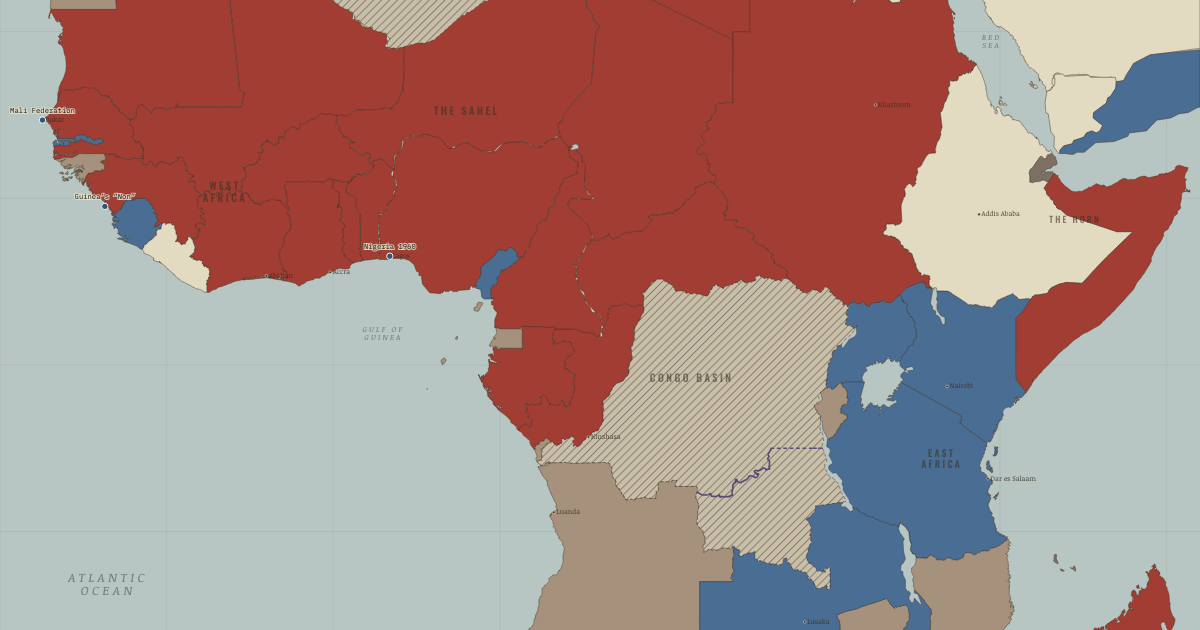
The map above is the world of Africa, 1960 — The Year of Africa.
Every state on the map that year: The world in 1960 · Europe in 1960.
Part of IB History: The Decolonization of Africa →
SHORT EXPLANATION
Seventeen African states became independent in 1960, the largest single burst of decolonization in history. Within a few months sovereignty came to most of French Africa, the Belgian Congo, British Nigeria and Italian Somaliland. The timing had an administrative explanation: French reforms had already put elected African governments and ministers in office. It also reflected a change in expectations. Ghana and Guinea had shown that independence was possible, and a growing membership at the United Nations expected colonial rule to end.
Independence was an immense achievement, but the new governments took over the institutions and economies their rulers had left them. Colonial borders enclosed peoples who had never chosen to live together; one or two export commodities sustained many economies, and administrations had few trained staff. Nigeria negotiated a federal bargain for its large and diverse population. The Belgian Congo received almost no preparation, and its disastrous transfer showed how much the terms of colonial rule could matter after independence.
The full story
Why did so many African territories reach independence in the same year? Part of the answer lies in a French law passed four years earlier. The 1956 loi-cadre gave elected territorial assemblies and African executives real authority. Leaders including Houphouët-Boigny and Senghor had already governed as ministers. When sovereignty arrived, several territories had governments ready to receive it; the change of flag completed a transfer of power already well advanced.
Guinea had taken a more dangerous route. In 1958 de Gaulle offered France’s colonies autonomy within a French Community, with immediate separation for any territory voting no. Guinea alone refused the Community. France retaliated by removing everything it could carry, but Guinea survived. The other territories accepted autonomy, then found the Community hollow and demanded full independence within two years.
These choices changed the setting in which later decisions were made. Ghana had shown that Britain would transfer power, and the UN General Assembly was growing more hostile to colonialism. As independence became the expected outcome, a government that held on had more to explain. Both superpowers, meanwhile, courted the states about to be born.
Nigeria’s leaders faced a different problem: how could one government hold together such a large and varied population? Their answer was a federation of three great regions. The arrangement kept the country together for six years, but the divisions it was meant to manage also marked the fault line of a later rupture.
The new states carried their concerns into international politics. The class of 1960 gave the Afro-Asian bloc a permanent majority in the General Assembly. There its members pressed against apartheid and Portuguese colonialism and supported non-alignment. Decolonization and anti-racism became central questions for the international system as well as for individual countries.
FULL EXPLANATION
How independence gained momentum
One independence could alter the prospects of another. Ghana showed that Britain would transfer power; Guinea showed that immediate separation from France could survive punitive retaliation. Each new UN member strengthened the anti-colonial majority in the General Assembly and gave diplomatic cover to movements still fighting. What had seemed exceptional became easier to expect. Colonial governments had reasons to reconsider their choices too. A negotiated withdrawal could preserve trade and influence more cheaply than a war. In French Africa the loi-cadre had already placed African ministers and assemblies in government, reducing the administrative gap at transfer. Together these changes help explain why so many transfers came close together. A cascade did not mean a single experience. Nigeria negotiated a federation, Cameroon had a hidden war, and Belgium left the Congo abruptly. Momentum accelerated several processes at once, while the policies of each empire helped determine how stable the handovers proved.
What did “too soon” mean?
The claim that independence came too soon deserves examination. Colonial governments controlled education, senior appointments and political participation; they then cited the resulting shortage of trained Africans as a reason to continue ruling. Belgium’s Congo was an extreme example. More time under the same system could have postponed accountability without providing genuine preparation. The shortage was nevertheless a real problem for the governments taking office. They needed trained officials, revenue systems that worked and accepted rules for competition between regions. Immediate sovereignty came with inherited weaknesses; a longer colonial apprenticeship was a promise that might never be honored. The cases show why speed alone cannot settle the question. Several French territories already had experienced ministers. Nigeria negotiated elaborate federal arrangements. The Congo had a rushed transfer after decades of deliberate exclusion. The time available, and the preparation accomplished within it, differed from one case to another.
Key places on the map
On this day
Why it happened
The framework law and African governments. France’s 1956 loi-cadre made elected territorial assemblies and African executives responsible for real affairs. Houphouët-Boigny and Senghor were among the leaders who gained ministerial experience before independence. Several territories therefore had African governments in place when sovereignty came in 1960. The formal handover could follow quickly because much of the transfer of authority had already happened.
Guinea’s “Non”. In 1958 de Gaulle offered France’s African colonies autonomy in a French Community; a vote against it meant immediate separation. Guinea alone voted no. France removed everything it could carry in retaliation, yet Guinea survived. Its example and the Community’s evident hollowness encouraged the other territories to demand full independence within two years. De Gaulle chose to let them go, preferring willing partners to sullen ones.
A changing international climate. By 1960 new General Assembly members had made anti-colonialism a global majority position. In December the UN passed Resolution 1514, declaring that colonialism must end. Both superpowers also courted the new states. The expectation had changed since 1945: independence was becoming the normal outcome, and holding out increasingly exceptional.
Independence creates momentum. Ghana, Guinea and the Congo had each become independent. Their examples made the next transfer easier to imagine and harder to refuse; no French or British territory wanted to be the colony still waiting. Nationalist pressure and colonial calculations reinforced one another, giving the movement momentum beyond any one territory.
THE TURNING POINT
Lagos, 1 October 1960 — Nigeria becomes independent. Nigeria lowered the Union Jack on 1 October 1960. Africa’s most populous nation brought some 250 peoples together in a federation of three regions, within borders drawn by others. The federal bargain was an attempt to make that large, plural country a democratic state. It held for six years. Then the regional divisions it had been designed to manage broke into coup and civil war (Chapter 7). Nigeria’s midnight showed how much independence promised, and how demanding the work of holding a state together would be.
What it changed
New voices at the UN. The states that became independent in 1960 helped give the Afro-Asian bloc a permanent majority in the UN General Assembly. They used that platform to oppose apartheid and Portuguese colonialism and to support non-alignment. Their presence brought decolonization and anti-racism to the center of world politics, changing the international system as well as their own countries.
Borders and political strain. Each of the seventeen states inherited colonial borders. Some enclosed peoples who had never chosen to live together, while others divided peoples between countries. The new governments had to make political communities within those lines. The Congo would face that test within days, Nigeria within six years.
The work after independence. The ceremonies of 1960 raised hopes of development, dignity and unity. Governments had to pursue those aims through economies still shaped by colonial rule: single crops, no industry and ports facing Europe. The distance between the promise and the inherited structures helps explain the coups, one-party states and disappointments of the later 1960s.
DISCUSSION QUESTION — Why did seventeen countries become independent in the single year 1960 — and was the speed a triumph or a problem?
The transfers clustered for several reasons. France’s loi-cadre had already placed African governments in office, so much of the handover came before the flag changed. Guinea survived separation and exposed the weakness of de Gaulle’s Community; within two years autonomy gave way to full independence across French Africa. At the UN and among both superpowers, independence became the expected outcome. Each transfer helped make the next possible. This was an epochal, largely peaceful liberation, and its speed also left difficult problems. New states inherited colonial economies, arbitrary borders, shallow institutions and tiny educated classes, with almost no time to build the foundations they needed. The Congo, in the next chapter, shows the catastrophic end of that range. A slower transition might have built stronger states, but it might also have prolonged colonial rule under another name. The question remains open.
An interesting fact
Michael Taiwo Akinkunmi was a twenty-three-year-old Nigerian student in England when his design won the 1959 flag competition, against nearly three thousand entries. The judges removed the red sun he had placed on the central band, leaving the green-white-green flag. In December 1960 the UN General Assembly passed Resolution 1514, declaring that colonialism must end, by 89 votes to 0. Nine countries abstained, among them Britain, France, Portugal, Spain, Belgium, South Africa and the United States, in a chamber transformed by the Year of Africa.
Related
THE FREE PRINTABLE STUDY GUIDE
Get the printable study guide for The Decolonization of Africa free. I’ll send you a few short letters, then one when a new atlas opens. That’s all. — Paul
NO TRACKING · YOUR ADDRESS IS USED FOR THE DISPATCH AND NOTHING ELSE · UNSUBSCRIBE ANYTIME