MAPS OF HISTORY · IB HISTORY · THE CRUSADES
IB HISTORY · 1095 – 1291 · 12 CHAPTERS
IB History: The Crusades — notes, maps and essay questions
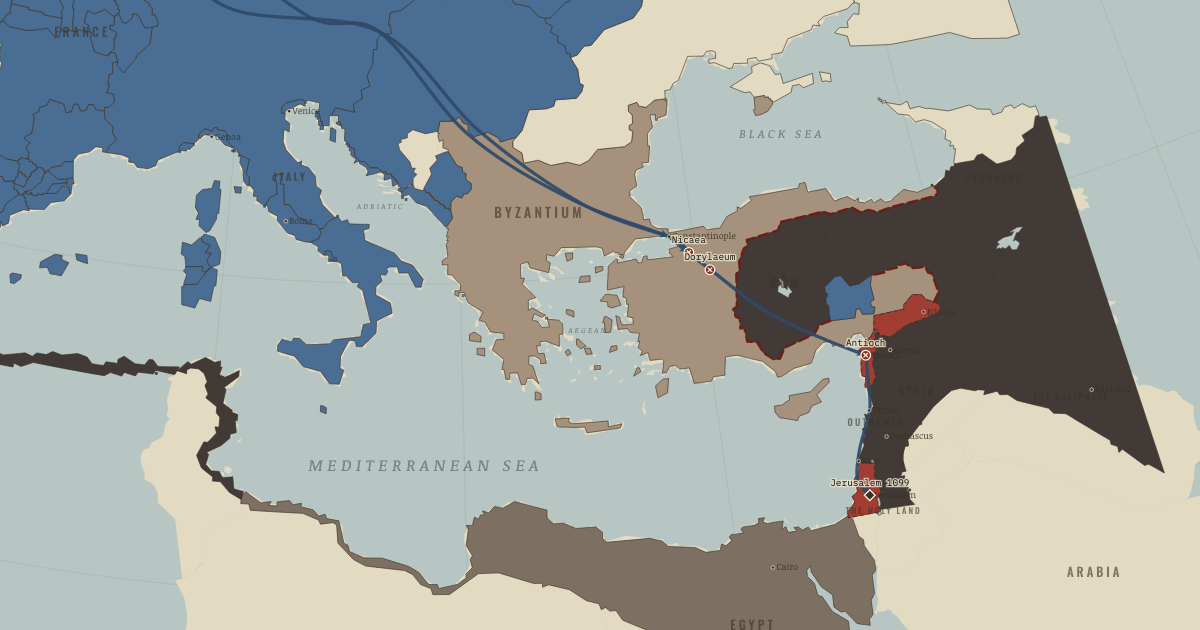
Why did half of Europe march east? Follow what they built and burned there, and what two centuries of contact changed on every shore of the Mediterranean.
IB notes for this atlas are in preparation. Meanwhile, this page gathers the study notes every one of its 12 chapters already carries: why each episode happened, the moment it turned on, what it changed, and the question historians still argue about. It also shows where the atlas fits the IB course.
WW2 is free in full, and chapter 1 of every atlas is free. A free account opens 3 more chapters a day. Opening a new atlas uses one of them. Membership opens all 21 — Join.
Where it fits the course
The atlas is filed under Paper 2 (Conflict) and Paper 3 for Higher Level (Africa and the Middle East). Its IB notes, with evidence lists, primary sources and model essay plans, are in preparation. These are the IB History pages for the parts of the course it serves:
Why it began
The opening chapters offer explanations for how this story began. Their arguments about the causes appear here in a few sentences each, ready to test against your own reading.
Chapter 1: Three Civilizations, One Sea
Manzikert and the Byzantine appeal. The defeat at Manzikert in 1071 was followed by the loss of much of Anatolia, a region that had supplied Byzantium with food and soldiers. Alexios I Komnenos sought Western mercenaries to recover it. Urban’s appeal brought tens of thousands east, pursuing a holy war with aims of their own. The emperor had asked for troops to employ; the movement he received was far harder to direct.
The Seljuk fracture. After Malik-Shah died in 1092, his heirs and their atabegs fought over his realm. Rival emirs held Syria, while the Sunni-Shia division set Baghdad apart from Fatimid Cairo. These rulers had reasons to distrust one another when the expedition arrived. A united defense might have stopped it at the frontier; their divisions made such a response harder to organize.
The reform papacy and the Peace of God. Gregorian reform had strengthened a papacy able to make demands on kings. The Peace and Truce of God movements, meanwhile, tried to limit knights’ private wars. Urban joined papal authority to a new purpose for those warriors: fighting eastward could become an act of penance.
Jerusalem and the pull of pilgrimage. Pilgrims already traveled in growing numbers to Jerusalem, the center of the medieval Christian map. Urban’s armed journey drew on that practice as well as apocalyptic expectations and the promise of remission of sins for those who died on the road. These hopes gave the expedition a religious force beyond an ordinary call to political service.
Chapter 2: The First Crusade
Muslim disunity, above all. The crusaders entered a region where potential opponents had their own conflicts. Seljuk heirs fought each other, Syrian emirs competed, and Fatimid Egypt retook Jerusalem from the Seljuks in 1098. Some emirs even sold supplies to the expedition. These divisions made a common defense difficult and gave the invaders an opening that a more united opposition might have closed.
Byzantine logistics and Italian fleets. Alexios transported the armies across the water, guided and fed them, even as distrust grew. Genoese and Pisan ships supplied food, timber and siege engines. The expedition needed these practical resources to reach and take Antioch and Jerusalem; conviction could not supply them on its own.
Zeal and the refusal to turn back. Many participants believed they were doing God’s work and continued despite starvation, disease and desertion. At Antioch the discovery of the Holy Lance strengthened morale in a desperate situation. Belief helped people endure, though it could not resolve the army’s problems of supply and command.
Chapter by chapter
These entries trace the atlas through 12 chapters, identifying the causes and turning point of each. Select a title to open its free chapter page, where the full explanation, a discussion question and the map appear together.
1. Three Civilizations, One Sea
CHAPTER 1 · THE WORLD OF 1095
Why it happened: Manzikert and the Byzantine appeal · The Seljuk fracture · The reform papacy and the Peace of God · Jerusalem and the pull of pilgrimage
The turning point: Clermont, 27 November 1095.
2. The First Crusade
CHAPTER 2 · 1096–1099
Why it happened: Muslim disunity, above all · Byzantine logistics and Italian fleets · Zeal and the refusal to turn back
The turning point: Antioch, June 1098 — the siege within a siege.
3. A Society on the Edge
CHAPTER 3 · OUTREMER
Why it happened: The tyranny of numbers · The maritime bargain · Coexistence as necessity
The turning point: Ascalon, 1153 — the high-water mark.
4. Europe’s First Standing Institutions
CHAPTER 4 · THE MILITARY ORDERS
Why it happened: The demographic gap demanded permanence · Papal privilege built a supranational body · The need to move money safely
The turning point: Krak des Chevaliers — permanence in stone.
5. Zengi, Nur al-Din, and the Second Crusade
CHAPTER 5 · 1144–1149
Why it happened: Edessa’s fatal exposure · The counter-crusade, constructed · Distrust, Latin and Greek
The turning point: Edessa, 24 December 1144.
6. Saladin
CHAPTER 6 · 1171–1187
Why it happened: The union of Egypt and Syria · Legitimacy, manufactured · The crusaders’ self-destruction
The turning point: The Horns of Hattin, 4 July 1187.
7. The Third Crusade
CHAPTER 7 · 1189–1192
Why it happened: The shock of 1187 · The logistics of holding Jerusalem · Exhaustion, personal and political
The turning point: Arsuf, 7 September 1191.
8. The Fourth Crusade — The Wrong Ending
CHAPTER 8 · 1202–1204
Why it happened: The Venetian debt · A Byzantine succession crisis · A century of Latin contempt for the Greeks
The turning point: The pretender’s bargain, 1203.
9. The Idea Turned Loose
CHAPTER 9 · CRUSADING EVERYWHERE
Why it happened: The indulgence, generalized · Frontier ambition, sanctified · Heresy treated as mortal threat
The turning point: Las Navas de Tolosa, 16 July 1212.
10. The Crusades of Kings
CHAPTER 10 · 1218–1270
Why it happened: The Egypt-first doctrine · Diplomacy could do what war could not · The gap between piety and power
The turning point: Jerusalem regained by treaty, 18 February 1229.
11. Baibars and the End
CHAPTER 11 · 1244–1291
Why it happened: The Mamluk military state · The Mongol shock, survived · European disengagement
The turning point: Ain Jalut, 3 September 1260.
12. What the Crusades Made
EPILOGUE · 1291 AND AFTER
Why it happened: The states were always demographically hollow · Islam unified; Christendom did not · The idea outgrew the place
The turning point: Acre, 18 May 1291 — the end, and the beginning of memory.
Essay questions, argued
Historians still debate the question at the end of each chapter. Before reading our brief answer, try making a plan for how you would answer it.
DISCUSSION QUESTION · CHAPTER 1
How did religious and material motives contribute to the First Crusade?
The choice between faith and material interest conceals how the two could work together. Participants spent money and risked death; some sold or mortgaged land to depart, hardly an easy route to profit. Yet honor, adventure, land and an outlet for a warrior culture’s aggression also attracted people, and conquest produced plunder, settlement and coercion. Urban’s appeal made fighting part of a religious undertaking. A man could seek salvation while advancing his family’s interests, and both purposes could help explain his decision.
The chapter behind it: Three Civilizations, One Sea. Every chapter’s question is on the discussion questions page.
DISCUSSION QUESTION · CHAPTER 5
Why did the Second Crusade fail where the First Crusade had taken Jerusalem?
The First Crusade had benefited from surprise, Byzantine help and divisions among its enemies. The Second faced stronger Muslim opposition and mistrust between crusaders and Byzantines, sharpened by memories of Antioch. Conrad and Louis also failed to coordinate their armies, which suffered heavily in Anatolia. In the Levant the survivors attacked Damascus, whose independence had helped contain Nur al-Din. The reasons for that decision remain disputed, but the failed siege damaged a useful relationship. Some crusaders blamed their sins; the campaign also reveals the costs of divided command and poor knowledge of local alliances.
The chapter behind it: Zengi, Nur al-Din, and the Second Crusade. Every chapter’s question is on the discussion questions page.
DISCUSSION QUESTION · CHAPTER 9
By 1220, crusades were being called against Muslims in Spain, pagans in the Baltic and heretics in France. What did “crusade” mean?
By 1220, a crusade was defined less by a journey to the Holy Land than by the authorization and privileges attached to a campaign. The papacy could offer vows, indulgences, legal protection and organized fundraising against enemies it identified as threats to Christendom. That made it possible to mobilize people and resources on several fronts. It also gave religious sanction to conquest in Iberia and the Baltic and to repression in Languedoc. The people involved did not all want the same thing: rulers seeking territory, settlers and those answering preachers could have different motives. Nor did all the wars have the same prospects. Iberian and Baltic campaigns could use land routes and nearby settlement; Outremer depended on a narrow coast supplied across the sea. The institution’s flexibility gave the papacy a powerful means of supporting war and widened the purposes for which holy war could be claimed.
The chapter behind it: The Idea Turned Loose. Every chapter’s question is on the discussion questions page.
DISCUSSION QUESTION · CHAPTER 12
Were the crusades “worth it,” and what can that question tell us?
We can judge particular acts, but a single balance sheet has difficulty capturing what the participants thought they were doing. Many undertook a penitential act in obedience to God, hoping to save their souls, rather than investing for a worldly return. Taking that belief seriously does not prevent us from judging their violence. The expeditions failed to secure a lasting Christian-held Jerusalem. Trade and learning crossed regions, although other routes existed already; Jewish communities, Byzantium and many civilians suffered grievously. The estimate of perhaps a million deaths is uncertain. Alongside judgment, the historian has other questions: why people went, how a fragile settler society survived so long, and why it eventually fell.
The chapter behind it: What the Crusades Made. Every chapter’s question is on the discussion questions page.
What it changed
Consequence questions need the end of the story. The final chapter, What the Crusades Made, sets out what the period left behind:
A catastrophe for Europe’s Jews. Jewish communities suffered devastating massacres in 1096 and later attacks. Christian Europe’s persecution continued long after those expeditions, through expulsions, blood libels and ghettoization. Crusading violence formed part of that wider history.
A maimed Byzantium, an advancing Islam. The Fourth Crusade’s sack in 1204 weakened Byzantium and deepened the Catholic–Orthodox divide. The restored empire survived, but later political and military developments added to its difficulties before the Ottomans conquered Constantinople in 1453. The frontier between Christian and Muslim powers moved into Europe.
A word that would not die. “Crusade” remains a metaphor in politics and ordinary speech. Its medieval meaning was more specific: an authorized campaign associated with spiritual rewards and legal privileges, directed at a changing range of places and enemies.
Revision tools
The atlas ends with a map quiz that asks you to find places and moments on the map itself (part of every plan from Starter up). The quick quiz and the discussion questions with our answers are free pages on this site, and the printable study guide gathers every chapter’s notes into one document for revision.
Read next
- The Mongol Empire, 1206–1294 · THE MONGOL EMPIRE
Maps of History is independent and is not affiliated with or endorsed by the International Baccalaureate Organization. IB course names describe alignment only; paper, theme and section names follow the new course outline and may change when the final guide is published.
THE DISPATCH
Get the printable study guide for The Crusades free. I’ll send you a few short letters, then one when a new atlas opens. That’s all. — Paul
NO TRACKING · YOUR ADDRESS IS USED FOR THE DISPATCH AND NOTHING ELSE · UNSUBSCRIBE ANYTIME