Crusades · CHAPTER 9 · CRUSADING EVERYWHERE
Crusades beyond the Holy Land
Chapter 9 of The Crusades, 1095–1291: “The Idea Turned Loose”
Once a crusade meant any holy war carrying an indulgence, popes aimed it far from the Levant. In Iberia the victory at Las Navas de Tolosa in 1212 broke Almohad power; in the Baltic the Teutonic Knights conquered and forcibly converted pagan peoples; and the Albigensian Crusade killed thousands at Béziers in 1209.
Chapter 9 is included with every paid plan. WW2 is free in full, and chapter 1 of every atlas is free. A free account opens 3 more chapters a day. Starter, at $9 a month, opens all 21 with no daily limit — see the plans.
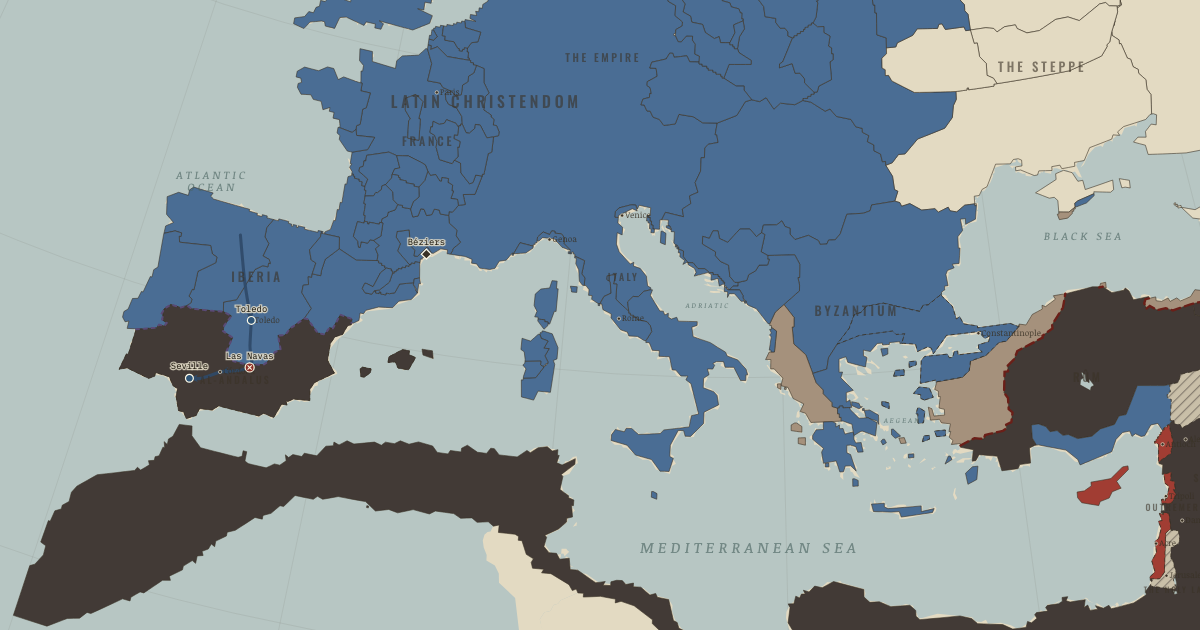
The map above is the world of The Crusades, 1212 — Las Navas — Iberia shifts.
Part of IB History: The Crusades →
SHORT EXPLANATION
Christian rulers had fought for territory in al-Andalus long before the crusades began. By 1212, however, the Church offered crusading rewards for that struggle. At Las Navas de Tolosa, several Christian kings defeated the Almohads, weakening their power and hastening the advance into Muslim Iberia. The Reconquista had acquired a new source of men and support.
Elsewhere, crusaders conquered and settled lands in the Baltic, forcing pagan peoples to convert. The authorization could reach fellow Christians too: during the Albigensian Crusade, attackers massacred inhabitants of Béziers in 1209. A summons first associated with helping the eastern churches could now give religious sanction to conquest and repression in quite different places.
The full story
The wars of Iberia, the Baltic and southern France had different enemies and purposes. What made them crusades was an arrangement the Church could carry from one campaign to another. A participant took a vow; preaching recruited fighters, Church-authorized fundraising supported them, and an indulgence and legal privileges rewarded their service. The destination no longer had to be Jerusalem.
In Iberia, that arrangement entered a struggle already generations old. Christian rulers had captured Toledo in 1085, before the First Crusade. Papal support gave the continuing war against al-Andalus another means of attracting fighters and resources. In 1212 several Christian kings joined forces at Las Navas de Tolosa and defeated the Almohads. Their power weakened, Córdoba and Seville fell in the decades that followed, and Granada remained as a tributary Muslim emirate. While the eastern crusader position was weakening, the western kingdoms were advancing.
The Teutonic Knights found a different opportunity in the Baltic. Their role in the Holy Land had been marginal; in the north, war against pagan peoples enabled them to establish a lasting monastic state. Settlement accompanied conquest, and conversion could be forced. Crusading could also be turned against Christians whom the Church condemned. In 1209, during the Albigensian Crusade against the Cathars of southern France, attackers stormed Béziers and killed thousands. The command “Kill them all; God will know his own” was reported by a later chronicler and may not be literal. The massacre itself is established: the attackers killed inhabitants without reliably separating Cathars from Catholics.
The geography of these campaigns helps explain their different results. Iberian kingdoms advanced over a connected land frontier and could settle the territory behind their armies. In the Baltic, too, nearby settlement supported sustained military pressure. Outremer depended instead on men and supplies crossing the sea to a narrow coast. Papal privileges could mobilize support, but they could not remove that disadvantage. They could be assigned to another war, however, and the institution’s reach grew accordingly. A means of organizing armed pilgrimage had become a way to authorize conquest and repression; its expanding usefulness made its moral boundaries harder to maintain.
FULL EXPLANATION
From Destination to Authorization
The First Crusade joined penance to an armed journey east. During the twelfth century, canon law and papal practice developed the vows, benefits and financing associated with that expedition. Those arrangements could then be offered for campaigns elsewhere. A pope could call on preachers, raise money and extend privileged status across kingdoms without sending the resulting armies to Jerusalem. This machinery did not create every war it served. Iberian expansion predated Clermont, and northern lords already sought land and influence. Authorization changed the resources and incentives available to them: outside fighters could be drawn in by preaching, spiritual reward and legal privilege. It also made the choice of an eligible enemy a matter of great consequence. The same institution could support territorial conquest, forced conversion, the suppression of heresy and, eventually, papal political wars in Italy. Its capacity to travel made it powerful, while making a limit on its uses harder to defend.
Remembering Béziers Carefully
The sources for Béziers invite care about two memorable details. The papal legate Arnaud Amalric reported nearly twenty thousand dead, a figure modern historians consider implausibly high for the town. Caesarius of Heisterbach, who was not an eyewitness, later attributed to him the order to kill everyone and let God recognize his own. Neither the number nor the words can simply be accepted as a literal record. The event does not disappear when those claims are questioned. Crusaders stormed the city and killed inhabitants without reliably distinguishing Catholics from Cathars. Remembering the civilian victims requires neither an inflated total nor certainty about a famous quotation. It requires us to name the violence and examine the authority that sanctioned the attack, while keeping the sources’ claims distinct from what they establish.
Key places on the map
On this day
Why it happened
The indulgence, generalized. The indulgence Urban offered for the Jerusalem expedition became available for other campaigns. Popes extended crusading rewards to wars against Muslims in Spain, pagans in the Baltic, heretics in France and, later, their own political enemies in Italy. The reward could follow the authorization rather than a single destination.
Frontier ambition, sanctified. The rulers on these frontiers already had ambitions: Iberian kings sought the land and cities of al-Andalus, while Baltic lords wanted territory and converts. Crusade authorization blessed their campaigns and brought in men and money from farther away. It strengthened existing projects rather than creating them.
Heresy treated as mortal threat. Church leaders regarded Cathar dissent as a grave spiritual threat. Their decision to authorize war against it brought crusading against fellow Christians in southern France. The institution had traveled far from the summons to aid the eastern churches.
THE TURNING POINT
Las Navas de Tolosa, 16 July 1212. At Las Navas de Tolosa on 16 July 1212, a coalition of Christian kings defeated the Almohads and badly weakened their power in Iberia. Within four decades Córdoba and Seville had fallen, leaving Granada a tributary emirate. The western campaigns were gaining territory that would last while the eastern project faced severe difficulties after the diversion to Constantinople.
What it changed
Iberia reconquered. The advance continued with Córdoba’s fall in 1236 and that of Seville in 1248, shown by the arrow. Granada survived as a tributary emirate until 1492. The Christian kingdoms could settle land behind a connected frontier; the rulers of Outremer could not rely on the same conditions.
A German Baltic. Crusading and settlement established the Teutonic order’s power in Prussia and Livonia. Its state shaped northern Europe for centuries, leaving borders and grievances that echoed into the modern age.
Crusade turned inward. Béziers showed that crusading could be directed against Christians. The Albigensian campaign also formed part of the wider setting in which the Inquisition developed, adding to the Church’s means of suppressing heresy.
DISCUSSION QUESTION — By 1220, crusades were being called against Muslims in Spain, pagans in the Baltic and heretics in France. What did “crusade” mean?
By 1220, a crusade was defined less by a journey to the Holy Land than by the authorization and privileges attached to a campaign. The papacy could offer vows, indulgences, legal protection and organized fundraising against enemies it identified as threats to Christendom. That made it possible to mobilize people and resources on several fronts. It also gave religious sanction to conquest in Iberia and the Baltic and to repression in Languedoc. The people involved did not all want the same thing: rulers seeking territory, settlers and those answering preachers could have different motives. Nor did all the wars have the same prospects. Iberian and Baltic campaigns could use land routes and nearby settlement; Outremer depended on a narrow coast supplied across the sea. The institution’s flexibility gave the papacy a powerful means of supporting war and widened the purposes for which holy war could be claimed.
An interesting fact
After Las Navas, Alfonso VIII sent Innocent III both a victory letter and the captured standard of the caliph al-Nasir. The standard was hung in St Peter’s; al-Nasir fled to Marrakesh and died within eighteen months. The letter claimed that only twenty-five or thirty Christians in the entire army had fallen. Historians reject that figure. Alfonso needed the pope’s continued support, and his report was an act of persuasion as well as an account of victory. Innocent had ordered processions in Rome that spring to pray for the campaign.
Related
THE FREE PRINTABLE STUDY GUIDE
Get the printable study guide for The Crusades free. I’ll send you a few short letters, then one when a new atlas opens. That’s all. — Paul
NO TRACKING · YOUR ADDRESS IS USED FOR THE DISPATCH AND NOTHING ELSE · UNSUBSCRIBE ANYTIME