Decolonization of Africa · CHAPTER 9 ·
Rhodesia, Zimbabwe and Namibia
Chapter 9 of The Decolonization of Africa, 1945–1994: “The Settler Redoubt”
Rhodesia’s white settlers declared independence unilaterally in 1965 and held out for fifteen years, until the 1979 Lancaster House settlement brought majority rule to Zimbabwe in 1980. In South African-occupied Namibia, the 1987–88 battle of Cuito Cuanavale led to talks linking Cuban withdrawal to Namibian independence.
Chapter 9 is included with every paid plan. WW2 is free in full, and chapter 1 of every atlas is free. A free account opens 3 more chapters a day. Starter, at $9 a month, opens all 21 with no daily limit — see the plans.
Free printable Decolonization of Africa study guide, sent by email ↓
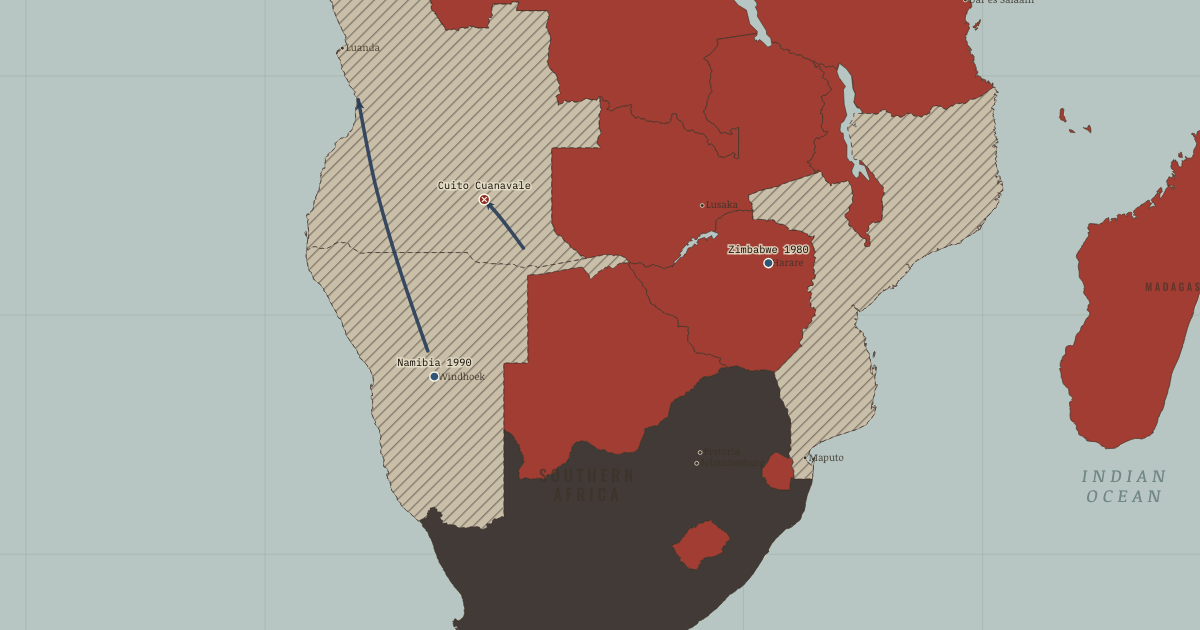
The map above is the world of Africa, April 1980 — Zimbabwe — a settler state ends.
Every state on the map that year: The world in 1980 · Europe in 1980.
Part of IB History: The Decolonization of Africa →
SHORT EXPLANATION
Southern Africa’s white minorities had reasons to resist a transfer of power that were especially difficult to overcome. They controlled land, wealth, and armed governments, and regarded the region as their home. In Rhodesia, the white government chose unilateral independence in 1965 rather than accept Britain’s condition of eventual majority rule. South African support and trade routes around sanctions helped it survive for fifteen years. Guerrilla war and the loss of Portuguese Mozambique as a friendly buffer finally brought it to negotiations.
The 1979 Lancaster House settlement brought majority rule to Zimbabwe in 1980, while protecting white-owned land for ten years. Peace was secured, but the central land grievance remained. South Africa still ruled Namibia, as it had since 1915 despite UN opposition. The war in Angola helped change that: after the disputed battle of Cuito Cuanavale in 1987–88, an agreement linked Cuban withdrawal from Angola with South African withdrawal from Namibia. Namibia became independent in 1990.
The full story
To understand why minority rule lasted so long in southern Africa, consider what a handover meant to the people who held power. Rhodesia’s quarter-million whites and South Africa’s much larger settler population controlled land, mines, and government, and regarded the region as their only home. Like Algeria’s settlers, they feared that majority rule would cost them everything. For decades they chose defiance, sanctions, and war over the compromises that had brought independence farther north.
Rhodesia could endure sanctions while its neighbors helped keep trade moving. Goods came through South Africa and Portuguese Mozambique, so economic pressure alone failed to topple the regime. Mozambique became independent in 1975 and turned hostile to Rhodesia. With that buffer gone and the guerrilla war growing, isolation became much harder to manage. The parties eventually agreed at Lancaster House to a ceasefire and elections on the basis of one person, one vote.
The settlement created Zimbabwe under Mugabe, but the terms needed for peace left another problem in place. For ten years, land transfers depended on willing buyers and willing sellers, preserving the colonial distribution. That grievance did not disappear when the war ended. After the clause and the patience behind it expired, violent seizures followed in 2000, along with economic collapse. Independence was a genuine achievement; its negotiated terms had also deferred a serious injustice.
South Africa, meanwhile, continued to occupy Namibia in defiance of the United Nations, fighting SWAPO guerrillas who had taken up arms in 1966. In 1987–88, South African and UNITA forces met Angolan and Cuban forces at Cuito Cuanavale, in the largest battle in Africa since the Second World War. Historians dispute whether the result was a victory, defeat, or stalemate. What followed is clearer: neither side could count on a cheap military solution, and negotiations linked Cuban withdrawal to Namibian independence. Military, economic, and diplomatic pressure was also closing in on Pretoria at home.
FULL EXPLANATION
Why Minority Rule Withstood Pressure
A government in Europe could weigh the cost of holding a colony against the possibility of withdrawing. White communities in southern Africa made that calculation from a different position. They controlled local institutions and regarded the territory as their permanent home; they feared losing property, status, and security under majority rule. They were prepared to bear costs that a distant metropolitan public would not have accepted. Rhodesia also benefited from South African support and supply routes through Portuguese Mozambique, which blunted early sanctions. This combination explains why predictions of quick collapse failed. It also helps us see how the pressure eventually worked. Guerrilla war raised security costs, Mozambique’s independence removed a buffer, sanctions accumulated, and diplomatic isolation narrowed the choices available to the regime. These forces did not act by themselves: African resistance sustained the challenge, while settler leaders chose repression and delay. The structure of settler rule made it durable; the actions of those resisting and defending it shaped the path to negotiation.
Cuito Cuanavale and the Bargain over Namibia
Accounts of Cuito Cuanavale differ in what they count as the decisive event. Cuban and African nationalist accounts often describe a decisive defeat of apartheid’s army. South African accounts emphasize the limited aims of immediate operations and say that permanent occupation of the town was never intended. Many historians call the fighting a stalemate; some distinguish the battle around Cuito from the later Cuban advance toward the Namibian border. There is no single undisputed military verdict. The subsequent negotiations can be understood without settling that verdict. Cuba had increased its forces, escalation threatened heavy costs to all sides, and the war in Angola became tied to the implementation of Namibian independence. The 1988 agreements provided for Cuban and South African withdrawals and a UN-supervised transition. Cuito did not end apartheid by itself. It helped weaken confidence in an unlimited military solution at a time when Pretoria was reassessing its regional and domestic strategy under wider pressure.
Key places on the map
On this day
Why it happened
Why settler rule endured. Rhodesia’s quarter-million whites and South Africa’s much larger settler population held land, mines, and political power in a region they considered their only home. A transfer to majority rule therefore seemed to threaten their security and possessions as well as their authority. As in Algeria, settlers resisted a change they feared would cost them everything. Their willingness to endure sanctions and war helps explain why a negotiated handover remained so difficult, even as colonies farther north became independent.
Rhodesia and sanctions. Rhodesia’s white government made two calculations when it declared independence unilaterally in 1965. It expected Britain to shrink from using force against fellow whites, and it expected to find ways around sanctions. Britain did not intervene militarily; trade through South Africa and Portuguese Mozambique, along with breached embargoes, kept the regime supplied. Sanctions did not bring it down during the fifteen years that followed. Their pressure accumulated nevertheless, and guerrilla war and the loss of the Portuguese buffer in 1975 made governing and sustaining the economy increasingly difficult.
The bargain at Lancaster House. By 1979, guerrilla pressure and sanctions had helped bring Rhodesia’s white rulers to accept majority rule. Lancaster House made that agreement possible by giving them constitutional guarantees: white parliamentary seats were reserved for a period, and land transfers were subject to a willing-buyer, willing-seller clause for ten years. These terms helped end the war and secure a peaceful transfer of power. They also left the colonial distribution of land in place. The grievance behind it would erupt two decades later.
The battle and negotiations. Fighting in south-east Angola in 1987–88 became the largest battle in Africa since El Alamein. Some historians see the bloody stalemate at Cuito Cuanavale, rather than the victory Pretoria expected, as the military hinge of the regional endgame. South Africa’s army could be checked, and Cuba and Angola entered negotiations in a stronger position. The subsequent linkage deal joined Cuban withdrawal to Namibian independence. Whether South Africa suffered a clear defeat or a check remains disputed; the changed bargaining position is easier to establish.
THE TURNING POINT
Cuito Cuanavale, 1987–88 — a disputed turning point. South Africa sent its heaviest armor against Angolan and Cuban forces around the ruined town of Cuito Cuanavale. The fighting ended in a standstill, challenging the belief that white military power could not be checked. Within months, linkage negotiations produced an agreement to end South Africa’s occupation of Namibia. Within two years Namibia was independent, and Pretoria, facing severe sanctions at home as well as a check abroad, had opened the talks that would end apartheid. The battle’s exact outcome is disputed, but the decisions that followed were made in a changed military and political setting.
What it changed
Zimbabwe and the land question. Zimbabwe’s independence under Mugabe was a peaceful transfer achieved after a long war. Lancaster House made it possible, but its ten-year land clause left the colonial distribution intact. Once that protection and the patience behind it expired, the unresolved grievance remained for the new state to confront. Violent seizures followed in 2000, as did economic collapse. The settlement had ended the immediate conflict without settling the land question.
Namibia becomes independent. After 75 years of South African rule and 23 years of war, Namibia became independent through the linkage deal. SWAPO’s Sam Nujoma took office after a UN-supervised transition that became a model. On the map, the second-to-last charcoal territory turns red; South Africa remains. The pressures that helped free Namibia, including the demonstration that apartheid’s state could be checked, now bore on Pretoria itself.
Pressure on Pretoria. The loss of friendly or controlled territory north of South Africa changed Pretoria’s position. Mozambique, Zimbabwe, and Namibia no longer formed a buffer around the apartheid state. Its army had been bloodied abroad; sanctions and capital flight were damaging the economy; and its townships were ungovernable. By 1990 these pressures were converging on a government with fewer regional defenses. The next two chapters follow its reckoning.
DISCUSSION QUESTION — Why did settler rule in southern Africa survive decades longer than colonialism elsewhere — and what combination of pressures finally ended it?
White settlers had both the means and the determination to resist majority rule. They controlled wealth and arms, regarded southern Africa as their home, and feared what a handover would cost them. As in Algeria, this made compromise difficult; unlike a metropolitan government, they had no distant home to withdraw to. Each pressure could initially be endured: Rhodesia evaded sanctions for fifteen years, guerrillas could not defeat the well-armed states alone, and isolation by itself was tolerable. Together the pressures changed the calculation. Armed resistance made the countries harder to govern, Portuguese rule in Mozambique collapsed, and sanctions and capital flight damaged the economy. At Cuito Cuanavale, a military check challenged confidence in white invincibility. African resistance sustained the challenge while diplomatic, economic, military, and internal pressures accumulated. Negotiation became possible because the costs of holding on were rising on several fronts at once.
An interesting fact
In 1979 Bob Marley released “Zimbabwe” on Survival. The following year he flew the Wailers and their equipment to Harare at his own expense to play at the independence ceremony. At Rufaro Stadium on 18 April 1980, as the new flag first rose, tear gas fired at crowds pressing the gates drifted onto the field and briefly interrupted the performance. Marley returned the next day for a free concert for the tens of thousands who had been shut out.
Related
THE FREE PRINTABLE STUDY GUIDE
Get the printable study guide for The Decolonization of Africa free. I’ll send you a few short letters, then one when a new atlas opens. That’s all. — Paul
NO TRACKING · YOUR ADDRESS IS USED FOR THE DISPATCH AND NOTHING ELSE · UNSUBSCRIBE ANYTIME