Haiti and Kenya independence · CHAPTER 10 ·
Road to Kenyan independence
Chapter 10 of Two Roads to Independence: Haiti 1789–1838 and Kenya 1895–1978: “The Road to Uhuru”
By 1960 Britain wanted to leave Kenya, and the first Lancaster House conference gave Africans an elected majority in the Legislative Council. Two parties formed: KANU, drawing on the Kikuyu, Luo and Kamba, and KADU, which demanded majimbo, strong regional government; Kenyatta, freed in 1961, led Kenya to independence in 1963.
Chapter 10 is included with every paid plan. WW2 is free in full, and chapter 1 of every atlas is free. A free account opens 3 more chapters a day. Starter, at $9 a month, opens all 21 with no daily limit — see the plans.
Free printable Haiti and Kenya independence study guide, sent by email ↓
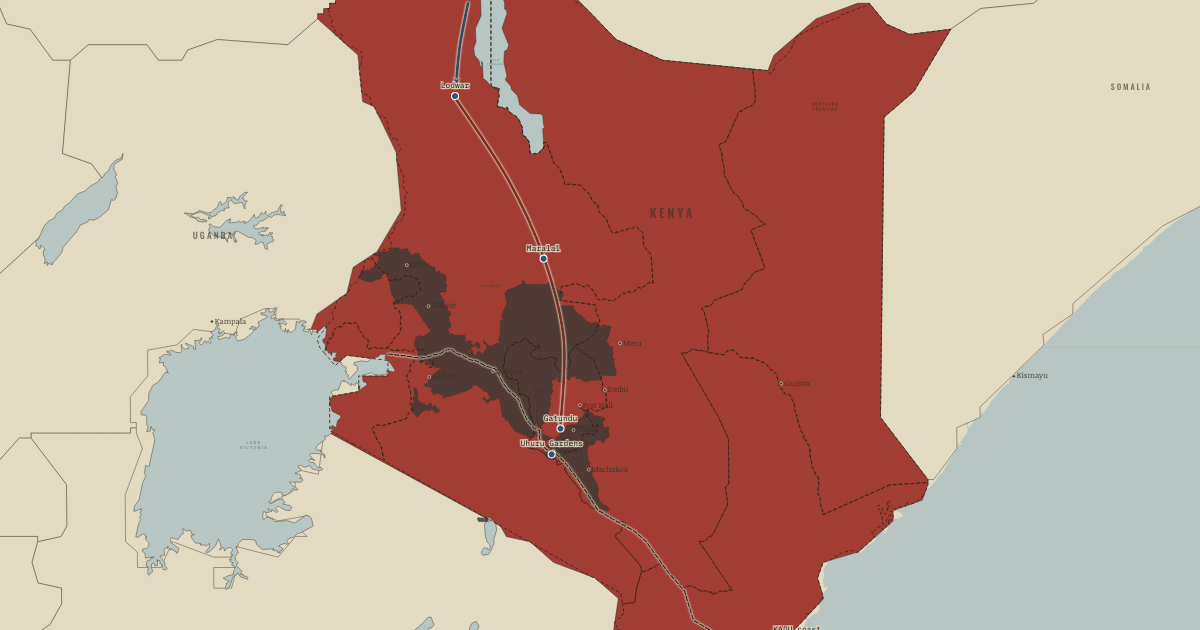
The map above is the world of Kenya, 12 December 1963 — Uhuru — independence.
Every state on the map that year: The world in 1960 · Europe in 1960.
Part of IB History: Haiti and Kenya →
SHORT EXPLANATION
In 1960 Britain faced the task of handing power to a Kenyan government. The first Lancaster House conference, held in a government mansion in London, gave Africans an elected majority in the Legislative Council, the colony's law-making body, ending the settlers' political hold. Kenyan leaders then had to decide how power would be shared among themselves. The Kenya African National Union (KANU) drew on the larger Kikuyu, Luo and Kamba communities. The Kenya African Democratic Union (KADU) allied smaller peoples, including the Kalenjin, Maasai, Mijikenda and many Luhya. KADU feared that a powerful centre would allow larger communities to take their land. Its answer was majimbo, a federation of strong regions with powers over land and police, like states in a federal country.
The man at the centre of the negotiations was still detained. KANU won the February 1961 election but refused office until Jomo Kenyatta was freed; in August he returned to Gatundu along the arrow from the northern desert. The second conference in 1962 incorporated majimbo into a compromise constitution. Dashed lines on the map show its seven regions and the Nairobi area, the boundaries of Kenya's later provinces. KANU won again in May 1963, and Kenyatta became prime minister on 1 June. At midnight on 12 December 1963 Kenya turned red. Britain had jailed Kenyatta as the rebellion's organiser; now it depended on him for a peaceful handover.
The full story
By 1960 Britain's leaders wanted to leave Kenya. They also wanted a successor government that would protect British friends and investments. Iain Macleod, the minister responsible for the colonies as Colonial Secretary since October 1959, chaired the first Lancaster House conference in London from January to February 1960. As it met, Harold Macmillan told the South African parliament on 3 February that a “wind of change” was blowing through Africa.
The resulting Macleod constitution changed who could make Kenya's laws. Of 65 Legislative Council seats, 33 were open seats whose outcome African voters would decide; 20 were reserved for European, Asian and Arab members. Settler hardliners called the arrangement betrayal, though the moderate settler leader Michael Blundell accepted it. The settlers had lost political control even while the land remained in the same hands.
Land also lay behind the division between the new African parties. KANU, founded at Kiambu on 14 May 1960 with Tom Mboya and Oginga Odinga among its leaders, favored a strong centre. KADU was founded at Ngong on 25 June under the coastal leader Ronald Ngala, with Daniel arap Moi as chairman. Its supporters feared that a Kikuyu-led government would settle its followers on the former White Highlands in the Rift Valley. Regional powers offered them a way to resist decisions made by a majority at the centre.
The election of February 1961 did not immediately settle who would govern. KANU won 67 percent of the vote but refused office while Kenyatta remained detained, so KADU took office instead. Kenyatta moved from Lodwar to Maralal in April and was freed to Gatundu in August. His return gave KANU its leader, KADU a necessary bargaining partner and Britain a man it hoped could maintain order.
At the second Lancaster House conference, from February to April 1962, negotiators sought a balance between central authority and majimbo, the federation of strong regions. They provided for a two-chamber parliament and regional assemblies with protected powers over land; the regional outlines are dashed on the map. A seventh region, North-Eastern, was added in March 1963 for the Somali-majority districts.
KANU won 83 of the 124 seats filled in May 1963, and Kenyatta became prime minister on 1 June. A final conference that autumn moved some powers back to the centre. On 8 October an agreement ended the Sultan of Zanzibar's sovereignty over the coastal strip, bringing the whole coast into Kenya. At midnight on 12 December the British flag came down at Uhuru Gardens. Majimbo had helped secure KADU's consent to independence; KANU dismantled it within two years.
FULL EXPLANATION
Why Britain left so quickly
The pressure for a rapid British departure came from several directions. The Emergency had shown that about 60,000 Europeans could govern more than eight million Africans only with British troops, at rising cost. Elsewhere in Africa, Ghana's independence in 1957 offered a possible course, while France's brutal war in Algeria and the Belgian Congo's collapse in July 1960 showed dangers British leaders wanted to avoid. Macmillan's government regarded colonies as a drain on a weakened economy and an embarrassment in the Cold War contest for the opinion of newly independent states. Iain Macleod later wrote that holding Britain's African territories by force would have required terrible bloodshed. In The Politics of the Independence of Kenya (1999), Keith Kyle describes London's effort to steer power to moderates who would protect investments and remaining settlers. Speed served that purpose: Britain hoped to select successors before more radical alternatives emerged.
Majimbo: protection or obstruction?
KADU's case for majimbo rested on a fear about land and political power. Kikuyu and Luo were more numerous and, after decades of mission schooling, better educated; regional land boards might prevent them from taking land in the Rift Valley and on the coast. Some settlers also supported KADU, hoping a weak central government would protect their farms. KANU answered that majimbo was a colonial device for dividing Africans into a federation of tribes dependent on Britain. The 1963 constitution gave regions assemblies and protected powers, but KANU's parliamentary majority removed those protections through amendments in 1964 and 1965. Arguments over regional power continued. In the early 1990s politicians revived the word majimbo to justify violent expulsions of Kikuyu and others from the Rift Valley. The 2010 constitution introduced a different form of devolution, with 47 elected county governments. The fear that the centre would favor the strongest communities remained a constant in Kenyan politics.
From prisoner to father of the nation
While Kenyatta was restricted, Governor Sir Patrick Renison publicly called him “the African leader to darkness and death”. Three years later Malcolm MacDonald, the last governor, worked with him as a partner. Kenyatta's change in standing between 1959 and 1963 answered different needs. At Maralal in April 1961 he told the press he had never led Mau Mau and spoke of a Kenya for all its races; at Nakuru in August 1963 he urged settler farmers to forgive the past and stay. Britain saw a guarantor of property and order, settlers a leader who would not seize their farms, and most Kenyans the prisoner whose suffering symbolized the nation's. Forest fighters were asked to forget the past and received little land or recognition. Historians including John Lonsdale argue that Kenyatta's belief in hard work and property reflected the Kikuyu ideal of earned self-mastery. His conservatism was a conviction as well as a political convenience.
Key places on the map
On this day
Why it happened
The Emergency made settler rule unaffordable. The Emergency revealed how much settler power depended on British soldiers and money. Even after the forest war, London faced bills for camps, garrisons and development, while settlers could not govern alone. Hola made the camps politically toxic. After the 1959 election Macmillan's government judged that handing power to Africans who would respect British interests was the cheapest way to protect those interests.
A continent on the move. The map's parchment neighbors show a larger change. Ghana became independent in 1957, seventeen African states followed in 1960, Tanganyika next door in December 1961 and Uganda in October 1962. The Congo's collapse into civil war in July 1960 warned Britain of the risks of leaving too late or too abruptly. As neighboring countries became free, continuing settler rule in Kenya became impossible to justify.
A political class ready to govern. Britain could negotiate an exit because African politicians already had experience, supporters and international contacts. The first African elections in 1957 brought trade unionist Tom Mboya and Oginga Odinga into the Legislative Council, where they pressed for Kenyatta's release and majority rule. Mboya's airlift of Kenyan students to American universities, begun in 1959, built links with Washington. These leaders provided negotiating partners for the handover.
Fear between Kenya’s peoples. Colonial government had organized Kenyans by ethnic group. As independence approached, smaller peoples feared Kikuyu and Luo would use power at the centre to take land in the Rift Valley and on the coast; settlers encouraged those fears. Majimbo offered one answer. The 1963 constitution was a bargain among Kenyan communities as well as an agreement for the transfer of British power.
THE TURNING POINT
Gatundu, August 1961. KANU's refusal to govern without Kenyatta made his detention a barrier to a stable government. When he was released to his home at Gatundu on 14 August 1961, he could unite KANU's factions, negotiate with KADU and reassure Britain. He spent his first months of freedom establishing his moderation. The emerging handover protected a settlement in which land would be bought, settlers could stay and forest fighters would be asked to forget. Governor Sir Patrick Renison had called him “the African leader to darkness and death”; within two years of his release he was the prime minister presiding over a peaceful transfer. His return helped settle both the leadership and the terms of independence.
What it changed
Majimbo dismantled. KADU dissolved itself into KANU in November 1964. Kenya became a republic on 12 December, with Kenyatta as president. Amendments in 1964 and 1965 removed the regions' protected powers. A strong central state governed from Nairobi through provincial administrators, much as the colony had been, while the fear of central domination that had inspired majimbo remained.
Land changes hands by sale. The settlement protected property through “willing buyer, willing seller”: settler farms would be sold, largely with British loan financing. Sale avoided the flight of capital and violence that seizure might have caused. But landless Kenyans, including many former forest fighters and detainees, were left to buy back land their families had lost.
A north that did not consent. A British commission heard in 1962 that most Somali-speaking people of the Northern Frontier District wanted to join Somalia. Britain instead made their districts a Kenyan region. Many boycotted the 1963 elections, while Somalia, independent since 1960, supported their claim. Within weeks of independence Kenya declared an emergency in the north-east, beginning the Shifta War discussed in the next chapter.
DISCUSSION QUESTION — Was Kenya’s independence granted by Britain or won by Kenyans?
Britain controlled much of the process: Lancaster House met in London on London's terms, Macleod set the pace, and the constitution protected settler property and British investments. That is the case for calling independence a grant. But the choices Britain faced had been changed by Kenyans. The Emergency made settler rule unaffordable; KANU's refusal to govern without Kenyatta forced his release; KADU made majimbo the price of consent; and Kenyan negotiators shaped the final texts. Keith Kyle and other historians show a bargain in which each side held cards. Kenyatta's release illustrates the relationship: Britain freed him after KANU had shown that a stable government could not form without him. British leaders decided under pressure to leave, and Kenyans in different parties fought over the terms. Independence was both conceded and won; the question is who decided which part of the settlement.
An interesting fact
Kenya first raised its flag at midnight on 12 December 1963. It took KANU's black, red and green and added two thin white stripes. Black represents the people, red the blood shed in the independence struggle, green the land and white peace; the central Maasai shield and crossed spears stand for the defence of freedom. The coat of arms carries the national motto Harambee, meaning “let us all pull together” in Swahili. Both symbols were chosen to speak for all communities in the new nation.
Related
THE FREE PRINTABLE STUDY GUIDE
Get the printable study guide for Two Roads to Independence free. I’ll send you a few short letters, then one when a new atlas opens. That’s all. — Paul
NO TRACKING · YOUR ADDRESS IS USED FOR THE DISPATCH AND NOTHING ELSE · UNSUBSCRIBE ANYTIME