MAPS OF HISTORY · IB HISTORY · THE DECOLONIZATION OF AFRICA
IB HISTORY · 1945 – 1994 · 12 CHAPTERS
IB History: The Decolonization of Africa — notes, maps and essay questions
The half-century in which the most bordered continent on earth drew its own map — negotiated in some capitals, fought for in others.
IB notes for this atlas are in preparation. Meanwhile, this page gathers the study notes every one of its 12 chapters already carries: why each episode happened, the moment it turned on, what it changed, and the question historians still argue about. It also shows where the atlas fits the IB course.
WW2 is free in full, and chapter 1 of every atlas is free. A free account opens 3 more chapters a day. Opening a new atlas uses one of them. Membership opens all 21 — Join.
Where it fits the course
The atlas is filed under Paper 2 (Popular Movements) and Paper 3 for Higher Level (Africa and the Middle East). Its IB notes, with evidence lists, primary sources and model essay plans, are in preparation. These are the IB History pages for the parts of the course it serves:
Why it began
The opening chapters offer explanations for how this story began. Their arguments about the causes appear here in a few sentences each, ready to test against your own reading.
Chapter 1: How Thin the Empire Really Was
Rule by a handful, through intermediaries. Frederick Lugard’s doctrine of indirect rule placed existing chiefs and emirs between British officials and the people they governed. Their work made a small, inexpensive administration possible. It also meant that officials depended on intermediaries who might cooperate under coercion or for local advantage. Organized refusal could make colonial decisions much harder to enforce.
An economy built for extraction, not development. A railway from a mine to a port was useful to an economy exporting raw materials and importing finished goods, even if it left African towns poorly connected. Investment in African education and industry was limited. At independence, the Belgian Congo had only a handful of African university graduates for thirteen million people. The demand for change therefore concerned the organization of the economy as well as political authority.
The war as solvent. The war of 1939–45 mobilized African soldiers, cash crops and forced labor. The fall of France and Singapore exposed the vulnerability of European powers; veterans returned having seen that weakness and having killed white men. The Atlantic Charter gave nationalists a further resource: a language of self-determination taken from the Allies’ own statement of their aims.
Pan-Africanism finds its leaders. The Manchester Congress of 1945 carried the inheritance of Du Bois, Padmore and Garvey into a political program for independence. Among its delegates were Nkrumah, Kenyatta and Hastings Banda, who would later govern. Ideas developed across borders could now be taken into struggles for power at home.
Chapter 2: The First Doors
The canal and Egyptian authority. Washington’s withdrawal of its Aswan Dam loan left Nasser seeking another source of money. Nationalizing the canal offered revenue for the project and asserted Egyptian authority over Egyptian territory. Britain and France saw their prestige, oil supplies and route to Asia at stake. Control of the waterway thus became a test of whether European powers could still command events in the postcolonial world by force.
Financial pressure on Britain. Eisenhower opposed an invasion that had been concealed from Washington, and feared it would drive Arab states toward Moscow. British forces could succeed in the field, but Britain needed support for sterling and emergency oil. As the pound came under speculative pressure, the United States withheld both. Faced with currency collapse, Britain folded within days. Military strength had not removed its financial dependence on its ally.
France concentrates on Algeria. France granted independence to Tunisia and Morocco in 1956 after relatively little struggle. Both were protectorates rather than settled French soil. Releasing them freed troops and legitimacy for the fight over Algeria, which Paris would not yield: it consisted of three French départements and housed a million pieds-noirs. French leaders gave up two possessions to concentrate on a third.
Nasser’s example travels. Three armies attacked Egypt, yet Nasser remained in power. His survival turned battlefield defeat into political victory and made him almost overnight a hero across the Arab and African world, and a model of militant, non-aligned nationalism. Radio Cairo’s “Voice of the Arabs” carried the example abroad. Egypt became a training ground and megaphone for liberation movements from Algeria to Angola.
Chapter by chapter
These entries trace the atlas through 12 chapters, identifying the causes and turning point of each. Select a title to open its free chapter page, where the full explanation, a discussion question and the map appear together.
1. How Thin the Empire Really Was
CHAPTER 1 · THE COLONIAL MAP OF 1945
Why it happened: Rule by a handful, through intermediaries · An economy built for extraction, not development · The war as solvent · Pan-Africanism finds its leaders
The turning point: Brazzaville, January 1944.
2. The First Doors
CHAPTER 2 · 1951–1956
Why it happened: The canal and Egyptian authority · Financial pressure on Britain · France concentrates on Algeria · Nasser’s example travels
The turning point: Suez, November 1956.
3. Ghana — The Model
CHAPTER 3 · 1947–1957
Why it happened: The invention of the mass party · “Positive Action” and prison as credential · Why Britain conceded the model · Cocoa: an economy that could pay
The turning point: Accra, midnight, 6 March 1957.
4. Algeria — The Exception
CHAPTER 4 · 1954–1962
Why it happened: Why settlers made compromise difficult · The FLN’s political strategy · Torture and French legitimacy · De Gaulle changes course
The turning point: The Battle of Algiers, 1957 — victory as defeat.
5. The Year of Africa
CHAPTER 5 · 1960
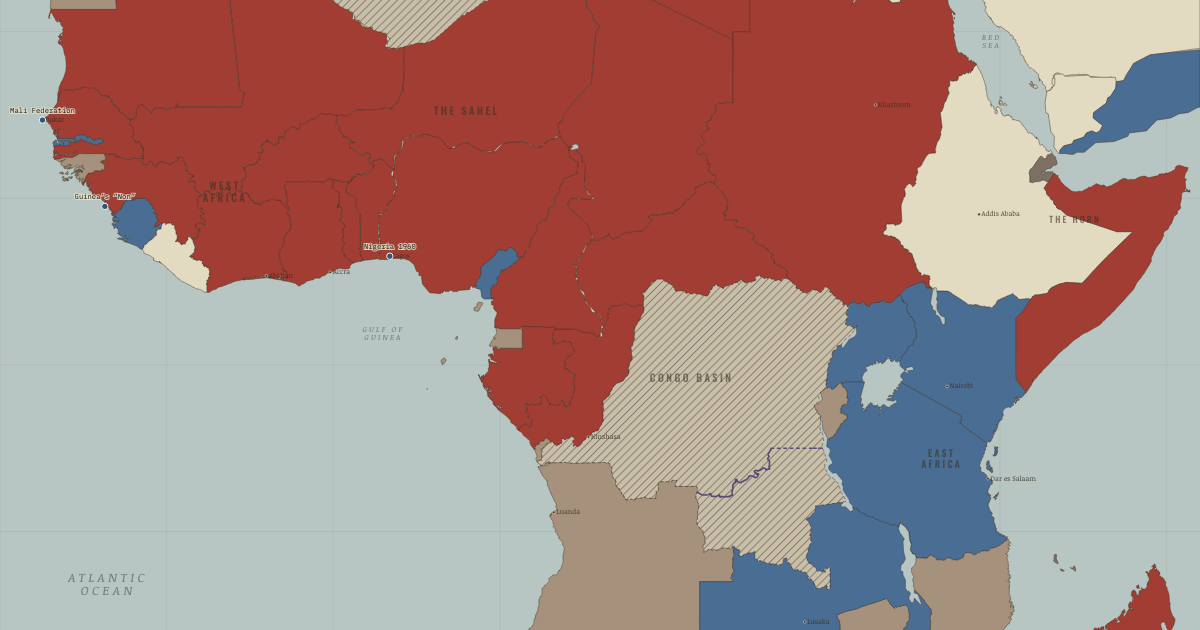
Why it happened: The framework law and African governments · Guinea’s “Non” · A changing international climate · Independence creates momentum
The turning point: Lagos, 1 October 1960 — Nigeria becomes independent.
6. The Congo Crisis
CHAPTER 6 · 1960–1965
Why it happened: A colony left unprepared · Katanga and the mines · The Cold War enters the crisis · The UN’s difficult mandate
The turning point: Katanga secedes, 11 July 1960.
7. Building States from Colonies
CHAPTER 7 · 1963–1979
Why it happened: The border decision of 1964 · Economies shaped for export · Why armies took power · Françafrique and dependence
The turning point: Addis Ababa & Cairo, 1963–64 — the borders are frozen.
8. The Portuguese Empire Falls Last
CHAPTER 8 · 1961–1975
Why it happened: Empire and the dictatorship · Cabral’s struggle · A revolution in the army · Foreign powers and Angolan rivals
The turning point: Luanda, 11 November 1975 — independence amid war.
9. The Settler Redoubt
CHAPTER 9 · 1965–1990
Why it happened: Why settler rule endured · Rhodesia and sanctions · The bargain at Lancaster House · The battle and negotiations
The turning point: Cuito Cuanavale, 1987–88 — a disputed turning point.
10. Apartheid’s Long Fall
CHAPTER 10 · 1948–1990
Why it happened: The architecture of apartheid · The turn to armed struggle · The pressure of finance · De Klerk’s calculation
The turning point: Mandela walks free, 11 February 1990.
11. The Four Years That Decided It
CHAPTER 11 · 1990–1994
Why it happened: Two sides that could obstruct but not win · The third force and the strategy of chaos · Hani’s murder and the response · The choice of truth and conditional amnesty
The turning point: The election, 27 April 1994.
12. What Independence Achieved, and Could Not
EPILOGUE · THE LEDGER OF FREEDOM
Why it happened: The gains of independence · The inherited constraints · Coups and personal rule
The turning point: Pretoria, 10 May 1994.
Essay questions, argued
Historians still debate the question at the end of each chapter. Before reading our brief answer, try making a plan for how you would answer it.
DISCUSSION QUESTION · CHAPTER 1
If colonial rule was so thin and cheap, why did it endure before 1945, and why did it unravel so quickly afterward?
Small administrations could endure because chiefs, clerks, soldiers and others carried out their orders, while European power seemed difficult to defeat. Before 1945 no coordinated challenge had overturned that arrangement. The war weakened several supports at once: it consumed imperial resources, mobilized and radicalized African populations, and exposed European defeats that challenged claims of white supremacy. Nationalists could invoke self-determination and look to the United States and the USSR, both of which had reasons to encourage them. The machinery still depended on cooperation, but the conditions that sustained it had changed.
The chapter behind it: How Thin the Empire Really Was. Every chapter’s question is on the discussion questions page.
DISCUSSION QUESTION · CHAPTER 5
Why did seventeen countries become independent in the single year 1960 — and was the speed a triumph or a problem?
The transfers clustered for several reasons. France’s loi-cadre had already placed African governments in office, so much of the handover came before the flag changed. Guinea survived separation and exposed the weakness of de Gaulle’s Community; within two years autonomy gave way to full independence across French Africa. At the UN and among both superpowers, independence became the expected outcome. Each transfer helped make the next possible. This was an epochal, largely peaceful liberation, and its speed also left difficult problems. New states inherited colonial economies, arbitrary borders, shallow institutions and tiny educated classes, with almost no time to build the foundations they needed. The Congo, in the next chapter, shows the catastrophic end of that range. A slower transition might have built stronger states, but it might also have prolonged colonial rule under another name. The question remains open.
The chapter behind it: The Year of Africa. Every chapter’s question is on the discussion questions page.
DISCUSSION QUESTION · CHAPTER 9
Why did settler rule in southern Africa survive decades longer than colonialism elsewhere — and what combination of pressures finally ended it?
White settlers had both the means and the determination to resist majority rule. They controlled wealth and arms, regarded southern Africa as their home, and feared what a handover would cost them. As in Algeria, this made compromise difficult; unlike a metropolitan government, they had no distant home to withdraw to. Each pressure could initially be endured: Rhodesia evaded sanctions for fifteen years, guerrillas could not defeat the well-armed states alone, and isolation by itself was tolerable. Together the pressures changed the calculation. Armed resistance made the countries harder to govern, Portuguese rule in Mozambique collapsed, and sanctions and capital flight damaged the economy. At Cuito Cuanavale, a military check challenged confidence in white invincibility. African resistance sustained the challenge while diplomatic, economic, military, and internal pressures accumulated. Negotiation became possible because the costs of holding on were rising on several fronts at once.
The chapter behind it: The Settler Redoubt. Every chapter’s question is on the discussion questions page.
DISCUSSION QUESTION · CHAPTER 12
Was Africa’s decolonization a success or a failure? How does the comparison we choose change the answer?
The answer depends on the question. Compared with the foreign rule, racial hierarchy and extractive government of 1945, decolonization brought a profound political change: most territories ruled by foreign powers became independent, and South Africans ended apartheid’s political order. Across much of Africa, schooling and health services expanded and life expectancy rose. Yet rapid prosperity, stable democracy and continental unity often proved elusive. Governments inherited commodity dependence, borders and institutions, and faced Cold War interference and debt. Their leaders also made choices about investment, corruption and repression. Judging the era by immediate Western-style prosperity overlooks its starting conditions; treating a new flag as proof that every promise was fulfilled overlooks the work still to do. Self-rule was an achievement, and accountable institutions and more independent economies remained unfinished projects.
The chapter behind it: What Independence Achieved, and Could Not. Every chapter’s question is on the discussion questions page.
What it changed
Consequence questions need the end of the story. The final chapter, What Independence Achieved, and Could Not, sets out what the period left behind:
Rwanda, April–July 1994. From April to July 1994 extremist leaders and militias organized genocide against the Tutsi. An estimated 800,000 people were murdered, including Hutu opponents of the killing, and international actors failed to stop it. Belgian colonial racial classification belongs to the history, but civil war, propaganda and postcolonial leaders’ decisions were also crucial. The Rwandan Patriotic Front’s advance ended the genocide. The later Congo wars need their own account, and those killed in Rwanda deserve remembrance in their own right.
Democracy and the 1990s. The 1990s produced grounds for questioning the view that Africa was a hopeless case. Apartheid ended, and multiparty elections took place in a number of former one-party states. Elections gave people opportunities to challenge governments, though their quality and consequences varied. Cold War proxy conflicts in Angola and Mozambique also moved toward an end as external support for proxy wars changed. None of this resolves every question about government or development, but the decade cannot be described by a single verdict of failure.
Follow a country. In Free Explore, move through the timeline and choose a country. The rising color records independence, while the markers open the histories behind it: Ghana’s early independence, Algeria’s war, the Congo’s crisis and South Africa’s long struggle against apartheid. Follow one route and see how much a single change of color contains.
Revision tools
The atlas ends with a map quiz that asks you to find places and moments on the map itself (part of every plan from Starter up). The quick quiz and the discussion questions with our answers are free pages on this site, and the printable study guide gathers every chapter’s notes into one document for revision.
Read next
- Kenya’s road to independence · TWO ROADS TO INDEPENDENCE
- Indian independence and partition · INDIAN INDEPENDENCE & PARTITION
Maps of History is independent and is not affiliated with or endorsed by the International Baccalaureate Organization. IB course names describe alignment only; paper, theme and section names follow the new course outline and may change when the final guide is published.
THE DISPATCH
Get the printable study guide for The Decolonization of Africa free. I’ll send you a few short letters, then one when a new atlas opens. That’s all. — Paul
NO TRACKING · YOUR ADDRESS IS USED FOR THE DISPATCH AND NOTHING ELSE · UNSUBSCRIBE ANYTIME