Feminism and the Tunisian Revolution · CHAPTER 10 ·
Tunisia’s transition to democracy
Chapter 10 of Protest and Change: Second-Wave Feminism and Tunisia, 1945–2015: “Building a Democracy”
After Ben Ali fled, sit-ins in the Kasbah forced the old ruling party out, and on 23 October 2011 Ennahda won 89 of 217 seats in the Constituent Assembly elections. It governed in coalition with two secular parties, and after a crisis at the Bardo from July 2013 Tunisia adopted a democratic constitution in January 2014.
Chapter 10 is included with every paid plan. WW2 is free in full, and chapter 1 of every atlas is free. A free account opens 3 more chapters a day. Starter, at $9 a month, opens all 21 with no daily limit — see the plans.
Free printable Feminism and the Tunisian Revolution study guide, sent by email ↓
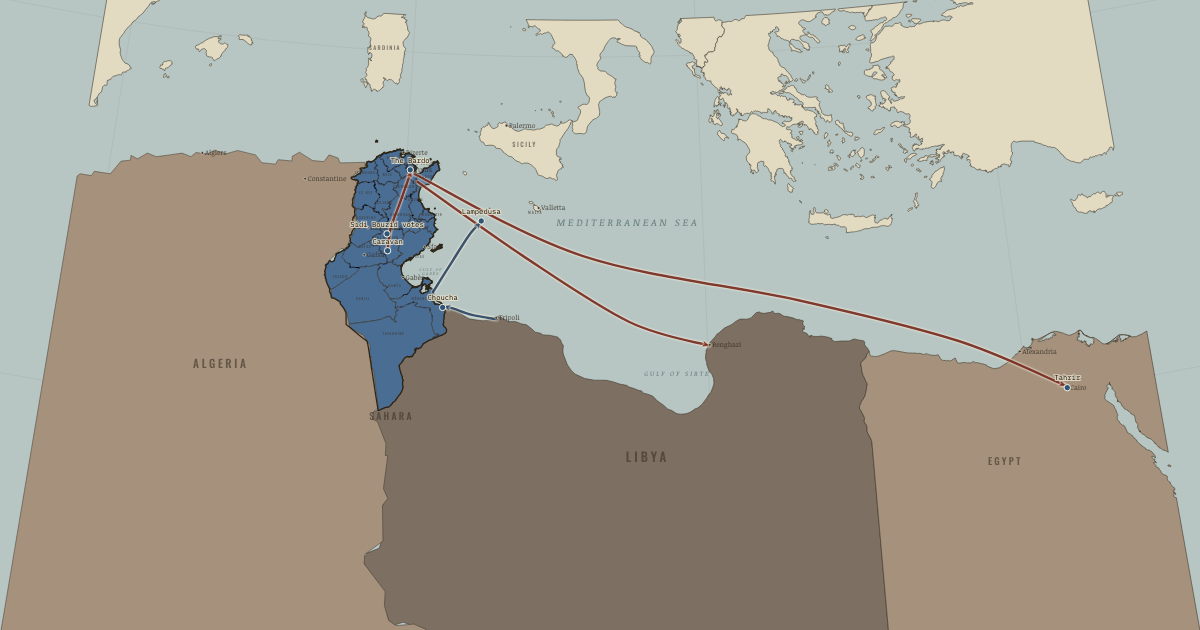
The map above is the world of Tunisia, March 2014 — A constitution in force; the emergency lifted.
Every state on the map that year: The world in 2010 · Europe in 2010.
Part of IB History: Second-wave feminism and Tunisia →
SHORT EXPLANATION
Ben Ali’s flight removed a president, but it left his ministers in the first interim government. Who would decide what replaced his rule? In January 2011 young people came from the interior to Tunis in the “Caravan of Liberation” and camped outside the prime minister’s office in the Kasbah. Two sit-ins forced the old guard out and won elections for a Constituent Assembly: an elected body to write a constitution, much like the convention that wrote the American Constitution in 1787. Continued pressure from the street shaped the passage from dictatorship to democracy.
At the election on 23 October 2011, Ennahda won 89 of 217 Assembly seats. The Islamist party sought to shape law by Islamic values through elections and governed with two secular parties. A rule requiring party lists to alternate women and men brought women about a quarter of the seats. The election gave rivals a place in government, but it did not settle how they would resolve their disagreements.
In 2013 jihadist gunmen, militants who use violence to impose their version of Islamic rule, assassinated left-wing opposition leaders Chokri Belaïd and Mohamed Brahmi. Crowds camped outside the Assembly at the Bardo. Egypt’s army had removed its elected Islamist president, and Tunisia faced the danger of confrontation too. The UGTT trade-union federation, employers’ union, Human Rights League and Order of Lawyers formed a “Quartet” to broker a National Dialogue. Like mediators in a labor dispute, they brought parties into negotiations with fixed deadlines. Ennahda handed power to a non-party government, and on 26 January 2014 the Assembly adopted a constitution guaranteeing equality between women and men.
The March 2014 map places these events beside their regional consequences. Tunisia is blue: its constitution is in force and the state of emergency has been lifted. Egypt is tan again under military rule, while Libya is grey-tan as its transition fragments. Arrows show the revolution’s example traveling to Cairo and Benghazi in 2011, the caravan to Tunis, refugees crossing from Libya’s war and young Tunisians sailing to Lampedusa. Street pressure, bargaining and outside mediation carried Tunisia through a transition its neighbors’ efforts failed to achieve.
The full story
Ben Ali’s prime minister, Mohamed Ghannouchi, led the first interim government after the president fled. Ministers of the old ruling party, the RCD, remained in office. For people who had risked their lives against that government, a change at the top left too much of the old order in place.
On 22 January 2011 young people from Menzel Bouzaiane and other interior towns set out for Tunis, along the arrow on the map. They camped in Kasbah square outside the prime minister’s offices until 28 January and forced a reshuffle. A second, larger sit-in brought more than 100,000 people into Tunis on 25 February. Ghannouchi resigned, and on 3 March the interim president promised elections to a constituent assembly, an elected body whose only task was to write a new constitution. A court dissolved the RCD on 9 March. An appointed commission then wrote the electoral law; its May 2011 decree required every list to alternate women and men. The protesters had secured a say in how the new rules would be made.
The October election brought a new conflict into the open. Ennahda, an Islamist party seeking to shape law by Islamic values through elections, won 89 of 217 seats with about 37 per cent of the vote. It formed a “troika” with two secular parties. In Sidi Bouzid, where the revolution began, voters mostly chose a populist list led by a London-based businessman. The town rioted when some of its seats were annulled. The interior had reason to fear that the politics it had helped create was passing it by.
Others feared what the new majority might do to women’s rights. In August 2012 a draft article describing women as “complementary” to men brought 7,000 to 9,000 protesters into the streets; the clause was dropped. Then violence made the dispute more acute. Jihadists, militants who use violence to impose their version of Islamic rule, shot secular leaders Chokri Belaïd on 6 February 2013 and Mohamed Brahmi on 25 July, using the same gun. Opposition groups blamed Ennahda for tolerating extremists. The murders became a crisis of trust in the transition itself.
After Brahmi’s death opposition deputies walked out and tens of thousands camped outside the Assembly at the Bardo. Egypt’s military coup on 3 July had shown where a contest of force could lead. Tunisia’s parties needed a way back to negotiation. Four organizations independent of the state and parties—the UGTT union federation, the employers’ union, the Human Rights League and the Order of Lawyers—formed a Quartet and convened the National Dialogue. Its roadmap gave the rivals a way to move together.
Ennahda agreed to hand power to non-party experts in January 2014 while the Assembly completed its work. On 26 January the constitution passed by 200 votes to 12. It kept the 1959 formula that Tunisia’s religion is Islam and guaranteed freedom of conscience. Article 21 declared men and women equal in rights and duties; Article 46 committed the state to parity in elected assemblies. In October Ennahda lost to the secular Nidaa Tounes and accepted the result. The constitution had given political opponents rules under which they could compete, and the losing party allowed the result to stand.
FULL EXPLANATION
“Twin tolerations” or a bargain of the weak?
Alfred Stepan argued in 2012 that Tunisia was building the “twin tolerations” needed between religion and a democratic state. Religious parties would accept the authority of elected institutions, while the state would permit religious citizens to organize and compete. He found evidence in Ennahda’s dialogue with secular opposition leaders in exile. Joint declarations of the opposition’s “18 October” coalition in the mid-2000s accepted the Personal Status Code, the 1956 family law that banned polygamy and made divorce a matter for the courts. Other accounts give the participants’ vulnerabilities more weight. Rory McCarthy describes Ennahda as divided between preachers and politicians: its leaders compromised partly from conviction and partly from memories of imprisonment and torture in the 1990s. Amel Boubekeur and other scholars call the result “bargained competition” among Islamists, secularists and old-regime elites who protected one another’s core interests. Few Ben Ali-era officials faced trial, and Nidaa Tounes, built around the old elite, returned to power in 2014. Ennahda’s concessions also followed Egypt’s July 2013 coup. Both readings recognize a bargain, but its durability may depend on whether mutual tolerance or fear and protection of interests did the greater work.
Why Tunisia’s transition survived
Tunisia was the only country among those that rose in 2011 to become a lasting democracy, at least for a decade. Comparisons with Egypt, Libya and Syria point to conditions that made its path possible. Safwan Masri’s Tunisia: An Arab Anomaly looks back to a reformist tradition reaching the 1861 constitution, mass education, the Personal Status Code and a relatively homogeneous population without Syria’s sectarian divisions or Libya’s tribal regions. Other scholars look at the institutions present in 2011. Tunisia’s army was small and politically marginal; Egypt’s controlled a vast business empire and took power in 2013. The UGTT had hundreds of thousands of members in every region and enough legitimacy to mediate between parties. Tunisia had little oil, giving foreign powers less reason to intervene. None of these conditions made negotiation automatic. Ennahda’s Rached Ghannouchi and Nidaa Tounes’s Béji Caïd Essebsi chose to negotiate at moments when they could have escalated. The setting made compromise possible; their decisions helped bring it about.
Women and the new constitution
The 2011 parity rule required party lists to alternate women and men, but women won only about a quarter of Assembly seats. About 93 per cent of lists were headed by men, and many parties won only one seat in a constituency. In those contests the first name mattered more than the alternation below it. Women’s associations, newly free to organize, also fought over the constitution itself. In 2012 an Ennahda majority on the rights committee proposed draft Article 28, protecting women “under the principle of complementarity with man within the family”. Protests led by the associations helped remove it. Mounira Charrad and Amina Zarrugh describe the final text as a negotiated victory: Article 21 declared equality, and Article 46 committed the state to parity and to eliminating violence against women. In the same months the government withdrew specific reservations to CEDAW, the UN women’s-rights treaty, effective in April 2014, while retaining a general declaration subordinating it to the constitution’s first chapter. Many Ennahda women deputies supported the final text. Rights granted by the state in 1956 were now defended from below, across a divide less simple than religious versus secular feminism.
Key places on the map
Why it happened
Pressure from the streets did not stop. The departure of the dictator did not end the protests. Young people from the interior towns that began the revolt joined trade unionists and students in occupying squares during the Kasbah sit-ins. They stayed until old ruling-party ministers resigned and a constituent assembly was promised. Their pressure prevented the old elite from managing a merely cosmetic change, as happened in several other Arab countries in 2011.
A union with national reach. The UGTT survived Bourguiba and Ben Ali as the only mass organization not wholly controlled by the regime. It had branches in every governorate and members in every profession. Its leadership had been compromised under Ben Ali, but siding with protesters in January 2011 rebuilt credibility. The union could call strikes and threaten the government, yet it could also negotiate. Those resources made it a natural convener of the National Dialogue.
An Islamist party that chose compromise. Ennahda’s leaders had experienced twenty years of persecution and knew the party could be crushed again. They accepted the Personal Status Code and dropped demands to cite Islamic law as a source of legislation. In 2014 they handed power to technocrats and accepted electoral defeat. Conviction, internal divisions and fear after Egypt’s example shaped these choices; the settlement depended on them.
Fear of the Egyptian outcome. Egypt’s army overthrew elected president Mohamed Morsi on 3 July 2013, and hundreds of his supporters were killed in August. Both Tunisian camps watched. Secular opponents of Ennahda could see that a military solution might destroy democracy, while Ennahda could see what might happen to an Islamist party unwilling to bend.
THE TURNING POINT
The Bardo: from crisis to constitution, July 2013 – January 2014. After Brahmi’s assassination, an elected Islamist government faced a mass movement demanding its departure. Politicians on both sides could escalate; Egypt had faced a similar confrontation only weeks earlier. The National Dialogue instead brought Tunisian rivals into negotiations with deadlines. On 26 January 2014 the Assembly at the Bardo adopted a constitution both camps could accept. Future election losers would have rules to appeal to, giving the transition a practical foundation.
What it changed
A democratic constitution. The 2014 constitution created a parliamentary system with a directly elected president. It guaranteed civil liberties, equality between women and men and parity in elected assemblies, and promised to favor poorer regions. Free legislative and presidential elections followed late that year. For most of the following decade Freedom House rated Tunisia the only “free” Arab country. The required constitutional court was never created, however, later leaving a president able to interpret the constitution alone.
The old elite returns by election. A new election could return familiar people to power. Nidaa Tounes (“Call of Tunisia”), the secular party founded in 2012 by 85-year-old Béji Caïd Essebsi, a former minister under Bourguiba, won 86 seats in October 2014 to Ennahda’s 69. Essebsi became president in December. Many revolutionaries concluded that political rules had changed while many of the same people remained in charge.
A region that went the other way. Tunisia’s neighbors followed different paths. Egypt returned to military rule in 2013, Libya had fragmented into rival governments and militias by 2014, and Syria descended into civil war. Libya’s collapse brought weapons, training camps and jihadist recruitment to Tunisia’s border. Foreign governments and donors invested heavily in Tunisia as evidence that democracy was possible in the region.
Women’s rights defended from below. Women’s campaigns against the “complementarity” clause and for parity showed them organizing freely on a mass scale for the first time. Women held about a third of the seats in the parliament elected in 2014. Their associations continued to win laws, including a comprehensive law against violence against women in 2017. Rights first granted from above could be defended and extended from below.
DISCUSSION QUESTION — How far was Tunisia’s democratic transition the achievement of civil society rather than of political parties?
Civil society consists of unions, associations and professional bodies between citizens and the state. Its contribution was decisive at two moments. In early 2011 young protesters and trade unionists forced the old ruling party out of government and won a constituent assembly. In 2013 the Quartet of the UGTT, employers, Human Rights League and lawyers turned a confrontation resembling Egypt’s into negotiation. The Nobel Committee later recognized that work. The mediators could set deadlines and bring rivals together, but they could not make the parties’ decisions for them. Ennahda agreed to hand over power and drop contested clauses; secular leaders such as Essebsi agreed to share the state with Islamists; Assembly deputies wrote and passed the constitution. Stepan stresses long negotiations between party leaders, while other historians emphasize the union’s distinctive weight. Civil society created conditions for compromise, and the parties made the compromises. Neither could have succeeded alone. Organizations between state and parties can apply pressure without seeking power themselves, a capacity on which democratic transitions usually depend.
An interesting fact
The 2011 Constituent Assembly included eighteen members elected by Tunisians abroad, from six overseas constituencies. Ten seats represented the large community in France; others covered Italy, Germany, the Americas and the rest of Europe, and the Arab world. Polling stations opened from Paris to Montreal days before the vote at home. People who had left because of unemployment or repression could therefore help choose the writers of Tunisia’s constitution. Some deputies they elected had themselves spent decades in exile, sentenced in absentia by the regime that had just fallen.
Related
THE FREE PRINTABLE STUDY GUIDE
Get the printable study guide for Protest and Change free. I’ll send you a few short letters, then one when a new atlas opens. That’s all. — Paul
NO TRACKING · YOUR ADDRESS IS USED FOR THE DISPATCH AND NOTHING ELSE · UNSUBSCRIBE ANYTIME