Crusades · CHAPTER 11 ·
Fall of the crusader states
Chapter 11 of The Crusades, 1095–1291: “Baibars and the End”
After Jerusalem was lost for good in 1244, the Mamluks, who seized Egypt in 1250 and halted the Mongols at Ain Jalut in 1260, took the crusader strongholds one by one under Baibars and his successors. Antioch fell in 1268, Krak des Chevaliers in 1271, Tripoli in 1289 and Acre on 18 May 1291, ending mainland Outremer.
Chapter 11 is included with every paid plan. WW2 is free in full, and chapter 1 of every atlas is free. A free account opens 3 more chapters a day. Starter, at $9 a month, opens all 21 with no daily limit — see the plans.
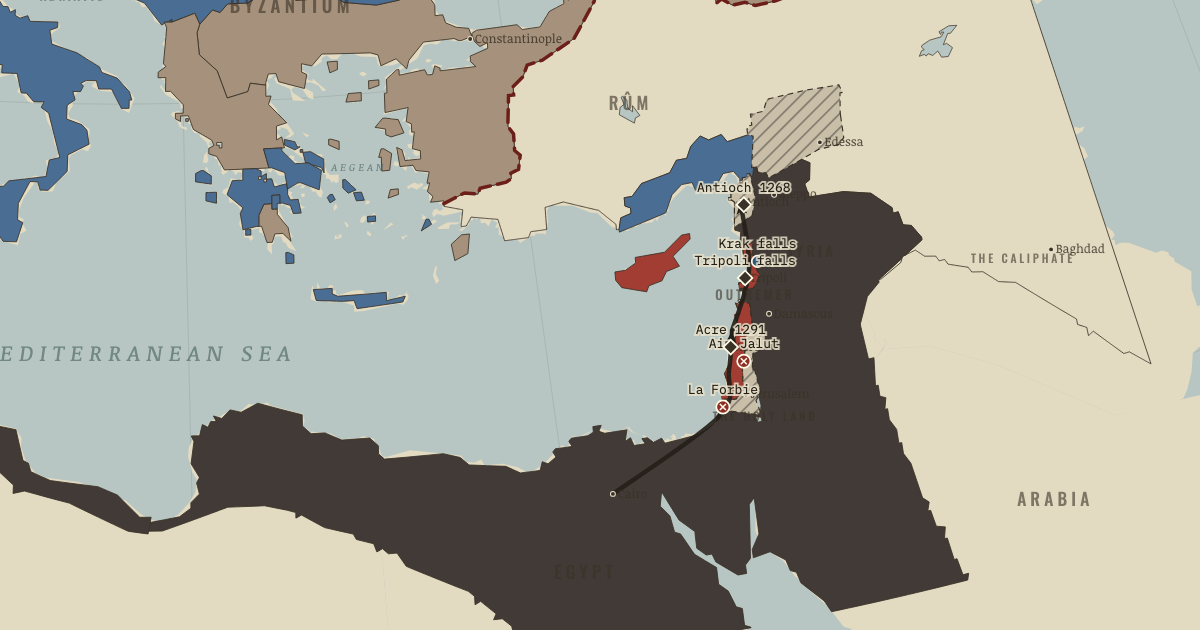
The map above is the world of The Crusades, 1271 — After Baibars — Antioch gone, Krak fallen.
Part of IB History: The Crusades →
SHORT EXPLANATION
After Jerusalem was lost in 1244, defeat at La Forbie deprived Outremer of an army it could scarcely replace. A different military power was rising in Egypt. The Mamluks, soldiers purchased as slaves and trained in military households, took power in 1250. Their victory over the Mongols at Ain Jalut in 1260 strengthened their claim to defend Muslim lands and gave them a position from which to campaign in Syria.
Baibars and his successors could bring that power against the coast repeatedly. Antioch fell in 1268 amid mass killing and enslavement; Krak des Chevaliers followed in 1271, Tripoli in 1289 and Acre in 1291. Each loss deprived the remaining towns of support, income and refuge. Western help was costly and intermittent, while the coast lacked a secure base from which to replace what it lost.
The full story
The army destroyed at La Forbie, near Gaza, in 1244 represented a chance for the Franks and their Damascene allies to resist together. Egyptian forces and Khwarezmian mercenaries, who had just sacked Jerusalem, defeated them. Jerusalem was lost, and Outremer would not again field an army of comparable size. The crusader states faced a further change in the balance of power when the Mongols destroyed Baghdad and the Abbasid caliphate. At Ain Jalut in Galilee in 1260, Egypt’s Mamluks checked a Mongol army. Their victory strengthened their position in Syria and gave the new regime prestige as a defender of Islam.
The contrast between Egypt and the crusader coast mattered over years, not just in one battle. Egyptian revenue supported soldiers and siege equipment; Mamluk control in Syria gave armies inland routes from which to return to the coast. The coastal cities depended partly on help arriving by sea. Each stronghold that fell meant less income and fewer places of refuge for its neighbors, as well as one fewer partner in their defense. Some Franks hoped for cooperation with the Mongols against Muslim powers. That possibility survived Ain Jalut, but it did not produce a durable rescue.
Baibars and his successors attacked the coastal network one stronghold at a time. The sack of Antioch in 1268 brought extensive killing and enslavement: it was an atrocity as well as a conquest. In 1271 Krak des Chevaliers, one of the great castles of the age, surrendered after a siege and a forged order. Tripoli was stormed and destroyed in 1289. After about six weeks under siege, Acre fell on 18 May 1291. People fought and fled through the city, and some drowned trying to escape through the harbor. The mainland crusader states had ended.
Western expeditions could reach the coast, but they were temporary and expensive, and European rulers had wars and succession problems at home. A fleet might have prolonged Acre’s defense. To reverse the losses, the Franks would also have needed a regional system capable of replacing men, money and strongholds as the Mamluks continued their campaigns. Ports and walls alone could not provide that system.
FULL EXPLANATION
The Mamluk Military State
A Mamluk military household began with young men purchased as slaves, often from outside the Islamic world. They were converted and trained, and when freed they retained ties to their commanders’ households. Ability and patronage could bring advancement. New purchases replenished the elite, so it did not depend solely on hereditary succession; this was a system with a long history in the Muslim world, not a modern meritocracy. In 1250 senior Mamluk officers displaced the Ayyubids in Egypt. Their victory at Ain Jalut supplied the new rulers with a powerful claim to defend Islam. It also strengthened their position in Syria. Egypt’s revenue paid for cavalry, sieges and repeated campaigns, giving Baibars and his successors the means to return to the coast after each conquest. Outremer, by contrast, depended in part on expeditions assembled far away in the West. The difference in sustained capacity helps explain why its contraction proved so difficult to reverse.
Why the End Came in Stages
Hattin did not bring the crusader states to an immediate end. Ports and castles, diplomacy and occasional Western expeditions preserved a coastal system for another century. Its survival makes the final fall look abrupt, but the system had been losing its parts for years. Antioch, the great castles and Tripoli fell before Acre. Each had supplied some combination of refuge, revenue and mutual support to the places left behind. Europeans continued to discuss recovery, even as crusade taxes were sometimes diverted, kings attended to other priorities and failed expeditions to Egypt discouraged another great effort. Acre’s defenders included military orders, townspeople and merchants; refugees from places already lost crowded into the port. Surviving accounts disagree over details and numbers. The siege deserves remembrance both as a brutal human event and as the end of a long imbalance in resources.
Key places on the map
On this day
Why it happened
The Mamluk military state. The Mamluks replenished their military elite by purchasing and training young soldiers. Once freed, men could advance through service and patronage. Egyptian revenue supported armies and sieges, and rulers invoked jihad to legitimate attacks. Together these gave Egypt a regional military power able to campaign against the coast repeatedly.
The Mongol shock, survived. The destruction of Baghdad and the Abbasid caliphate showed the reach of Mongol power and alarmed Muslim rulers and crusaders alike. Some Franks hoped for a Mongol ally against Muslim neighbors. At Ain Jalut the Mamluks checked the advance and gained prestige as defenders of Islam. Frankish–Mongol cooperation remained possible afterward, but it did not save Outremer.
European disengagement. Western rulers had to raise money and assemble forces far from the coast. Crusade taxes were sometimes diverted, papal and imperial disputes impeded cooperation, and kings faced competing wars and obligations. Crusading in Iberia, the Baltic and Italian politics drew attention and resources too. The aid that reached Outremer never matched the Mamluks’ capacity for repeated campaigns.
THE TURNING POINT
Ain Jalut, 3 September 1260. On 3 September 1260, the Mamluks defeated a Mongol force at Ain Jalut in Galilee, checking an advance that had reached Syria. The victory gave the new Egyptian regime prestige as a defender of Muslim lands and strengthened its regional position. It did not make Outremer’s fall inevitable, but it strengthened the power Baibars and his successors would bring against the coast.
What it changed
Outremer erased. On the map, the coast turns to lost-hatch. Acre’s fall in 1291 ended the mainland crusader states born after the First Crusade in 1099; Cyprus remained under Latin rule.
The orders relocate. The orders continued after losing the mainland. The Hospitallers later established themselves on Rhodes and then Malta, and the Teutonic Knights built a Baltic state. The Templars withdrew to Cyprus; following action by the French king and the papacy, their order was suppressed in 1307–14.
Crusading survives its object. The loss of the states did not end crusading. Plans to recover the Holy Land continued for centuries, as did crusade taxes and the language of holy war. The idea had purposes beyond holding the coast.
DISCUSSION QUESTION — Why did no European fleet save Acre in 1291?
Acre received outside help, but no force arrived that could break the siege. Raising and transporting a large expedition was costly. Kings faced other wars and obligations, papal and imperial disputes had impeded cooperation, and crusade taxes had sometimes been diverted. The failed expeditions against Egypt also showed how difficult it was to establish a lasting regional base. Even a fleet that saved Acre temporarily would have left the question of how to supply men, money and strongholds for its continuing defense. The Mamluks could draw on regional resources more readily than the remaining coastal states.
An interesting fact
The anonymous Templar of Tyre witnessed Acre’s fall and served as secretary to Grand Master William of Beaujeu. He describes Beaujeu being struck by a javelin in the breach. When men thought he was withdrawing, the master showed them his wound and answered: “I am not fleeing; I am dead,” Acre was not quite the last Latin foothold. The Templars held Ruad, a waterless islet two miles off Tortosa, until 1302–03, when its garrison surrendered and was taken into captivity in Cairo.
Related
THE FREE PRINTABLE STUDY GUIDE
Get the printable study guide for The Crusades free. I’ll send you a few short letters, then one when a new atlas opens. That’s all. — Paul
NO TRACKING · YOUR ADDRESS IS USED FOR THE DISPATCH AND NOTHING ELSE · UNSUBSCRIBE ANYTIME