Feminism and the Tunisian Revolution · CHAPTER 9 ·
Tunisian Revolution
Chapter 9 of Protest and Change: Second-Wave Feminism and Tunisia, 1945–2015: “Twenty-Eight Days”
On 17 December 2010 the street vendor Mohamed Bouazizi set himself on fire in Sidi Bouzid after officials confiscated his scales, and protests spread from the interior to Tunis, Sfax and Sousse. Police killed protesters in Kasserine, Thala and Regueb, and after twenty-eight days the 23-year rule of President Ben Ali fell.
Chapter 9 is included with every paid plan. WW2 is free in full, and chapter 1 of every atlas is free. A free account opens 3 more chapters a day. Starter, at $9 a month, opens all 21 with no daily limit — see the plans.
Free printable Feminism and the Tunisian Revolution study guide, sent by email ↓
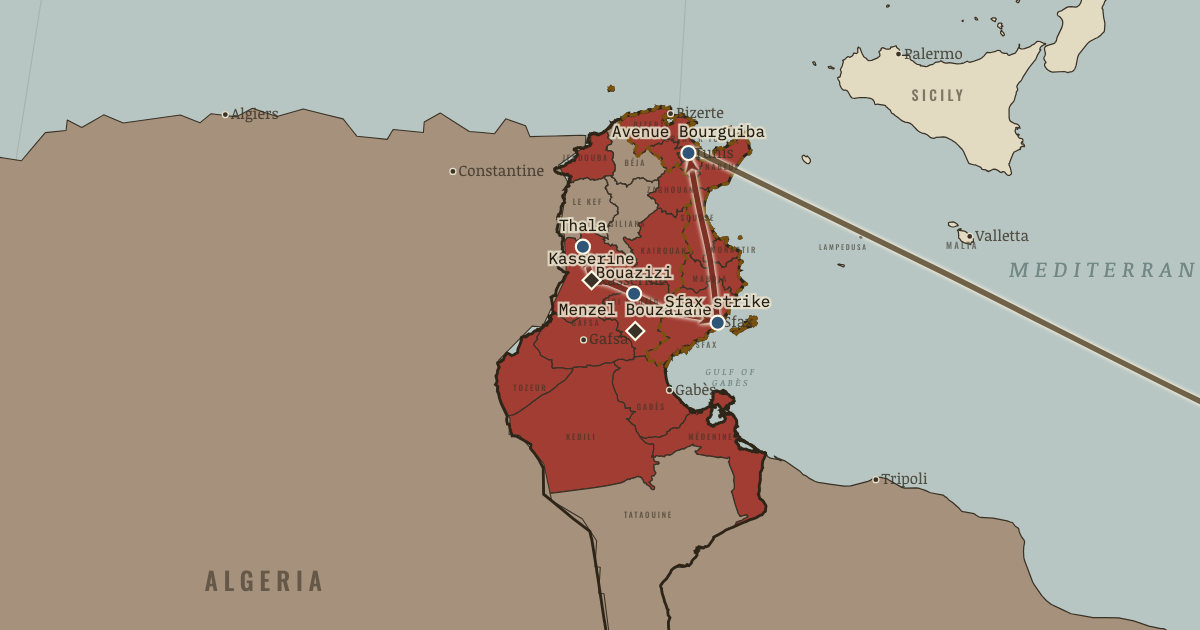
The map above is the world of Tunisia, 14 January 2011 — Ben Ali flees.
Every state on the map that year: The world in 2010 · Europe in 2010.
Part of IB History: Second-wave feminism and Tunisia →
SHORT EXPLANATION
On 17 December 2010 a municipal inspector confiscated the scales of Mohamed Bouazizi, a 26-year-old street vendor in Sidi Bouzid. Officials refused to hear his complaint. He set himself on fire outside the governorate building, and protests began that afternoon. Within twenty-eight days President Zine el-Abidine Ben Ali’s 23-year dictatorship had fallen. The snapshots follow the revolt across Tunisia’s 24 governorates, provinces much like counties, from the neglected interior to the favored coast.
Police killed protesters at Menzel Bouzaiane on 24 December. By the end of the month demonstrations had reached eleven governorates, including Tunis, Sfax and Sousse. Amnesty International counted at least 25 people killed in Kasserine, Thala and Regueb from 8 to 10 January. Funerals brought mourners together, and the killings gave them fresh reasons to protest. What began as a regional revolt became a national one.
The protesters had ways to reach and organize one another. Phone videos circulated on Facebook and appeared on the satellite channel Al Jazeera, breaking the state’s media blackout. Lawyers and regional branches of the UGTT, the national trade-union federation, much like Britain’s TUC, organized marches and strikes. On 12 January a general strike brought all the workers of Sfax out at once. Two days later, during a general strike in Tunis, thousands outside the Interior Ministry shouted “Dégage!” (“Get out!”). The army stood aside, and Ben Ali fled to Saudi Arabia that evening. A national commission later counted 338 dead, including prisoners who died after his flight. The protest that had failed to spread from Gafsa in 2008 had now found a wider reach.
The full story
The revolt began in the Centre-West, where the regime’s unwritten bargain had failed conspicuously. Tunisians were expected to accept political silence in return for jobs and order. For a street vendor in Sidi Bouzid, even the attempt to earn a living could end in a confrontation with officials. On 17 December 2010 Mohamed Bouazizi set himself on fire after his scales were confiscated and his complaint went unheard.
His relatives and local unionists marched that day on the governorate offices; a governorate is one of Tunisia’s 24 provinces. A cousin filmed the march, and the footage reached Al Jazeera, which Tunisians watched by satellite. On 24 December the National Guard, a paramilitary police force, shot dead 18-year-old Mohamed Ammari at Menzel Bouzaiane, where a memorial now marks the place. He was the first of the uprising’s martyrs, the name Tunisians give those killed by the security forces. By 31 December protests had reached the eleven governorates colored red in the second snapshot. Local anger had traveled through connections already available to its organizers and witnesses.
The deaths brought more people into the streets. Bouazizi died on 4 January; about 5,000 attended his funeral. From 8 to 10 January police fired on crowds and funeral processions in Kasserine, Thala and Regueb. Amnesty International counted at least 25 killed, the government admitted 21, and unions said more than 50. Each funeral gathered people around a loss for which they held the authorities responsible. Repression was creating occasions for further protest.
Ben Ali, president since 1987, answered with threats and promises. On 10 January he called the protesters terrorists and promised 300,000 jobs. The following day regional branches of the UGTT, Tunisia’s national trade-union federation, pushed its leadership to authorize regional general strikes: workers across a region would stop work together. The International Crisis Group, an independent research body, calls the decision the true turning point. On 12 January 30,000 to 50,000 marched in Sfax, strikes closed Kairouan and Tozeur, Tunis’s poorest suburbs rose, and the army was deployed in the capital. On the map red crosses the dashed coastal outline. The revolt had reached the regime’s own heartland and acquired an organized means of disrupting it.
Ben Ali promised freedoms and an end to live fire on 13 January. The next day the UGTT held a two-hour general strike in Tunis, and around 10,000 people gathered outside the Interior Ministry. That evening he flew to Jeddah in Saudi Arabia, along the arrow leaving the map. His defenders had ceased to act together: the army guarded buildings and declined to coordinate repression with the presidential guard. General Rachid Ammar later testified that he had received no order to fire, casting doubt on the famous story that he refused one.
The official commission of inquiry later counted 338 dead and 2,147 injured, including 86 prisoners who died after Ben Ali left. Four governorates—Béja, Siliana, Le Kef and Tataouine—remain tan because no protest before 14 January has been documented there. The government had lost the capacity to hold its ground before demonstrations were documented in every governorate.
FULL EXPLANATION
Facebook, Al Jazeera or the unions?
Early accounts called the uprising a “Facebook revolution” or a “Twitter revolution”. New media did make events visible beyond the towns where they occurred. The blogger Lina Ben Mhenni traveled to Sidi Bouzid and Kasserine and posted photographs from hospitals. Al Jazeera, banned from operating in Tunisia, broadcast amateur footage every day. Tunisians could see what state television concealed. Seeing a protest and organizing one are different tasks. Sociologist Choukri Hmed describes “dormant networks” of trade unionists, teachers, lawyers and leftist activists, many veterans of the Gafsa defense campaign, reactivated in December. The International Crisis Group and Joel Beinin emphasize the UGTT’s regional federations. After the union decision of 11 January, strikes in Sfax, Kairouan and Tozeur on 12 January helped turn scattered protests into a national movement. The timing gives their argument weight. Images carried information and outrage; unions and lawyers helped people act together. Neither alone had been enough in Gafsa in 2008.
The army and the legend of the general who said no
A popular account gives General Rachid Ammar a dramatic role in Ben Ali’s fall. According to the story, the army chief of staff refused an order to shoot the crowds and told the president he was finished. Political scientist Sharan Grewal traces it to a blog post by activist Yassine Ayari, later amplified by foreign commentators. Ammar told investigators in April 2011 that he had never received such an order, so he had not refused it. The army’s actual conduct still mattered. The International Crisis Group reports that from about 10 January senior officers declined to coordinate with Ali Seriati, the presidential guard commander. Soldiers replaced police in Kasserine and were welcomed. Scholars of civil-military relations point to the army’s position under Ben Ali: he kept it small, about 35,000 strong, and favored the police while denying the army political influence. It had little stake in his survival. Egypt’s army, by contrast, ran a business empire and steered its revolution. Tunisian restraint did not mean innocence: the army also killed protesters during the curfew after 14 January. The evidence replaces a heroic refusal with a quieter withdrawal of support.
Counting the martyrs
Counts of the dead record different periods and different groups. By 13 January the human-rights federation FIDH had compiled a named list of 66. The interim government spoke of 78 at the end of January. On 1 February the Interior Ministry reported 147 protest deaths and 72 prisoners who died on 14 and 15 January, many in prison fires and escapes, including 42 at Monastir. In May 2012 the national investigative commission chaired by Taoufik Bouderbala reported 338 dead and 2,147 injured between 17 December 2010 and 21 January 2011. Its count included 86 prisoners and members of the security forces. The official list of “martyrs of the revolution”, published in 2021, named only 129 and excluded many categories; families protested. The title carries benefits, making the definitions consequential for survivors as well as for the historical record. Roughly 300 to 340 people died, at least a quarter after Ben Ali fled, and their names remain contested.
Key places on the map
On this day
Why it happened
Blocked hopes in the interior. In Sidi Bouzid, Kasserine and Gafsa unemployment stood far above the national rate of 13 per cent, while poverty was about four times that of the coast. Education had raised hopes of jobs that did not exist. Those seeking informal work could encounter humiliation from police and officials instead. The interior had revolted in 1984 and 2008; in 2010 familiar grievances spread with a different speed and reach.
Dignity as the demand. Poverty alone does not capture the meaning many Tunisians found in Bouazizi’s act. It spoke to humiliation by officials, an experience that crossed class lines and helped draw the coastal middle class into protest. Many Tunisians call the uprising the “Revolution of Freedom and Dignity” and dislike the foreign label “Jasmine Revolution”.
Networks ready to mobilise. Under Ben Ali, union branches, the lawyers’ bar, teachers’ unions and human-rights activists survived in weakened form. Defending the Gafsa prisoners gave them experience they could use again. In December 2010 they organized marches, documented killings and called strikes. Their connections gave local protesters a means of acting across the country; in 2008 the UGTT’s national leadership had held back.
New media against an old blackout. A state television blackout could leave each town unaware of protests elsewhere. Phone cameras, Facebook and Al Jazeera made that isolation harder to maintain: footage from Thala in the afternoon could be watched in Sfax that evening. WikiLeaks’ publication of US diplomatic cables in December 2010 also confirmed what many suspected about corruption in the ruling family.
THE TURNING POINT
The Sfax general strike, 12 January 2011. Sfax showed that a revolt from the interior could interrupt life in the coastal heartland. Tunisia’s second city and industrial center lies within the coastal outline on the map, and its regional union was the country’s strongest. After the UGTT authorized regional strikes on 11 January, tens of thousands marched in Sfax; strikes followed in Kairouan and Tozeur, and Tunis’s suburbs rose that night. Bouazizi’s act had begun the uprising. Now organized workers could stop the economy, presenting Ben Ali with a wider threat than scattered riots. He fled two days later.
What it changed
A dictator falls in four weeks. On 14 January Ben Ali’s departure ended his 23 years in power and 55 years of one-party government. Old-regime figures initially led the interim authorities, but protesters demanded a deeper break. Young people came from the interior in the Caravan of Liberation, and sit-ins took place in Kasbah square outside the prime minister’s offices. A lasting change was that Tunisians no longer feared to speak in public.
The Arab uprisings. Tunisia’s rapid success encouraged people elsewhere to believe their rulers could fall quickly. Protest began in Egypt on 25 January, and Hosni Mubarak fell on 11 February; demonstrations began in Libya from 17 February and also spread to Yemen, Bahrain and Syria. The slogan “the people want the fall of the regime” traveled with them. That expectation of quick change cost many lives in Libya and Syria. Tunisia alone produced a democratic transition, lasting a decade before President Kaïs Saïed suspended parliament in 2021.
A revolution without leaders. No single leader, party or program directed the uprising. The authorities therefore had no single leadership to suppress, but the revolution also lacked an agreed direction after Ben Ali fled. Old-regime officials, the UGTT, returning exiles such as Rached Ghannouchi and new parties entered the resulting political space. Who would inherit the revolution became the central conflict of the next three years.
The dead and the wounded. Families of the dead and wounded pressed for recognition, compensation and trials of police officers. Their campaigns kept Kasserine and Thala in public memory. The official list of martyrs appeared only in 2021, and the slow delivery of justice remained a grievance through later crises.
DISCUSSION QUESTION — Why did the protests that failed in the Gafsa mining basin in 2008 succeed in bringing down Ben Ali in 2010–11?
Both uprisings grew from unemployment, corruption, regional neglect and police abuse. In 2008 the Gafsa revolt stayed within an isolated mining basin. Few images reached the rest of Tunisia, the national union leadership held back, and police could cordon off the area and jail its leaders. In 2010–11 the same grievances reached many governorates within two weeks. Videos on Facebook and Al Jazeera crossed the blackout; regional unions pushed the UGTT to authorize strikes; and the killings in Kasserine produced national outrage. The army, with little stake in Ben Ali’s survival, finally stood aside. Historians differ over the weight of media and unions, but neither spread nor defection alone explains the outcome. The earlier failure also supplied experienced organizers for the later movement.
An interesting fact
A poem written in 1933 supplied some of the revolution’s most famous lines. Abu al-Qasim al-Shabbi, its young Tunisian author, died of heart disease the following year, aged 25. The opening couplet of “The Will to Live” promises that if a people one day wills to live, fate must answer and the chains must break. The couplet had entered Tunisia’s national anthem in 1987 and was sung at Ben Ali’s official ceremonies. In January 2011 crowds chanted it against his regime in Tunis; demonstrators in Cairo and other Arab cities soon took it up. Words the government had made official became an anthem of its overthrow.
Related
THE FREE PRINTABLE STUDY GUIDE
Get the printable study guide for Protest and Change free. I’ll send you a few short letters, then one when a new atlas opens. That’s all. — Paul
NO TRACKING · YOUR ADDRESS IS USED FOR THE DISPATCH AND NOTHING ELSE · UNSUBSCRIBE ANYTIME