Decolonization of Africa · CHAPTER 4 ·
Algerian War
Chapter 4 of The Decolonization of Africa, 1945–1994: “Algeria — The Exception”
Algeria was legally part of France and home to about a million European settlers, so the demand for independence met a wall. The FLN launched its insurrection on 1 November 1954, France committed about half a million soldiers and used torture in the 1957 Battle of Algiers, and Algeria became independent in July 1962.
Chapter 4 is included with every paid plan. WW2 is free in full, and chapter 1 of every atlas is free. A free account opens 3 more chapters a day. Starter, at $9 a month, opens all 21 with no daily limit — see the plans.
Free printable Decolonization of Africa study guide, sent by email ↓
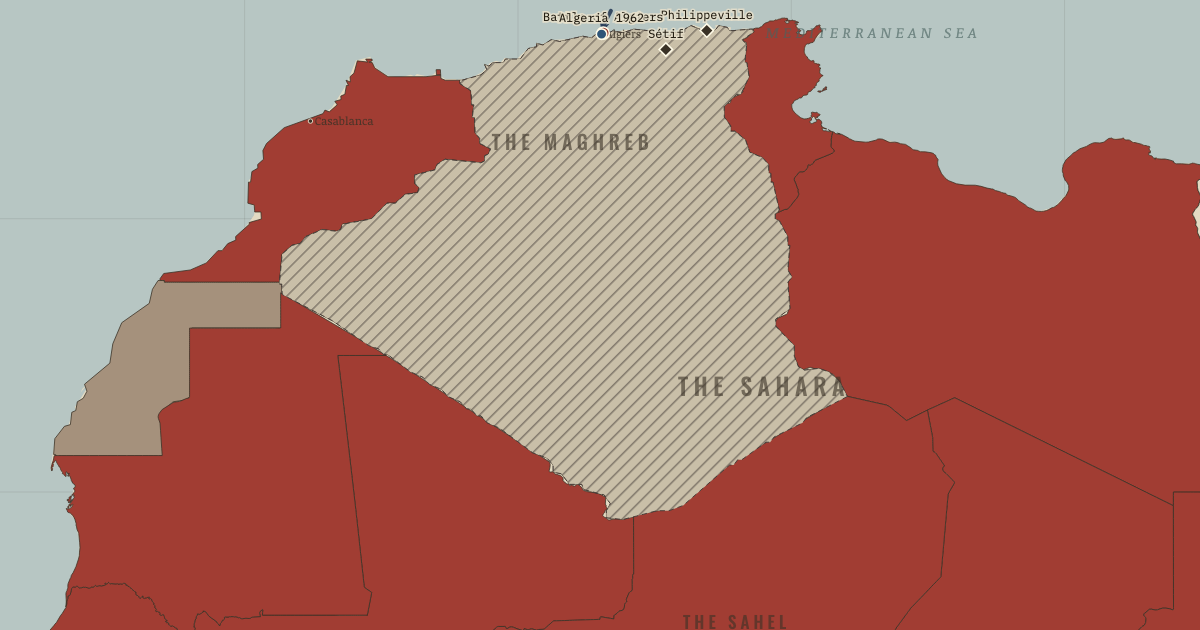
The map above is the world of Africa, 1960 — The Year of Africa.
Every state on the map that year: The world in 1960 · Europe in 1960.
Part of IB History: The Decolonization of Africa →
SHORT EXPLANATION
Algeria occupied a different place in French law from a protectorate or an overseas possession: it was part of France, divided into départements. About a million European settlers lived there, owned the best land and wielded influence in Paris. For them, independence threatened homes, farms and status in the country where they lived. Their resistance helped make the struggle unlike Ghana’s negotiated independence, and Algeria became the scene of a terrible colonial war.
The National Liberation Front (FLN) sought to survive and make French rule unworkable while taking its case abroad. France sent roughly half a million troops. In the Battle of Algiers, systematic torture helped its forces control the streets while damaging France’s legitimacy at home and abroad. Independence came in July 1962 after immense suffering. The dead remain a subject of fierce dispute: Algerian estimates run well over a million, while most French historians count several hundred thousand.
The full story
At Sétif in 1945, a victory-day march gave way to killings. Weeks of French reprisals followed, leaving thousands dead and destroying a generation’s faith in gradual reform. Nine years later, on 1 November 1954, the National Liberation Front (FLN) launched a coordinated insurrection. Its cells and regional zones were intended to sustain a struggle that would make Algeria impossible to govern, rather than simply hold ground against the French army.
The conflict was especially hard to settle because about a million Europeans regarded Algeria as their country. They held land and economic power, and their influence in Paris could block compromise. Independence threatened their homes, farms and status. Settlers and the army that identified with them resisted with a desperation unlike that in Ghana or Nigeria; settler interests also lay behind violence in Kenya, Rhodesia and South Africa.
France committed about half a million soldiers. During the Battle of Algiers in 1957, paratroopers broke the FLN’s urban network through mass arrests and torture. They achieved a tactical victory, but the exposure of their methods damaged France’s standing abroad. Offensives in the countryside also battered the FLN. These successes left France with the problem of governing an unwilling population for an indefinite time.
De Gaulle returned to power in 1958 amid settlers’ hopes that he would preserve French Algeria. He instead concluded that self-determination served France better than continuing the war. Settlers and much of the army revolted against his change of course, while the OAS used terror to try to wreck a settlement. Algeria became independent in July 1962.
The end brought further suffering. About a million settlers fled to a France that scarcely wanted them. The harkis, Algerians who had fought for France, were largely abandoned, and tens of thousands were killed in reprisals. Hundreds of thousands of Algerians had died in the war, although estimates vary widely and remain politically charged; the economy was shattered and France traumatized. Ahmed Ben Bella led the exhausted country, only to be overthrown by his own defense minister within three years. Algeria’s war-forged army has held power ever since.
FULL EXPLANATION
The FLN’s strategy of endurance
The FLN had to survive losses it could not prevent. It organized in cells and regional commands, so that the destruction of fighting units would not necessarily end resistance. Its attacks aimed to show that France could not restore normal rule, while its diplomats brought Algeria before the United Nations and the non-aligned world. French reprisals tended to bring recruits to the FLN and reduce sympathy for France abroad. Together, these actions sought to wear down France’s political capacity to continue. Civilians faced terrible risks in this struggle. The FLN also used violence against rivals and against Algerians it considered collaborators. Those acts belong to the account of its strategy, alongside the consequences of French repression. France could control cities and destroy units without settling who would govern Algeria. Settler pressure blocked early compromise; conscription brought the war into French society; and the political cost of continued occupation rose. Later liberation movements and their opponents studied the war because territory and battlefield strength did not by themselves decide whether a colonial power could sustain its rule.
The Battle of Algiers and the price of control
French paratroopers broke the FLN’s bombing network in Algiers using intelligence extracted through detention and torture. On the immediate operational question, they succeeded. The treatment of prisoners, however, violated the legal and republican principles France invoked to justify its presence. It divided French opinion and gave the FLN evidence to present to international audiences. How much did this campaign change the whole war? Historians debate its weight alongside rural fighting, settler politics, economic strain and de Gaulle’s strategy. The battle nevertheless exposes a problem for a durable settlement: methods that secure immediate control can damage the legitimacy on which continued rule depends. The victims were people, not data points; their treatment also shows what can happen to a state’s institutions when emergency violence becomes routine and its consequences escape control.
Key places on the map
On this day
Why it happened
Why settlers made compromise difficult. For a million Europeans, Algeria was home. Their land, economic power and influence in Paris gave them both a reason and the means to resist a compromise that threatened their farms, homes and status. The army identified with them. This made the struggle unlike Ghana or Nigeria; in Algeria, Kenya, Rhodesia and South Africa, settler interests formed a structural background to violence.
The FLN’s political strategy. The FLN faced an army it could not defeat in open battle. It therefore sought to keep resistance alive and make Algeria ungovernable. Attacks could provoke reprisals that radicalized the population and damaged France’s reputation; diplomacy took the conflict to the UN and the non-aligned world. The movement accepted terrible military losses in a struggle to wear down France politically.
Torture and French legitimacy. French forces gained control in the Battle of Algiers with the help of systematic torture. Once intellectuals and the press exposed the practice, the same methods divided opinion in France and turned metropolitan and world opinion against the war. France claimed to defend republican values, yet its forces violated them in the Casbah. A tactical victory had a cost for the legitimacy of French rule.
De Gaulle changes course. De Gaulle returned to power in 1958 amid a settler-military revolt. He came to see Algérie française as unsustainable: war was draining France, isolating it internationally and obstructing the modern European future he wanted. His move toward self-determination in “a war without a name” enraged settlers and the army, bringing barricades and the OAS revolt. He faced them down and accepted the political cost of ending a war he judged unwinnable.
THE TURNING POINT
The Battle of Algiers, 1957 — victory as defeat. Massu’s paratroopers break the FLN bombing network in the Casbah in 1957, using checkpoints, mass arrests and torture. France has won control of the immediate battlefield. But when those methods become an international scandal, they strengthen the FLN’s claim to the moral high ground and help turn French society against the war. The battle reveals the distance between defeating a network and securing legitimacy for continued rule.
What it changed
Independence and its costs. The July 1962 independence left a country with a shattered economy and hundreds of thousands of Algerians dead; estimates vary widely and remain politically charged. France, too, was traumatized. Ahmed Ben Bella took charge of the exhausted country, but his defense minister overthrew him within three years. Algeria’s war-forged army has held power ever since.
The harkis and pieds-noirs. Nearly a million European settlers fled to a France that barely wanted them. Another community faced an even more terrible fate: the harkis, Algerians who had fought for France, were largely abandoned, and tens of thousands were killed in reprisals after independence. Frightened people had to move, and memories of their losses continue to poison French-Algerian relations. These are human experiences to remember, not entries on a scorecard.
Lessons for southern Africa. Southern African opponents drew different lessons from the same war. Algeria showed how fiercely a settler minority could fight, how savage the conflict could become, and that the colonial power might nevertheless lose. Whites in Rhodesia and South Africa took the lesson “never surrender”; liberation movements took “endure and internationalize.” Algeria’s example shaped the conflicts in chapters 8 and 9.
DISCUSSION QUESTION — France could crush the FLN in open battle yet still lost the war. What does Algeria teach about how colonial and settler wars are actually decided?
France’s victories at Algiers and in the Challe offensives damaged the FLN, but they did not answer how France could govern eleven million unwilling Algerians indefinitely, or how long it would accept the cost. The FLN survived, provoked reprisals and took its cause abroad, raising the political and moral price of continued rule. The war consumed blood and money, corroded French democratic values and became indefensible at the UN and in the press. Algeria shows how a settler power facing a patient, organized majority can win battles and still lose a war when political will and international legitimacy give way. Later struggles in Rhodesia, Namibia and South Africa confirmed the wider lesson.
An interesting fact
For thirty-seven years France did not call the conflict a war. The fighting of 1954–62 was officially “operations for the maintenance of order”; in everyday French it was les événements, “the events”. In June 1999 the National Assembly voted to put “Algerian war” into French law. The dead remain disputed too: Algeria honors 1.5 million martyrs, while most French historians estimate several hundred thousand Algerian dead. The distance between those figures is part of the war’s unfinished history.
Related
THE FREE PRINTABLE STUDY GUIDE
Get the printable study guide for The Decolonization of Africa free. I’ll send you a few short letters, then one when a new atlas opens. That’s all. — Paul
NO TRACKING · YOUR ADDRESS IS USED FOR THE DISPATCH AND NOTHING ELSE · UNSUBSCRIBE ANYTIME