Crusades · CHAPTER 3 · OUTREMER
Crusader states (Outremer)
Chapter 3 of The Crusades, 1095–1291: “A Society on the Edge”
For nearly two centuries the four crusader states of Outremer formed a thin coastal ribbon where a small Latin elite ruled larger Muslim and Eastern Christian populations. The Franks relied on castles such as Krak des Chevaliers and on Italian fleets paid with self-governing quarters, and lived by truces, taxes and trade.
Chapter 3 is included with every paid plan. WW2 is free in full, and chapter 1 of every atlas is free. A free account opens 3 more chapters a day. Starter, at $9 a month, opens all 21 with no daily limit — see the plans.
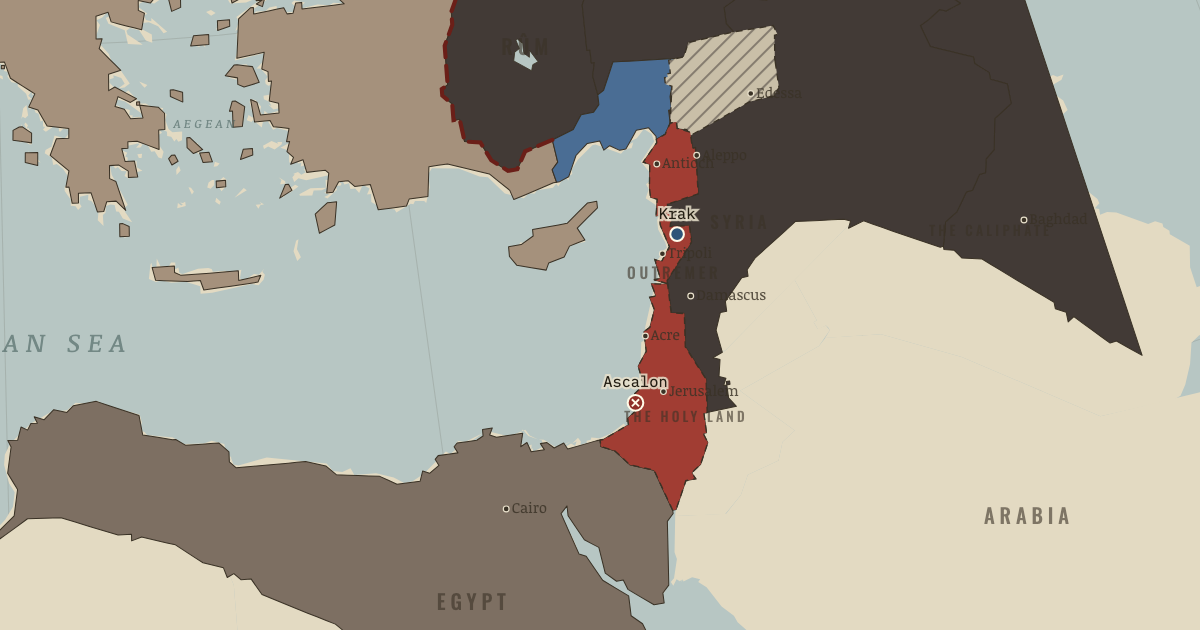
The map above is the world of The Crusades, 1153 — Ascalon — the peak of Outremer.
Part of IB History: The Crusades →
SHORT EXPLANATION
Four crusader states survived for nearly two centuries with a small Frankish population ruling far larger Muslim and Eastern Christian communities. Castles such as Krak des Chevaliers helped a few soldiers guard roads and frontiers. Italian fleets connected the ports to Europe, in exchange for self-governing quarters and shares of customs and conquered ports.
Survival also required cooperation with the people and powers of the region. Frankish rulers taxed Muslim farmers, traded, made truces and allied with Muslim neighbors, even as holy war continued. The capture of Ascalon in 1153 brought the kingdom to its widest extent. Yet its narrow territory and limited manpower left it vulnerable: a lost field army would be difficult to replace before its cities came under attack.
The full story
Outremer’s rulers faced a problem that shaped the way they defended their conquests. Perhaps a few hundred thousand Franks lived across the four states, among a much larger native population. There were too few settlers to occupy the countryside densely. Instead, they concentrated their strength at places from which they could control roads and watch the frontier.
A great castle such as Krak des Chevaliers made a small force more useful. It could shelter cavalry, while an enemy wishing to remove the garrison faced a long and costly siege. These strongpoints helped the Franks keep territory that they lacked the numbers to hold everywhere at once. Much of the states’ effort went into defense, even when opportunities for conquest arose.
The ports needed a different kind of protection. Outremer had no fleet of its own, so Genoa, Pisa and Venice supplied ships and links to Europe. The price gave those republics interests inside the states they supported: self-governing urban quarters and shares of customs revenues and conquered ports. Their ships helped sustain commerce and warfare, while their privileges gave them a measure of power in Outremer.
Government on land likewise depended on relationships across religious lines. Frankish lords taxed Muslim farmers, hired local troops and made truces with neighboring emirs. Farmers, craftsmen, interpreters and allies made the states workable. The Syrian gentleman Usama ibn Munqidh wrote of Franks and Muslims sharing roads, doctors and shrines, sometimes with amusement and sometimes with dismay. Settlers born in the East, whom newcomers called poulains, could shock fresh arrivals from Europe by the way they dressed, ate and married.
Such familiarity did not erase conquest. A Latin elite governed larger subject populations under laws that varied by community, and a neighbor who traded in one year might raid in another. Accommodation and violence were both part of life on this frontier.
The capture of Ascalon in 1153 brought the kingdom to its widest extent. It also left more territory to defend as Nur al-Din brought Aleppo and Damascus together under hostile rule. The states depended on Western traffic and on divisions among surrounding powers; an increasingly united opponent threatened that balance. Castles could delay an attack, but the narrow land behind them offered little room to retreat or gather replacements if a field army was destroyed.
FULL EXPLANATION
Frontier, Colony, or Both?
The name we give Outremer changes what we notice. “Colonial” puts conquest, settlement and extraction by a ruling minority in the foreground. It reminds us that cultural exchange took place within unequal institutions: the Latin elite controlled land and courts and ruled a subject majority. Yet the word can also bring with it modern assumptions about nation-states, racial ideology and metropolitan economies that do not fit the twelfth century. “Frontier society” brings the Franks’ dependence on local labor, their cultural borrowing and their shifting alliances into view. It has its own danger, for a picture of negotiation can make conquest and unequal law seem less severe. Consider the rulers who fought fellow Christians at one moment and allied with Muslim emirs at another. They had conquered their position, but they also had to adapt to the people and powers around them. Both terms help if we use them to ask who ruled, who paid taxes and whose work sustained the states, rather than letting either name settle the question for us.
What Castles Could Not Solve
A castle could make scarce soldiers count for more. From a strongpoint a garrison watched roads and sheltered cavalry; an attacker had to invest time and supplies in a siege. The military orders later provided permanent garrisons that kings struggled to maintain. But a fortress also needed food and money, and its defenders might eventually need a field army to relieve them. The narrow coastal states had little territory in which to withdraw, collect replacements and buy time. Hattin in 1187 showed what happened when the mobile force on which the defenses depended was lost. Much of the kingdom’s field army had been concentrated in one campaign; after its destruction, cities surrendered in quick succession. Isolated fortresses could delay conquest, but they could not restore that army. The stone defenses were formidable, and they still depended on resources and soldiers beyond their walls.
Key places on the map
On this day
Why it happened
The tyranny of numbers. Perhaps a few hundred thousand Franks lived in the four states, ruling a much larger native population. Their numbers could not sustain dense settlement across the countryside. Castles and hired or local troops helped them hold ground, but every campaign drew on a limited supply of defenders.
The maritime bargain. Ships connected Outremer to Europe and supported its wars. Genoa, Pisa and Venice provided them in return for self-governing quarters in ports including Acre and Tyre, and shares of customs and conquered ports. The arrangement brought essential help while giving the republics their own powerful interests in the states.
Coexistence as necessity. Ruling a conquered population required daily cooperation. Frankish lords taxed Muslim farmers, traded through Muslim intermediaries and could ally with one emir against another. Raids and massacres belonged to this same world: practical accommodation allowed the states to function alongside recurring violence.
THE TURNING POINT
Ascalon, 1153 — the high-water mark. The last Fatimid fortress on the coast, Ascalon fell in 1153. Its capture brought the kingdom to its widest extent, but the new ground also had to be defended. At the same time Nur al-Din was consolidating Aleppo and Damascus into a hostile power, changing the balance inland.
What it changed
A brittle strength. A castle could hold up an attacker, but it needed supplies and might need relief. The loss of a field army would leave the narrow kingdom little time or space to gather replacements before its cities were exposed. Hattin will bring that danger into view.
The orders fill the gap. The kingdom had too few knights and no standing troops to occupy all its great castles. The military orders helped provide permanent garrisons, supported by resources from Europe. The next chapter examines how these fighting religious communities worked.
A culture that outlasts the states. The states also connected communities through sugar, textiles and trade routes, and through the movement of techniques and ideas in both directions. Exchange continued after the last stronghold fell. The epilogue considers this legacy.
DISCUSSION QUESTION — Was Outremer a colonial society, a frontier society, or something for which we have no clean word?
“Colonial” identifies a settler elite that conquered land and extracted resources from a subject majority. That is an important part of Outremer. Yet the comparison can import modern assumptions about nation-states, racial ideology and metropolitan economies into a different medieval setting. “Frontier society” makes the Franks’ adaptation to Levantine life, reliance on local labor and allies, and alliances across religious lines easier to see. It can also obscure unequal rule. We need both insights: conquest gave the rulers power, while their position required constant negotiation with the society around them.
An interesting fact
Usama ibn Munqidh recalled praying in a small oratory beside al-Aqsa in Jerusalem, which the Templars, whom he called his friends, kept available to him. A newly arrived Frank twice seized him and turned him east, insisting that he should pray that way. The Templars removed the man and apologized: he had just arrived and had never seen a Muslim pray toward Mecca. Usama judged Franks long settled in the East better company than newcomers. His account gives us a Muslim visitor’s view of the difference between them.
Related
THE FREE PRINTABLE STUDY GUIDE
Get the printable study guide for The Crusades free. I’ll send you a few short letters, then one when a new atlas opens. That’s all. — Paul
NO TRACKING · YOUR ADDRESS IS USED FOR THE DISPATCH AND NOTHING ELSE · UNSUBSCRIBE ANYTIME