Crusades · CHAPTER 6 ·
Saladin and the fall of Jerusalem
Chapter 6 of The Crusades, 1095–1291: “Saladin”
Saladin ended the Fatimid caliphate in Egypt in 1171 and, after Nur al-Din’s death in 1174, took Syria, uniting the two powers around the crusader states. On 4 July 1187 he destroyed the army of Jerusalem at the Horns of Hattin; the cities surrendered one after another, and Jerusalem gave up in October 1187.
Chapter 6 is included with every paid plan. WW2 is free in full, and chapter 1 of every atlas is free. A free account opens 3 more chapters a day. Starter, at $9 a month, opens all 21 with no daily limit — see the plans.
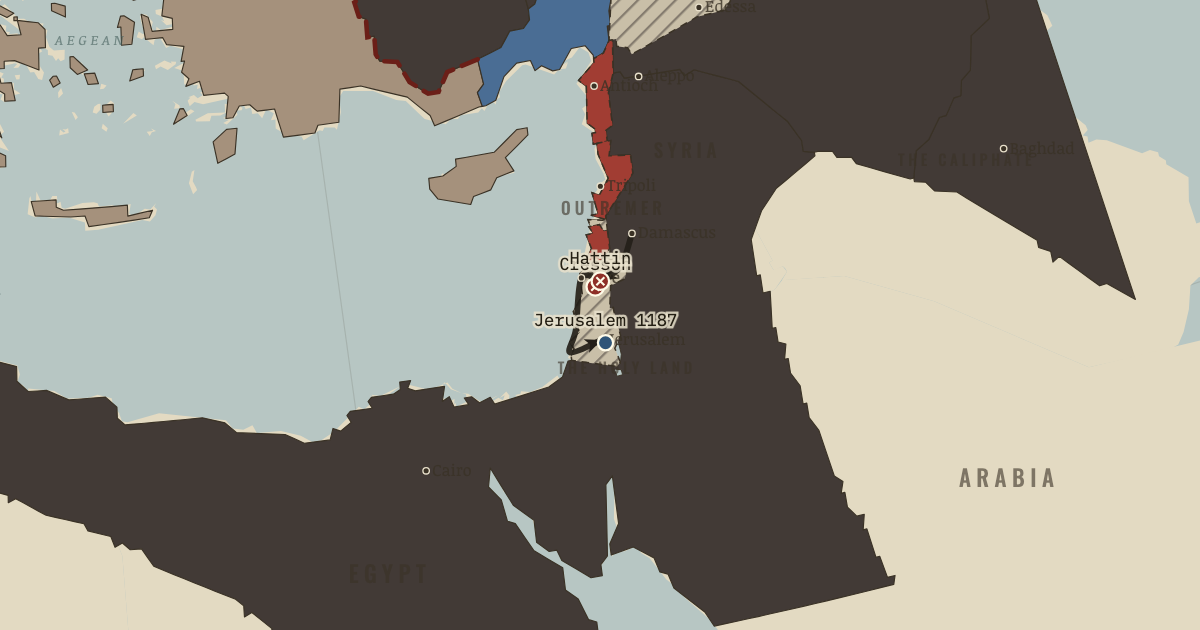
The map above is the world of The Crusades, 1187 — Hattin — the kingdom collapses.
Part of IB History: The Crusades →
SHORT EXPLANATION
The crusader states had survived partly because their Muslim neighbors competed with one another. Saladin changed that balance. Sent to Egypt as an officer of Nur al-Din, he ended the Shia Fatimid caliphate in 1171 and restored Sunni allegiance. After Nur al-Din died, he spent years taking Syrian territory, largely from fellow Muslims. Marriage into the Zengid house, recognition from the Baghdad caliph and the language of jihad supported his authority. By 1186 he ruled Egypt and much of Syria, bringing their resources to bear around the crusader coast.
In 1187 the kingdom’s army left its water to relieve Tiberias. Saladin destroyed it at the Horns of Hattin, and cities surrendered in succession, including Jerusalem in October. He demanded ransoms but reduced or waived many and allowed no general massacre. The contrast with the slaughter of 1099 was sharp: his treatment saved lives and helped establish his authority and enduring reputation.
The full story
Saladin arrived in Egypt as a subordinate of Nur al-Din. In 1171 he abolished the Shia Fatimid caliphate and restored Sunni allegiance, establishing himself as Egypt’s ruler. Nur al-Din died in 1174, and Saladin then spent years acquiring territory in Syria, often fighting fellow Muslims. By 1186 he controlled Egypt and much of Syria. The crusader states could no longer rely in the same way on the rivalry between rulers on either side of them.
Saladin had to establish his authority as well as win territory. He married into the Zengid family, obtained recognition from the caliph in Baghdad and presented his expansion as preparation for recovering Jerusalem. The resources he brought together mattered: Egypt could finance continued war, while Syria supplied depth. A ruler who controlled both could sustain a campaign that would have been harder for their separate rulers to mount.
The kingdom met this danger with its own leadership divided. A disputed succession had put King Guy on the throne against a powerful faction. At the Springs of Cresson, a reckless charge by the military orders cost the kingdom valuable cavalry. Guy then faced a decision about Tiberias. Despite opposition among his commanders, he led the main army away from water and across a dry plateau to relieve it.
Saladin made that journey part of the battle. His forces harassed the crusaders, used fire and controlled the wells, exhausting men who were already short of water. At Hattin on 4 July 1187 the surrounded army was destroyed and the True Cross captured. Cities fell in rapid succession afterward, and Jerusalem surrendered in October. Saladin required ransoms but reduced or waived many and allowed no general massacre. Compared with the slaughter of 1099, his treatment of the city saved lives and strengthened his standing and legend.
Why did a single battle open the way to such losses? The kingdom had concentrated its scarce mobile forces in the field. Its castles could delay an attacker, but without an army they could not readily relieve one another, and there were too few soldiers to replace the field force and defend the walls. Saladin’s coordinated sweep exploited that weakness. Tyre held out, and Tripoli and Antioch survived in the north; the collapse was not complete. Even so, the defeat opened the way to the loss of conquests made over nearly ninety years.
FULL EXPLANATION
Unity Changed the Strategic Equation
For years the crusader states had been able to deal with rulers in Damascus, Aleppo and Cairo whose interests did not always coincide. Saladin’s achievement was to bring Egypt and much of Syria under one authority. Consider what that gave him: Egypt provided revenue, grain and fleets, while Syria offered routes, cities and armies. Their combined resources allowed campaigns on several fronts and made losses easier to replace than they were for the coastal states. None of this guaranteed victory in every battle. The new position had to be assembled over years, often through wars against fellow Muslims. Saladin used the language of jihad to present those wars as preparation for recovering Jerusalem. Nur al-Din’s consolidation of Syria, Saladin’s Egyptian base and his later Syrian conquests were successive stages in state-building. By Hattin, the balance of resources had changed through decades of effort.
The Making of a Shared Hero
Saladin’s treatment of Jerusalem in 1187 helped make him a hero remembered across religious boundaries. His clemency was significant beside the massacre of 1099, and the lives saved were real. Yet mercy was not his response to every captive. After Hattin he ordered captured Templars and Hospitallers executed; he killed Reynald of Châtillon himself while sparing King Guy. Medieval rulers could use selective mercy and exemplary violence together. Writers then gave different meanings to his career. Muslim court authors celebrated a champion of jihad. Later Western literature increasingly portrayed a chivalric opponent, and a courteous enemy could reflect the ideals of those he defeated. Enlightenment writers used the “noble Saladin” to criticize the fanaticism of their own crusading ancestors. These accounts shaped a hero for their audiences, but political usefulness and genuine mercy could coexist. His reputation has to accommodate his violence, his clemency and the ways both were remembered.
Key places on the map
On this day
Why it happened
The union of Egypt and Syria. Saladin brought Egypt and much of Syria under his authority between 1171 and 1186. Earlier, the crusader states could seek help among competing rulers; now one ruler could draw on resources from both regions. That made the kingdom’s position more dangerous without making the outcome of each battle certain.
Legitimacy, manufactured. Saladin, a Kurdish commander, gained power from fellow Muslim rulers and needed support for his authority. His Zengid marriage and the caliph’s recognition helped supply it. The language of jihad presented his Syrian campaigns as preparation for war against the Franks. Urban and Nur al-Din had also joined religious purpose to the building of political power.
The crusaders’ self-destruction. The disputed succession left Guy opposed by a powerful faction. The military orders lost valuable cavalry at Cresson, and the march toward Tiberias took the main army away from water and exposed it to encirclement. As Chapter 3 showed, the kingdom had little strategic depth in which to absorb the loss of that force.
THE TURNING POINT
The Horns of Hattin, 4 July 1187. On 4 July 1187 at the Horns of Hattin, Guy’s army ran short of water and was surrounded and destroyed; the True Cross was captured. Most of the kingdom’s field force was gone. Its scattered defenses could no longer count on relief from that army, opening the way to the loss of cities acquired over nearly ninety years.
What it changed
Outremer reduced to slivers. The map marks the kingdom’s lost territory with hatching. Tyre held out on the coast, and Tripoli and Antioch survived in the north. Even with those exceptions, Saladin reversed much of the Frankish conquest in one campaigning season.
The Third Crusade summoned. News of Jerusalem’s fall shook Europe. Three major kings took the cross for the Third Crusade, whose expedition to the eastern Mediterranean is the subject of the next chapter.
A legend in two civilizations. The mercy shown at Jerusalem entered a reputation that crossed religious boundaries. Muslim writers celebrated a champion of jihad; Western writers fashioned a chivalric opponent. Those accounts drew on a career that included both clemency and ruthless violence.
DISCUSSION QUESTION — Was Saladin’s reputation as a hero earned, or was it made by later storytellers?
His reputation was both earned and made. At Jerusalem in 1187, Saladin’s treatment saved lives and contrasted sharply with the massacre of 1099. He also ordered captured members of the military orders executed after Hattin and killed Reynald of Châtillon. Since he had taken power from fellow Muslims, he needed legitimacy; public mercy could strengthen his authority while remaining genuine mercy. Muslim court writers praised his jihad, while Western writers made him a chivalric opponent whose courtesy reflected their own ideals. Enlightenment authors later used the “noble Saladin” to criticize their crusading ancestors. The reputation rests on actions that later writers selected and interpreted for their own audiences.
An interesting fact
Saladin’s secretary, Imad al-Din al-Isfahani, recorded a scene he witnessed in the sultan’s tent after Hattin. Saladin seated the captured King Guy beside him and gave him water cooled with snow. Guy passed the cup to Reynald of Châtillon. Saladin had an interpreter make clear that Guy, rather than the sultan, had given Reynald the drink: custom bound a host who offered a captive water to spare him. Saladin then killed Reynald himself, fulfilling an earlier oath, but spared Guy, saying that kings do not kill kings. The distinction over the cup made room for both acts.
Related
THE FREE PRINTABLE STUDY GUIDE
Get the printable study guide for The Crusades free. I’ll send you a few short letters, then one when a new atlas opens. That’s all. — Paul
NO TRACKING · YOUR ADDRESS IS USED FOR THE DISPATCH AND NOTHING ELSE · UNSUBSCRIBE ANYTIME