Crusades · CHAPTER 7 ·
Third Crusade
Chapter 7 of The Crusades, 1095–1291: “The Third Crusade”
The Third Crusade brought three kings east, but Frederick Barbarossa drowned in the Saleph and Philip II left early. Richard I seized Cyprus, helped take Acre, where he had some 2,700 prisoners executed, and beat Saladin at Arsuf in 1191, yet never tried to hold Jerusalem; his 1192 treaty kept a reduced coastal state.
Chapter 7 is included with every paid plan. WW2 is free in full, and chapter 1 of every atlas is free. A free account opens 3 more chapters a day. Starter, at $9 a month, opens all 21 with no daily limit — see the plans.
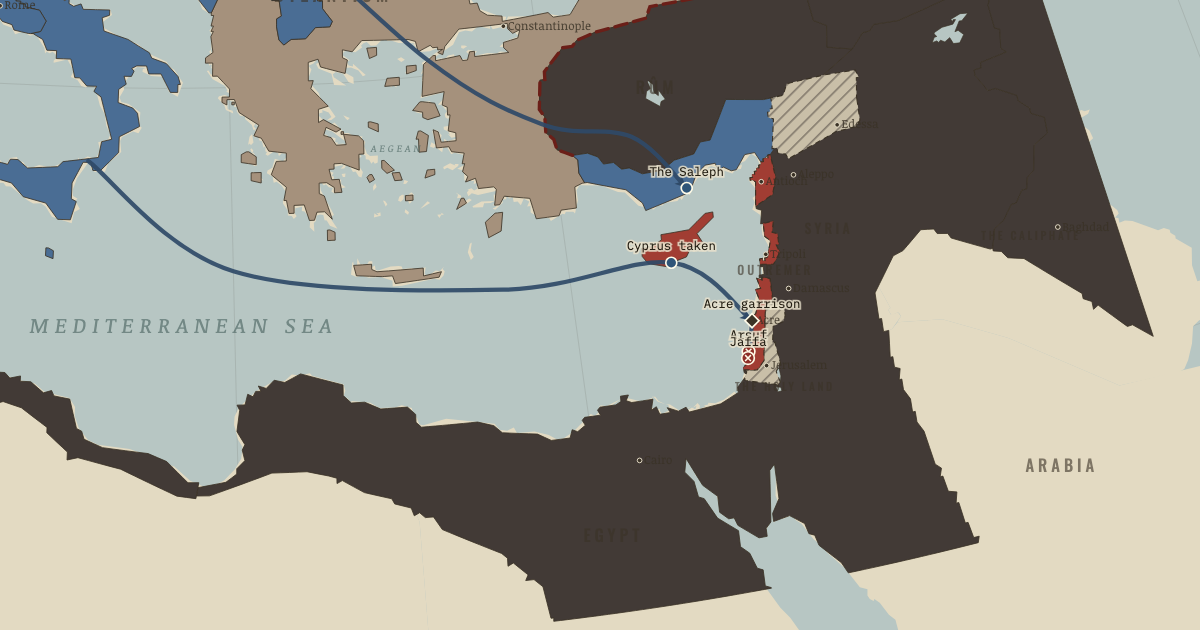
The map above is the world of The Crusades, 1192 — The treaty coast.
Every state on the map that year: The world in 1200 · Europe in 1200.
Part of IB History: The Crusades →
SHORT EXPLANATION
Jerusalem’s loss brought three powerful kings to the Third Crusade, but their armies did not remain together. Frederick Barbarossa drowned in the Saleph, and Philip II of France left early. Richard I of England seized Cyprus, helped capture Acre and defeated Saladin at Arsuf. At Acre he also ordered the killing of about 2,700 prisoners from the surrendered garrison.
Richard approached Jerusalem twice without attempting to hold it. The city lay inland, beyond the support of his fleet, and Saladin held the surrounding country and drew resources from Egypt. A victory at Jerusalem would have left a garrison to face those conditions after the crusading army departed. The 1192 treaty instead preserved a reduced Latin coastal state and allowed Christian pilgrims to visit Jerusalem under Muslim rule.
The full story
The loss of Jerusalem and the True Cross in 1187 brought rival European kings to a common cause. Their expedition soon lost much of its strength. Frederick Barbarossa led a huge German army overland, but drowned crossing the Saleph in Cilicia in 1190; grief and disease dispersed much of his force. Philip II of France would leave the campaign early. Richard the Lionheart traveled by sea, seizing Cyprus from its Byzantine ruler on the way. This unplanned conquest became a Latin kingdom that survived the mainland states by centuries.
The long siege of Acre ended in surrender in 1191. Its terms involved ransom, the return of the True Cross and the release of Christian captives. When negotiations stalled, Richard ordered some 2,700 prisoners from the surrendered garrison killed in sight of Saladin’s army. He then led his army south along the coast. Saladin’s forces harassed the march, but Richard kept his men together in a defensive formation until, at Arsuf, they broke the opposing army in open battle.
Arsuf showed that the crusaders could defeat Saladin in the field. It did not settle what would happen to Jerusalem after a victory there. On the coastal march the fleet could help supply Richard’s army; Jerusalem lay inland, surrounded by country Saladin controlled. He also retained the resources of Egypt. A garrison left in the city would need supplies and reinforcement after the main army moved on, and Richard could not create the settlers or remove the Egyptian base needed to make that occupation secure. He advanced toward Jerusalem twice and withdrew both times rather than take a place he expected to lose.
Richard fought another hard defensive battle at Jaffa in 1192. By then both rulers had reasons to make peace: Richard needed to protect his lands in Europe, while Saladin’s emirs were exhausted. Their treaty preserved a smaller coastal Latin state and allowed Christian pilgrimage to Jerusalem without transferring the city. The crusade had recovered a defensible foothold and access to its sacred destination, though it had not recovered the destination itself.
FULL EXPLANATION
Why Arsuf Did Not Decide the War
At Arsuf, Richard’s infantry and cavalry moved together in a defensive column close to the coast. The fleet could supply the army, and the formation allowed it to endure repeated attacks without coming apart. A charge eventually broke Saladin’s forces. Crusader confidence recovered, and the road to Jaffa was secured. Yet Saladin still had his state and its much larger resources. Jerusalem lay in a different position altogether: inland, surrounded by enemy-held territory and far from the fleet. Taking it would have been one operation; supplying its garrison after the army moved on would have been another. Some contemporaries, intent on the sacred city, saw Richard’s withdrawal as failure. His decision gave weight to the second problem. The coast could be supported from the sea, and holding it kept a Latin state alive. Arsuf illustrates how battlefield superiority can leave the political and logistical difficulties of a war unresolved.
Acre and the Limits of Chivalric Memory
Acre’s surrender opened negotiations over ransom, the True Cross and the release of Christian captives. When implementation stalled, Richard ordered roughly 2,700 Muslim prisoners killed, although accounts differ about the number. Several explanations have been offered: guarding so many men would burden the coming march, Richard distrusted Saladin, and he may have wanted to force compliance. These pressures help us understand the decision; the victims were nevertheless men who had surrendered. Later romantic accounts can celebrate Richard’s courage and diplomacy while passing over the massacre, just as idealized portraits of Saladin can omit his executions after Hattin. There is little to gain from turning the two acts into a moral scoreboard. Both belong in the history. Chivalry regulated some conduct while coexisting with extreme coercion, and practical pressures, retaliation and reputation help explain how violence against prisoners became thinkable.
Key places on the map
On this day
Why it happened
The shock of 1187. Jerusalem and the True Cross were lost in 1187. The shock galvanized western Europe as nothing had since 1095, bringing kings who were bitter rivals to take the cross. Their resources strengthened the expedition, but their European disputes came with them: Richard I and Philip II remained rivals, and Philip left early.
The logistics of holding Jerusalem. A force might take Jerusalem, but an inland garrison would then need supplies and reinforcement through hostile territory. Saladin could draw on Egypt while the coastal crusader army depended on access by sea. Richard saw Egypt as the strategic key to securing the Holy Land; later crusaders made attacks there an important part of their plans.
Exhaustion, personal and political. The war had strained both sides. Saladin’s emirs were exhausted after years of fighting. Richard, meanwhile, needed to return to Europe: Philip had left and threatened his interests, and Richard’s brother John was maneuvering against him. The peace of 1192 answered pressures on both rulers.
THE TURNING POINT
Arsuf, 7 September 1191. On 7 September 1191, Richard’s disciplined army defeated Saladin at Arsuf and secured its march along the coast. The victory demonstrated the strength of a crusader army in battle. Jerusalem posed a further question: how could an inland garrison be supplied and defended after that army had gone? Arsuf did not answer it.
What it changed
A rescued but truncated kingdom. The surviving state of Outremer was smaller and governed from Acre, with its strength concentrated along the coast. Jerusalem stayed under Muslim rule, while Christian pilgrims gained access. The mainland states endured in this diminished form for another century.
Cyprus, the lasting prize. Cyprus was an unplanned conquest, but it supplied the Latin world with a wealthy and defensible island base. Its Latin rulers lasted until 1571, long after the crusader states on the mainland had fallen.
The Egypt doctrine. Saladin could draw on Egypt even after defeat in the field. Later crusaders therefore made Egypt a major target, though their campaigns had different plans and outcomes. Richard’s difficulty at Jerusalem helps explain why the resources behind an opposing army mattered as much as a victory over it.
DISCUSSION QUESTION — Richard defeated Saladin at Arsuf and Jaffa but did not try to hold Jerusalem. Was his decision a failure or a realistic judgment?
Richard made a realistic judgment about what his victories could secure. Capturing Jerusalem would have answered the religious hope that brought the kings east. Holding it required something more: a garrison, supplies and reinforcement through territory where Saladin remained powerful, while Egypt continued to support his war. Richard lacked the settlers and forces for a secure occupation. His 1192 treaty kept a coastal state that could be supported from the sea and allowed pilgrims to reach Jerusalem without possessing it. Contemporaries had reason to regret the loss of the Holy City; Richard had reason to doubt that taking it would be enough to keep it.
An interesting fact
For all the stories of their rivalry, Richard and Saladin never met face to face. Envoys carried their exchanges, often Saladin’s brother al-Adil. In October 1191 Richard proposed a remarkable settlement: al-Adil would marry his sister Joan, the widowed queen of Sicily, and the couple would rule Jerusalem jointly. Saladin’s judge and biographer Baha al-Din says the sultan accepted, reckoning Richard could not deliver. Joan was furious at the prospect of marrying a Muslim, and the scheme dissolved. Later paintings of the rulers together depict a meeting that never occurred.
Related
THE FREE PRINTABLE STUDY GUIDE
Get the printable study guide for The Crusades free. I’ll send you a few short letters, then one when a new atlas opens. That’s all. — Paul
NO TRACKING · YOUR ADDRESS IS USED FOR THE DISPATCH AND NOTHING ELSE · UNSUBSCRIBE ANYTIME