MAPS OF HISTORY · IB HISTORY · PROTEST AND CHANGE
IB HISTORY · 1945 – 2015 · 12 CHAPTERS
IB History: Second-wave feminism and Tunisia — notes, maps and essay plans
Women’s rights advanced from the jury box to the UN; in Tunisia, twenty-eight days toppled a dictator. Why do movements emerge, how do they change the law, and whom do they leave behind?
This page gathers the atlas’s IB notes: where each of its 12 chapters fits the syllabus, the concepts and evidence it supports, practice questions with model essay plans, primary sources, and starting points for the Internal Assessment.
WW2 is free in full, and chapter 1 of every atlas is free. A free account opens 3 more chapters a day. Opening a new atlas uses one of them. Membership opens all 21 — Join.
Where it fits the course
Every chapter’s IB notes name the parts of the course it serves. Across the atlas they add up to this: It is the paired atlas for the Paper 1 Focused Study Protest and Change, whose page holds a free source-question set.
- Paper 1 · Protest and Change · 12 CHAPTERS
- Paper 2 · Authoritarian Rule · 3 CHAPTERS
- Paper 2 · Popular Movements · 11 CHAPTERS
- Paper 3 · The Americas, section 11.11 · 5 CHAPTERS
- Old course · Prescribed subject 4: Rights and protest · 2 CHAPTERS
- Old course · World history topic 10: Authoritarian states (20th century) · 2 CHAPTERS
Chapter by chapter
Across its 12 chapters, the atlas holds 72 points of evidence and 35 primary sources. Here you can read all the evidence for chapters 1 and 2. For each later chapter there is one point and the practice question; the rest is in the atlas. Select a chapter title to open its free page and read the full explanation.
1. The Problem That Has No Name
CHAPTER 1 · 1945–1963 · CONCEPTS: CAUSATION, SIGNIFICANCE
EVIDENCE TO USE · ALL 6 POINTS (A FREE CHAPTER)
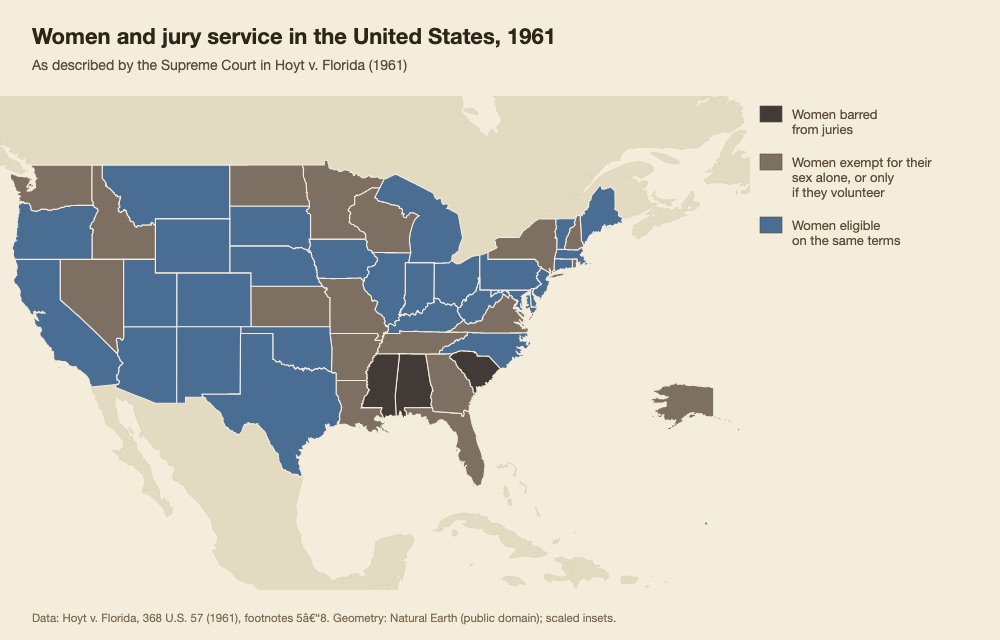
- In Hoyt v. Florida (1961), the Supreme Court upheld a law under which women appeared on Florida’s jury lists only if they volunteered. The Court’s reasoning placed them at home: woman was “still regarded as the center of home and family life”.
- Women had the vote, but jury service shows how far equal citizenship remained from reality. In 1961 Alabama, Mississippi and South Carolina excluded women from juries altogether, while eighteen other states allowed them an exemption simply because they were women.
- By 1960 roughly one in three married American women had paid work. Women working full time nevertheless earned only 60.7 per cent of men’s median pay. The expectation that women belonged at home sat uneasily with their growing participation in work and the unequal rewards they received there.
- Betty Friedan gave educated women a name for their unhappiness in The Feminine Mystique, published on 19 February 1963. She drew on a 1957 survey of her Smith College classmates, and the book went on to sell more than a million copies.
- On 14 December 1961, President Kennedy established the Commission on the Status of Women, chaired by Eleanor Roosevelt. Its work documented unequal pay and laws; by 1967, it had led to the creation of state commissions in all fifty states.
- The Equal Pay Act, signed on 10 June 1963, prohibited paying women less for “equal work”. Yet most jobs were segregated by sex, so the act addressed a difference in pay for equal work while leaving much of the separation between jobs in place. Women’s earnings stayed near 60 per cent of men’s until the late 1970s.
2. Organising for Equality
CHAPTER 2 · 1963–1970 · CONCEPTS: CHANGE, PERSPECTIVES
EVIDENCE TO USE · ALL 6 POINTS (A FREE CHAPTER)
- Women gained a federal ban on job discrimination when an amendment to Title VII of the Civil Rights Act passed by 168 votes to 133. Howard Smith of Virginia had proposed adding “sex” to the law on 8 February 1964.
- In its first year, the EEOC received about a third of its complaints from people alleging sex discrimination. Officials nevertheless treated the clause as a “fluke”; NOW was founded on 30 June 1966 to press for action.
- In Weeks v. Southern Bell (1969), NOW’s use of litigation produced a result: a federal appeals court held that Title VII overrode a Georgia rule excluding women from jobs that required lifting more than 30 pounds.
- A few hundred radical feminists protested at the Miss America pageant in Atlantic City on 7 September 1968. They burned nothing, yet the press invented the “bra-burner”, an image that made the movement famous and gave others an easy way to mock it.
- For three weeks in June 1968, 187 sewing machinists at Ford’s Dagenham plant struck and brought car production to a halt. They won an increase from 85 to 92 per cent of the male rate for their grade.
- The Equal Pay Act received royal assent in Britain on 29 May 1970, though it did not come into force until December 1975. Women’s hourly pay rose from about 63 per cent of men’s in 1970 to 76 per cent in 1977.
3. The Personal Is Political
CHAPTER 3 · 1968–1975 · CONCEPTS: CHANGE, CONSEQUENCE
EVIDENCE TO USE · 1 OF 6
- Consciousness-raising groups gave women a place to compare experiences of sex, marriage and housework. Kathie Sarachild described the groups in 1968, and Carol Hanisch defended them in “The Personal Is Political”. What had seemed private could now be understood as a shared political grievance.
Practice question: Compare and contrast the ways in which campaigners achieved abortion law reform in the United States and France, 1969–1975.
5 more points of evidence, 3 primary sources and the model plan for this question are in the IB notes of chapter 3 in the atlas.
4. Who Was Left Out?
CHAPTER 4 · 1970–1981 · CONCEPTS: PERSPECTIVES, SIGNIFICANCE
EVIDENCE TO USE · 1 OF 6
- In “Double Jeopardy” (1969), Frances Beal argued that Black women experienced racism and sexism together. She challenged the idea of housework as women’s prison: Black women, she pointed out, had always worked for wages.
Practice question: Why did Black, Chicana and poor women organize separately from the mainstream women’s movement in the United States in the 1970s? Examine the reasons.
5 more points of evidence, 3 primary sources and the model plan for this question are in the IB notes of chapter 4 in the atlas.
5. The ERA and the Backlash
CHAPTER 5 · 1972–1982 · CONCEPTS: CAUSATION, PERSPECTIVES
EVIDENCE TO USE · 1 OF 6
- The Equal Rights Amendment passed the Senate by 84 votes to 8 on 22 March 1972. Hawaii ratified it that same day, and within nine months the number of ratifying states had reached 22.
Practice question: To what extent was the failure of the Equal Rights Amendment the result of the campaign led by Phyllis Schlafly?
5 more points of evidence, 4 primary sources and the model plan for this question are in the IB notes of chapter 5 in the atlas.
6. A Global Movement
CHAPTER 6 · 1975–1985 · CONCEPTS: CHANGE, PERSPECTIVES
EVIDENCE TO USE · 1 OF 6
- From 19 June to 2 July 1975, delegations from 133 governments gathered in Mexico City for the first UN World Conference on Women. It opened a Decade for Women that continued until 1985.
Practice question: How significant was the UN Decade for Women (1976–1985) for women outside the Western world?
5 more points of evidence, 3 primary sources and the model plan for this question are in the IB notes of chapter 6 in the atlas.
7. Bourguiba’s Tunisia
CHAPTER 7 · 1956–1987 · CONCEPTS: CONTINUITY, CHANGE
EVIDENCE TO USE · 1 OF 6
- Tunisia’s Personal Status Code changed the terms of marriage and divorce. Decreed on 13 August 1956 and effective from 1 January 1957, it abolished polygamy and repudiation by husbands, while allowing either spouse to seek a divorce in court.
Practice question: To what extent did Habib Bourguiba’s reforms (1956–1987) improve women’s position in Tunisia?
5 more points of evidence, 3 primary sources and the model plan for this question are in the IB notes of chapter 7 in the atlas.
8. Ben Ali: Stability and Silence
CHAPTER 8 · 1987–2010 · CONCEPTS: CAUSATION, CONTINUITY
EVIDENCE TO USE · 1 OF 6
- On 7 November 1987, Ben Ali took power after seven doctors certified Bourguiba unfit under Article 57 of the constitution. He went on to win re-election four times, receiving between 89 and 99 per cent of the vote.
Practice question: Examine how Zine el-Abidine Ben Ali maintained power in Tunisia between 1987 and 2010.
5 more points of evidence, 3 primary sources and the model plan for this question are in the IB notes of chapter 8 in the atlas.
9. Twenty-Eight Days
CHAPTER 9 · DECEMBER 2010 – JANUARY 2011 · CONCEPTS: CAUSATION, SIGNIFICANCE
EVIDENCE TO USE · 1 OF 6
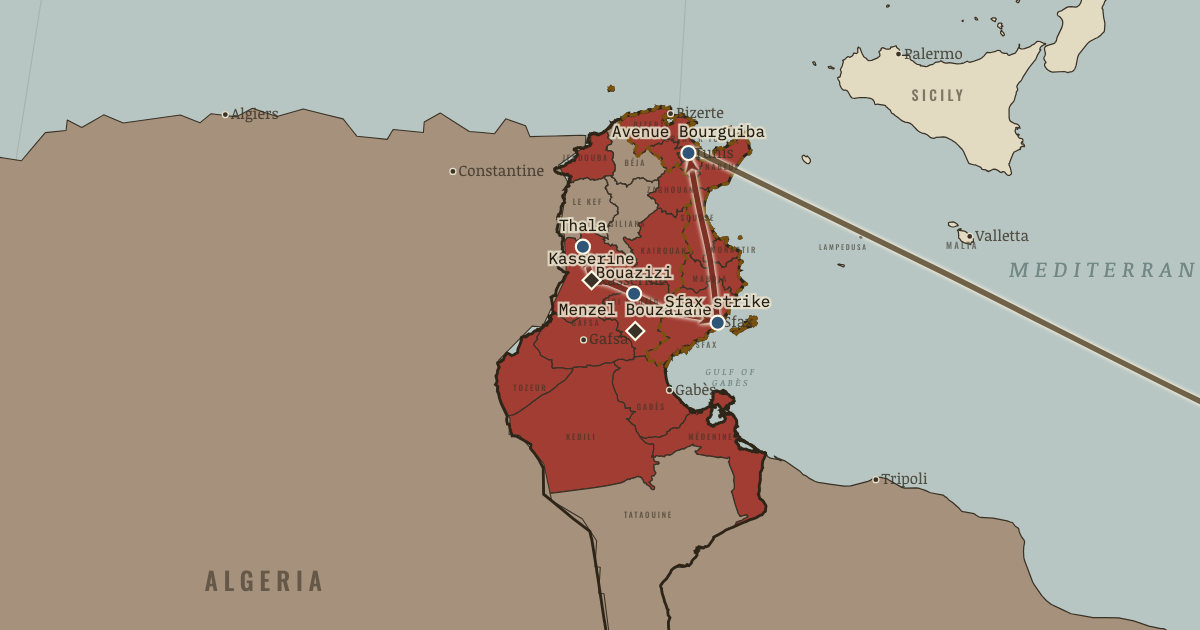
- Mohamed Bouazizi was a 26-year-old street vendor in Sidi Bouzid. After an inspector confiscated his scales, he set himself on fire outside the governorate building on 17 December 2010. He died on 4 January 2011.
Practice question: To what extent was the role of the trade unions the most important reason for the fall of Ben Ali in January 2011?
5 more points of evidence, 3 primary sources and the model plan for this question are in the IB notes of chapter 9 in the atlas.
10. Building a Democracy
CHAPTER 10 · 2011–2014 · CONCEPTS: CHANGE, CONSEQUENCE
EVIDENCE TO USE · 1 OF 6
- Young people from Tunisia’s interior arrived in Tunis on 23 January 2011 as the Caravan of Liberation. Their arrival was followed by the Kasbah sit-ins, which forced Prime Minister Mohamed Ghannouchi to resign on 27 February 2011.
Practice question: Why did Tunisia’s democratic transition survive the political crisis of 2013? Evaluate the reasons.
5 more points of evidence, 3 primary sources and the model plan for this question are in the IB notes of chapter 10 in the atlas.
11. Terrorism and Fragility
CHAPTER 11 · 2012–2015 · CONCEPTS: CONSEQUENCE, CONTINUITY
EVIDENCE TO USE · 1 OF 6
- Supporters of Ansar al-Sharia attacked the US embassy in Tunis on 14 September 2012, and four people died. The government did not designate the group a terrorist organisation until 27 August 2013.
Practice question: Discuss how terrorism affected Tunisia’s democratic transition between 2012 and 2015.
5 more points of evidence, 4 primary sources and the model plan for this question are in the IB notes of chapter 11 in the atlas.
12. Two Movements Compared
EPILOGUE · 1945–2015 · CONCEPTS: PERSPECTIVES, SIGNIFICANCE
EVIDENCE TO USE · 1 OF 6
- A catalyst gave each movement a grievance around which people could organize: Betty Friedan’s book on 19 February 1963 and Mohamed Bouazizi’s self-immolation in Sidi Bouzid on 17 December 2010.
Practice question: Compare and contrast how second-wave feminism and the Tunisian revolution brought about change.
5 more points of evidence, 4 primary sources and the model plan for this question are in the IB notes of chapter 12 in the atlas.
Practice questions and essay plans
Each chapter closes with a practice question and a model plan. The plan gives a thesis, three points with evidence and a link back to the question, a counter-argument and a judgement. Chapter 1’s plan appears here in full. The other plans are outlined here and given in full in the atlas.
PAPER 2 · PROTEST AND CHANGE · CHAPTER 1
To what extent was the emergence of second-wave feminism in the United States caused by changes in women’s economic position after 1945?
Economic change was the deepest cause of second-wave feminism. As more married women entered paid work, unequal pay became a grievance they encountered in daily life. Economic change made the movement possible; writers and officials named and measured the grievance, while ideas and institutions helped turn it into a movement.
Women’s growing participation in paid work exposed them to unequal rewards.
EVIDENCEBy 1960 about a third of married women worked for wages. Jobs were advertised by sex, and women in full-time work earned 60.7 per cent of men’s pay.
LINKThe more women participated in paid work, the more directly they could encounter its unequal rewards. This helps explain the early demands for equal pay and Title VII, as well as why working women, alongside suburban housewives, filed most early complaints.
Women’s unequal legal standing gave reformers a political target.
EVIDENCEHoyt v. Florida (1961) upheld jury service for women only if they volunteered. Three states still barred women from juries, and some states restricted married women’s control of property.
LINKWinning the vote had left other inequalities in citizenship untouched. The jury and property laws showed that the grievance reached beyond pay, and they gave reformers specific rules to challenge in court and in Congress.
Ideas and institutions helped give private discontent an organized form.
EVIDENCEFriedan’s book sold more than a million copies. Kennedy’s Commission of 1961–63 inspired state commissions, and members of those commissions founded NOW in 1966.
LINKA woman could experience unequal treatment on her own; a movement needed a shared language for the grievance and an organization through which to act. Without these, economic change would have produced private frustration rather than organized protest.
Economic change was not the only way to explain the movement. Some historians, following Meyerowitz, argue that post-war culture was less uniformly domestic than Friedan portrayed it. Others emphasize the civil-rights movement as both a model and a training ground, suggesting that its political example mattered more than economics in making women’s protest thinkable.
Economic change was necessary to the movement: it created the grievance and the educated women who would articulate it. It was not sufficient on its own. The Commission, Friedan and the example of the civil-rights movement supplied language, evidence and a method. An account of the movement must therefore weigh economic structure alongside the actions of the people who organized it.
Read the chapter behind this plan: The Problem That Has No Name.
PAPER 2 · PROTEST AND CHANGE · CHAPTER 3
Compare and contrast the ways in which campaigners achieved abortion law reform in the United States and France, 1969–1975.
Campaigners in both countries used public confession to break the silence that helped restrictive laws remain enforceable. The institutions through which reform came were different. American campaigners saw change in state legislatures and then the Supreme Court; in France, civil disobedience pushed a reluctant government toward legislation.
Both movements brought a hidden crime into public view.
In the United States, federalism produced different state laws before a national court ruling.
In France, civil disobedience forced the government to legislate.
The evidence for each point, the counter-argument and the judgement are in the IB notes of chapter 3 in the atlas. Read the chapter first: The Personal Is Political.
PAPER 2 · PROTEST AND CHANGE · CHAPTER 10
Why did Tunisia’s democratic transition survive the political crisis of 2013? Evaluate the reasons.
The transition survived because nationally legitimate civil society organisations, especially the UGTT, could bring the parties into mediation, and because Ennahda chose compromise while the army remained outside politics. Egypt’s July 2013 coup also showed both sides what failure could cost.
Civil society gave the parties a mediator.
Ennahda was willing to compromise.
An apolitical army and events in Egypt encouraged bargaining.
The evidence for each point, the counter-argument and the judgement are in the IB notes of chapter 10 in the atlas. Read the chapter first: Building a Democracy.
PAPER 2 · PROTEST AND CHANGE · CHAPTER 4
Why did Black, Chicana and poor women organize separately from the mainstream women’s movement in the United States in the 1970s? Examine the reasons.
Separate organization answered several needs. Mainstream priorities reflected the lives of white, middle-class women, while movements in Black and Chicano communities pressed women to put race first. Welfare and coerced sterilization also presented urgent problems that called for a different account of oppression.
The mainstream agenda left central problems unaddressed.
Exclusion within the movement encouraged the pursuit of autonomy.
Women developed a different analysis of oppression.
The evidence for each point, the counter-argument and the judgement are in the IB notes of chapter 4 in the atlas. Read the chapter first: Who Was Left Out?.
Primary sources
Before reading a primary source, it helps to know where it came from and its context. Each chapter’s IB notes provide both. Here are the sources from chapter 1 in full.
TEXT · CHAPTER 1
The Feminine Mystique, opening lines
- CREATOR
- Betty Friedan
- DATE
- 19 February 1963
- ORIGIN
- First lines of chapter 1, “The Problem That Has No Name”, published by W. W. Norton, New York
Context. For the book, Friedan drew on a 1957 questionnaire of her Smith College classmates and interviews with suburban wives.
© Betty Friedan estate / W. W. Norton; quoted for criticism and instruction
TEXT · CHAPTER 1
Hoyt v. Florida: why a state may excuse women from juries
- CREATOR
- Justice John Marshall Harlan II, for a unanimous Supreme Court
- DATE
- 20 November 1961
- ORIGIN
- Opinion of the US Supreme Court, 368 U.S. 57 (1961), upholding the murder conviction of Gwendolyn Hoyt by an all-male Florida jury
Context. Women entered Florida’s jury lists only if they registered to serve. The ruling stood until Taylor v. Louisiana (1975).
US Supreme Court opinion (US government work) · original ↗
TEXT · CHAPTER 1
Remarks upon signing the Equal Pay Act
- CREATOR
- President John F. Kennedy
- DATE
- 10 June 1963
- ORIGIN
- Remarks at the White House, published in the Public Papers of the Presidents
Context. Kennedy spoke four months after The Feminine Mystique appeared, and four months before his Commission on the Status of Women reported.
US government work; text from the American Presidency Project · original ↗
PICTURE · CHAPTER 1
Women and jury service in the United States, 1961
- CREATOR
- Maps of History
- DATE
- Situation in 1961
- ORIGIN
- Map drawn from the footnotes of Hoyt v. Florida (1961)
Context. Eight further states allowed women to be excused for family responsibilities. The map shows them as eligible on the same terms.
Map: Maps of History. Data: Hoyt v. Florida, 368 U.S. 57, footnotes 5–8
Every other source in the atlas (31)
- Chapter 2: Organising for Equality
- Civil Rights Act of 1964, Title VII, section 703(a) United States Congress · Signed 2 July 1964
- NOW Statement of Purpose National Organization for Women (drafted by Betty Friedan) · Adopted 29 October 1966
- Equal Pay Act 1970, section 1(1) Parliament of the United Kingdom · Royal assent 29 May 1970; in force 29 December 1975
- Women’s pay as a share of men’s, United States, 1960–1985 Maps of History · Data 1960–1985
- Chapter 3: The Personal Is Political
- Roe v. Wade: the right of privacy Justice Harry Blackmun, for a 7–2 majority of the Supreme Court · 22 January 1973
- The Manifesto of the 343 343 French women, among them Simone de Beauvoir · 5 April 1971
- Abortion Act 1967, section 1(1)–(2) Parliament of the United Kingdom · Royal assent 27 October 1967; in force 27 April 1968
- Chapter 4: Who Was Left Out?
- A Black Feminist Statement The Combahee River Collective (Barbara Smith, Beverly Smith, Demita Frazier) · April 1977
- King v. Smith: Alabama’s “substitute father” rule Chief Justice Earl Warren, for the Supreme Court · 17 June 1968
- Coerced sterilisation: what the records show Maps of History, compiled from official and court records · Records of 1965–1978
- Chapter 5: The ERA and the Backlash
- The Equal Rights Amendment as sent to the states United States Congress · Passed the Senate 22 March 1972
- What’s Wrong with “Equal Rights” for Women? Phyllis Schlafly · February 1972
- Ratifications of the Equal Rights Amendment by year, 1972–1982 Maps of History · Data 1972–1982
- The Equal Rights Amendment at the deadline, 30 June 1982 Maps of History · Situation on 30 June 1982
- Chapter 6: A Global Movement
- CEDAW, Article 1 United Nations General Assembly · Adopted 18 December 1979
- Message to the Senate transmitting CEDAW President Jimmy Carter · 12 November 1980
- CEDAW: who had ratified by December 1985 Maps of History · Situation at 31 December 1985
- Chapter 7: Bourguiba’s Tunisia
- The Personal Status Code Government of Habib Bourguiba (beylical decree) · 13 August 1956; in force 1 January 1957
- Constitution of the Tunisian Republic Constituent Assembly of Tunisia · 1 June 1959
- Poverty rate by region, Tunisia, 2010 Maps of History · Data 2010
- Chapter 8: Ben Ali: Stability and Silence
- “Corruption in Tunisia: What’s Yours Is Mine” US Embassy Tunis, classified by Ambassador Robert F. Godec · June 2008 (published by WikiLeaks in December 2010)
- Unemployment and poverty in Tunisia, 2010 Maps of History, compiled from Tunisian official statistics · 2010 survey data
- Poverty rate by region, Tunisia, 2010 Maps of History · Data 2010
- Chapter 9: Twenty-Eight Days
- Words of the uprising Abu al-Qasim al-Shabbi; protesters in Tunisia · 1933; December 2010 – January 2011
- Where protest was first documented, December 2010 – January 2011 Maps of History · 17 December 2010 – 13 January 2011
- How many died in the revolution? The counts compared Maps of History, compiled from official and NGO counts · Counts of 2011–2021
- Chapter 10: Building a Democracy
- Constitution of the Tunisian Republic National Constituent Assembly of Tunisia · Adopted 26 January 2014; promulgated 27 January 2014
- Announcement of the Nobel Peace Prize 2015 The Norwegian Nobel Committee · 9 October 2015
- Tunisia’s state of emergency, 2011–2015 Maps of History · January 2011 – December 2015
- Chapter 11: Terrorism and Fragility
- UN experts on Tunisian foreign fighters UN News, reporting the Working Group on the use of mercenaries · 10 July 2015
- Constitution of 2014, Article 49: the limits of limits National Constituent Assembly of Tunisia · Adopted 26 January 2014
- Tunisia’s state of emergency, 2011–2015 Maps of History · January 2011 – December 2015
- Poverty rate by region, Tunisia, 2010 Maps of History · Data 2010
- Chapter 12: Two Movements Compared
- Welfare Is a Women’s Issue Johnnie Tillmon, chair of the National Welfare Rights Organization · Spring 1972
- Constitution of the Tunisian Republic National Constituent Assembly of Tunisia · Adopted 26 January 2014; promulgated 27 January 2014
- The Equal Rights Amendment at the deadline, 30 June 1982 Maps of History · Situation on 30 June 1982
- Where protest was first documented, December 2010 – January 2011 Maps of History · 17 December 2010 – 13 January 2011
Internal Assessment starting points
Each starting point is an idea for an investigation: a question, the concept it tests, the kinds of sources you could use and where they are held, and one caution. The investigation must be your own work, and your teacher approves the question.
To what extent did the jury-exemption system upheld in Hoyt v. Florida (1961) keep women off juries in one Florida county between 1950 and 1975?
CONCEPTContinuity
SOURCESState statutes, court records and jury lists; local newspapers; the Supreme Court record in Hoyt v. Florida; later rulings such as Taylor v. Louisiana (1975).
WHERE TO FIND THEMFlorida State Archives; Library of Congress, Chronicling America and digitised newspapers; Cornell LII and Justia for opinions.
CAUTIONJury lists may be incomplete or closed. Before drawing conclusions, ask what the available records show about who was summoned.
How far did the Ford Dagenham strike of 1968 change the pay and grading of women workers at Ford by 1984?
CONCEPTChange
SOURCESUnion records, Ford wage agreements, parliamentary debates (Hansard), oral histories with the machinists, press reports from 1968 and 1984.
WHERE TO FIND THEMModern Records Centre, University of Warwick; Hansard online; British Library newspapers; the TUC Library Collections at London Metropolitan University.
CAUTIONThe 2010 film and later memories have reshaped the story of the strike. Set oral histories beside records made at the time.
Why did the Illinois legislature never ratify the Equal Rights Amendment between 1972 and 1982?
CONCEPTCausation
SOURCESIllinois House and Senate journals and roll calls, campaign materials of STOP ERA and of ERA Illinois, newspaper coverage, interviews.
WHERE TO FIND THEMIllinois State Archives; Schlesinger Library, Radcliffe Institute (women’s movement papers); the Phyllis Schlafly papers at the Eagle Forum archive, St. Louis; Chicago Tribune archive.
CAUTIONEach campaign was trying to persuade its audience. Its materials can reveal strategy, but should not be treated as neutral descriptions.
How did the National Welfare Rights Organization present welfare as a women’s issue between 1966 and 1975?
CONCEPTPerspectives
SOURCESNWRO newsletters and conference papers, Johnnie Tillmon’s writing, court cases such as King v. Smith (1968), press coverage.
WHERE TO FIND THEMGeorge A. Wiley Papers, Wisconsin Historical Society; Moorland-Spingarn Research Center, Howard University; Ms. magazine archive.
CAUTIONAn organisation’s own sources may overstate its membership. Look for independent estimates to compare with its claims.
What role did the UGTT’s regional unions play in spreading protest in Tunisia between 17 December 2010 and 14 January 2011?
CONCEPTSignificance
SOURCESUGTT statements, press reports, NGO reports by the International Crisis Group and Amnesty International, interviews, videos posted at the time.
WHERE TO FIND THEMInternational Crisis Group and Amnesty International online archives; Nawaat and Al Jazeera archives; academic studies by Joel Beinin and Hèla Yousfi.
CAUTIONSources may take sides, and many are in Arabic or French. Establish the dates of online videos and verify them carefully.
How far did the Personal Status Code of 1956 change marriage and divorce in Tunisia between 1956 and 1985?
CONCEPTChange
SOURCESThe text of the Code and its amendments, national statistics on marriage and divorce, court records where available, women’s memoirs.
WHERE TO FIND THEMJournal officiel de la République tunisienne; Institut National de la Statistique; Archives nationales de Tunisie; Mounira Charrad’s published research.
CAUTIONCustomary practice may be hidden by official statistics. Examine change in daily life as well as change in the law.
How did the British press report the women’s liberation conference at Ruskin College, Oxford, in 1970?
CONCEPTPerspectives
SOURCESNational and local newspaper reports, conference papers, participants’ recollections, photographs.
WHERE TO FIND THEMThe Women’s Library, London School of Economics; British Library newspapers; History Workshop archives at the Bishopsgate Institute.
CAUTIONEditors’ assumptions about the movement can shape press reports. Compare their accounts with those of participants.
Revision tools
The atlas ends with a map quiz that asks you to find places and moments on the map itself (part of every plan from Starter up). The quick quiz and the discussion questions with our answers are free pages on this site, and the printable study guide gathers every chapter’s notes into one document for revision.
Read next
- Mass protest in India’s independence movement · INDIAN INDEPENDENCE & PARTITION
- Haiti and Kenya: independence and identity · TWO ROADS TO INDEPENDENCE
Maps of History is independent and is not affiliated with or endorsed by the International Baccalaureate Organization. IB course names describe alignment only; paper, theme and section names follow the new course outline and may change when the final guide is published.
THE DISPATCH
Get the printable study guide for Protest and Change free. I’ll send you a few short letters, then one when a new atlas opens. That’s all. — Paul
NO TRACKING · YOUR ADDRESS IS USED FOR THE DISPATCH AND NOTHING ELSE · UNSUBSCRIBE ANYTIME