MAPS OF HISTORY · IB HISTORY · WWI
IB HISTORY · 1871 – 1923 · 15 CHAPTERS
IB History: The First World War — notes, maps and essay questions
Europe split into two armed blocs, and a Balkan quarrel became a world war. Why did this happen, and why did the map drawn in 1919–1923 settle so little? Follow the war and its whole European arc on one living map.
IB notes for this atlas are in preparation. Meanwhile, this page gathers the study notes every one of its 15 chapters already carries: why each episode happened, the moment it turned on, what it changed, and the question historians still argue about. It also shows where the atlas fits the IB course.
WW2 is free in full, and chapter 1 of every atlas is free. A free account opens 3 more chapters a day. Opening a new atlas uses one of them. Membership opens all 21 — Join.
Where it fits the course
The atlas is filed under Paper 2 (Conflict) and Paper 3 for Higher Level (Europe, (1871–1923)). Its IB notes, with evidence lists, primary sources and model essay plans, are in preparation. These are the IB History pages for the parts of the course it serves:
- Paper 2 · Conflict
- Paper 3 · Europe · HL (1871–1923)
Why it began
The opening chapters offer explanations for how this story began. Their arguments about the causes appear here in a few sentences each, ready to test against your own reading.
Chapter 1: Bismarck’s Europe and the Two Blocs
A new giant in the middle of Europe. The new Germany changed the scale of the European problem. Its population grew from about 41 million in 1871 to about 65 million by 1910, while France’s remained near 39 million. By 1913 it produced more than twice as much steel as Britain. The largest population west of Russia and Europe’s fastest-growing industry did not determine a particular alliance; they did require other powers to decide how to live beside a formidable neighbor. Bismarck’s system was one answer.
Alsace-Lorraine and the French grievance. Germany’s victory brought unity at the price of a lasting French grievance. Under the Treaty of Frankfurt, France surrendered Alsace and most of Lorraine, with about 1.5 million inhabitants, and owed five billion francs in indemnity. It paid within three years, but could not recover the provinces. Their loss remained a wound in French politics, and Bismarck devoted twenty years to containing the hostility the victory had helped create.
The Eastern Question. The Ottoman Empire had governed the Balkans for centuries. As it retreated, diplomats asked who would inherit its lands: this was the Eastern Question. Russia saw itself as protector of Orthodox Slavs and wanted free passage for its warships through the Straits. Austria-Hungary feared that strong Slav states on its border would unsettle Slavs within its own empire. Both were German partners, so each Balkan crisis threatened to set Bismarck’s allies against one another.
The Kaiser’s new course. Wilhelm II became emperor in 1888 at twenty-nine and intended to rule in person. He forced Bismarck to resign in March 1890. His new chancellor, Leo von Caprivi, and foreign office adviser Friedrich von Holstein wanted simpler, more transparent commitments; they saw the Reinsurance Treaty as incompatible with the Austrian alliance. Dropping it made Germany’s policy easier to state, while removing a secret link that had discouraged Russia from seeking France. Within two years Bismarck’s system had ended.
Chapter 2: The Balkan Crises
The Ottoman retreat. The Ottoman Empire had lost Balkan territory since the Congress of Berlin. The Young Turk revolution of 1908 and Italy’s war against the empire in 1911–12 persuaded neighboring states that they might take what remained. Each retreat revived the Eastern Question: who would inherit Ottoman lands? Austria-Hungary and Russia had competing answers, and the final Balkan settlement brought them closer to collision (Chapter 1).
Serbia’s turn toward Russia. Under the Obrenović kings, Serbia had been tied to Vienna by a secret treaty of 1881. That relationship changed in 1903, when army officers murdered King Alexander and Queen Draga and installed a dynasty looking to Russia and the union of South Slavs. Vienna tried economic pressure in the ‘Pig War’ of 1906–09, a trade boycott named for Serbia’s principal export. Serbia instead found French loans and Russian protection. The effort to restore Austrian influence helped drive its neighbor further away.
A Habsburg empire afraid for its South Slavs. About seven million South Slavs lived under Habsburg rule, including Croats, Serbs, Slovenes, and Bosnian Muslims. Austrian leaders feared that a successful Serbia could attract them away, as Piedmont had drawn Italians from Habsburg rule during Italian unification in the 1860s. Annexation was intended to end Serbia’s claim to Bosnia. It also gave Serbian nationalists a grievance. Unification or Death, the secret society known as the Black Hand, was founded in 1911 and recruited young Bosnian Serbs.
Russia’s need to recover face. Defeat by Japan in 1905 and the revolution that followed left Russia too weak to fight over Bosnia in 1909. Germany’s demand for acceptance of annexation became a remembered humiliation in St Petersburg. From 1910 Russia rebuilt its army with French money and returned its attention to the Balkans, sponsoring the Balkan League as a barrier to Austria-Hungary. It sought to recover influence in the region where its retreat had exposed its weakness.
Chapter 3: The Powder Keg
The alliance machine. Bismarck had used alliances to isolate crises. By 1914 the opposing alignments could spread one. An Austrian attack on Serbia threatened Russian interests; German support for Austria raised the prospect of war with Russia; and Germany's plan for that war included an attack on France. A network meant to deter an enemy could thus carry a local quarrel into several countries.
Timetables as destiny. Staffs expected the first army to concentrate to gain a decisive advantage. Germany's Schlieffen Plan aimed to defeat France in roughly six weeks, before Russia completed its slower mobilization. The railway schedules were hard to change, and fear of losing time pressed against negotiation. “Mobilization means war” captured the danger, though it did not remove political leaders' choices.
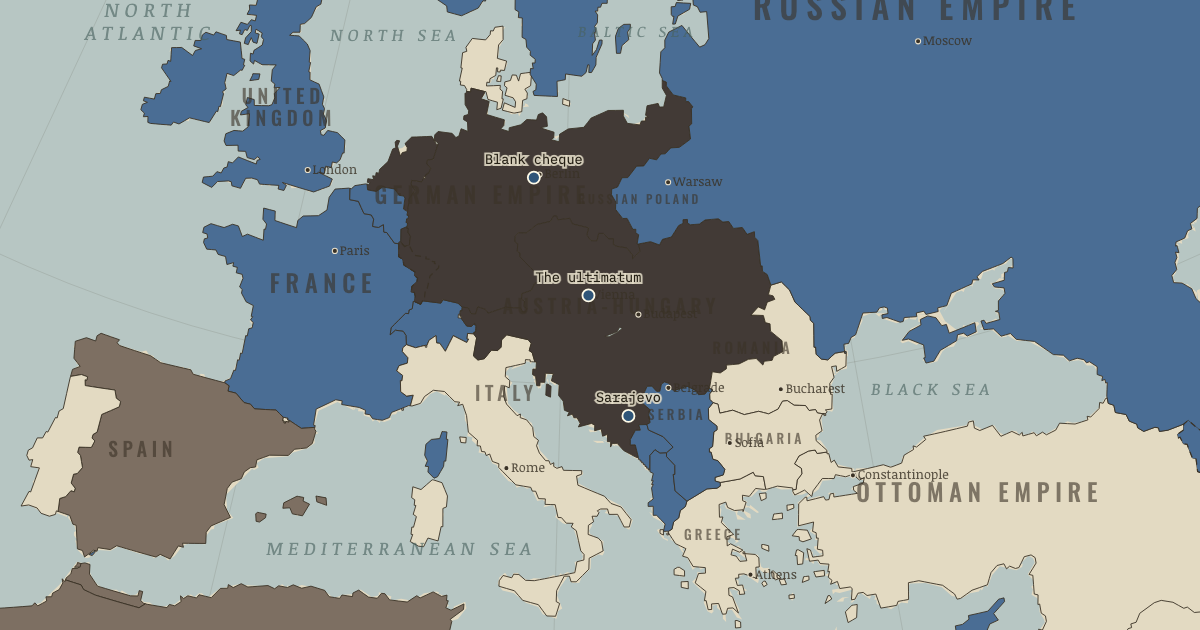
Austria-Hungary’s existential fear. The Dual Monarchy contained eleven nationalities under an aging emperor. On the map, much of its territory is not Austria or Hungary. Leaders in Vienna saw South Slav nationalism, encouraged from Belgrade, as a threat to the empire's survival. Some already wanted a local war to destroy Serbian power; the assassination supplied an occasion to act.
Germany’s closing window. Russia was expanding its railways with French financing, and German planners feared that their relative advantage would diminish after 1917. If war with Russia was expected, some concluded that it would be better fought sooner. Fischer emphasized German ambitions; other historians see reckless brinkmanship, accompanied by hope that Britain would stay out. Whatever the balance of motives, Berlin backed escalation in July.
Chapter by chapter
These entries trace the atlas through 15 chapters, identifying the causes and turning point of each. Select a title to open its free chapter page, where the full explanation, a discussion question and the map appear together.
1. Bismarck’s Europe and the Two Blocs
CHAPTER 1 · 1871–1907
Why it happened: A new giant in the middle of Europe · Alsace-Lorraine and the French grievance · The Eastern Question · The Kaiser’s new course
The turning point: Kronstadt, July 1891.
2. The Balkan Crises
CHAPTER 2 · 1908–1913
Why it happened: The Ottoman retreat · Serbia’s turn toward Russia · A Habsburg empire afraid for its South Slavs · Russia’s need to recover face
The turning point: The Bosnian crisis, September 1908 – March 1909.
3. The Powder Keg
CHAPTER 3 · JUNE–AUGUST 1914
Why it happened: The alliance machine · Timetables as destiny · Austria-Hungary’s existential fear · Germany’s closing window
The turning point: Sarajevo, 28 June 1914.
4. The Guns of August
CHAPTER 4 · AUG–SEP 1914
Why it happened: The two-front arithmetic · A plan diluted, or a plan impossible? · Plan XVII and the cult of the offensive · Russia moves early — for its ally
The turning point: The Marne, 5–12 September.
5. The Trench
CHAPTER 5 · THE SYSTEM, 1914–1918
Why it happened: Firepower and mobility · Railways behind the front · Men and space · Why attack continued
The turning point: First Ypres, October–November 1914.
6. The Widening War
CHAPTER 6 · 1915
Why it happened: Seeking a route around the west · Italy changes sides · Bulgaria chooses the Central Powers · The eastern front gives way
The turning point: Gorlice–Tarnów, 2 May 1915.
7. The Furnaces
CHAPTER 7 · 1916
Why it happened: The bargain at Verdun · Allies and the timetable · Brusilov’s preparations · Romania chooses its moment
The turning point: Verdun holds; German command changes.
8. The Slowest Weapon
CHAPTER 8 · 1914–1918 · THE WAR AT SEA
Why it happened: The fleet and its diplomatic purpose · Two methods of economic pressure · The five-month calculation · The argument over convoy
The turning point: Convoy begins in May 1917.
9. The World’s War
CHAPTER 9 · 1914–1918 · THE GLOBAL WAR
Why it happened: Empires at war · Japan’s opportunity · Three overlapping commitments · Lettow-Vorbeck’s campaign and its cost
The turning point: The wartime agreements, 1916.
10. Breaking Points
CHAPTER 10 · 1917
Why it happened: Russia’s collapsing authority · Why the government continued the war · What French soldiers refused · Two ways through the line
The turning point: The October Revolution, 7 November 1917.
11. Brest-Litovsk: The Gamble in the East Pays
CHAPTER 11 · WINTER 1917–18
Why it happened: Lenin’s cold arithmetic · Germany’s eastern ideology · The garrison paradox
The turning point: The treaty signed, 3 March 1918.
12. The Spring Offensives and the Hundred Days
CHAPTER 12 · MAR–NOV 1918
Why it happened: Why the trench finally broke · Ludendorff’s strategic vacuum · The American weight, actual and virtual · The soft fronts were structural
The turning point: Amiens, 8 August 1918.
13. Armistice
CHAPTER 13 · NOVEMBER 1918
Why it happened: Collapse from the rear, forced from the front · Why an armistice, not a surrender · The pandemic’s war logistics
The turning point: The eleventh hour, 11 November 1918.
14. The Peace That Failed
CHAPTER 14 · 1919 AND AFTER
Why it happened: Three peacemakers, three incompatible peaces · The reparations tangle · Self-determination’s impossible geometry · Enforcement: the peace nobody guarded
The turning point: The Hall of Mirrors, 28 June 1919.
15. The New Map of Europe
EPILOGUE · 1919–1923
Why it happened: The method Versailles set · Empires that collapsed into a vacuum · Promises made in wartime · The Bolshevik challenge
The turning point: Lausanne, 24 July 1923.
Essay questions, argued
Historians still debate the question at the end of each chapter. Before reading our brief answer, try making a plan for how you would answer it.
DISCUSSION QUESTION · CHAPTER 1
Did Bismarck’s alliance system keep the peace, or did it build the trap that closed in 1914?
The peace under Bismarck was real: no great-power war broke out between 1871 and 1890, and Germany used alliances to restrain partners as well as protect itself. Yet the Dual Alliance tied Germany to Austrian fears in the Balkans, while the secret Reinsurance Treaty created commitments difficult to reconcile with it. Christopher Clark stresses the change after Bismarck: his successors let Russia go and alarmed Britain, helping form the later blocs. Historians following Fritz Fischer emphasize continuity in German ambition from the 1890s to 1914. Bismarck postponed the tensions created by unification without resolving them. His personal skill sustained the arrangement; institutions that can operate beyond their inventor offer a more durable basis for security.
The chapter behind it: Bismarck’s Europe and the Two Blocs. Every chapter’s question is on the discussion questions page.
DISCUSSION QUESTION · CHAPTER 6
Was Gallipoli a sound strategy badly executed, or an unattainable plan?
The plan promised much: a route for supplies to Russia, which was short of shells; a threat to the Ottoman Empire; and influence over neutral Balkan states. The question is whether the Allies could obtain those gains with the means they had. The naval attack alerted the defenders, while civilian-crewed minesweepers faced fire and mines remained a formidable obstacle. The land campaign met steep ridges and determined Ottoman troops, including forces commanded by Mustafa Kemal, able to move along interior lines. At Suvla in August, troops landed against little initial opposition but did not seize the heights quickly. Roughly 130,000 men died in the campaign. The aims were substantial, but the difficulty exceeded the preparation and capabilities assigned to them.
The chapter behind it: The Widening War. Every chapter’s question is on the discussion questions page.
DISCUSSION QUESTION · CHAPTER 11
Why did the gains at Brest-Litovsk fail to save Germany?
The eastern victory released divisions for the west and promised food and other resources. But Germany had to hold its new position: roughly a million German and Austro-Hungarian troops remained east, while Ukrainian grain arrived in disappointing quantities. Romanian oil offered another potential resource, although Romania’s settlement was separate from Brest-Litovsk. The treaty also gave the Allies further reason to resist German terms. Timing brought these gains and costs together. The transferred divisions could fight that spring; fuller returns from the east would take longer, and American arrivals were strengthening the Allies. Germany needed a quick victory from its temporary advantage, and its offensives failed to deliver one.
The chapter behind it: Brest-Litovsk: The Gamble in the East Pays. Every chapter’s question is on the discussion questions page.
DISCUSSION QUESTION · CHAPTER 15
“In 1919–1923 armies drew the map of Europe, and treaties only signed it.” How far do you agree?
Armies mattered most clearly in the east and south-east. Poland’s eastern frontier followed the battle line of 1920, Vilnius and Memel were seized by force, and Lausanne recognized the frontier won by Kemal’s army. Here treaties recorded results that soldiers had made possible. The claim fits the center and west less well. Versailles, Saint-Germain and Trianon drew frontiers that no army fought over in 1919, and the defeated states were too weak to resist. Diplomats did not make every decision alone there either. Plebiscites, votes in which local people chose their state much like referendums, settled Schleswig and Upper Silesia; new states had already been proclaimed in Prague and Zagreb. Drawing a border and keeping it were separate problems. Lines could be placed on paper, but those that lasted had force behind them or the consent of people living along them. The 1923 map was unstable because its borders outran the willingness to defend them—a gap governments of every era should consider before signing.
The chapter behind it: The New Map of Europe. Every chapter’s question is on the discussion questions page.
What it changed
Consequence questions need the end of the story. The final chapter, The New Map of Europe, sets out what the period left behind:
Guardians and revisionists. The new map gave governments different interests in its survival. France allied with Poland in 1921 and later signed treaties with the Little Entente—Czechoslovakia, Romania and Yugoslavia—to support the settlement. Germany, Hungary and Bulgaria wanted revision, and Fascist Italy, a disappointed victor, increasingly joined them. Most guardians of the settlement were new, small states with divisions of their own; among the revisionists was the strongest economy on the continent. The balance favored those seeking to redraw the map.
Minorities as pretexts. Some 25 to 30 million Europeans lived in another nation’s state. Treaties supervised by the League promised them equality before the law and schools in their own language, but a promise needed a means of enforcement. League procedures were slow, many complaints were set aside, and governments in Warsaw, Bucharest and Belgrade pressed assimilation. In the 1930s Nazi Germany used German minorities’ grievances in Czechoslovakia and Poland as pretexts to break up the settlement. Minority protection had become a weapon against the states that had undertaken it.
Hyperinflation and the radical right. By November 1923, after the Ruhr crisis drove German inflation out of control, a lifetime’s savings could not buy a loaf of bread. That month Adolf Hitler, the leader of a small Munich party, believed the republic was about to fall. He attempted to seize power in the Beer Hall Putsch, an armed coup launched from a Munich beer hall. It failed, and he went to prison. For millions of Germans, however, occupation and hyperinflation left the treaty, the republic and ruin linked in a single memory.
From Lausanne to the next war. The wars of 1919–1922 hardened the belief that stable frontiers required nations of a single people. The Lausanne exchange gave that belief international approval. In 1944 Winston Churchill cited it when defending the expulsion of Germans from lands Poland would gain; the policy was carried out in 1945, after Nazi Germany’s war of conquest and occupation. The next war had begun in 1939 over Danzig, the German port made a Free City by the peace, and the Polish Corridor, which cut East Prussia off from Germany. The settlement had drawn those fault lines years earlier.
Revision tools
The atlas ends with a map quiz that asks you to find places and moments on the map itself (part of every plan from Starter up). The quick quiz and the discussion questions with our answers are free pages on this site, and the printable study guide gathers every chapter’s notes into one document for revision.
Read next
- The road to the next war, 1931–1941 · THE ROAD TO WAR
- Russia’s revolutions, 1917–1924 · THE RUSSIAN REVOLUTION
Maps of History is independent and is not affiliated with or endorsed by the International Baccalaureate Organization. IB course names describe alignment only; paper, theme and section names follow the new course outline and may change when the final guide is published.
THE DISPATCH
Get the printable study guide for WWI free. I’ll send you a few short letters, then one when a new atlas opens. That’s all. — Paul
NO TRACKING · YOUR ADDRESS IS USED FOR THE DISPATCH AND NOTHING ELSE · UNSUBSCRIBE ANYTIME