MAPS OF HISTORY · IB HISTORY · THE SOVIET UNION UNDER STALIN
IB HISTORY · 1924 – 1953 · 12 CHAPTERS
IB History: The Soviet Union under Stalin — notes, maps and essay plans
How did one man come to rule a sixth of the world’s land? Follow the succession Stalin won, the revolution from above he imposed, its cost in famines, camps and deportations, and the system that outlived him.
This page gathers the atlas’s IB notes: where each of its 12 chapters fits the syllabus, the concepts and evidence it supports, practice questions with model essay plans, primary sources, and starting points for the Internal Assessment.
WW2 is free in full, and chapter 1 of every atlas is free. A free account opens 3 more chapters a day. Opening a new atlas uses one of them. Membership opens all 21 — Join.
Where it fits the course
Every chapter’s IB notes name the parts of the course it serves. Across the atlas they add up to this:
- Paper 2 · Authoritarian Rule · 12 CHAPTERS
- Paper 3 · Europe, section 13.8 · 10 CHAPTERS
- Paper 3 · Europe, section 13.11 · 2 CHAPTERS
- Old course · World history topic 10: Authoritarian states (20th century) · 7 CHAPTERS
- Old course · World history topic 12: The Cold War: superpower tensions and rivalries (20th century) · 1 CHAPTER
Chapter by chapter
Across its 12 chapters, the atlas holds 72 points of evidence and 26 primary sources. Here you can read all the evidence for chapters 1 and 2. For each later chapter there is one point and the practice question; the rest is in the atlas. Select a chapter title to open its free page and read the full explanation.
1. The Succession
CHAPTER 1 · 1924–1929 · CONCEPTS: CAUSATION, SIGNIFICANCE
EVIDENCE TO USE · ALL 6 POINTS (A FREE CHAPTER)
- When Stalin became General Secretary in April 1922, his colleagues regarded the job as administrative. Yet the Secretariat let him appoint local party secretaries, and those secretaries chose delegates to party congresses. Control over appointments could thus shape who voted at a congress.
- Lenin’s postscript of 4 January 1923 described Stalin as “too rude” and proposed his removal. The warning did not remove him: in May 1924 Zinoviev and Kamenev persuaded the leadership both to withhold the Testament from publication and to keep Stalin in office.
- The “Lenin Enrolment” of 1924 added more than 200,000 members, mostly young workers who owed their careers to the apparatus Stalin ran. Their arrival helped convert the apparatus’s power over appointments into votes.
- By the Fourteenth Congress in December 1925, Stalin had weakened Trotsky and turned against former allies. Zinoviev and Kamenev’s Leningrad delegation was overwhelmingly outvoted, showing how quickly that change of alliance could take effect.
- Trotsky, the leader of the Left, was removed in stages: expelled from the party in November 1927, exiled to Alma-Ata on 17 January 1928, and deported to Turkey in February 1929.
- In January–February 1928 Stalin requisitioned grain in Siberia, breaking the NEP compromise. This put him at odds with Bukharin, Rykov and Tomsky, who were removed from their posts as the “Right deviation” in 1929–30.
2. The Great Turn: Collectivisation
CHAPTER 2 · 1929–1933 · CONCEPTS: CAUSATION, CHANGE
EVIDENCE TO USE · ALL 6 POINTS (A FREE CHAPTER)
- On 30 January 1930 the Politburo divided kulaks into three categories and set initial targets of 60,000 for the camps and 150,000 for deportation. The quotas show that dekulakisation was planned at the center.
- Fewer than a tenth of peasant households were collectivised in October 1929. By 1 March 1930, about 56 per cent were: such a rapid increase could be achieved only through coercion by officials, activists and the OGPU.
- Stalin blamed local officials for “excesses” in “Dizzy with Success”, published in Pravda on 2 March 1930. Within weeks, millions of peasants left collective farms. Their departure revealed how little of the drive had been voluntary.
- Lynne Viola reports that the OGPU recorded about 13,750 mass disturbances in 1930, with roughly 2.5 million participants. It was the largest rural revolt in Europe since the Russian civil war.
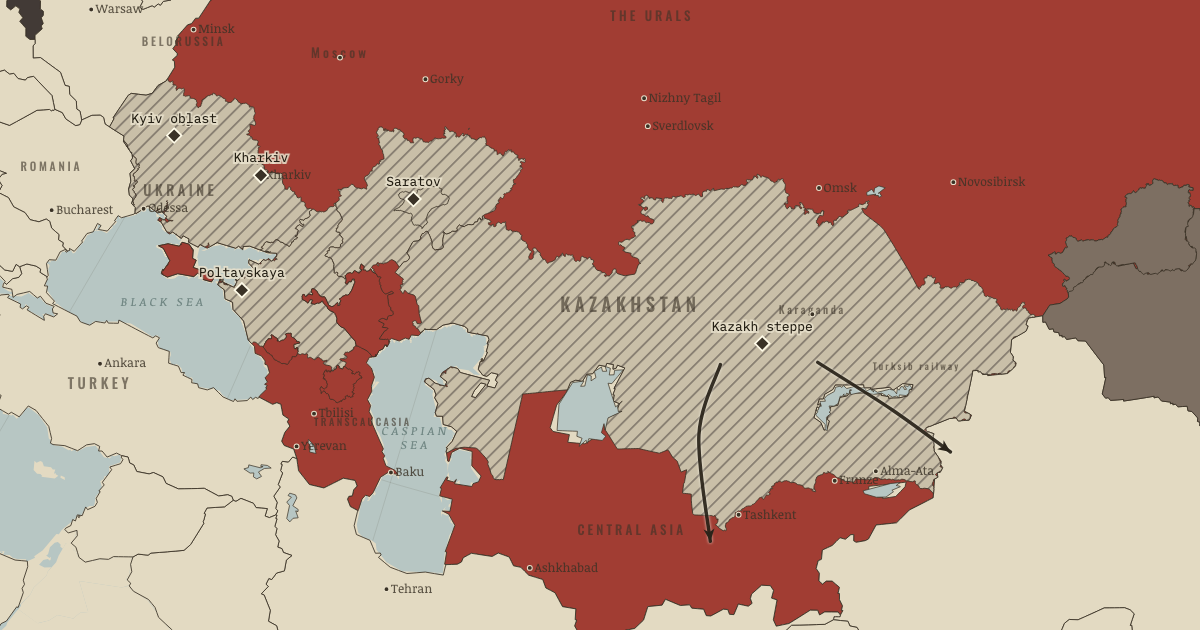
- About 1.8 million people were deported as “kulaks” in 1930–31. They were sent to special settlements in the Northern Krai, the Urals, western Siberia and Kazakhstan, and many died during the first winters.
- Collective farms contained over nine-tenths of peasant households by 1937. But by 1933 the numbers of horses and cattle had roughly halved, and they did not recover until the 1950s.
3. The Famines
CHAPTER 3 · 1930–1933 · CONCEPTS: CONSEQUENCE, PERSPECTIVES
EVIDENCE TO USE · 1 OF 6
- Under the Law of 7 August 1932, stealing collective-farm property could bring a sentence of shooting or at least ten years’ imprisonment. Even hungry peasants gathering ears of grain left in the fields could be prosecuted as “enemies of the people”.
Practice question: Discuss the view that Stalin’s policies deliberately brought about the Soviet famine of 1932–33.
5 more points of evidence, 2 primary sources and the model plan for this question are in the IB notes of chapter 3 in the atlas.
4. The Five-Year Plans
CHAPTER 4 · 1928–1941 · CONCEPTS: CHANGE, CONSEQUENCE
EVIDENCE TO USE · 1 OF 6
- How much did heavy industry grow? Official figures show steel output rising from 4.3 million tonnes in 1928 to 18.3 million in 1940, and coal from 35.4 to 165.9 million tonnes. Western recalculations by Bergson and Jasny put the rate of growth lower.
Practice question: How far had the Five-Year Plans achieved their aims by 1941?
5 more points of evidence, 3 primary sources and the model plan for this question are in the IB notes of chapter 4 in the atlas.
5. The Gulag
CHAPTER 5 · 1930–1953 · CONCEPTS: CONTINUITY, CONSEQUENCE
EVIDENCE TO USE · 1 OF 6
- On 27 June 1929, the Politburo decided that prisoners serving sentences of three years or more should be sent to OGPU camps. The government decree of 11 July gave those camps an additional task: to colonize remote regions and exploit their natural resources.
Practice question: Examine the role of the Gulag in maintaining Stalin’s authoritarian rule.
5 more points of evidence, 2 primary sources and the model plan for this question are in the IB notes of chapter 5 in the atlas.
6. The Great Terror
CHAPTER 6 · 1936–1938 · CONCEPTS: CAUSATION, PERSPECTIVES
EVIDENCE TO USE · 1 OF 6
- According to NKVD figures, about 1.5 to 1.6 million people were arrested in 1937–38, and 681,692 were shot. Most fell victim to mass operations ordered from Moscow and carried out under regional quotas.
Practice question: “The Great Terror was the work of Stalin alone.” Discuss.
5 more points of evidence, 2 primary sources and the model plan for this question are in the IB notes of chapter 6 in the atlas.
7. Nations and Deportations
CHAPTER 7 · 1937–1944 · CONCEPTS: CONSEQUENCE, PERSPECTIVES
EVIDENCE TO USE · 1 OF 6
- In September and October 1937, the NKVD sent about 172,000 Koreans from the Soviet Far East to Kazakhstan and Uzbekistan. Fear of Japanese espionage was used to justify this first deportation of an entire nationality.
Practice question: Examine how national minorities were treated in the Soviet Union under Stalin.
5 more points of evidence, 3 primary sources and the model plan for this question are in the IB notes of chapter 7 in the atlas.
8. Propaganda and the Cult
CHAPTER 8 · 1929–1953 · CONCEPTS: SIGNIFICANCE, PERSPECTIVES
EVIDENCE TO USE · 1 OF 6
- On Stalin’s fiftieth birthday, 21 December 1929, Pravda devoted pages to tributes from his colleagues. The public cult began as forced collectivisation was getting under way.
Practice question: How important was propaganda in maintaining Stalin’s rule between 1929 and 1953? Evaluate its contribution.
5 more points of evidence, 2 primary sources and the model plan for this question are in the IB notes of chapter 8 in the atlas.
9. Daily Life, Women and Family
CHAPTER 9 · 1930–1953 · CONCEPTS: CHANGE, CONTINUITY
EVIDENCE TO USE · 1 OF 6
- Between 1926 and 1939, the Soviet urban population rose from about 26 million to 56 million. Some peasants were fleeing collectivisation and famine; others were recruited by the new industries.
Practice question: To what extent did the lives of Soviet women change under Stalin?
5 more points of evidence, 2 primary sources and the model plan for this question are in the IB notes of chapter 9 in the atlas.
10. Stalin at War
CHAPTER 10 · 1941–1945 · CONCEPTS: SIGNIFICANCE, CONSEQUENCE
EVIDENCE TO USE · 1 OF 6
- Between July and November 1941, about 1,523 industrial enterprises were evacuated east; by the end of the year, some 12 million people had also been moved. Within months, many of the enterprises had restarted production in the Urals.
Practice question: Discuss the impact of the Second World War on Stalin’s authoritarian rule.
5 more points of evidence, 2 primary sources and the model plan for this question are in the IB notes of chapter 10 in the atlas.
11. High Stalinism
CHAPTER 11 · 1945–1953 · CONCEPTS: CONTINUITY, CHANGE
EVIDENCE TO USE · 1 OF 6
- The famine of 1946–47 killed between under 1 million and about 2 million people, with most estimates placing the toll at 1 to 1.5 million. The state nevertheless kept large grain reserves and continued exporting grain to Eastern Europe during the famine.
Practice question: Compare and contrast how Stalin maintained control in the 1930s and after 1945.
5 more points of evidence, 2 primary sources and the model plan for this question are in the IB notes of chapter 11 in the atlas.
12. Death and Judgement
EPILOGUE · 1953–1956 · CONCEPTS: PERSPECTIVES, SIGNIFICANCE
EVIDENCE TO USE · 1 OF 6
- Stalin died on 5 March 1953. Within weeks, his successors began to reduce the camp population: the amnesty of 27 March released about 1.2 million prisoners, most of them serving short sentences.
Practice question: Examine how Stalin’s authoritarian rule was challenged, and explain why those challenges failed during his lifetime.
5 more points of evidence, 2 primary sources and the model plan for this question are in the IB notes of chapter 12 in the atlas.
Practice questions and essay plans
Each chapter closes with a practice question and a model plan. The plan gives a thesis, three points with evidence and a link back to the question, a counter-argument and a judgement. Chapter 1’s plan appears here in full. The other plans are outlined here and given in full in the atlas.
PAPER 2 · THE SOVIET UNION UNDER STALIN · CHAPTER 1
How far did control of the party apparatus account for Stalin’s rise to power by 1929?
The party apparatus was the decisive condition of Stalin’s rise because appointments could be translated into dependable majorities at congresses. That power became effective in a particular political situation: his rivals underestimated him, while “socialism in one country” appealed to a party tired of waiting for world revolution.
Through the Secretariat, Stalin built a loyal following within the party before his rivals recognized what he was doing.
EVIDENCEFrom April 1922, as General Secretary, he placed provincial secretaries who chose delegates to congresses. The Lenin Enrolment of 1924 brought in more than 200,000 members whose careers depended on the apparatus. Robert Daniels called the result a “circular flow of power”.
LINKThe chain from appointments to delegates helps explain Stalin’s victories in every important vote from 1925 to 1929.
Stalin’s rivals gave him opportunities because they feared Trotsky more than they feared him.
EVIDENCEIn May 1924 Zinoviev and Kamenev protected Stalin from Lenin’s Testament; by 1925 they had lost their Leningrad base. Bukharin joined Stalin against the United Opposition in 1926–27, then suffered defeat himself in 1929.
LINKThese shifting alliances left a coalition against the apparatus to form only when it was too late.
At each stage Stalin also advanced the policy that held the greater appeal.
EVIDENCE“Socialism in one country” offered progress without waiting for a European revolution, whereas Trotsky’s “permanent revolution” sounded risky. In 1928 Stalin adopted grain seizures, a measure close to the Left’s programme, and so isolated the Right.
LINKBy changing policy, Stalin used his organizational strength to win political victories over both factions.
Stephen Kotkin and Sheila Fitzpatrick, among other historians, give weight to Stalin’s intelligence, ideological conviction and appeal to newly promoted officials, arguing that these mattered as much as manipulation. On their reading, the apparatus expressed genuine support as well as patronage: many communists preferred Stalin’s blunt, practical style.
The apparatus supplied a necessary instrument, but Stalin still had to use it. His choices of allies and policies, and his rivals’ misjudgements, explain how appointments became power. Without those mistakes, control of appointments alone would not have produced a dictator by 1929; the machine and the mistakes belong together in the judgement.
Read the chapter behind this plan: The Succession.
PAPER 2 · THE SOVIET UNION UNDER STALIN · CHAPTER 3
Discuss the view that Stalin’s policies deliberately brought about the Soviet famine of 1932–33.
Procurement quotas, collectivisation and punitive decrees were deliberate policies, and they caused and deepened the famine. But causing mass death and intending it are different things. Whether Stalin intended those deaths, or targeted Ukrainians as a nation, remains contested; an answer should keep the clear evidence of causation separate from the debate over intent.
Soviet policy caused the famine.
In Ukraine and the Kuban, later measures made the famine worse.
Kazakhstan shows that a policy could be lethal without national targeting.
The evidence for each point, the counter-argument and the judgement are in the IB notes of chapter 3 in the atlas. Read the chapter first: The Famines.
PAPER 2 · THE SOVIET UNION UNDER STALIN · CHAPTER 12
Examine how Stalin’s authoritarian rule was challenged, and explain why those challenges failed during his lifetime.
Stalin faced challenges from party oppositions, peasants, national movements in the borderlands, a communist state abroad and, at the end of his life, prisoners. Tito alone succeeded while Stalin lived. Elsewhere, overwhelming force and control over information and appointments defeated opposition; real change came only after Stalin’s death.
Stalin defeated party opposition first through organisation, then through terror.
The regime used mass force against social and national resistance.
Tito succeeded beyond the reach of Soviet troops.
The evidence for each point, the counter-argument and the judgement are in the IB notes of chapter 12 in the atlas. Read the chapter first: Death and Judgement.
PAPER 2 · THE SOVIET UNION UNDER STALIN · CHAPTER 4
How far had the Five-Year Plans achieved their aims by 1941?
The plans largely achieved their central aim: they built a heavy-industrial and military base capable of fighting a modern war. Their stated social aims of rising living standards and efficient planning were another matter. To judge the plans, we must decide whether to measure them by the regime’s priorities or by socialism’s promises.
Heavy industry expanded rapidly.
Industry in the east gave the Soviet Union a defensible base.
The gains came alongside serious losses in living standards and efficiency.
The evidence for each point, the counter-argument and the judgement are in the IB notes of chapter 4 in the atlas. Read the chapter first: The Five-Year Plans.
Primary sources
Before reading a primary source, it helps to know where it came from and its context. Each chapter’s IB notes provide both. Here are the sources from chapter 1 in full.
TEXT · CHAPTER 1
Letter to the Congress (Lenin’s “Testament”) and its postscript
- CREATOR
- V. I. Lenin, dictated to his secretaries
- DATE
- 24 December 1922; postscript 4 January 1923
- ORIGIN
- Notes dictated during Lenin’s illness, read to delegation leaders at the Thirteenth Party Congress in May 1924 and first published in the USSR in 1956
Context. Lenin was partly paralysed and isolated by his doctors when he dictated the notes. How far can the typed text be shown to contain his own words? Some historians, notably Stephen Kotkin, question this.
Translation: Maps of History, from the Russian text (Lenin, Polnoe sobranie sochinenii, vol. 45). The author died in 1924. · original ↗
TEXT · CHAPTER 1
My Life (memoir), on Stalin’s appointment as General Secretary
- CREATOR
- Leon Trotsky
- DATE
- Written in exile in 1929; published 1930
- ORIGIN
- Autobiography written on the island of Prinkipo after Trotsky’s deportation from the USSR (Berlin: Granit, 1930; New York: Scribner, 1930)
Context. Trotsky wrote the memoir as Stalin’s defeated rival, and his account misdates the appointment. Stalin became General Secretary in April 1922, after the Eleventh Congress.
Translation: Maps of History, from the Russian text of Moia zhizn’ (1930). The author died in 1940; the work was first published in 1930. · original ↗
Every other source in the atlas (24)
- Chapter 2: The Great Turn: Collectivisation
- Politburo resolution “On measures for the liquidation of kulak households in districts of comprehensive collectivisation” Central Committee of the All-Union Communist Party (Bolsheviks), Politburo · 30 January 1930
- “Dizzy with Success: Concerning Questions of the Collective-Farm Movement” J. V. Stalin · 2 March 1930
- Chapter 3: The Famines
- Decree “On the protection of the property of state enterprises, collective farms and cooperatives and the strengthening of public (socialist) property” Central Executive Committee and Council of People’s Commissars of the USSR · 7 August 1932
- Directive of the Central Committee and the Council of People’s Commissars on the mass departure of peasants V. M. Molotov (Chairman of the Council of People’s Commissars) and J. V. Stalin (Secretary of the Central Committee) · 22 January 1933
- Chapter 4: The Five-Year Plans
- Speech to the First All-Union Conference of Leading Personnel of Socialist Industry J. V. Stalin · 4 February 1931
- Constitution of the USSR, Articles 12 and 118 Extraordinary Eighth All-Union Congress of Soviets · 5 December 1936
- Official output of key industries, 1928–1940 Compiled by Maps of History from official Soviet statistics · Figures for 1928, 1932, 1937 and 1940
- Chapter 5: The Gulag
- Decree “On the use of the labour of criminal prisoners” Council of People’s Commissars of the USSR · 11 July 1929
- Population of Gulag camps and colonies on 1 January, selected years Compiled by Maps of History from published NKVD/MVD statistics · 1934–1953
- Chapter 6: The Great Terror
- Operational Order No. 00447 “On the operation to repress former kulaks, criminals and other anti-Soviet elements” N. I. Yezhov, People’s Commissar of Internal Affairs · 30 July 1937
- Constitution of the USSR, Articles 125 and 127 Extraordinary Eighth All-Union Congress of Soviets · 5 December 1936
- Chapter 7: Nations and Deportations
- Decree of the Presidium of the Supreme Soviet “On the resettlement of the Germans living in the Volga regions” Presidium of the Supreme Soviet of the USSR · 28 August 1941
- State Defence Committee decree No. GKO-5859ss “On the Crimean Tatars” State Defence Committee (GKO), chaired by J. V. Stalin · 11 May 1944
- “On the Cult of Personality and Its Consequences” (the “Secret Speech”): on the deportations N. S. Khrushchev, First Secretary of the Communist Party · 25 February 1956
- Chapter 8: Propaganda and the Cult
- “On the Cult of Personality and Its Consequences” (the “Secret Speech”): on Stalin’s Short Biography N. S. Khrushchev, First Secretary of the Communist Party · 25 February 1956
- Statute of the Union of Soviet Writers: the definition of socialist realism First All-Union Congress of Soviet Writers · August–September 1934
- Chapter 9: Daily Life, Women and Family
- Constitution of the USSR, Article 122 Extraordinary Eighth All-Union Congress of Soviets · 5 December 1936
- Decree of the Presidium of the Supreme Soviet “On the transition to the eight-hour working day and the seven-day working week, and on the prohibition of unauthorised departure of workers and employees from enterprises and institutions” Presidium of the Supreme Soviet of the USSR (M. I. Kalinin, A. F. Gorkin) · 26 June 1940
- Chapter 10: Stalin at War
- Order No. 227 of the People’s Commissar of Defence “On measures to strengthen discipline and order in the Red Army and to prohibit unauthorised withdrawal from combat positions” J. V. Stalin, People’s Commissar of Defence · 28 July 1942
- Radio address to the Soviet people J. V. Stalin, Chairman of the State Defence Committee · 3 July 1941
- Chapter 11: High Stalinism
- Resolution of the Orgburo of the Central Committee “On the journals Zvezda and Leningrad” Organisational Bureau of the Central Committee, All-Union Communist Party (Bolsheviks) · 14 August 1946
- TASS announcement “Arrest of a group of doctor-wreckers” TASS, the official Soviet news agency · 13 January 1953
- Chapter 12: Death and Judgement
- “On the Cult of Personality and Its Consequences” (the “Secret Speech”): on the Seventeenth Congress N. S. Khrushchev, First Secretary of the Communist Party · 25 February 1956
- “On the Cult of Personality and Its Consequences” (the “Secret Speech”): the purpose of the report N. S. Khrushchev, First Secretary of the Communist Party · 25 February 1956
Internal Assessment starting points
Each starting point is an idea for an investigation: a question, the concept it tests, the kinds of sources you could use and where they are held, and one caution. The investigation must be your own work, and your teacher approves the question.
How accurately did Western newspapers describe the Ukrainian famine as it was happening in 1933?
CONCEPTPerspectives
SOURCESArticles by Gareth Jones and Walter Duranty (March 1933); British Foreign Office reports; later survivor testimony.
CAUTIONConsider what the correspondents could see at the time, then compare their accounts with what the archives later revealed. A judgment made with hindsight alone would overlook the conditions in which they reported in 1933.
How much did workers’ lives in Magnitogorsk improve from 1932 to 1937?
CONCEPTChange
SOURCESJohn Scott’s memoir Behind the Urals (1942); Soviet newspapers; wage and housing statistics.
CAUTIONScott was sympathetic to the Soviet project and, as a foreigner, enjoyed privileges. Compare his impressions with the wage and housing statistics when judging workers’ lives.
What led some Western observers to accept the Moscow show trials of 1936–38 as credible?
CONCEPTPerspectives
SOURCESTrial transcripts published by the People’s Commissariat of Justice (1936–38); Joseph Davies, Mission to Moscow (1941); the Dewey Commission report (1937).
CAUTIONThe published transcripts were edited. Treat the trials as staged performances, and use archival evidence to test each confession.
How did Soviet posters portray the relationship between Stalin and Lenin from 1929 to 1953?
CONCEPTChange
SOURCESSoviet political posters and Pravda front pages from the birthday issues of 1929, 1939 and 1949.
CAUTIONFind the date and print run of each poster before comparing it with the others. Online reproductions are often undated or given the wrong label.
How do testimonies collected after 1989 remember the deportation of the Crimean Tatars in 1944?
CONCEPTSignificance
SOURCESOral testimony collections; the GKO decree of 11 May 1944; NKVD reports published in document collections.
CAUTIONThe testimony was recorded decades after the deportation, and later events shaped what people remembered. Compare these memories with documents from the time.
How much did the June 1940 labour decree change discipline in Soviet factories?
CONCEPTConsequence
SOURCESThe decree text; prosecution statistics; factory newspapers; workers’ letters.
CAUTIONProsecution totals show how the decree was enforced, but managers often ignored the law to retain workers. Factory records and letters can also show how people behaved.
What explains the protests in Tbilisi in March 1956 following the Secret Speech of 1956?
CONCEPTCausation
SOURCESThe text of the Secret Speech (US State Department, 1956); reports on the Georgian events; memoirs.
CAUTIONThe sources on the Tbilisi events are few and often partisan. Identify what they leave uncertain, including the number of dead.
Revision tools
The atlas ends with a map quiz that asks you to find places and moments on the map itself (part of every plan from Starter up). The quick quiz and the discussion questions with our answers are free pages on this site, and the printable study guide gathers every chapter’s notes into one document for revision.
Read next
- The revolutions of 1917 and the state Stalin inherited · THE RUSSIAN REVOLUTION
- The Cold War, 1945–1991 · THE COLD WAR
Maps of History is independent and is not affiliated with or endorsed by the International Baccalaureate Organization. IB course names describe alignment only; paper, theme and section names follow the new course outline and may change when the final guide is published.
THE DISPATCH
Get the printable study guide for The Soviet Union under Stalin free. I’ll send you a few short letters, then one when a new atlas opens. That’s all. — Paul
NO TRACKING · YOUR ADDRESS IS USED FOR THE DISPATCH AND NOTHING ELSE · UNSUBSCRIBE ANYTIME