WWI · CHAPTER 6 ·
Gallipoli and the widening of WWI
Chapter 6 of The Great War, 1871–1923: “The Widening War”
In 1915 both sides looked beyond the stalled Western Front. Italy joined the Entente, the Allied attack at Gallipoli ended in evacuation, and the breakthrough at Gorlice–Tarnów forced Russia’s Great Retreat. Bulgaria joined the Central Powers and Serbia was overrun, and the Ottoman government carried out the Armenian genocide.
Chapter 6 is included with every paid plan. WW2 is free in full, and chapter 1 of every atlas is free. A free account opens 3 more chapters a day. Starter, at $9 a month, opens all 21 with no daily limit — see the plans.
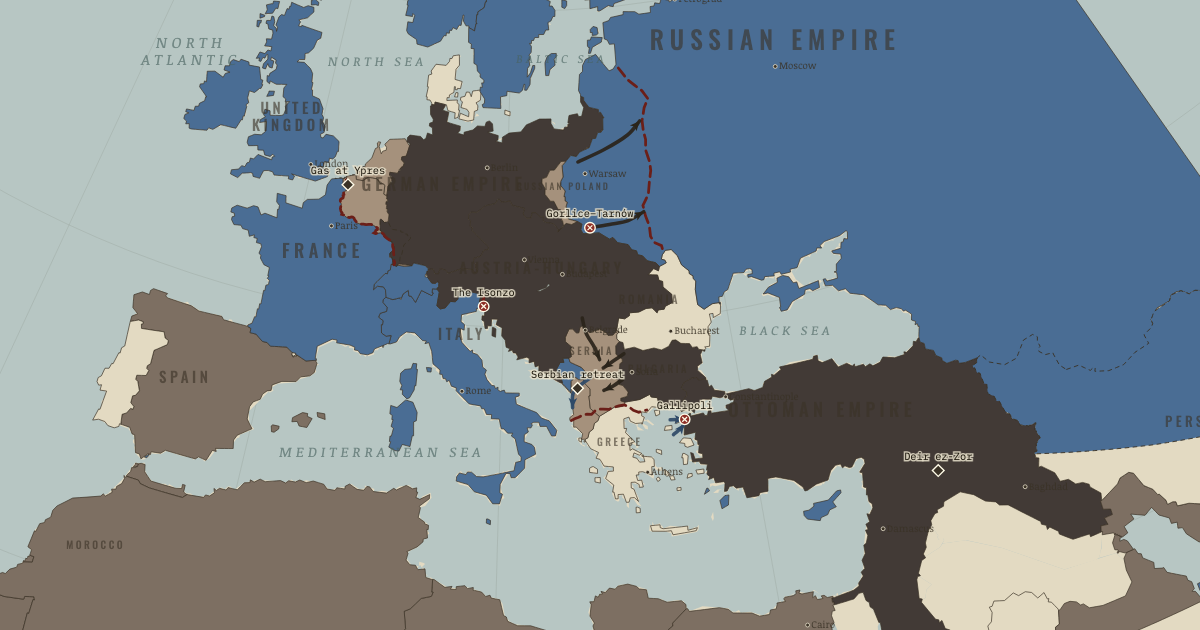
The map above is the world of Europe, November 1915 — The widening war.
Every state on the map that year: The world in 1914 · Europe in 1914.
Part of IB History: The First World War →
SHORT EXPLANATION
In 1915 both coalitions sought decisions beyond the blocked Western Front. Italy joined the Entente after promises of Austro-Hungarian territory; Bulgaria joined the Central Powers with Serbian territory in view. The Allies attacked the Dardanelles, hoping to reach Constantinople and open a route to Russia. Gallipoli failed, Serbia was overrun, and a land corridor connected the Central Powers to the Ottoman Empire.
The war moved farther in the east. At Gorlice–Tarnów, German and Austro-Hungarian forces broke the Russian line, beginning the Great Retreat from Poland and Lithuania. The Ottoman government, meanwhile, used the cover of war to deport and murder Anatolia's Armenians. An estimated 800,000 to 1.5 million died. The map records the genocide as part of the war and as an act of remembrance.
The full story
The deadlock in France encouraged both alliances to look elsewhere in 1915. New partners might add armies or expose an enemy to attack from another direction. Italy entered the Entente after being promised Austro-Hungarian lands, and began its long series of attacks along the Isonzo. On the Western Front itself, Germany released chlorine at Ypres, introducing large-scale poison-gas warfare.
The Dardanelles offered the Allies several possible gains at once. If they could force the straits, they could threaten Constantinople, supply Russia and perhaps bring the Ottoman Empire out of the war. The plan also promised to influence neutral Balkan states. But reaching those objectives meant landing and sustaining troops against defended ridges. Ottoman forces held the heights at Gallipoli; after months of fighting the Allies evacuated.
The Eastern Front offered more room for movement. Concentrated German and Austro-Hungarian artillery helped break a thin Russian line at Gorlice–Tarnów. The Great Retreat carried Russian armies out of Poland and Lithuania. Defeat, shortages and the movement of refugees strained the country behind the front. Nicholas II took personal command, linking later military setbacks more closely to his own rule.
Those developments affected the Balkans. With Gallipoli stalled and Russia retreating, Bulgaria saw an opportunity to regain Macedonia from Serbia. It joined the Central Powers in October and helped overrun Serbia. Serbian soldiers and civilians fled across the Albanian mountains in a disastrous winter retreat. Serbia's defeat opened a corridor from Berlin to Constantinople, making it easier to supply the Ottoman war effort.
The war also gave the Ottoman government cover for a campaign against its Armenian population. Armenians from Anatolia were deported toward the Syrian desert and subjected to mass killing and starvation. An estimated 800,000 to 1.5 million died. Their genocide is marked on the map in remembrance.
FULL EXPLANATION
The Dardanelles: aims and means
The case for attacking the Dardanelles was powerful. Opening the straits could bring supplies to Russia, threaten Constantinople and perhaps persuade wavering Balkan states to join the Allies. But those gains depended on getting through the straits and overcoming the Ottoman defenses. Warships first approached the mined narrows without secure minesweeping. When troops landed afterward, the defenders had been alerted. The landing force faced steep ridges, poor intelligence, divided command and limited amphibious experience. Ottoman forces held the heights and moved along interior lines; Mustafa Kemal's rapid decisions also mattered. The objectives were real, but a plan must be judged by its means as well as its prizes. The forces and preparation assigned to Gallipoli did not match the operation's difficulty.
From defeat to political strain
At Gorlice–Tarnów a short, intense bombardment and concentrated attack surprised a thin section of the Russian line. Russian railways and reserves could not seal the gap quickly, so a local breach grew into a general retreat. Its importance went beyond the territory lost. Civilians were uprooted, food and transport disrupted, and confidence in the army shaken. Nicholas II then took personal command at the front. Future military results would reflect more directly on the monarchy, while government at home suffered. Russia rebuilt much of its army by 1916, but military recovery did not restore the same reserve of public trust. The defeat contributed to pressures that culminated in revolution in 1917.
Key places on the map
On this day
Why it happened
Seeking a route around the west. British advocates of an eastern strategy looked to the Dardanelles, Salonika and Mesopotamia. Opening the straits might let Russian grain out and shells in, threaten a Central Power ally and encourage Balkan states to join the Entente. Each prospect depended on reaching it: troops, ships, supplies and expeditionary skills had to be brought over long routes, often without priority. A promising destination on a map was not yet an achievable operation.
Italy changes sides. Although Italy belonged to the Triple Alliance, it remained neutral in 1914, arguing that the alliance was defensive. Both coalitions courted it in 1915. The Entente's secret Treaty of London on 26 April promised Trentino, Trieste and parts of Dalmatia, bringing an army of roughly 875,000 into the war. Italy received less than the wartime promises at the peace settlement. The grievance called “mutilated victory” later became part of Fascist politics.
Bulgaria chooses the Central Powers. Defeated in the Second Balkan War of 1913, Bulgaria wanted Macedonia back from Serbia. By 1915 the stalled Gallipoli campaign and Russia's retreat made the Central Powers appear stronger and able to offer Serbian land. Bulgaria joined them in October and attacked Serbia. The resulting Berlin–Constantinople railway corridor joins their territories on the map.
The eastern front gives way. The Eastern Front was roughly twice as long as the western line and held at lower troop density. Weaker Russian railways and shortages of rifles and other equipment made it harder to respond to a concentrated attack in 1915. Yet German chief of staff Falkenhayn doubted that eastern victories alone could decide the war: Russia's distances made a complete defeat difficult. The campaign nevertheless brought major gains and placed the Russian state under great strain.
THE TURNING POINT
Gorlice–Tarnów, 2 May 1915. On 2 May a roughly four-hour German and Austro-Hungarian bombardment struck a narrow Russian sector. The attack broke through, and the breach developed into the Great Retreat; the front eventually moved hundreds of kilometres, about 500 km. The victory relieved Austria-Hungary and strengthened the Central Powers' appeal to Bulgaria, contributing to Serbia's later defeat. After the retreat Nicholas II took personal command, exposing the monarchy to future military failures as pressures grew toward the February 1917 revolution.
What it changed
Russia's army and government. The Russian army recovered sufficiently to mount major offensives in 1916. The strain at home remained: refugees crowded cities, inflation reduced purchasing power, and Nicholas's absence at headquarters left government in Petrograd associated with the Tsarina and Rasputin. Defeat had become part of a wider crisis of confidence.
A Central Powers corridor. Serbia's defeat connected Berlin, Vienna, Sofia and Constantinople by land and rail. Guns, funds and other supplies could reach the Ottoman Empire more readily. The Central Powers now formed a connected bloc from northern Europe toward Mesopotamia, while the Entente continued to apply pressure at sea.
Gallipoli remembered. Churchill left office and later served in the trenches. Subsequent planners studied Gallipoli's amphibious failures, including during preparations for the Second World War. In Australia and New Zealand, where the campaign holds an important place in national memory, 25 April remains Anzac Day. Mustafa Kemal's role helped establish the reputation of the future founder of modern Turkey.
Naming the Armenian genocide. The Ottoman government used wartime institutions against its Armenian citizens, including gendarmes, requisition powers and transport. In May 1915 the Entente described the violence as “crimes against humanity”; the issue received much less attention in the final peace settlement. A later statement attributed to Hitler asked who remembered the Armenians, although its wording and source are contested. The marker makes remembrance part of the map's account of the war.
DISCUSSION QUESTION — Was Gallipoli a sound strategy badly executed, or an unattainable plan?
The plan promised much: a route for supplies to Russia, which was short of shells; a threat to the Ottoman Empire; and influence over neutral Balkan states. The question is whether the Allies could obtain those gains with the means they had. The naval attack alerted the defenders, while civilian-crewed minesweepers faced fire and mines remained a formidable obstacle. The land campaign met steep ridges and determined Ottoman troops, including forces commanded by Mustafa Kemal, able to move along interior lines. At Suvla in August, troops landed against little initial opposition but did not seize the heights quickly. Roughly 130,000 men died in the campaign. The aims were substantial, but the difficulty exceeded the preparation and capabilities assigned to them.
An interesting fact
Fritz Haber helped organize Germany's chlorine attack at Ypres. His ammonia synthesis had another reach: it made nitrogen fertilizer available on a vast scale and helped Germany produce explosives when access to Chilean nitrates was restricted. Days after he returned from the front, his wife Clara Immerwahr shot herself with his service pistol. She was the first woman to earn a chemistry doctorate at Breslau. Whether her death was a protest against his gas work remains disputed; the surviving evidence is fragmentary. Haber received the 1918 Nobel Prize in Chemistry for ammonia synthesis.
Related
THE FREE PRINTABLE STUDY GUIDE
Get the printable study guide for WWI free. I’ll send you a few short letters, then one when a new atlas opens. That’s all. — Paul
NO TRACKING · YOUR ADDRESS IS USED FOR THE DISPATCH AND NOTHING ELSE · UNSUBSCRIBE ANYTIME