WWI · CHAPTER 8 · · THE WAR AT SEA
Blockade and U-boat war in WWI
Chapter 8 of The Great War, 1871–1923: “The Slowest Weapon”
Britain used its command of the sea to cut Germany off from imported food and raw materials, a slow blockade that contributed to severe civilian hunger. The fleets met in full only at Jutland in 1916. Germany’s unrestricted submarine warfare of 1917 was blunted by convoys and helped bring the United States into the war.
Chapter 8 is included with every paid plan. WW2 is free in full, and chapter 1 of every atlas is free. A free account opens 3 more chapters a day. Starter, at $9 a month, opens all 21 with no daily limit — see the plans.
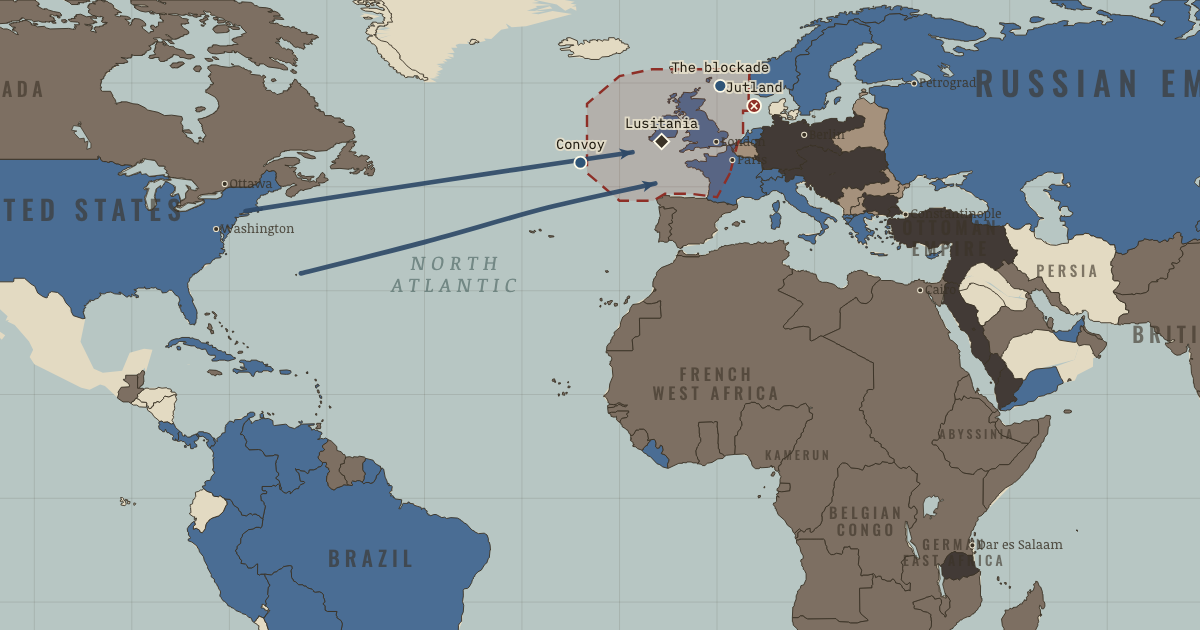
The map above is the world of The world, April 1917 — America comes in.
Every state on the map that year: The world in 1918 · Europe in 1918.
Part of IB History: The First World War →
SHORT EXPLANATION
Britain could restrict Germany's overseas trade because its navy controlled the routes out of the North Sea. The blockade slowly deprived the German economy of imports and brought severe hunger to civilians. At Jutland in 1916 Germany sank more ships than it lost, but it did not dislodge Britain from the sea routes. The surface fleet had failed to lift the blockade.
Germany turned to submarines to attack Britain's own supplies. In 1917 it resumed unrestricted sinking without warning in a declared zone around the British Isles, hoping to force Britain out before American power counted. The Allies grouped merchant ships into escorted convoys, reducing losses. Britain stayed in the war, while the submarine campaign helped bring the United States into it.
The full story
The world map shows a front without a trench line. Britain controlled the exits from the North Sea and could restrict the overseas trade on which Germany depended. Food, fertilizer and raw materials became harder to obtain. The pressure accumulated gradually, but its effects were felt in severe civilian hunger. Estimates of the deaths attributable to the blockade remain disputed.
Germany's surface fleet met Britain's at Jutland in 1916. It inflicted heavier losses than it suffered, yet the British retained the routes needed to maintain the blockade. German leaders looked instead to submarines, hoping that unrestricted attacks on shipping would starve Britain before the United States could intervene effectively. Losses rose sharply in spring 1917. Then the Allies began gathering merchant ships into escorted convoys. Britain did not surrender, and the campaign helped bring America into the war.
Both campaigns sought to deprive an enemy economy of imports, but their methods differed. British surface ships could stop and divert neutral vessels. A submarine that surfaced to search a merchantman risked gunfire, ramming or a radio call for help; Germany chose to sink ships without warning. Deaths at sea could be sudden and visible, as in the loss of 1,198 people aboard the Lusitania. Hunger accumulated less visibly across a population.
German planners in 1917 predicted that sinking 600,000 tons a month would defeat Britain within five months. That forecast depended on more than the number of ships Germany could sink. Britain could change how it protected and supplied itself: it adopted convoy, rationed food and built ships. The United States entered on 6 April, bringing credit and industrial resources before its army arrived in force. The figures looked precise, but the outcome also depended on an opponent capable of responding.
FULL EXPLANATION
Blockade, law and visibility
Britain's control of the surface allowed it to divert neutral ships into British ports. It also widened the definition of contraband, restricting goods that might reach Germany. A German submarine trying to stop and search a merchantman faced a different problem: the ship might be armed or use its radio to summon help. Germany chose unrestricted attacks without warning. The methods and their legal positions differed, yet both sought to damage the economy sustaining the enemy and exposed civilians to harm. Public reactions were shaped partly by how the suffering appeared. Drowned passengers had names and photographs; deaths associated with malnutrition appeared in dispersed and disputed statistics. Visibility cannot settle their moral weight. Naval power explains which methods were available to each side, but it does not remove responsibility for the choices made.
How convoy changed the problem
When merchant ships sailed independently, submarines could encounter isolated targets along many routes, while escorts had a vast area to cover. Convoy changed that arrangement. Merchantmen traveled in groups guarded by warships, leaving fewer groups to protect and requiring a submarine to approach escorts to attack. The improvement came from organizing the ships differently. Admiralty opponents had practical concerns about captains keeping station and ports becoming congested; a naval preference for hunting the enemy also shaped resistance. Better shipping statistics challenged some objections. Germany's forecast counted tonnage and food reserves, but those quantities could change as Britain and its allies adapted. Convoy, rationing, shipbuilding and American finance all influenced the outcome.
Key places on the map
On this day
Why it happened
The fleet and its diplomatic purpose. Admiral Tirpitz intended the “risk fleet” to make a war against Germany so dangerous that Britain would prefer neutrality and concessions, including colonies. Naval rivalry instead deepened British suspicion and helped bring Britain closer to France and Russia. Germany's fleet could challenge Britain but could not reliably defeat it, and its leaders hesitated to risk its loss. Long periods in port later formed part of the background to the sailors' mutiny in 1918 (Chapter 13). The fleet had influenced diplomacy even when it remained in harbor.
Two methods of economic pressure. Britain treated food as “contraband” and diverted neutral ships into its ports. The United States protested, although Britain settled claims for losses. German submarines faced danger in stopping vessels for inspection; unrestricted attacks instead sank ships without warning. Both campaigns sought to deny supplies to an enemy, but the deaths of 1,198 people aboard the Lusitania were immediate and conspicuous. Hunger was harder to see and its death toll harder to establish. This helps explain the difference in public reaction; it does not settle the legal or moral questions.
The five-month calculation. Holtzendorff's staff study estimated shipping sunk, neutral tonnage frightened away and the duration of British food reserves. Its conclusion was victory in five months, “before a single American soldier sets foot on the continent.” The decision went against the Chancellor's judgment. Yet the calculation depended on how merchants and governments would respond as well as on sinkings. Convoy, rationing and American shipbuilding could alter that response. Precise inputs could not guarantee the prediction.
The argument over convoy. The Admiralty's objections to convoy included practical questions: could merchant captains keep station, and would gathering ships congest ports? Escorts were wanted elsewhere, while a navy accustomed to seeking the enemy hesitated to guard freighters. Junior officers and a civilian ministry challenged the figures used against convoy, arguing that the reported “weekly 5,000 sailings” was inflated about twentyfold. Prime-ministerial pressure helped secure adoption. The decision put existing ships and escorts to work in a different arrangement.
THE TURNING POINT
Convoy begins in May 1917. Escorted convoys began in May 1917. During the following six months shipping losses fell sharply and U-boat losses rose; one comparison puts the changes at roughly two-thirds and double, respectively. Convoy formed part of a wider response, but it altered the conditions in which submarines hunted. Germany's five-month prediction failed. Britain remained in the war, and American entry brought growing resources to the Entente.
What it changed
The United States enters. The United States entered the war on 6 April 1917 after unrestricted submarine warfare and the Zimmermann telegram helped end its neutrality. The telegram, intercepted by British codebreakers, proposed a German alliance with Mexico against the United States. American loans, food, steel and shipping strengthened an Entente whose dollars and credit were under pressure. Soldiers followed the money and supplies: approximately two million Americans had reached Europe by late 1918.
Hunger after the armistice. The blockade continued after the November 1918 armistice, through the winter of 1918–19, and gave the Allies leverage in peace negotiations. Hunger and the imposed peace became connected grievances in German memory. Later Nazi plans for self-sufficiency and the conquest of grain-producing lands drew in part on fear of another blockade. The political consequences of the weapon outlasted the fighting.
The questions left by sea war. Prize law, submarine attacks and restrictions on food had all become urgent questions during the sea war. They returned in the next world war. Several major navies used unrestricted submarine warfare during 1939–45, although their policies and starting dates differed. The experience of 1914–18 had not settled the treatment of merchant crews or civilian supplies in a future war.
DISCUSSION QUESTION — Can a moral distinction be drawn between the British blockade and Germany’s submarine campaign?
The difference in method matters. Britain generally stopped and diverted ships; unrestricted German attacks sank them without warning, immediately endangering passengers and crews. Britain's surface fleet made its method possible, while submarines faced different dangers when stopping a vessel. Both governments sought to weaken the enemy's war economy knowing civilians would suffer, and both faced disputes over maritime law. A photograph can show drowned passengers more readily than a statistic can show deaths from hunger, but visibility does not determine moral weight. A judgment must weigh the methods, military purposes, foreseeable suffering and alternatives in each campaign. The slow harm of economic pressure deserves attention alongside the sudden loss of a ship.
An interesting fact
The marine painter Norman Wilkinson was associated with “Dazzle” camouflage, which by 1917 gave British merchant ships striking patterns. The aim was to confuse a submarine commander's judgment of course and speed, not to hide a ship against the horizon. A commander had little time at the periscope to calculate a torpedo's angle, and broken outlines were meant to make that calculation harder. More than two thousand British ships reportedly carried the patterns by the armistice. Admiralty evidence of effectiveness was inconclusive, though crews and insurers believed in them. Picasso, seeing camouflage in wartime Paris, is said to have claimed an artistic precedent: “It is we who created that.”
Related
THE FREE PRINTABLE STUDY GUIDE
Get the printable study guide for WWI free. I’ll send you a few short letters, then one when a new atlas opens. That’s all. — Paul
NO TRACKING · YOUR ADDRESS IS USED FOR THE DISPATCH AND NOTHING ELSE · UNSUBSCRIBE ANYTIME