WWI · CHAPTER 12 ·
Spring Offensive and Hundred Days
Chapter 12 of The Great War, 1871–1923: “The Spring Offensives and the Hundred Days”
Germany launched Operation Michael on 21 March 1918, and its stormtroopers broke the British Fifth Army, but its offensives outran their supplies and never split the Allies. From Amiens on 8 August, Allied artillery, tanks, aircraft and infantry advanced together, and by late September Ludendorff was demanding an armistice.
Chapter 12 is included with every paid plan. WW2 is free in full, and chapter 1 of every atlas is free. A free account opens 3 more chapters a day. Starter, at $9 a month, opens all 21 with no daily limit — see the plans.
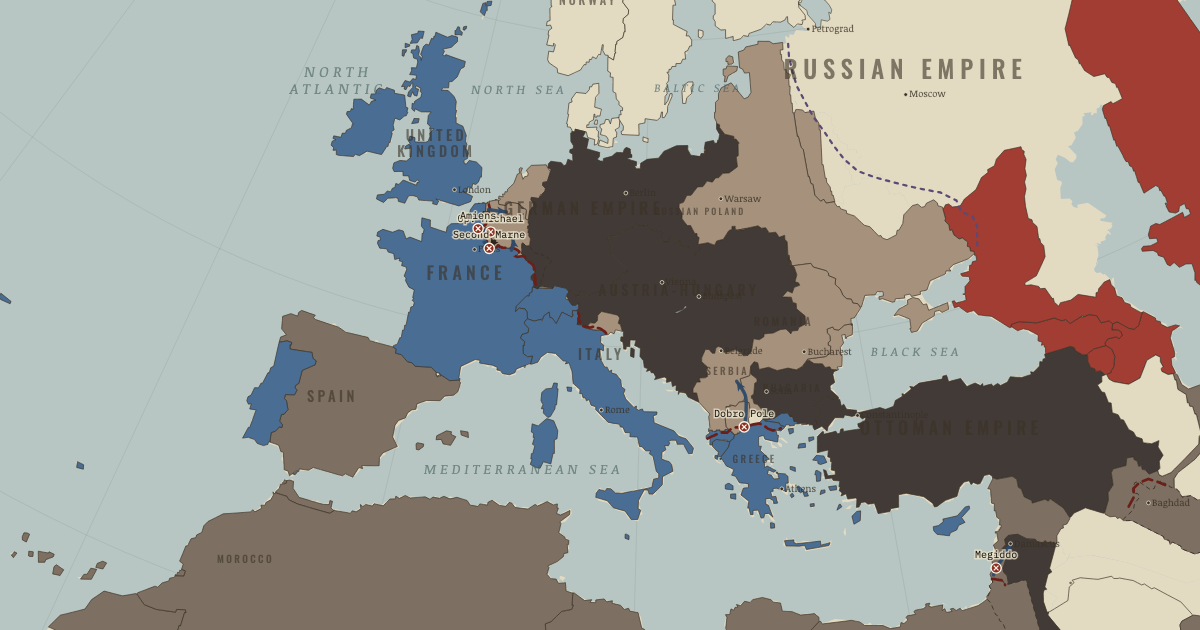
The map above is the world of Europe, July 1918 — The high-water mark in the west.
Every state on the map that year: The world in 1918 · Europe in 1918.
Part of IB History: The First World War →
SHORT EXPLANATION
Germany attacked in spring 1918 while it still had a chance to defeat the Allies before American strength grew. Short bombardments and stormtroopers moving past strongpoints opened defenses that had resisted attack for years. The troops who broke through then needed guns, food and reserves to follow them across devastated ground. Germany gained large areas, but failed to separate the Allied armies or force a decision.
From July the Allies made openings serve a longer campaign. Artillery, tanks, aircraft and infantry attacked together; further blows followed in different sectors before German defenses could recover. As the German army retreated, Bulgaria, the Ottoman Empire and Austria-Hungary faced defeat and strain at home. Pressure across several fronts brought the Central Powers toward collapse.
The full story
Germany’s leaders faced a narrowing opportunity in 1918. Divisions released from the east could strengthen an attack in France, but American troops were arriving to reinforce the Allies. Operation Michael began on 21 March with a short, intense bombardment. Stormtroopers passed around strongpoints and broke into the British Fifth Army’s front, carrying the German advance farther than any since 1914.
A breach was not yet a victory. The ground ahead had been devastated, and guns, ammunition and food struggled to reach infantry moving forward on foot. Later offensives made substantial salients but ran into the same difficulty. Ludendorff sought weak points in the line, without consistently choosing objectives whose loss would disrupt cooperation between the Allied armies. The Allies remained together; Germany had gained ground without securing a decisive objective.
The cost was severe. About a million German casualties included experienced assault troops who were especially difficult to replace. Under pressure, the Allies appointed Foch to coordinate their forces. The last German attack failed at the Marne in July, and the initiative passed to the Allies.
At Amiens on 8 August, Allied artillery, tanks, aircraft and infantry achieved surprise and advanced together. The tanks were useful, though unreliable; the attack also depended on shells, vehicles and coordination. Instead of letting one assault run on until it was exhausted, the Allies followed it with blows in other sectors. Germany had to move reserves from one threatened place to another, with fresh American manpower behind the Allied campaign.
The Western Front was only part of the strain on the Central Powers. Blockade and attrition had weakened Germany’s partners before defeats at Dobro Pole and Megiddo accelerated their collapse. Bulgaria, the Ottoman Empire and Austria-Hungary faced military defeat and mounting troubles at home. By late September Ludendorff was demanding an armistice.
FULL EXPLANATION
Break-in versus exploitation
German troops had learned how to enter a fortified line. Artillery calculated its fire in advance, avoiding the ranging shots that warned defenders; stormtroopers bypassed strongpoints, and junior leaders acted on local weaknesses. Once infantry had crossed the line, however, it still needed its guns and supplies. The men could advance beyond artillery range, while horse-drawn transport struggled through ruined ground. Germany lacked enough tanks and trucks to sustain the pace. Ludendorff’s choice of target mattered too: a place where a breach was attainable was not necessarily the place whose loss would disrupt Allied coordination. The Allies later coupled surprise with greater transport and ammunition, stopping attacks before exhaustion and striking elsewhere. A breach needed reinforcement and supply, or renewed pressure elsewhere to prevent recovery. Otherwise the ground gained could become an exposed salient.
The Hundred Days as a system
Amiens brought several methods together on a timetable. Artillery fired on calculated targets without the customary warning shots; tanks crossed wire and trenches, while aircraft and infantry supported the advance. Tanks helped, but their unreliability makes it impossible to credit them alone with the result. Foch and the national commanders followed one attack with others in different sectors. Each threatened position demanded a German response, so reserves had to move repeatedly rather than settle into a stable defense. American arrivals supplied confidence and replacements even where American units were absent. The system of pressure extended beyond France: blockade and attrition had weakened Germany’s partners, and Bulgaria’s exit threatened communications with the Ottoman Empire and Austria-Hungary. Each further armistice isolated Germany. The campaign worked against armies short of resources and a coalition whose members were failing.
Key places on the map
On this day
Why it happened
Why the trench finally broke. A defended line became more vulnerable when artillery could calculate fire without warning registration shots. Infiltration or armor helped troops cross the defended zone, aircraft observed, and junior leaders directed local action. Both sides learned to break in. The problem was what followed: German trucks and useful tanks were few, and horses were exhausted. By August the Allies had more mechanical transport and ammunition, and could stop an attack before exhaustion and strike again. New methods challenged the deadlock of Chapter 5, but a successful advance still had to be supplied.
Ludendorff’s strategic vacuum. Asked for Michael’s objective, Ludendorff is reported to have said: “We chop a hole. The rest follows.” A hole in the line did give German troops room to advance, but the salients they gained lengthened their own front by roughly 120 kilometers. Depleted troops then had to hold it. Foch’s successive attacks had a different relationship to the larger campaign: by striking in several places, they obliged German reserves to respond repeatedly. Breaking a line and using the breach to defeat an enemy were separate achievements.
The American weight, actual and virtual. American troops fought at Belleau Wood, Saint-Mihiel and the Meuse–Argonne; roughly 26,000 Americans died in the last, the country’s deadliest battle. Their presence also mattered beyond their own sectors. Arrivals of around 10,000 a day gave the Allies a source of replacements Germany could not match. Ludendorff had sought victory before that weight became decisive. German surrender rates after Amiens suggest a loss of confidence as well, although the numbers alone cannot explain every surrender.
The soft fronts were structural. The coalition’s other armies entered the final campaigns with serious weaknesses. Bulgarian soldiers had spent a year on half-rations opposite a reinforced Salonika force. Ottoman manpower was exhausted, and Russia’s withdrawal had drawn some Ottoman troops to the Caucasus. Austria-Hungary faced hunger and desertion amid national tensions. Allied attacks still had to defeat these armies, but blockade, attrition and imperial overstretch had already made the coalition vulnerable across several fronts.
THE TURNING POINT
Amiens, 8 August 1918. At Amiens on 8 August, defenders faced an attack they had not heard being prepared. Roughly 15,000 German troops surrendered in hours, and some reportedly called reinforcements “strikebreaker!” Ludendorff named it “the black day of the German Army.” The prisoners and reported reactions reveal a serious loss of confidence as well as the force of the Allied attack. Further defeats followed; at the end of September Ludendorff told the Kaiser that Germany needed an armistice.
What it changed
Five weeks, three armistices. The coalition came apart over five weeks. Bulgaria signed an armistice on 29 September, the Ottoman Empire on 30 October and Austria-Hungary on 3 November. The Habsburg army was disintegrating while its constituent peoples declared independence. Each departure exposed the partners still fighting and left Germany more isolated.
The birth of modern battle. Amiens showed how calculated surprise could bring artillery, infantry, aircraft and tanks into one attack. The Hundred Days extended the method through repeated blows across a broad front. Monash and Currie helped develop it; Fuller and Germans studying stormtroop tactics contributed to thinking about future warfare. Campaigns in 1939, 1944 and 1991 would use and adapt elements of combined arms under different technological and military conditions.
A defeat that fled the battlefield. Many German formations retreated in order, and the armistice arrived before Allied troops occupied Germany itself. Civilians at home therefore saw less of the rapid defeat that followed four largely static years. Ludendorff, who had demanded the armistice, later promoted the “stab-in-the-back” myth, blaming socialists, republicans and Jews for a defeat rooted in military and political collapse. That false account became a dangerous inheritance for the Weimar Republic.
DISCUSSION QUESTION — Could a different German strategy have won in 1918, or were the spring offensives a hopeless gamble?
Germany had alternatives to the offensives it chose. It might have shortened its line, defended and sought a negotiated peace; the Hindenburg Line had resisted attacks well into 1918. But a settlement required terms acceptable to both sides. After Brest-Litovsk, German leaders had shown little willingness to relinquish gains such as Belgium, while American arrivals and financial support reduced Allied incentives to compromise. A narrower attack against the French or supply centers such as Amiens or Hazebrouck might have used German strength differently and perhaps prolonged the war, but it would still have faced Allied resources and growing American manpower. The actual offensives cost roughly a million casualties without forcing a decision. The U-boat campaign’s contribution to American entry and the eastern settlement had narrowed Germany’s choices before 1918. Victory is difficult to envisage under those constraints, though we cannot prove that every alternative would have failed.
An interesting fact
Paris came under fire from about 120 kilometers away during the spring offensives. Krupp’s Paris Gun had a barrel more than thirty meters long and sent shells some forty kilometers into the stratosphere, among the first human-made objects to reach it. Each flight took roughly three minutes, and gunners allowed for the Earth’s rotation. The weapon had limited military value, but its shells killed civilians. On Good Friday, 29 March 1918, one brought down the roof of Saint-Gervais church on the congregation, killing 88 people, about a third of the gun’s total toll. German forces removed and destroyed the guns before the armistice; the Allies recovered no barrel.
Related
THE FREE PRINTABLE STUDY GUIDE
Get the printable study guide for WWI free. I’ll send you a few short letters, then one when a new atlas opens. That’s all. — Paul
NO TRACKING · YOUR ADDRESS IS USED FOR THE DISPATCH AND NOTHING ELSE · UNSUBSCRIBE ANYTIME