WWI · CHAPTER 14 ·
Treaty of Versailles
Chapter 14 of The Great War, 1871–1923: “The Peace That Failed”
The 1919 peace settlements replaced four fallen empires with a belt of new states, but some 25 to 30 million Europeans became minorities. The Treaty of Versailles limited Germany’s army, demilitarized the Rhineland and imposed reparations, yet left Germany intact. Former German and Ottoman lands became League mandates.
Chapter 14 is included with every paid plan. WW2 is free in full, and chapter 1 of every atlas is free. A free account opens 3 more chapters a day. Starter, at $9 a month, opens all 21 with no daily limit — see the plans.
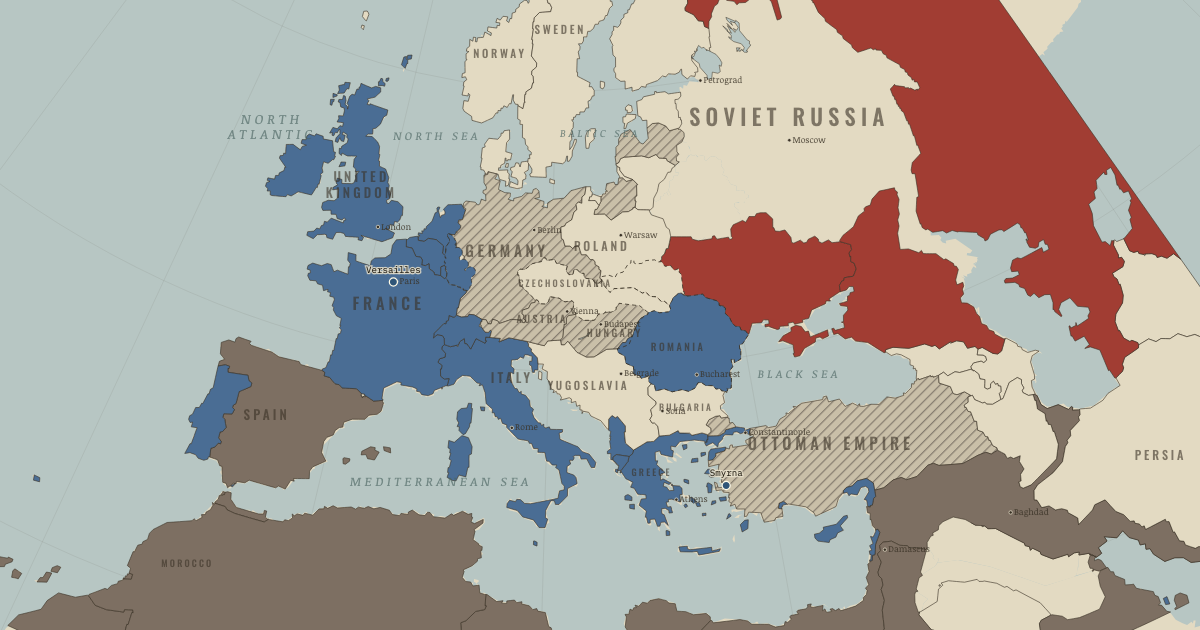
The map above is the world of Europe, June 1919 — The new map.
Every state on the map that year: The world in 1920 · Europe in 1920.
Part of IB History: The First World War →
SHORT EXPLANATION
The fall of four empires left the peacemakers drawing a new belt of states across Europe. Self-determination offered a reason for giving peoples governments of their own, but their populations were intermingled. Borders answered some claims while leaving millions of people as minorities, anxious about their place in another nation-state. Former German and Ottoman territories outside Europe became mandates administered by the victors, with little independence.
Versailles restricted Germany’s forces and demanded reparations, yet left it intact and potentially the strongest European state, surrounded by smaller neighbors. Germans resented the settlement, while its divided guardians lacked the will to enforce it. The 1920s showed that cooperation and peaceful revision were possible. Later revisionist leaders nevertheless found grievances and opportunities in the vulnerable order.
The full story
The peacemakers faced a problem of population as well as power. From Finland to Yugoslavia, states were created or restored, including Poland. Self-determination promised peoples a say in their government, and these new states answered national claims that imperial rule had suppressed. But communities in central and eastern Europe lived intermingled. A boundary that brought one people into its national state could put another under a government it did not consider its own. Roughly twenty-five to thirty million Europeans became minorities in someone else’s nation-state.
The promise had a different reach outside Europe. Former German and Ottoman territories became League of Nations mandates administered by the victors rather than independent countries. Self-determination had helped justify the remaking of Europe, while the colonial world received almost none of the promised freedom.
At Versailles the victors had to decide what security would require of Germany. France, invaded twice within living memory, wanted a physical barrier against another attack. Britain wanted a Germany able to trade and balance French power. Wilson sought an order of open rules and collective security through the League. The resulting treaty limited Germany’s army, demilitarized the Rhineland and imposed reparations, but left Germany potentially powerful. Germans saw Article 231 as a symbol of imposed guilt.
Money tied the settlement to the victors’ own debts. France owed Britain, Britain owed the United States, and German reparations were expected to help service both. At the same time, the United States rejected the treaty and Britain drew back from firm guarantees. The settlement was too severe to win German consent and not strong enough to remove German power; the states expected to uphold it did not agree on how to do so.
These weaknesses did not make another world war automatic. The 1920s brought cooperation and peaceful revision, showing that the settlement could be changed without a general war. The Depression, dictatorship, weak enforcement and deliberate aggression later turned a vulnerable order into catastrophe. Versailles made that collapse possible; leaders still chose the course that brought it about.
FULL EXPLANATION
The limits of self-determination
Self-determination promised that peoples should govern themselves. It gave national movements in Poland, Czechoslovakia, Finland and other new states a compelling answer to imperial rule. Their states were not simply artificial creations of a conference. Yet the principle gave no easy instruction for drawing a boundary through mixed populations. Communities had overlapping historical claims, and regions were economically interdependent. Favor one claim and another community could find itself across the border. A map of clean national states would have required coercion or forced movement. Minority-protection treaties tried to address the people left on the wrong side, but lacked strong enforcement. There was also a political choice about whose claims counted. The victors applied self-determination against enemy empires, declined to free their own colonies and forbade Austria to unite with Germany. Later regimes invoked minority protection as a pretext to attack the settlement, rather than improve it.
Versailles and the coming of the next war
Article 231 illustrates the difference between a clause’s legal purpose and its political life. Its purpose was to establish liability for damages; in Germany it became known as the war-guilt clause. Reparations, too, became politically toxic, even though schedules were revised and American loans financed much of the payment. Symbolism and money helped undermine acceptance of the peace. Security depended on the victors acting together. France sought lasting protection, Britain wanted recovery and a balance of power, and the United States rejected both the treaty and the League of Nations. The order lacked a dependable enforcer. Yet its weakness does not draw a straight line to 1939. The 1920s included German recovery, negotiation and peaceful revision. The Great Depression, elites’ contempt for democracy, Nazi ideology and governments’ deliberate choices in the 1930s were necessary parts of the catastrophe. Versailles left an order vulnerable to attack; political actors chose to destroy rather than repair it.
Key places on the map
On this day
Why it happened
Three peacemakers, three incompatible peaces. Each principal peacemaker had a different idea of what the war should secure. Clemenceau wanted France protected against a neighbor with twenty million more people. Wilson hoped rules could redeem the slaughter; Lloyd George wanted Germany punished but also able to trade and balance France. All three had electorates to satisfy (“Hang the Kaiser,” “make Germany pay”). The compromise satisfied no single theory: too Wilsonian to crush Germany, too Carthaginian to convert it, too compromised to inspire. Its clauses show the competing demands placed on a committee. Two powers that would decide Europe’s next war were missing from the durable settlement: Russia was uninvited, and America soon gone.
The reparations tangle. The demand for reparations was connected to debts among the victors. France owed Britain; Britain owed America; America alone insisted on repayment. German payments were the only source that could service the chain. Creditors’ books encouraged high sums, but collection was fitful and resentment total. The Ruhr occupation in 1923 followed, while hyperinflation gave propagandists a powerful gift. American loans subsequently supplied Germany with money to pay France, which could pay Britain, which could pay America. The circuit ran until 1929 cut the current. Keynes’ deeper point reaches beyond the arithmetic: treating Europe’s economy as a courtroom instead of a system would impoverish the victors too.
Self-determination’s impossible geometry. Self-determination was a powerful argument against the enemy empires, including Austria-Hungary and the Ottoman lands. The victors were less willing to accept it when their own arrangements were at issue. Austria could not join Germany, colonies remained under outside rule, and petitioners from Ireland to Ho Chi Minh went unheard. The selectivity was noticed immediately and everywhere; Wilson’s own Secretary of State privately called the phrase “loaded with dynamite.” In a region of mixed populations, the map made ethnicity a title-deed of statehood. Every dictator of the next twenty years would cite Paris’s principle while dismantling its map.
Enforcement: the peace nobody guarded. A treaty’s restrictions need someone willing to uphold them. The American guarantee died in the Senate, as did American membership of the League. Britain’s commitment faded with the memory of war, leaving France expected to police Europe alone. When France acted in the Ruhr in 1923, its own allies condemned it. By 1925 enforcement had become “appeasement” avant la lettre. The vacuum mattered more than the clauses themselves: a severe peace without enforcement brought resentment without the security its severity was meant to provide.
THE TURNING POINT
The Hall of Mirrors, 28 June 1919. The Hall of Mirrors gives the signing its setting: two German delegates put their names to the treaty under the victors’ eyes in the room where Bismarck’s empire was born in 1871. The date, 28 June 1919, answers Sarajevo exactly five years earlier. It is the century’s most consciously symbolic moment. The settlement’s content begins to erode within four years, but the images of dictated peace, guilt clause and mirrors continue to power German politics until a corporal of this war makes its destruction his program.
What it changed
What 1919 genuinely built. The order failed within twenty years, but it also built institutions and supplied language that outlasted it. The flawed League of Nations was the first permanent machinery for collective security; the UN inherited its charter, court and agencies wholesale. The settlement produced the International Labour Organization and provided mandate accountability, however thin. Anticolonialists around the world seized Wilsonian language and never returned it. The order’s institutional DNA governs the one you live in.
The successor wars. The armistice and peace treaties did not bring fighting everywhere to an end. The Polish-Soviet war and Greco-Turkish catastrophe followed; the latter brought the compulsory “population exchange” of 1923, ethnic cleansing made a treaty instrument. Irish independence, Arab revolts against the mandates and Freikorps fighting in the Baltics belong to this aftermath too. Historians increasingly describe a “greater war” of 1912–1923. Scrub the last snapshots with that longer conflict in mind.
The twenty-year armistice. German opposition to war guilt and demands for revision reached well beyond the Nazis. Italy had its “mutilated victory,” Hungary its Trianon irredentism, and minorities could be made into pretexts. The Depression struck an order without shock absorbers. In 1936 Germany remilitarized the Rhineland while the enforcers watched. Our WW2 atlas begins at that moment, where this chapter’s consequences lead into its first chapter.
DISCUSSION QUESTION — “The Treaty of Versailles caused the Second World War.” Prosecute and defend that sentence.
The case against Versailles begins with its combination of humiliation and surviving German power. War guilt, reparations and unilateral disarmament gave German governments a common grievance and gave Hitler a platform. German minorities supplied pretexts, while Russia’s exclusion and America’s departure deprived the order of guardians. The defense has evidence too. Versailles was milder than Brest-Litovsk, Germany’s own 1918 blueprint, and than partition in 1945. Weimar suffered from the Depression, elite contempt for the republic and deliberate myth-making, including the army’s “stab-in-the-back,” as much as from treaty clauses. Moreover, the treaty was being revised peacefully: reparations effectively ended by 1932, before Hitler mattered. Versailles made the peace vulnerable and weakened the coalition that might have defended it, making later destructive choices cheaper. It did not make 1939 inevitable. The 1920s show that reconciliation was possible; the 1930s show the cost of abandoning enforcement. A policy of punishment or reconciliation needs the resources to carry it through.
An interesting fact
On 3 October 2010 Germany paid about €70 million, the final payment on bonds floated in the 1920s to meet reparations. The debt had survived a long interruption: Hitler repudiated it, and the 1953 London Debt Agreement partially revived it while deferring the last tranche of interest until reunification. Germany reunited on 3 October 1990. The final invoice was settled on its twentieth anniversary, ninety-two years after the guns stopped.
Related
THE FREE PRINTABLE STUDY GUIDE
Get the printable study guide for WWI free. I’ll send you a few short letters, then one when a new atlas opens. That’s all. — Paul
NO TRACKING · YOUR ADDRESS IS USED FOR THE DISPATCH AND NOTHING ELSE · UNSUBSCRIBE ANYTIME