WWI · CHAPTER 2 ·
Bosnian crisis and the Balkan Wars
Chapter 2 of The Great War, 1871–1923: “The Balkan Crises”
Three crises between 1908 and 1913 were settled without a great-power war, yet each left Europe more dangerous. When Austria-Hungary annexed Bosnia-Herzegovina in 1908, Russia, pressed by Germany, backed down in 1909 and resolved never to retreat again. Germany’s gunboat at Agadir in 1911 hardened the western rivalry too.
WW2 is free in full, and chapter 1 of every atlas is free. A free account opens 3 more chapters a day. Starter, at $9 a month, opens all 21 with no daily limit — see the plans.
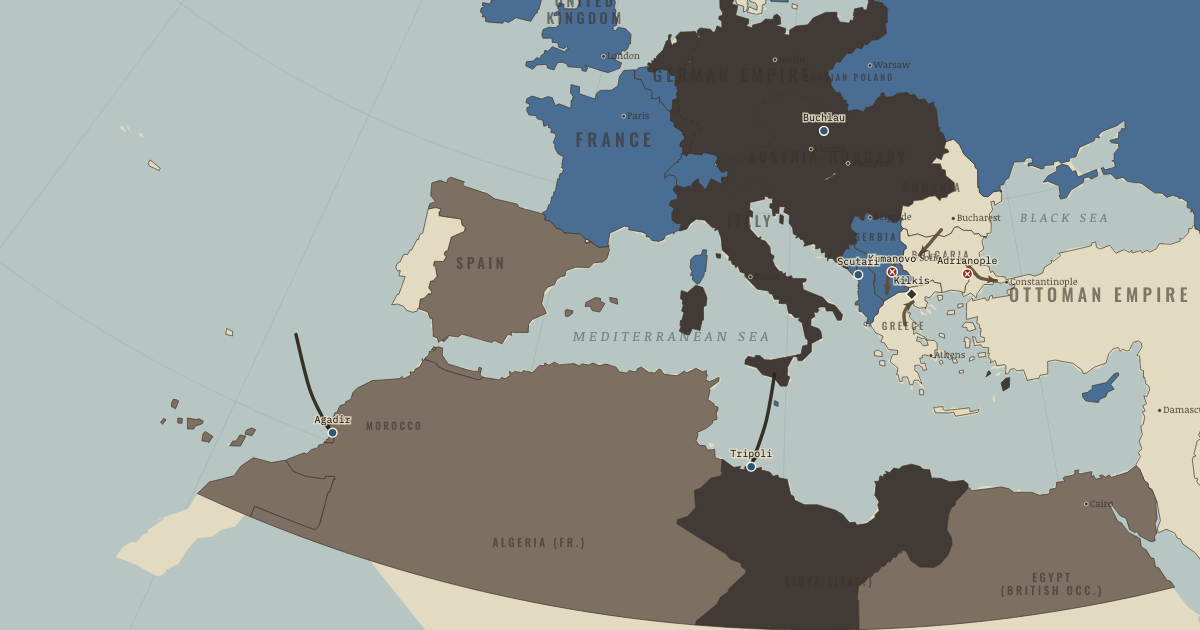
The map above is the world of Europe, August 1913 — The Treaty of Bucharest.
Every state on the map that year: The world in 1914 · Europe in 1914.
Part of IB History: The First World War →
SHORT EXPLANATION
Between 1908 and 1913 Europe’s great powers survived three crises without fighting one another. Their settlements nevertheless changed what governments expected from the next confrontation. Austria-Hungary annexed Bosnia-Herzegovina in 1908, after administering the Ottoman province since 1878. Serbia wanted to unite Bosnia’s Serbs with its own kingdom and appealed to Russia. Germany supported Austria-Hungary and demanded Russian acceptance. Still weakened by defeat by Japan, Russia yielded and remembered the retreat as a humiliation. In 1911 Germany sent a gunboat to Agadir during a Moroccan dispute, hoping to divide Britain from France. Instead, the two moved closer together.
The Balkan Wars of 1912–13 changed the map itself. Serbia, Bulgaria, Greece, and Montenegro defeated the Ottoman Empire, which had ruled much of southeastern Europe for centuries, then fought each other over its lands. Ottoman territory in Europe, once a buffer between Austria-Hungary and Russia, largely disappeared. Serbia nearly doubled in size and sought Russian protection. Vienna feared that the larger kingdom would attract South Slavs inside its own empire and increasingly considered force the answer. On the map the striped Ottoman Balkans largely disappear and Serbia turns blue. The powers had kept their peace, but they carried the grievances and lessons of these settlements into the next crisis.
The full story
Austria-Hungary had administered Bosnia-Herzegovina since 1878, although the province remained formally Ottoman. In July 1908 the Young Turks, reforming officers, forced the Ottoman sultan to restore a constitution. Vienna feared that a revived Ottoman government might seek to reclaim Bosnia. Its foreign minister, Alois von Aehrenthal, met Russia’s Alexander Izvolsky at Buchlau castle in September. Izvolsky accepted annexation in return for Austrian support for opening the Straits between the Black Sea and Mediterranean to Russian warships. The bargain came apart when Vienna annexed Bosnia in October before Russia had secured passage through the Straits. In March 1909 Germany demanded that Russia recognize the annexation. Russia was unready for war and yielded. Bosnia turns from tan to charcoal on the map; in St Petersburg, an agreement made in private had ended in public humiliation.
A different dispute tested the partnership in western Europe. In 1911 French troops occupied Fez, Morocco’s capital. Germany sent the gunboat Panther to Agadir and demanded a large share of French Africa as compensation, hoping to weaken the British-French understanding. Britain feared a German Atlantic naval base. Its finance minister, David Lloyd George, publicly warned Berlin that Britain would not be pushed aside. Germany accepted part of the French Congo, while Morocco became a French protectorate: it retained its ruler, but France controlled defense and foreign affairs. The outcome also changed naval planning. The Royal Navy would guard the North Sea and the French fleet the Mediterranean, leaving each country dependent on the other. The attempt to split the Entente had helped give it practical force.
The next wars began with the Balkan states themselves. Italy’s seizure of Libya from the Ottomans in 1911–12 exposed Ottoman weakness. In October 1912 Serbia, Bulgaria, Greece, and Montenegro—the Balkan League—attacked. Bulgaria advanced to within forty kilometers of Constantinople; Serbia won at Kumanovo and occupied much of Macedonia, a mixed region claimed by the Christian allies; Greece took Salonika. The great powers met in London and created an independent Albania, denying Serbia a route to the sea. The victors then disputed Macedonia. Bulgaria attacked its former allies in the Second Balkan War of 1913 and lost most of its gains. Serbia emerged nearly twice its former size. That October Vienna sent an ultimatum, a final demand with a deadline and threat of war, and Serbian troops left Albania within eight days. Austria-Hungary had seen a threat succeed, Serbia had gained by fighting, and Russia had reason to preserve its remaining Balkan client. Each would approach another confrontation with those experiences in mind.
FULL EXPLANATION
What each crisis taught
A settlement can end a crisis while teaching its participants incompatible lessons. Russia called its 1909 retreat a “diplomatic Tsushima,” recalling its naval disaster against Japan in 1905. Dominic Lieven shows why that memory made another retreat difficult for Sergei Sazonov, foreign minister from 1910. Vienna had seen Russian weakness instead. Its chief of staff, Franz Conrad von Hötzendorf, repeatedly urged war on Serbia, and the successful ultimatum of October 1913 suggested that firmness backed by Germany could work. German leaders, having watched the Entente hold at Agadir, regarded Austria-Hungary as their dependable ally and became readier to support Vienna without conditions. Samuel Williamson and Christopher Clark emphasize how such expectations reinforced each other: one government might expect an opponent to yield again, while that opponent was determined not to repeat its humiliation. The crises narrowed the choices leaders believed available, though none made war inevitable.
The Balkan states as actors
The Balkan kingdoms had plans of their own. Governments in Belgrade, Sofia, Athens, and Cetinje negotiated their league particularly with the division of Macedonia in mind. Russia’s minister in Belgrade, Nicholas Hartwig, encouraged the pact, but St Petersburg could not control it afterward. In October 1912 the League went to war after the great powers had warned against it. Richard Hall and Edward Erickson explain the Ottoman defeat through divided command and chaotic mobilization following the Italian war, as well as Balkan strength. Once the Ottomans had lost, Bulgaria gambled that it could take Macedonia from its allies by force, starting the Second Balkan War. The fighting also affected civilians. Mark Mazower draws attention to violence documented by the Carnegie Endowment’s international commission in 1914: expulsion became a way of building nation-states. The kingdoms’ independent choices required their powerful patrons to respond to events they had not directed.
Armies, alliances and the “war council” debate
The naval race was only one contest over military strength. David Stevenson argues that the land arms race of 1911–13 did more to make war likely because it changed the balance on which general staffs based their plans. Germany passed army laws in 1912 and 1913, and France extended conscription from two to three years in 1913. Russia’s Great Programme envisaged a peacetime army more than a third larger by 1917, with French loans for strategic railways. German planners came to believe that waiting would worsen their position. That fear forms the background to a disputed meeting on 8 December 1912. After London warned that Britain would not stand aside if France were attacked, Wilhelm II met his service chiefs; general staff chief Helmuth von Moltke said war was unavoidable and the sooner the better. John Röhl reads the meeting as evidence of preparation for war. Others, surveyed by Annika Mombauer, observe that it produced no decision beyond an army bill and a press campaign. It reveals a mood in Berlin, including the belief that an early war would be fought on better terms, but does not by itself establish a decision to start one.
Key places on the map
On this day
Why it happened
The Ottoman retreat. The Ottoman Empire had lost Balkan territory since the Congress of Berlin. The Young Turk revolution of 1908 and Italy’s war against the empire in 1911–12 persuaded neighboring states that they might take what remained. Each retreat revived the Eastern Question: who would inherit Ottoman lands? Austria-Hungary and Russia had competing answers, and the final Balkan settlement brought them closer to collision (Chapter 1).
Serbia’s turn toward Russia. Under the Obrenović kings, Serbia had been tied to Vienna by a secret treaty of 1881. That relationship changed in 1903, when army officers murdered King Alexander and Queen Draga and installed a dynasty looking to Russia and the union of South Slavs. Vienna tried economic pressure in the ‘Pig War’ of 1906–09, a trade boycott named for Serbia’s principal export. Serbia instead found French loans and Russian protection. The effort to restore Austrian influence helped drive its neighbor further away.
A Habsburg empire afraid for its South Slavs. About seven million South Slavs lived under Habsburg rule, including Croats, Serbs, Slovenes, and Bosnian Muslims. Austrian leaders feared that a successful Serbia could attract them away, as Piedmont had drawn Italians from Habsburg rule during Italian unification in the 1860s. Annexation was intended to end Serbia’s claim to Bosnia. It also gave Serbian nationalists a grievance. Unification or Death, the secret society known as the Black Hand, was founded in 1911 and recruited young Bosnian Serbs.
Russia’s need to recover face. Defeat by Japan in 1905 and the revolution that followed left Russia too weak to fight over Bosnia in 1909. Germany’s demand for acceptance of annexation became a remembered humiliation in St Petersburg. From 1910 Russia rebuilt its army with French money and returned its attention to the Balkans, sponsoring the Balkan League as a barrier to Austria-Hungary. It sought to recover influence in the region where its retreat had exposed its weakness.
THE TURNING POINT
The Bosnian crisis, September 1908 – March 1909. The bargain at Buchlau was meant to give each empire something: Austria-Hungary could annex Bosnia, and Russia could seek passage for warships through the Straits. Vienna acted before Russia secured that passage. Germany then insisted in March 1909 that Russia recognize the annexation, and Russia yielded. The result left Austria-Hungary acting with German support, Serbia aggrieved, and its Russian patron humiliated. These powers confronted one another again five years later, when Russia was much less willing to retreat.
What it changed
The July Crisis follows the script. Sarajevo, where the assassination of June 1914 occurred, was the capital of the province annexed in 1908. Young Bosnian Serbs armed through the Black Hand carried out the killing. Austria-Hungary turned again to the ultimatum that had worked against Serbia in October 1913, and Germany again promised support (Chapter 3). This time the confrontation escalated into general war.
Bulgaria’s revenge. The 1913 Treaty of Bucharest ended the Second Balkan War by taking most of Macedonia and southern Dobruja from Bulgaria. In October 1915 Bulgaria joined the Central Powers, Germany’s side, which offered it Macedonia. Its army helped crush Serbia within weeks (Chapter 6). The larger war offered a chance to pursue territory lost in the earlier one.
An arms race on land. Germany’s army laws of 1912 and 1913, France’s three-year service law, and Russia’s Great Programme produced some of Europe’s largest peacetime increases in army size. General staffs considered when the changing balance would favor them. German planners expected their advantage to disappear around 1916 or 1917. That expectation helps explain Berlin’s readiness to risk war while its leaders still believed victory possible, as armies moved in August 1914 (Chapter 4).
Nation-building by expulsion. New borders after the Balkan Wars displaced entire communities. Hundreds of thousands of Muslims fled toward Anatolia, the Turkish heartland in Asia; Bulgarians, Greeks, and Serbs were expelled from districts that changed hands. A Bulgarian–Ottoman agreement in 1913 arranged a voluntary exchange of villagers along the new border. The compulsory Greek–Turkish exchange of 1923 (Chapter 15) later gave the practice a place in international law.
DISCUSSION QUESTION — Which of the three crises of 1908–1913 did most to make a general European war likely in 1914?
Bosnia best explains several attitudes visible in July 1914: Russia remembered its retreat, while Germany had shown that it would back Austria-Hungary. Agadir helps explain the western response, convincing British leaders that Germany sought European dominance and tightening naval links with France, making British neutrality less likely. The Balkan Wars have the strongest claim to have changed the immediate situation. They largely removed the Ottoman buffer, nearly doubled Serbia’s size, and strengthened Vienna’s conviction that only war could solve its South Slav problem. Christopher Clark is among the historians who give those wars particular weight. Bosnia shaped expectations; the Balkan Wars created the conditions in which leaders would apply them. All three crises nevertheless ended without a general war, and none made the decisions of 1914 inevitable.
An interesting fact
Leon Trotsky reported the Balkan Wars while living in exile in Vienna. Writing as Antid Oto for the Kiev newspaper Kievskaya Mysl, he covered the fighting of 1912–13 and reported matters the belligerents’ own newspapers kept quiet. Five years later he led the Bolshevik delegation at Brest-Litovsk. Soon afterward, as commissar for war, he built the Red Army that marched on Warsaw in 1920. Journalists, soldiers, and politicians carried experience from the smaller wars into the much larger catastrophe that followed.
Related
THE FREE PRINTABLE STUDY GUIDE
Get the printable study guide for WWI free. I’ll send you a few short letters, then one when a new atlas opens. That’s all. — Paul
NO TRACKING · YOUR ADDRESS IS USED FOR THE DISPATCH AND NOTHING ELSE · UNSUBSCRIBE ANYTIME