WWI · CHAPTER 7 ·
Verdun, the Somme and Brusilov
Chapter 7 of The Great War, 1871–1923: “The Furnaces”
In 1916 both sides turned to attrition. Germany attacked Verdun, which France felt bound to defend, and the battle exhausted both armies. The Allies attacked on the Somme partly to relieve Verdun; its first day was the bloodiest in British military history. In the east, Brusilov shattered the Austro-Hungarian armies.
Chapter 7 is included with every paid plan. WW2 is free in full, and chapter 1 of every atlas is free. A free account opens 3 more chapters a day. Starter, at $9 a month, opens all 21 with no daily limit — see the plans.
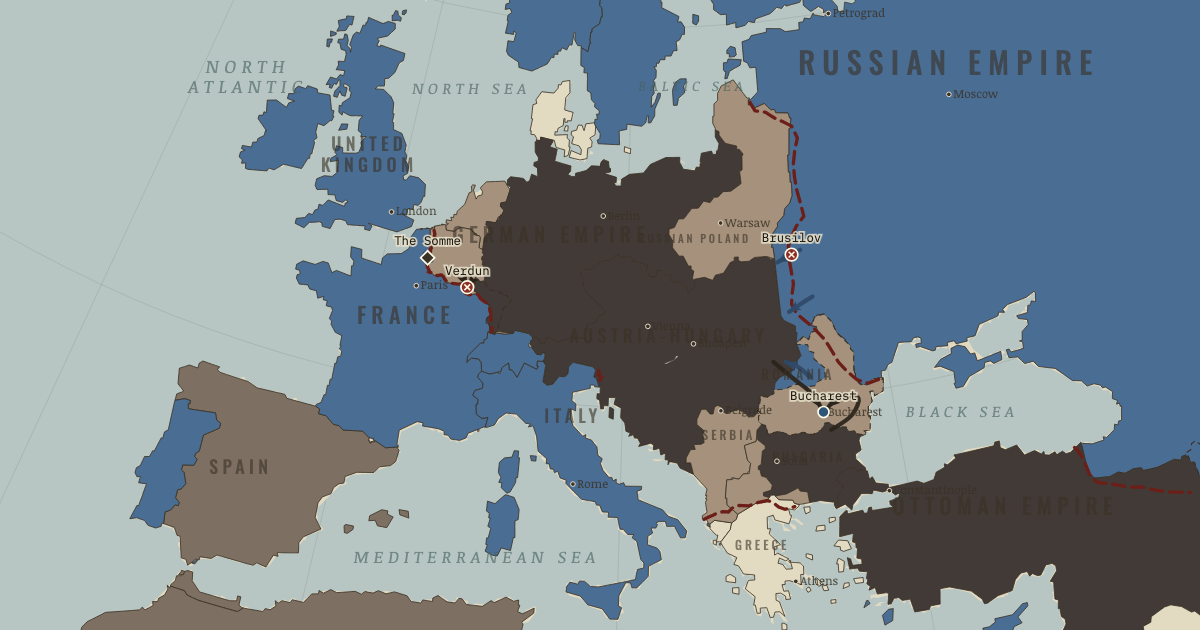
The map above is the world of Europe, December 1916 — The furnaces.
Every state on the map that year: The world in 1918 · Europe in 1918.
Part of IB History: The First World War →
SHORT EXPLANATION
In 1916 the war's opponents sought to exhaust each other. Germany chose Verdun because France had compelling reasons to defend the fortress city; the Allies attacked on the Somme partly to relieve it. Both battles cost hundreds of thousands of casualties for a shift of only a few kilometers. Neither side could determine in advance how the losses would be shared.
In the east, General Brusilov broke the Austro-Hungarian line by preparing attacks across a broad front. Russian railways, reserves and cooperation could not sustain his advance. His success encouraged Romania to join the Entente, but the Central Powers overran much of the country and obtained its grain and oil. Greater resources could give a coalition an advantage in a long war, while leaving the outcome of an individual battle uncertain.
The full story
Why did Germany choose Verdun? The fortress city had political and emotional importance for France, and Falkenhayn expected the French to fight for it. His later memorandum described an intention to drain French manpower, although historians dispute the document and its relation to his original plan. The French did defend Verdun, but German losses mounted too. Pétain kept supplies moving along the road to the city and rotated divisions through the battle, spreading its burden across much of the French army.
The Somme offensive served an ally in distress: it began partly to draw German strength away from Verdun. Its first day became a memorial to British mass loss. During the months that followed, the British army also learned to combine artillery and infantry in new ways. Farther east, Brusilov prepared attacks in several sectors, concealing the location of the main blow, and broke the Austro-Hungarian line. Romania, hoping to gain Transylvania, entered the war after his success. Central Powers armies then overran much of Romania and took its grain and oil.
These events make a distinction necessary. Attrition means wearing down an enemy's people and material faster than they can be replaced. Over the whole war, the Entente's greater combined resources gave it reason to expect an advantage. At Verdun, however, France and Germany suffered roughly similar casualties: a commander could not simply choose a battle and dictate the exchange. The Somme gained little ground, yet relieved Verdun, damaged German units and taught the British costly lessons about barrages, infantry tactics and tanks. Brusilov showed that surprise could break a trench line, but weak railways and poor cooperation restricted the use Russia could make of its success. That success had also encouraged Romania to enter at a moment when the apparent balance was about to change.
FULL EXPLANATION
Attrition in strategy and battle
The Entente possessed greater combined population, industry, finance and access to the sea. Sustained pressure could therefore exhaust the Central Powers over the course of the war. This was an argument about the resources available to whole coalitions, not a guarantee about the next battle. At Verdun German troops attacked fortified ground, and German prestige became attached to holding the positions they captured. France defended the city; Germany defended its gains; both suffered heavily. The Somme inflicted serious losses on Germany at a terrible price to the Allies. To judge either offensive, we must ask what it gained, how its methods changed and what it cost. A favorable long-term balance alone cannot answer those questions.
How Brusilov broke the line
A conspicuous concentration of troops at one narrow point told defenders where reserves would be needed. Brusilov instead prepared several sectors, bringing approach trenches close to the Austro-Hungarian positions and using aerial observation to guide shorter bombardments. The defenders had to spread their reserves because they could not confidently identify the main attack. Their already fragile cohesion magnified the shock. Breaking the line, however, did not provide the means to exploit it indefinitely. Neighboring Russian commands failed to coordinate, railways could not supply an unlimited advance, and German reinforcements stiffened the defense. Later attacks around Kovel returned to costly older methods. Surprise, density and command could change the course of trench fighting, but tactics could not by themselves overcome shortages and poor coordination.
Key places on the map
On this day
Why it happened
The bargain at Verdun. The attritional interpretation of Verdun depended on France losing men faster than Germany. That exchange was difficult to secure when German troops had to attack a fortress zone under its guns. Captured ground acquired a value of its own: by summer German prestige was tied to defending those gains, just as French prestige was tied to holding the city. The battle drew both armies into a costly defense of ground.
Allies and the timetable. At Chantilly in December 1915 the Allies planned simultaneous offensives in the east, west and south. Pressure on several fronts would make it harder for Germany to move reserves where they were needed. Verdun interrupted the plan by absorbing French troops. The Somme, on ground selected where the British and French armies met, became a predominantly British operation launched partly to help France. Its timing and location reflected the demands of fighting as a coalition.
Brusilov’s preparations. Brusilov spread his reserves across a wide front rather than massing them at one obvious point. Approach trenches reached within 75 meters of the Austrian lines, and aerial photographs helped prepare artillery fire. Surprise at many points struck an army already weakened by growing surrenders among some Slavic regiments. The advance outran its railways, German reinforcements strengthened the defense, and attacks near Kovel reverted to costly older methods. The preparations opened an opportunity that Russia's railways and neighboring commands could not sustain.
Romania chooses its moment. Romania sought Transylvania, indicated by the blue arrow, and secured Entente promises before entering after Brusilov's victory made Austria-Hungary appear close to collapse. Its position was difficult: it bordered three enemies, its army lacked supplies, and Russian help came late and grudgingly. Defeat delivered a vital oilfield and an estimated million tons of grain to the Central Powers. The intervention intended to help end the war strengthened Romania's enemies. Bulgaria's timing in Chapter 6 and its eventual reckoning in Chapter 12 offer another view of a smaller power's risks.
THE TURNING POINT
Verdun holds; German command changes. By July the fighting at Verdun had failed to produce the favorable exchange associated with Falkenhayn's later account. He was dismissed in August. Hindenburg and Ludendorff, celebrated for their victories in the east, replaced him and acquired decisive influence over Germany's war effort. They pressed the “Hindenburg Programme” of mobilization at home and soon supported unrestricted submarine warfare. The change mattered far beyond the fortress: different leaders would now decide how far Germany should gamble.
What it changed
Losses and resources. The estimated losses are staggering: roughly 300,000 dead at Verdun, another 300,000 on the Somme, and perhaps a million Austro-Hungarian and Russian casualties in the east. Romania was overrun, while the western lines moved only kilometers. The resources left to continue the war also mattered. Germany ended 1916 outnumbered and blockaded, with the “turnip winter” beginning and a weakened ally to support. The Entente's greater resources would count over time, although its own armies had paid heavily for the pressure.
A weakened Habsburg ally. After Brusilov's offensive, Austria-Hungary depended increasingly on German divisions and command. Emperor Franz Joseph died in November 1916; within months his successor Karl secretly approached the French about peace. The empire that had helped start the war could no longer fight it alone. Its dependence forms part of the story of its rapid dissolution in 1918.
The survivors carry the war forward. Much of the French army had passed through Verdun. Many of those soldiers would face Nivelle's 1917 offensive and the mutinies that followed in part of the army. Veterans of the Somme carried costly experience into the BEF of 1918. The war also shaped later leaders: Charles de Gaulle was wounded and captured at Verdun, and Pétain commanded its defense. Their later decisions belonged to lives marked by the fighting of 1916.
DISCUSSION QUESTION — Could attrition be a rational strategy in 1916?
The case for attrition begins with the difficulty of breaking the western front (Chapter 5). The Entente could maintain pressure with greater combined resources, including through blockade, and German manpower was under severe strain by 1918. But a sound expectation about the long war did not make any particular attack sound. Verdun showed that commanders could not dictate the exchange of casualties; prolonged losses also damaged Russian and part of French morale before Germany's defeat. An offensive must be judged by its methods, likely gains, losses and alternatives. Superior resources do not make the people committed to battle interchangeable.
An interesting fact
Audiences saw The Battle of the Somme while the battle was still being fought. Official cameramen Geoffrey Malins and John McDowell supplied the footage, and the film opened on 21 August 1916. It reportedly sold around twenty million tickets in six weeks, bringing images of actual dead and wounded to an audience approaching half of Britain. Its most familiar sequence, men going “over the top,” was almost certainly staged at a trench-mortar school behind the lines: filming an actual assault head-on was exceptionally difficult.
Related
THE FREE PRINTABLE STUDY GUIDE
Get the printable study guide for WWI free. I’ll send you a few short letters, then one when a new atlas opens. That’s all. — Paul
NO TRACKING · YOUR ADDRESS IS USED FOR THE DISPATCH AND NOTHING ELSE · UNSUBSCRIBE ANYTIME