WWI · CHAPTER 4 ·
Schlieffen Plan and the Marne
Chapter 4 of The Great War, 1871–1923: “The Guns of August”
In August 1914 Germany sought to defeat France through neutral Belgium before Russia was ready. France’s attacks in Lorraine failed, and Russia invaded East Prussia but lost at Tannenberg. On 5 September French and British forces struck a gap between German armies at the Marne, and Germany fell back to the Aisne and dug in.
Chapter 4 is included with every paid plan. WW2 is free in full, and chapter 1 of every atlas is free. A free account opens 3 more chapters a day. Starter, at $9 a month, opens all 21 with no daily limit — see the plans.
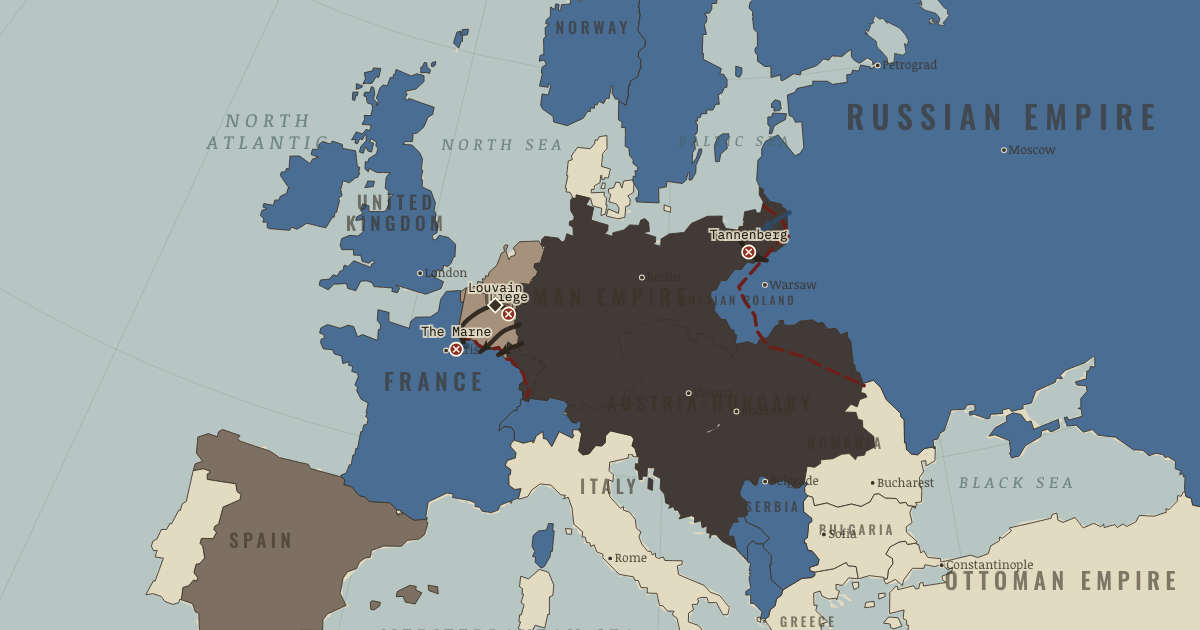
The map above is the world of Europe, September 1914 — The Marne — the short war dies.
Every state on the map that year: The world in 1914 · Europe in 1914.
Part of IB History: The First World War →
SHORT EXPLANATION
Germany's war plan addressed a problem that had troubled its leaders for twenty years: France and Russia could fight it from opposite directions. Russia's large army was expected to assemble slowly, leaving an interval in which Germany might defeat France and then send troops east by rail. The strongest German forces would cross neutral Belgium and sweep around Paris. Speed was central to the plan, and German leaders accepted the violation of Belgian neutrality to obtain it.
The opening campaign brought German armies deep into France, while French attacks failed at terrible cost and Russia invaded East Prussia earlier than expected. Yet distance traveled came at a price. After roughly 500 kilometres on foot, the German right wing was strained, with food, ammunition, guns and horses struggling to follow from the railways. The armies moved east of Paris and a gap opened between them. French and British forces struck at the Marne in early September; the Germans withdrew and dug in. Their destruction of a Russian army at Tannenberg could not recover the quick western victory their strategy required.
The full story
The German arrows through Belgium represent an attempt to solve the problem of France and Russia together. Germany intended to defeat France during the weeks in which Russia was expected to assemble its larger army, then transfer forces east. The route through neutral Belgium made a wide sweep possible, but Belgian forts resisted and German violence against civilians supplied the Allies with a powerful propaganda cause.
France had an offensive plan of its own. Its attacks in Lorraine rested in part on faith that fighting spirit could overcome firepower. They failed at appalling cost. On the other front Russia invaded East Prussia earlier than German planners expected, forcing Germany to attend to danger in the east while its main campaign was still under way in the west.
At Tannenberg, German forces used railway movements and Russian radio messages sent without proper coding to help surround and destroy Samsonov's army. The victory was considerable, but the fate of the German strategy depended on France. There the right wing had marched roughly 500 kilometres. Men were exhausted, horses were failing, and food and ammunition had to travel farther from the railheads. French forces were falling back toward their depots and could use intact railways to move reserves. Joffre replaced unsuccessful generals and shifted armies to the threatened flank.
The German armies moved east of Paris, about fifty kilometres away, and a gap opened between them. From 5 September French and British forces attacked into it at the Marne. The Germans withdrew to the Aisne and dug in; the dashed line appearing on the map marks the beginning of the new front. Germany remained a powerful opponent, but its intended sequence—defeat France first, then turn against Russia—had failed. It now faced the prolonged war on two fronts that the opening plan had been designed to avoid.
FULL EXPLANATION
Logistics of the sweep
The distance from the German armies to Paris tells us where they stood, but not what they still had the strength to do. The march consumed food and ammunition; horses needed fodder; casualties needed replacements. These supplies had to travel forward from railheads left farther behind with every advance. Roads became congested, horses weakened, and orders arrived late. The French, retreating toward their own depots, could use intact railways to move reserves. By early September the German right wing had covered roughly 500 kilometres and could no longer maintain the expected pace. Moltke's decisions mattered, but even the movement he commanded demanded continuous speed from a mass army dependent largely on boots and horses. Military theorists call the limit the culminating point: an attacker may continue to gain ground after its ability to turn that movement into a decisive result has begun to decline.
Tannenberg and the logic of coalition war
Russia attacked East Prussia before it was fully ready, partly to relieve pressure on its French ally. At Tannenberg the cost was immense. German forces used their railway mobility and intercepted Russian radio messages to surround and destroy Samsonov's Second Army. Moltke sent two corps east, although they arrived too late for that battle and their absence alone did not cause the German defeat at the Marne. The episode shows why an ally's attack can matter beyond the front on which it is fought: it obliges a shared enemy to divide attention and forces. Russia paid heavily for that pressure. Tannenberg also had consequences inside Germany. It made Hindenburg and Ludendorff national celebrities, giving military leaders a prestige that would shape politics for years.
Key places on the map
On this day
Why it happened
The two-front arithmetic. The Franco-Russian alliance of 1894 joined two powers whose combined strength exceeded Germany's. Schlieffen's proposed answer depended on their different mobilization speeds: defeat France during Russia's slower assembly, then turn east. The route through Belgium was chosen for speed, at the risk of British intervention. The western campaign had to be quick for the sequence to work; that necessity did not prove it could be made quick enough.
A plan diluted, or a plan impossible?. Moltke the Younger weakened the right wing compared with Schlieffen's earlier sketch and allowed the Lorraine armies to counterattack rather than draw the French west. Traditionalists blame these changes. Historians who stress logistics question whether the original sweep was feasible either: marching men and horses needed supplies beyond the railheads, and cavalry faced rifles. The exhaustion and shortages of the actual right wing at the Marne give that objection weight, while leaving room to examine command decisions.
Plan XVII and the cult of the offensive. France's Plan XVII also relied on attack. Its armies advanced into Lorraine under a doctrine that placed great faith in morale, but German firepower helped defeat the opening attacks within about ten days at terrible cost. Joffre subsequently used railways to move forces against the German flank. Both opening plans failed, and French forces were able to recover closer to their depots.
Russia moves early — for its ally. Russia entered East Prussia in roughly two weeks, much sooner than the six German planners had expected, and before its army was fully ready. Part of its purpose was to help France. The resulting loss of Samsonov's army at Tannenberg was a severe price. Two German corps sent east were absent from the Marne; that absence alone does not explain the outcome there, but it shows how an ally can force an opponent to divide resources.
THE TURNING POINT
The Marne, 5–12 September. A gap had opened between the German First and Second Armies. Lieutenant-Colonel Hentsch, sent forward to assess the position and coordinate a retreat, found the danger real, and the Germans fell back. Moltke reportedly told the Kaiser, “Majesty, we have lost the war.” The attribution is uncertain; the loss of the quick western victory on which the German plan depended is not.
What it changed
The race to the sea — and the wall. After the Marne both sides tried to turn the other's northern flank, extending the fighting toward the sea. A fortified front came to run from the Swiss frontier toward the Channel. At First Ypres in Flanders, the old British regular army suffered grievous losses resisting a German offensive. Chapter 5 examines the trench system that followed.
Tannenberg makes a duumvirate. Hindenburg and Ludendorff emerged from Tannenberg as celebrated figures. By 1916 their authority had grown until they effectively directed the German war effort, pushing the Kaiser and chancellor into the background. Battlefield prestige had become political power.
Atrocity and the war of cultures. The killings at Louvain and Dinant supplied the Entente with evidence for its portrayal of a war against “the Hun.” Propaganda also exaggerated and embellished real crimes. Memories of those exaggerations later contributed to skepticism about atrocity reports in the next world war.
The shell famine. Armies consumed ammunition faster than prewar plans had allowed. Shell shortages helped drive governments to organize industrial production, bring scarce materials under control and employ women in munitions work. The crisis contributed to political upheaval in Britain and France. Industrial supply became central to sustaining and deciding the war.
DISCUSSION QUESTION — The Schlieffen Plan came within 50 km of Paris. Was it a near-run gamble, or never really possible?
The last 50 km were not simply another stretch like the first 400. German men and horses were exhausted, supply routes were long, and two corps had gone east; the defenders could draw on railways around Paris. Historians emphasizing logistics argue that the advance was reaching its limit. Operational historians also identify consequential decisions: the movement east of Paris, the gap between armies and the fighting in Lorraine. These explanations address different parts of the campaign. Command choices mattered within a plan that made enormous demands on men, animals and transport, and crossing Belgium had also risked British intervention.
An interesting fact
About six hundred Paris taxis carried roughly five thousand men of the 7th Division toward the Marne. They were a small fraction of the armies engaged and probably did not decide the battle. The meters ran, and the French treasury later paid the cab companies 70,012 francs, reported as 27 per cent of the metered fare. The journey became a lasting symbol of a city placing its everyday resources at the battle's service.
Related
THE FREE PRINTABLE STUDY GUIDE
Get the printable study guide for WWI free. I’ll send you a few short letters, then one when a new atlas opens. That’s all. — Paul
NO TRACKING · YOUR ADDRESS IS USED FOR THE DISPATCH AND NOTHING ELSE · UNSUBSCRIBE ANYTIME