WWI · CHAPTER 3 ·
July Crisis and outbreak of WWI
Chapter 3 of The Great War, 1871–1923: “The Powder Keg”
After the assassination at Sarajevo on 28 June 1914, Austria-Hungary resolved to crush Serbia and Germany gave it unconditional backing, the so-called blank cheque. Russia mobilized to shield Serbia, Germany declared war on Russia and France, and its troops crossed into Belgium on 4 August, which brought Britain into the war.
Chapter 3 is included with every paid plan. WW2 is free in full, and chapter 1 of every atlas is free. A free account opens 3 more chapters a day. Starter, at $9 a month, opens all 21 with no daily limit — see the plans.
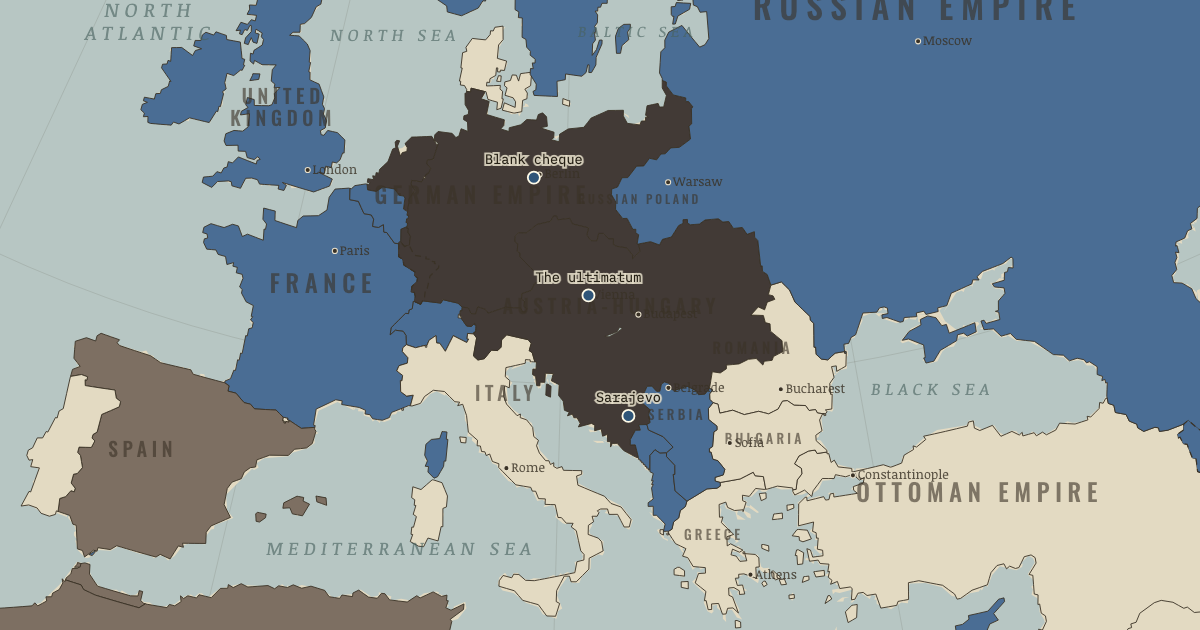
The map above is the world of Europe, July 1914 — The powder keg.
Every state on the map that year: The world in 1914 · Europe in 1914.
Part of IB History: The First World War →
SHORT EXPLANATION
A murder in Sarajevo on 28 June 1914 became a war among five great powers within five weeks. The distance between those events is the puzzle of the July crisis. Germany and Austria-Hungary were allies; France and Russia belonged to another alliance, with Britain attached more loosely to both. These relationships were intended to discourage attack: a government threatening one power had to consider its partners as well. But a dispute with one partner could also bring the others into danger.
Austria-Hungary chose to strike Serbia, Germany supported Vienna, and Russia prepared to protect Serbia. The preparations themselves made waiting frightening. Mobilization meant calling up reserves and sending them to the frontier on railway schedules arranged in advance. If an opponent assembled first, a government feared that its own army would be caught unready. The pressure was severe, but it did not issue the orders. Leaders, especially in Vienna and Berlin, made choices that carried the crisis forward, and each choice made the next harder to reverse.
The full story
The Austrian heir's murder gave Vienna an opportunity to deal with a danger it had long feared. Austria-Hungary ruled many peoples, including South Slavs whose nationalism had encouragement from Serbia. Some Austrian leaders wanted to break Serbian power before it could further threaten the empire. Germany's unconditional promise of support, the “blank cheque,” made a hard policy more attractive: Vienna could act knowing that its great-power ally stood behind it.
The ultimatum sent to Serbia on 23 July was designed to be difficult to accept. Serbia nevertheless agreed to most of its demands. Vienna chose war anyway, declaring it on 28 July and shelling Belgrade. Russia had reason to resist the destruction of a fellow Slavic state: a Serbian defeat would weaken Russian influence in the Balkans. Its mobilization was intended to deter Austria-Hungary, but it also confronted Germany with the possibility of a Russian army assembling against its ally.
German leaders had already accepted a plan for war on two fronts. It called for a rapid attack on France through neutral Belgium, before Russia could bring its full strength to bear. Waiting while Russia mobilized seemed to put that plan at risk. Germany declared war on Russia on 1 August and on France on 3 August; its troops crossed the Belgian frontier on 4 August. Britain's cabinet had been divided, but the invasion of Belgium brought Britain into the war, citing its guarantee of Belgian neutrality.
The map now carried the consequences of decisions made far beyond the original dispute. Alliance commitments and military plans made the crisis dangerous, yet governments still decided how to respond. In this account, leaders in Vienna and Berlin bear the heaviest responsibility because they chose escalation. Russia's general mobilization and other decisions helped accelerate the final chain.
FULL EXPLANATION
The system and the choice
Fritz Fischer and Christopher Clark give the reader different ways to look at the same sequence. Fischer argued that German leaders were willing to risk a continental war for wider ambitions. Clark emphasized several governments misreading one another as they stumbled through the crisis. The question is not whether structures or choices existed: alliances and war plans made a Balkan dispute capable of spreading, while officials decided what to do within those conditions. Influential people in Vienna wanted a military solution even after Serbia's extensive concessions. Berlin promised unconditional support knowing Russia might intervene. Russia's general mobilization then made waiting look more dangerous to Germany. These decisions were made under different pressures and for different purposes; the system explains those pressures without taking responsibility away from the people who acted.
The mobilization trap
Mobilizing millions required a sequence of railway movements, not a single order to march. Units needed trains and routes, and each movement depended on others fitting into the schedule. Once under way, redirecting them threatened congestion and disruption. Generals warned that an order could not easily be recalled. Germany's accepted plan added a further constraint: war with Russia was to begin with an immediate campaign against France. These difficulties mattered because both sides feared being overtaken. Preparations taken for one country's safety could appear to its rival as the beginning of an attack, prompting the rival to prepare in turn. This is a security dilemma. Yet the timetables did not decide on war by themselves. Political leaders had accepted the plans and could still pause or negotiate, although doing so carried real but bearable risk.
Key places on the map
On this day
Why it happened
The alliance machine. Bismarck had used alliances to isolate crises. By 1914 the opposing alignments could spread one. An Austrian attack on Serbia threatened Russian interests; German support for Austria raised the prospect of war with Russia; and Germany's plan for that war included an attack on France. A network meant to deter an enemy could thus carry a local quarrel into several countries.
Timetables as destiny. Staffs expected the first army to concentrate to gain a decisive advantage. Germany's Schlieffen Plan aimed to defeat France in roughly six weeks, before Russia completed its slower mobilization. The railway schedules were hard to change, and fear of losing time pressed against negotiation. “Mobilization means war” captured the danger, though it did not remove political leaders' choices.
Austria-Hungary’s existential fear. The Dual Monarchy contained eleven nationalities under an aging emperor. On the map, much of its territory is not Austria or Hungary. Leaders in Vienna saw South Slav nationalism, encouraged from Belgrade, as a threat to the empire's survival. Some already wanted a local war to destroy Serbian power; the assassination supplied an occasion to act.
Germany’s closing window. Russia was expanding its railways with French financing, and German planners feared that their relative advantage would diminish after 1917. If war with Russia was expected, some concluded that it would be better fought sooner. Fischer emphasized German ambitions; other historians see reckless brinkmanship, accompanied by hope that Britain would stay out. Whatever the balance of motives, Berlin backed escalation in July.
THE TURNING POINT
Sarajevo, 28 June 1914. The assassination nearly failed. A bomb missed the archduke's car that morning; later, the driver took a wrong turn past the café where Princip stood. That mistake gave Princip another opportunity. His shot did not itself cause the war, but it gave advocates of force in Vienna an occasion to pursue their policy against Serbia.
What it changed
The dominoes fall in one week. Austria-Hungary declared war on 28 July, and further declarations followed before Britain entered on 4 August. In the next chapter a German army group wheels through Belgium, roughly 1,500 km from Sarajevo. The route shows how far the consequences of the Balkan crisis traveled.
Britain comes in — over Belgium. The German crossing into Belgium resolved a division in Britain's cabinet. Interventionists could point to the 1839 guarantee of Belgian neutrality; Germany's phrase “the scrap of paper” entered the public argument. Britain brought the Royal Navy and the City's credit, as well as eventual resources from the empire shown on the world map, encompassing about a quarter of humanity.
The short-war illusion. Many soldiers expected to be “home before the leaves fall.” Crowds welcomed war, although the enthusiasm was less universal than the legend suggests. Governments anticipated a much shorter conflict than the fifty-one months that followed. Chapter 5 shows the fighting that overturned those expectations.
DISCUSSION QUESTION — Was the First World War an accident, a choice — or both? Who, if anyone, was to blame?
The “sleepwalkers” interpretation stresses the alliances, timetables and misread signals through which a crisis produced a war no one had intended on that scale. Fischer's school points to evidence of Vienna's desire for a Balkan war and Berlin's willingness to risk, perhaps seek, a continental one while its advantage lasted. The two levels belong together. The system made escalation easier; leaders in Vienna and Berlin chose it, while Russia's early general mobilization reduced the time available to others. Under different conditions, the nuclear age faced a related danger: deterrence arrangements can reward a state for moving first.
An interesting fact
The car in which Franz Ferdinand was shot survives: a Gräf & Stift double phaeton, displayed beside his bloodstained tunic in Vienna's Museum of Military History. Its plate, A III 118, has invited the reading Armistice, 11-11-18, though the resemblance is coincidence. During the final days of the crisis, the Kaiser and the Tsar, cousins who signed their English telegrams “Willy” and “Nicky,” appealed to one another to restrain events as their governments moved toward war.
Related
THE FREE PRINTABLE STUDY GUIDE
Get the printable study guide for WWI free. I’ll send you a few short letters, then one when a new atlas opens. That’s all. — Paul
NO TRACKING · YOUR ADDRESS IS USED FOR THE DISPATCH AND NOTHING ELSE · UNSUBSCRIBE ANYTIME