Stalin’s Soviet Union · CHAPTER 10 ·
Stalin in World War II
Chapter 10 of The Soviet Union under Stalin, 1924–1953: “Stalin at War”
Stalin ignored warnings of the German attack of 22 June 1941, and the Red Army lost millions of men as occupation spread from Leningrad to the Volga and the Caucasus by November 1942. Yet his state evacuated more than 1,500 factories east in 1941 and mobilised people and industry on an enormous scale.
Chapter 10 is included with every paid plan. WW2 is free in full, and chapter 1 of every atlas is free. A free account opens 3 more chapters a day. Starter, at $9 a month, opens all 21 with no daily limit — see the plans.
Free printable Stalin’s Soviet Union study guide, sent by email ↓
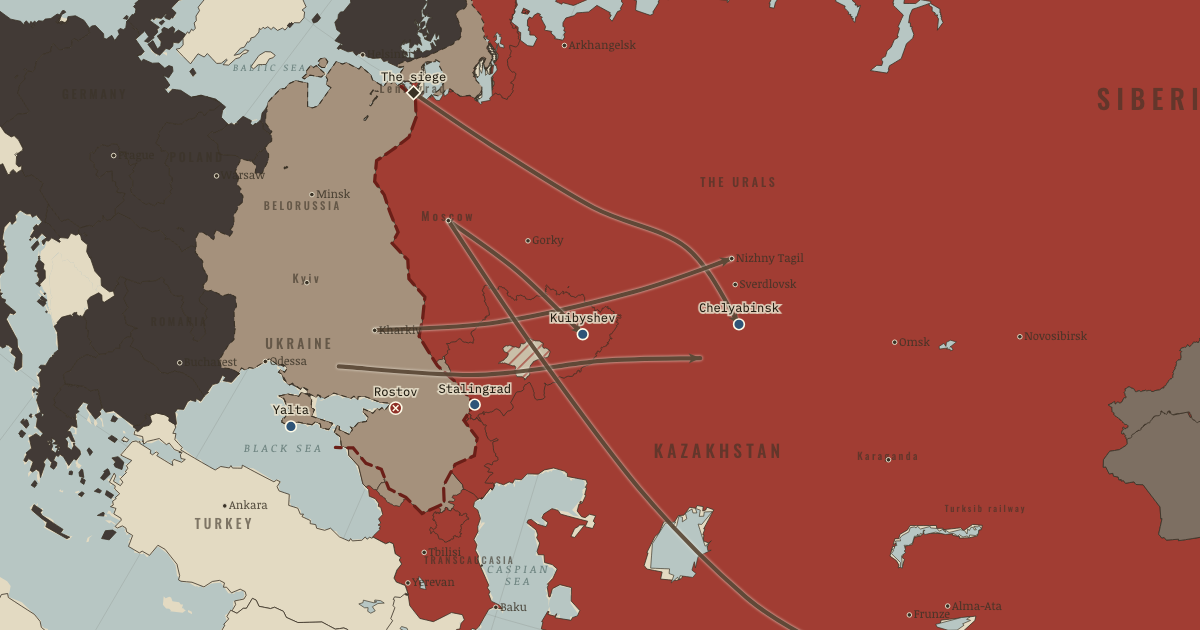
The map above is the world of The Soviet Union, November 1942 — The high-water mark: Stalingrad and the Caucasus.
Every state on the map that year: The world in 1942 · Europe in 1942.
Part of IB History: The Soviet Union under Stalin →
SHORT EXPLANATION
By November 1942 German forces had occupied the Soviet territory shown in tan, from the outskirts of Leningrad to Stalingrad on the Volga and the foothills of the Caucasus. The dashed line marks the front. The war of 1941–45 brought Stalin’s state close to destruction; victory would later give it a powerful claim to legitimacy.
Stalin had ignored repeated warnings before Germany attacked on 22 June 1941. In the first months the Red Army, the Soviet armed forces, lost millions of men. The regime nevertheless moved people and industry on an enormous scale. The arrows trace more than 1,500 factories evacuated in the second half of 1941 to the Urals, the Volga, Siberia and Central Asia. Many were producing weapons within months. The Five-Year Plans, programmes of forced industrial growth begun in 1928, had already built an industrial heartland beyond German reach. Like a company’s five-year budget, the plans set targets, but they had the force of law.
Stalin led the five-man State Defence Committee, which could order any institution in the country, and served as Supreme Commander. He stayed in Moscow in October 1941 when the government went to Kuibyshev on the Volga. After Rostov fell in July 1942, Order No. 227, “Not one step back!”, forbade unauthorized retreat. He also learned to listen to his generals and used Russian patriotism and the Orthodox Church to rally the population.
About 26 to 27 million Soviet citizens died. After victory in 1945, Stalin could present the sacrifices of the 1930s as the price of survival. This became the regime’s strongest argument for itself.
The full story
The German invasion of 22 June 1941 exposed a grave misjudgment. Stalin trusted the Nazi–Soviet Pact, the 1939 non-aggression treaty with Hitler, and dismissed intelligence warnings as British provocations. He forbade actions that might provoke Germany. The Red Army, the Soviet armed forces, was consequently unprepared along a new and unfortified border. German troops took Minsk in the first week.
Witnesses describe Stalin withdrawing to his dacha, his country house outside Moscow. On 30 June colleagues came to propose a State Defence Committee, or GKO, with Stalin at its head. This small war cabinet could direct every institution. On 3 July he addressed the population by radio as “brothers and sisters”. The appeal came with coercion: Order No. 270 in August branded soldiers who surrendered as traitors and made their families liable to arrest. A state that had terrorized its people now asked them to save it.
The government also had to save the means of producing weapons. Two days after the invasion it created a Council for Evacuation. Factories in Ukraine, Belarus, Leningrad and Moscow were dismantled and sent east by rail, often under bombing. The map’s arrows follow the routes. Between July and November 1941 about 1,500 large enterprises and millions of workers moved to the Urals, the Volga, western Siberia, Kazakhstan and Central Asia.
Chelyabinsk received the Kirov works from Leningrad and the Kharkiv diesel plant and became “Tankograd”. Some factories began work in unheated sheds before their walls and roofs were finished. They could be re-established in part because the Five-Year Plans had built an industrial base in the Urals. The binding targets set from 1928, rather like a company’s five-year budget with the force of law, had demanded enormous sacrifices; the capacity they created now became a decisive wartime asset.
The leadership of the war combined harsh orders with increasing reliance on commanders. After Rostov fell in July 1942, opening the route to the Caucasus, Stalin issued Order No. 227. Penal battalions sent punished soldiers to dangerous sectors, while blocking detachments behind the lines were ordered to stop retreating troops by force. From late 1942 Stalin relied more on professional commanders including Georgy Zhukov and Aleksandr Vasilevsky. The Stalingrad counter-offensive, told in The War Room, turned the war.
Stalin also invoked Russian history and faith to rally the population. Officers’ ranks and shoulder boards returned, and in September 1943 the Orthodox Church was allowed to elect a patriarch, its head, for the first time since 1925. In February 1945 Stalin met Roosevelt and Churchill at Yalta, the conference of the “Big Three” allied leaders. The Red Army’s advance had by then given him control of Eastern Europe. Victory cost 26 to 27 million Soviet lives, and the regime presented the sacrifice as proof that Stalin’s harsh methods had saved the country.
FULL EXPLANATION
How good a war leader was Stalin?
Two familiar portraits of Stalin at war pull in opposite directions. In 1956 Khrushchev described a blundering amateur, claiming that Stalin planned operations on a globe and caused the disasters of 1941–42. Histories under Brezhnev restored a wise commander, much as Stalin’s own propaganda had portrayed a military genius. Both accounts distort the record. Richard Overy’s Russia’s War (1997) and Geoffrey Roberts’s Stalin’s Wars (2006), drawing on Stavka’s records—the Soviet high command—and commanders’ memoirs, give a more balanced account. Stalin ignored warnings and forbade retreats; his insistence on holding Kyiv ended with more than 600,000 men encircled in September 1941. From 1942 he accepted generals’ advice more often, coordinated military and industrial planning through the GKO and handled the alliance with Britain and the United States skilfully. Oleg Khlevniuk emphasizes the confusion and waste caused by centralizing decisions. Stalin nearly lost the war in 1941 and subsequently helped win it by learning, within a system whose capacity to mobilize was its greatest asset.
The evacuation in numbers
Moving a factory meant moving machine tools and people on railways that were also carrying troops west. Records of the Council for Evacuation, studied by Mark Harrison and the Soviet historian G. A. Kumanev, show the scale. About 1,500 enterprises, mostly large plants, moved east between July and November 1941; the largest groups went to the Urals and western Siberia. About 12 million people had moved by the end of 1941 and 16 to 17 million by early 1942. Output fell sharply in the winter of 1941–42 before recovering, and by 1943 the Urals produced a large share of Soviet steel and tanks. Harrison stresses that the Soviet economy, although smaller than Germany’s, out-produced it in many weapons by concentrating on war and cutting civilian consumption to the bone. Allied help supplied other necessities: Lend-Lease from the United States and Britain included some 400,000 trucks and jeeps and large food deliveries, providing mobility and food Soviet industry could not supply. The war economy depended on both severe priorities at home and aid from allies.
Counting the cost
Stalin concealed the scale of the loss, speaking of 7 million dead; under Khrushchev the figure rose to 20 million. Demographic studies after 1991, including those by Evgeny Andreev, Leonid Darsky and Tatiana Kharkova, put total excess deaths at about 26 to 27 million. G. F. Krivosheev’s team counted some 8.7 million military dead. The remainder were civilians killed by occupation, siege, hunger, forced labour and mass murder. Holocaust victims included about 1 million Jews within the pre-1939 borders and some 2.5 million within the 1941 borders. For Leningrad alone, estimates range from about 630,000 civilians, the Soviet figure at Nuremberg, to more than a million. Totals also include deaths caused by the Soviet state, such as executions of soldiers and deaths in the Gulag and among deported peoples, counted differently by historians. Estimates of the pre-war population, migration and wartime births affect the ranges. The loss of men of fighting age left women greatly outnumbering men for decades.
Key places on the map
On this day
Why it happened
Stalin misjudged Hitler’s intentions. Stalin expected Germany to avoid a war with the Soviet Union while still fighting Britain. He treated warnings from spies, Churchill and his own border commanders as provocations and forbade measures that might give Hitler a pretext. Frontier units were not on alert on 22 June 1941, and much of the air force was destroyed on the ground that day. The Terror had removed experienced officers and left subordinates afraid to contradict him, making it harder to challenge the judgment that helped turn surprise into catastrophe.
The industrial base of the 1930s. Factories built under the Five-Year Plans in the Urals and Siberia lay beyond German reach. Planners were accustomed to directing resources, and the experience of building factories from nothing in the 1930s helped make evacuation possible in 1941. Ukraine had supplied much of the Union’s coal, iron and steel. Without Magnitogorsk and Kuznetsk, losing that production might have been fatal.
A system built for mobilisation. The state controlled every factory, farm and newspaper and could redirect the economy to war faster than a market economy. Rationing, labour conscription and moving millions of workers were familiar practices from the 1930s. Centralization had produced waste in peacetime; now it allowed resources to be concentrated on tanks, aircraft and shells. By 1942 more than half of national output went to war.
German brutality strengthened Soviet resistance. Some people in newly annexed lands and among deported or persecuted groups initially welcomed the Germans. Nazi occupation soon showed most that the alternative to Stalin was worse. Policy treated Soviet citizens as racial inferiors: prisoners of war were starved, villages burned, Jews murdered and civilians deported for labour. As rule hardened, resistance and partisan warfare grew. German brutality became a powerful reason to defend Stalin’s state.
THE TURNING POINT
Kuibyshev and Moscow, October 1941. As German forces approached Moscow, the GKO ordered the government, foreign embassies and much of the bureaucracy to Kuibyshev on the Volga on 15 October 1941. Officials fled, and panic swept Moscow the next day. Stalin chose to remain. A state of siege was declared on 19 October; on 7 November troops marched through Red Square straight to the front. His presence steadied the capital and army when collapse seemed possible. The decision became central to his wartime image and to the home front’s struggle for the regime’s survival.
What it changed
Victory as the regime’s new legitimacy. Victory gave the regime an answer to criticism of the 1930s. Collectivisation, the plans and even the purges could be presented as harsh but necessary preparation for survival. Stalin’s May 1945 toast to the Russian people as the Union’s leading nation set the tone. Memory of war and sacrifice remained central to Soviet and post-Soviet identity.
An empire in Eastern Europe. The Red Army reached Berlin with Soviet forces occupying Poland, eastern Germany, Hungary, Romania, Bulgaria and Czechoslovakia. The Tehran agreement of 1943 and Yalta agreement of 1945 recognized Soviet interests in the region. Within three years communist governments loyal to Moscow ruled most of it. The postwar map’s grey-tan satellites show a buffer of dependent states between the Soviet Union and Germany.
Returning prisoners and new suspicions. Captured soldiers, forced labourers and people who had lived under occupation returned to a state suspicious of their loyalty. The NKVD screened more than four million repatriated people in filtration camps; many went to the Gulag or labour battalions. The war refilled camps it had emptied, and suspicion of people who had seen the West lasted until Stalin’s death.
A demographic wound and a ruined west. The deaths of 26 to 27 million people, mostly young men, left millions more women than men and depressed the birth rate for decades. By Soviet count, the German retreat left 1,710 towns and some 70,000 villages destroyed. Famine struck already exhausted regions in 1946–47. Reconstruction dominated Stalin’s last years, and its costs again fell on villages and camps.
DISCUSSION QUESTION — How far was Stalin’s leadership responsible for the Soviet victory in 1945?
Stalin’s decisions helped produce the danger that victory overcame. He ignored warnings and forbade retreats in 1941, contributing to catastrophic losses, while the purges of 1937–38 had weakened the officer corps. He also stayed in Moscow in October 1941, learned after 1942 to rely on commanders such as Zhukov, coordinated the war economy through the GKO and handled the alliance with Britain and the United States skilfully. Overy and Roberts credit him with more than Khrushchev allowed; Khlevniuk emphasizes the costs of centralization. The wider system mattered more than his personal decisions: industrial capacity built in the 1930s, evacuation and conversion, the endurance of workers and soldiers, and Lend-Lease all contributed. German brutality also turned people against the invader. Stalin’s regime was suited to total war, and its leader both endangered and helped secure victory. Wartime success could legitimize dictatorship regardless of the price its people paid.
An interesting fact
Lenin’s body was among the things sent east. In July 1941, as German armies advanced, it was secretly removed from the Mausoleum on Red Square and carried by special train to Tyumen in western Siberia, more than 2,000 kilometres away. It remained under guard in the local agricultural technical college with the scientists who maintained it. The Mausoleum was camouflaged; parades in Red Square, including that of 7 November 1941, passed an empty tomb. The body returned to Moscow in 1945.
Related
THE FREE PRINTABLE STUDY GUIDE
Get the printable study guide for The Soviet Union under Stalin free. I’ll send you a few short letters, then one when a new atlas opens. That’s all. — Paul
NO TRACKING · YOUR ADDRESS IS USED FOR THE DISPATCH AND NOTHING ELSE · UNSUBSCRIBE ANYTIME