Stalin’s Soviet Union · CHAPTER 8 ·
Stalin’s cult of personality
Chapter 8 of The Soviet Union under Stalin, 1924–1953: “Propaganda and the Cult”
Stalin’s cult of personality began with page after page of tributes in Pravda for his fiftieth birthday on 21 December 1929. His portrait and words then filled schools, factories and squares, places from Stalingrad to Stalinabad took his name, and socialist realism, adopted in 1934, bound art to the party’s vision.
Chapter 8 is included with every paid plan. WW2 is free in full, and chapter 1 of every atlas is free. A free account opens 3 more chapters a day. Starter, at $9 a month, opens all 21 with no daily limit — see the plans.
Free printable Stalin’s Soviet Union study guide, sent by email ↓
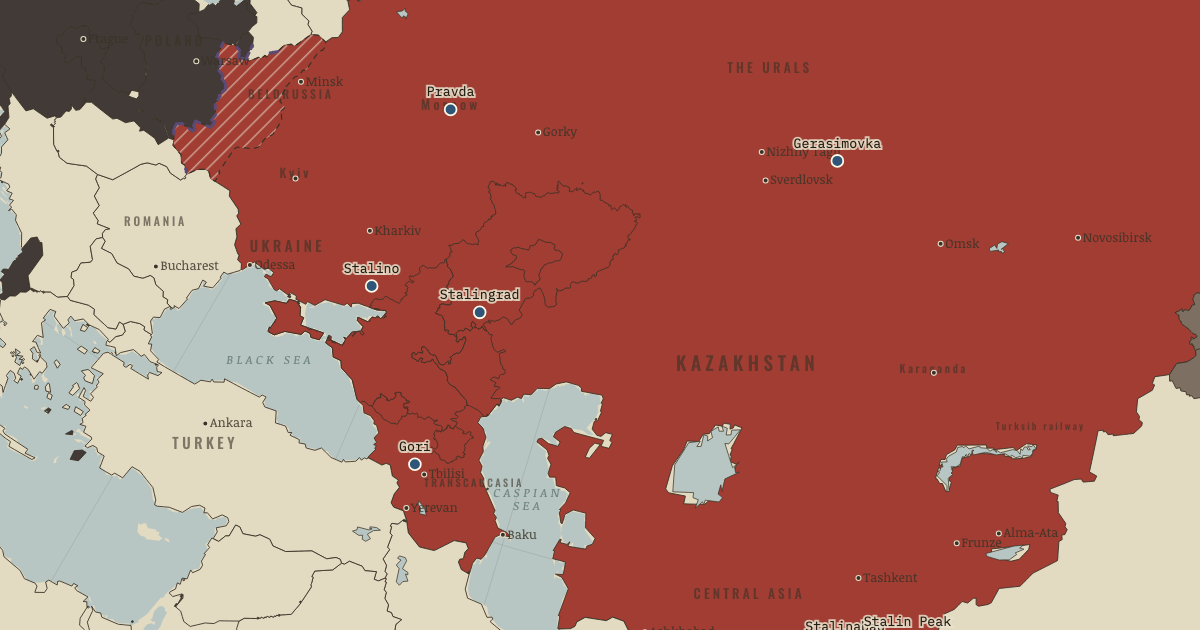
The map above is the world of The Soviet Union, September–December 1939 — Eastern Poland annexed; Stalin turns sixty.
Every state on the map that year: The world in 1939 · Europe in 1939.
Part of IB History: The Soviet Union under Stalin →
SHORT EXPLANATION
In December 1929 the Soviet press celebrated Stalin’s fiftieth birthday with tributes to a leader who had defeated his rivals. His name, portrait and words soon filled schools, factories and public squares. He became the vozhd (“leader”), the “Lenin of today” and the “father of peoples”. The map’s markers show how his name entered the landscape, from Stalingrad on the Volga to Stalinabad in Tajikistan and Stalin Peak, the Union’s highest mountain.
This was a cult of personality: official worship of a living leader as wise, kind and infallible. It resembled a modern brand built around a founder’s image, with a crucial difference: doubting Stalin’s image could lead to arrest. The regime used persuasion and fear together.
The leader’s image belonged to a wider effort to shape what Soviet citizens saw and remembered. Socialist realism asked artists to show reality “in its revolutionary development”. Like an architect’s drawing of a building not yet complete, art was to portray life as it was supposed to become. Stalin edited the 1938 party history, the Short Course, which made him Lenin’s chief helper and erased leaders removed in the purges, the waves of expulsions and arrests. Such figures disappeared from photographs too. Schools revived Russian national heroes and offered children martyrs such as Pavlik Morozov, the village boy said to have denounced his father and been killed by relatives.
Many people, especially the young, believed much of the official account; others repeated it publicly while joking in private. The cult tied loyalty to the Soviet system to loyalty to Stalin. When his image was later attacked, the authority of the system was shaken as well.
The full story
The celebration of Stalin’s fiftieth birthday gave his public image a decisive new prominence. On 21 December 1929 Pravda (“Truth”), the party’s daily newspaper, printed pages of tributes from his colleagues. The Great Turn was beginning at the same time. Forced collectivization formed part of a “revolution from above”, a transformation directed by the state, and the image of Stalin became attached to that transformation.
The association appeared in everyday public life. Speeches closed with ovations, letters thanked Stalin personally, and cities, factories, collective farms and the Union’s highest peak took his name. Stalingrad had been named in 1925; Stalino, Stalinabad, Stalinsk and Stalinogorsk followed during the 1930s, as the markers show. Stalin himself corrected drafts of praise and sometimes moderated them, presenting himself as a modest servant of the party. The image gave a human face to a state whose decisions could otherwise seem remote and frightening.
Artists and writers were expected to help shape the society the state wanted to create. The First Congress of Soviet Writers adopted socialist realism in 1934: art was to show life as the party said it was becoming. Stalin had called writers “engineers of human souls” in 1932, and they were reminded of his words. Literature, on this account, had work to do on its readers, as engineering did on its material.
The government also changed what children learned about their country. In the mid-1930s schools returned to textbooks, exams and discipline. New textbooks and Sergei Eisenstein’s 1938 film presented Russian heroes including Alexander Nevsky and Peter the Great as forerunners of Soviet patriotism. Revolutionary teaching could thus draw strength from an older national past.
Party members encountered an equally purposeful account of the revolution itself. Stalin edited the Short Course, published in 1938 and compulsory for every member; by 1953 tens of millions of copies had been printed. It enlarged his role in the civil war, including at Tsaritsyn, later Stalingrad, and portrayed leaders purged—expelled and arrested—in 1936–38 as traitors from the beginning. Readers were given a past arranged around Stalin’s eventual leadership.
It is harder to know what readers and listeners made of these messages. Historians examine diaries, letters and police reports on popular mood, each offering a different glimpse. Jochen Hellbeck’s diaries show young people sincerely trying to remake themselves as good Soviet citizens. The NKVD reports studied by Sarah Davies contain jokes, rumors and complaints; some peasants called collective farms a second serfdom.
Commitment and criticism did not always belong to different people. Many believed in socialist goals while doubting the methods used to reach them. Stephen Kotkin calls one way of navigating Soviet life “speaking Bolshevik”: people used official language to make claims and protect themselves. Children encountered heroes such as Pavlik Morozov, said to have denounced his father, and millions joined the communist youth organizations, the Young Pioneers and Komsomol. Whether or not citizens accepted every claim, the cult required a public performance of loyalty.
FULL EXPLANATION
How the cult was made
The cult centered on one man, but many people made it. Jan Plamper’s The Stalin Cult (2012) examines the work of artists, editors, censors and Stalin himself. Approved paintings and posters generally showed him calm, taller than those around him and slightly above or beside Lenin; his pockmarked face and withered left arm were never shown. Committees reviewed the work, and artists competed for commissions and prizes, including the Stalin Prizes established in 1939. Stalin sometimes cut excessive praise; at other times he ordered a play or history rewritten. Plamper finds older models in the veneration of the tsar and Orthodox saints, carried to a mass audience by radio, cinema and newspapers. Sarah Davies and Jeffrey Brooks examine another part of the machinery: newspapers organized expressions of gratitude. When citizens thanked Stalin for a new factory, a public good appeared as a personal gift. Such images could seem spontaneous even though their production was managed in detail.
The return of Russian history
The regime’s early heroes came from the revolution and civil war, and its propaganda celebrated class struggle and internationalism. The Terror made that inheritance difficult to use. A commander or party leader honored in a textbook might be condemned as a traitor at a show trial, forcing the book’s withdrawal. David Brandenberger’s National Bolshevism (2002) and Propaganda State in Crisis (2011) trace this change as the original revolutionary message faltered. From 1934 the government increasingly reached into Russian history. Andrei Shestakov edited a school textbook in 1937, films presented Alexander Nevsky and Peter the Great, and Pushkin’s centenary was celebrated in 1937. The textbook even described the tsars’ conquest of Ukraine and Georgia as a “lesser evil”, arguing that the alternative was rule by Poland, Persia or Turkey. Brandenberger argues that familiar national heroes mobilized ordinary people more effectively than abstract Marxism. The shift also elevated Russians as the “first among equals” among Soviet peoples. That theme gained force during the war and helps explain growing suspicion of other nations.
Belief, performance and dissent
How much room remained for independent thought under propaganda and terror? Since the 1950s historians have disagreed. Older totalitarian theory, associated with Hannah Arendt and Carl Friedrich and Zbigniew Brzezinski, assumed that the two forces produced atomized individuals without independent views. Social historians found a more varied society. Sarah Davies’s Popular Opinion in Stalin’s Russia (1997) draws on police reports of widespread grumbling over prices, privileges and the empty promises of the 1936 constitution. Jochen Hellbeck’s Revolution on My Mind (2006) uses diaries to follow people who wanted sincerely to become new Soviet persons, even as they struggled with doubt. Stephen Kotkin’s “speaking Bolshevik” offers another possibility: official language could serve people pursuing their own interests. These sources have their own pressures. Police reports sought enemies; diarists feared discovery. They cannot supply a simple count of believers. They do suggest that belief, doubt and pretense could coexist, sometimes within the same person.
Key places on the map
On this day
Why it happened
A leader without rivals needed a public image. Stalin had defeated his rivals by 1929, but he did not command Lenin’s authority or Trotsky’s fame. The cult linked him to Lenin and presented the plans’ achievements as proof of his wisdom and success. Colleagues who had known him as one leader among several competed to praise him, and their public devotion became a test of loyalty. Collectivization and industrialization could be presented as the work of the revolution’s leader rather than the demands of a committee.
A poorly educated society needed simple messages. The regime needed to reach millions of new workers and peasants with little schooling. A portrait of Stalin among workers, children or soldiers could communicate a heroic figure without requiring a knowledge of Marxist theory. Posters, film, radio and slogans carried such messages widely. Literacy campaigns sharply raised literacy in the 1930s and enlarged the audience for print; wired loudspeakers in workplaces and squares reached people who still could not read.
Russian traditions of the ruler as father. Many peasants had grown up with an image of the tsar as a distant father, while officials bore blame for injustice. The cult offered a familiar division of responsibility: Stalin was wise and kind, and local officials committed “excesses”, as in his 1930 article “Dizzy with Success”. Plamper and others argue that the pattern gave people who disliked particular policies reason to hope that the leader would correct them.
The Terror required a new history. A show trial could turn yesterday’s hero into today’s traitor. Histories and textbooks became obsolete; libraries removed books by and about the condemned, and owners inked faces out of photographs. The government needed an authoritative account that explained the purges while putting Stalin at the center of the revolution. The Short Course of 1938, written to his instructions and corrected by him, supplied one and became the basis of all teaching.
THE TURNING POINT
Pravda, 21 December 1929. Pravda’s birthday issue of 21 December 1929 appeared as Stalin began the revolution from above. Until then he had presented himself as one member of a collective leadership. Now colleagues competed to praise him, and newspapers increasingly attributed policy and success to him personally. That timing connected the cult to the Great Turn. Support for the plans could be presented as loyalty to Stalin, and criticism of collectivization or industrialization as an attack on the leader himself.
What it changed
Loyalty to one man became loyalty to the state. The cult made policy and leader difficult to separate: propaganda credited achievements to Stalin, so doubt about policy could be treated as “anti-Soviet agitation” under Article 58. A joke about him could bring a camp sentence, and thousands were convicted for such remarks. The Terror and Gulag enforced the limits around the image, making silence a safe form of loyalty.
Russian patriotism mobilised for war. The revived Russian past became a resource for wartime mobilization. In 1941 Stalin invoked Alexander Nevsky, Dmitry Donskoy, Suvorov and Kutuzov; propaganda appealed to the motherland as well as socialism. Soldiers’ cry “For the Motherland, for Stalin!” joined country and leader. The war completed the turn from revolutionary toward patriotic legitimacy.
The cult reached its peak after victory. After victory the cult reached its peak. Stalin’s seventieth birthday in December 1949 brought gifts from around the world, enough to fill a Moscow museum, and his portrait was illuminated in the night sky above the city. Soviet power carried the cult into the new Eastern European satellite states, where cities and streets were also renamed for him.
Its demolition shook the system. Khrushchev’s 1956 denunciation of the “cult of personality” attacked an image on which the regime had relied for a generation. Statues were removed and cities renamed; in 1961 Stalin’s body was taken from the Lenin Mausoleum. The shock to believers and protests in Georgia and Eastern Europe revealed how much authority had been invested in one man’s image.
DISCUSSION QUESTION — Did most Soviet citizens believe the propaganda of the Stalin era?
There is no single reliable measure of what most citizens believed. The evidence varies with age, place and experience. Hellbeck’s diaries show sincere attempts, especially by young and newly educated people, to become good Soviet citizens. Workers promoted through the plans had reasons to believe in a system that had advanced them. Davies’s police reports preserve jokes, complaints and rumors, particularly among peasants who had experienced collectivization and famine. Kotkin’s “speaking Bolshevik” helps us see how a person could use official language to advance or stay safe without accepting it completely. Neither kind of source is transparent: police looked for dissent, while diarists feared discovery. Belief in socialist goals was common, while belief in particular claims was weaker. The regime required people to take part publicly regardless of private conviction. Propaganda could therefore make conformity a normal feature of public life even when it did not persuade everyone.
An interesting fact
A photograph of Stalin beside the new Moscow–Volga Canal in 1937 originally included Nikolai Yezhov, the police chief who ran the Terror. After Yezhov was arrested in 1939 and shot in 1940, retouchers removed him: Stalin appeared to walk alone, with canal water in the space his companion had occupied. The British designer David King collected hundreds of such altered images, including removed faces and painted-over figures, in The Commissar Vanishes (1997). They show how extensively the visual record was revised.
Related
THE FREE PRINTABLE STUDY GUIDE
Get the printable study guide for The Soviet Union under Stalin free. I’ll send you a few short letters, then one when a new atlas opens. That’s all. — Paul
NO TRACKING · YOUR ADDRESS IS USED FOR THE DISPATCH AND NOTHING ELSE · UNSUBSCRIBE ANYTIME