Stalin’s Soviet Union · CHAPTER 7 ·
Stalin’s ethnic deportations
Chapter 7 of The Soviet Union under Stalin, 1924–1953: “Nations and Deportations”
Between 1937 and 1944 Stalin’s state deported entire peoples to Kazakhstan, Central Asia and Siberia, reversing the 1920s policy of promoting national minorities. The Koreans of the Far East went first in 1937, followed by the Volga Germans, Karachays, Kalmyks, Chechens, Ingush, Balkars and Crimean Tatars.
Chapter 7 is included with every paid plan. WW2 is free in full, and chapter 1 of every atlas is free. A free account opens 3 more chapters a day. Starter, at $9 a month, opens all 21 with no daily limit — see the plans.
Free printable Stalin’s Soviet Union study guide, sent by email ↓
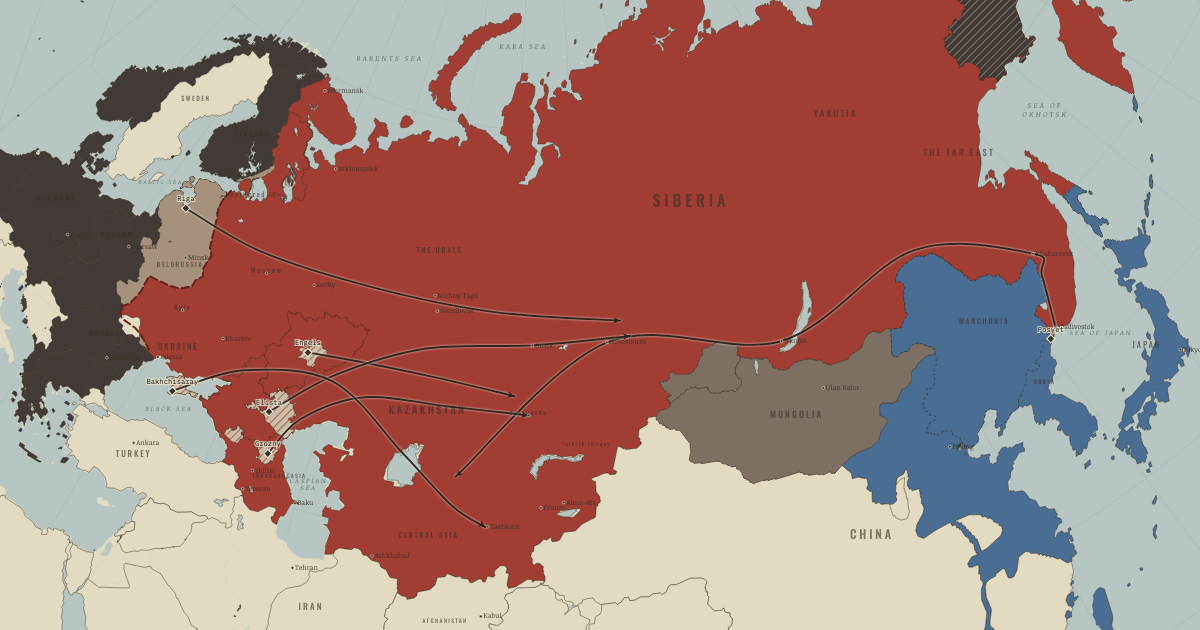
The map above is the world of The Soviet Union, May 1944 — Chechens, Ingush and Crimean Tatars deported.
Every state on the map that year: The world in 1945 · Europe in 1945.
Part of IB History: The Soviet Union under Stalin →
SHORT EXPLANATION
In the 1920s the Soviet government tried to bring its national minorities into socialism by supporting their languages and institutions. Under korenizatsiia (“taking root”), it promoted local schools, newspapers and officials, in a policy resembling modern affirmative action. But the state’s attention to nationality could serve another purpose. As the prospect of war grew, people with relatives or a homeland across a border came to be seen as possible enemies within.
The first entire people removed were the Koreans of the Far East, deported in 1937. The map’s arrows follow them and later deportees: Volga Germans in 1941; Karachays and Kalmyks in 1943; and Chechens, Ingush, Balkars and Crimean Tatars in 1944. They were sent to Kazakhstan, Central Asia and Siberia. A classification once used to build national cultures had become a means of selecting whole communities for removal.
A second kind of deportation accompanied Soviet expansion. The Nazi–Soviet Pact of August 1939 was a non-aggression treaty with a secret agreement dividing Eastern Europe between Hitler and Stalin. The Soviet Union acquired eastern Poland, the Baltic states and Bessarabia (today Moldova). Most remained under German occupation in May 1944, the date shown by the map’s tan western zone. The NKVD, the political police, camp administration and forerunner of the KGB, had removed hundreds of thousands from these annexed lands as “anti-Soviet elements”.
During the war the government charged entire peoples with collaboration with Germany, although many of their men served in the Red Army, the Soviet armed forces. The NKVD moved their communities east within days; pale hatching marks the homelands abolished afterward. Around 3 million people were deported as members of suspect nations, and tens of thousands to hundreds of thousands died in transit or during the first years of exile. Their nationality, rather than an individual act, determined their punishment.
The full story
Soviet leaders first acted against minorities along borders they feared they might have to defend. Poles, Germans, Finns and Koreans had homelands or connections beyond the Soviet Union, and planners imagined that they might help an invading power. In 1936 tens of thousands of Poles and Germans were moved from Ukraine’s western border zone to Kazakhstan. Their residence and ancestry made them suspect before any invasion had occurred.
Japan’s position in Manchuria made the Far East another focus of anxiety. An August 1937 decree ordered the removal of all Koreans there. During September and October, trains carried about 172,000 people to Kazakhstan and Uzbekistan, along the longest arrow on the map. At the same time, the Great Terror of 1937–38 brought mass arrests and shootings in “national operations” against minorities suspected of foreign espionage. The Polish operation alone shot about 111,000 people. The government was treating membership of a national group as evidence of a danger to the state.
The Nazi–Soviet Pact of August 1939 created a different problem for Soviet rulers. Its secret protocol divided Eastern Europe between Hitler and Stalin, and the Red Army entered eastern Poland on 17 September. Soviet forces occupied the Baltic states in June 1940; staged elections preceded their annexation in August. Romania was forced to surrender Bessarabia and northern Bukovina. On the map, these territories lie in the tan zone still held by Germany in 1944.
The government presented annexation as liberation, but it also sought to eliminate possible opposition to its new rule. In four waves during 1940–41 the NKVD deported Polish settlers, officials and their families. On the night of 14 June 1941 it removed more than 40,000 people from the Baltic republics, most of them women, children and elderly people. In spring 1940 the NKVD had also shot about 22,000 captured Polish officers and officials at Katyn and other sites, a crime marked in the Road to War atlas. Deportation and killing helped secure territories whose populations had not chosen Soviet rule.
Germany’s invasion brought a charge that could be applied to whole peoples: collaboration. In August 1941, as German armies advanced, a decree accused the Volga Germans of concealing saboteurs and abolished their republic. About 440,000 people were deported from the Volga, and by 1942 roughly 900,000 Soviet Germans had been moved east. After the Red Army retook the North Caucasus and Crimea in 1943–44, the NKVD removed the Karachays, Kalmyks, Chechens, Ingush, Balkars and Crimean Tatars. Some individuals had collaborated; the state punished entire communities.
Operation Lentil began on 23 February 1944 and moved about 496,000 Chechens and Ingush in a week. About 191,000 Crimean Tatars followed in May. The deportees became “special settlers”, restricted to assigned villages rather as prisoners on parole may be restricted to a district. Their homelands, shown hatched, were renamed and resettled. Neither service nor family relationship protected them: ancestry determined who was sent away.
FULL EXPLANATION
From “affirmative action” to “enemy nations”
Terry Martin’s The Affirmative Action Empire (2001) helps explain how a policy of promotion could leave tools for deportation. In the 1920s the party created thousands of national territories, from union republics to national villages, and supported local languages and officials. It hoped that non-Russian peoples would come to identify socialism with opportunities in their own cultures. To administer these arrangements, the state recorded national identities. Those records could also tell officials whom to remove. Martin calls groups with homelands across the border “diaspora nationalities”. From 1934–36, as officials came to regard them as possible agents of foreign powers, Poles, Germans, Finns and Koreans were removed from border zones. The national operations of 1937–38 brought shootings and deportations, turning them into what Martin calls “enemy nations”. Francine Hirsch and other historians emphasize another part of Soviet thinking: ethnographers and planners regarded nations as stages of development that the state could manage. Both accounts connect wartime removal to categories the regime created and recorded in every internal passport.
Counting the deported and the dead
The NKVD recorded how many people it moved more carefully than how many died. Pavel Polian’s Against Their Will (2004) counts about 3 million deported as members of suspect nationalities in 1936–52, among some 6 million forced migrants of all kinds. The NKVD records include about 172,000 Koreans in 1937 and roughly 900,000 Germans by 1942. For 1943–44 they give about 69,000 Karachays, 93,000 Kalmyks, 496,000 Chechens and Ingush, 37,000 Balkars and 191,000 Crimean Tatars. A count of arrivals cannot tell us by itself how many died later. Many deportees reached settlements in winter without housing or food, and mortality in transit and the first years of exile was high. NKVD-based figures suggest that a fifth to a quarter of Crimean Tatars died within two years, and that 100,000 to 200,000 Chechens and Ingush died, at least a quarter of those deported. Community surveys after the Crimean Tatars returned put their losses closer to half. Registration was incomplete and the estimates cover different years, so the evidence calls for a range.
Collaboration and collective guilt
The authorities invoked collaboration to defend the wartime removals, and some members of the affected peoples had indeed cooperated with Germany. Crimean Tatars served in German-organised self-defence battalions, a Kalmyk cavalry corps fought for the Germans, and an armed insurgency against Soviet rule operated in Chechnya in 1940–44. These facts deserve attention. They do not explain why the state deported people without regard to what they had done. The same peoples sent tens of thousands of men to the Red Army. Families of soldiers, party members and veterans were removed; Kalmyk and Chechen soldiers were later withdrawn from the front and sent after their relatives. Russians and Ukrainians, among others, produced far larger numbers of collaborators, yet were not deported as peoples. The government assigned guilt through nationality rather than individual conduct. Norman Naimark argues in Stalin’s Genocides (2010) that the Chechen and Ingush deportation meets the definition of genocide. The European Parliament recognized it as genocide in 2004; Ukraine’s parliament recognized the Crimean Tatar deportation as genocide in 2015. Other historians prefer ethnic cleansing, the forced removal of a people from a territory. Their terminology differs, but the collective assignment of guilt is central to the crime.
Key places on the map
On this day
Why it happened
Fear of foreign enemies on the borders. Japan occupied Manchuria from 1931, Nazi Germany rose to power in 1933, and the two signed the Anti-Comintern Pact against communism in 1936. Soviet planners looked at Koreans near Japanese-ruled Korea and Poles and Germans near Poland and assumed that kinship across the border could turn them into allies of an invader. Leaders already alert to enemies could regard clearing the border as protection. That assumption opened the way to removing whole peoples.
The habit of classifying people by nationality. National registration made a policy of removal administratively possible. The state had recorded nationality since the 1920s; from 1932 it appeared on a separate line in internal passports. At sixteen, children of mixed marriages had to choose one parent’s nationality. Officials could therefore identify citizens as Korean, German or Chechen, and the NKVD could organize removals in days. Records made for a policy that supported national cultures could be put to another use.
The Nazi–Soviet Pact brought hostile new lands. After the August 1939 Pact, Soviet authorities governed eastern Poland, the Baltic states and Bessarabia. Their populations had not previously lived under Soviet rule. Among them were officers, officials, landowners and priests, and settlers whom Poland had placed on the land after 1921. The NKVD treated these groups as anti-Soviet by definition and deported them in 1940–41 to secure the new borders before a war both Stalin and Hitler expected.
War made collective punishment seem justified. Germany invaded in 1941 and occupied the North Caucasus and Crimea in 1942–43. Cases of collaboration supplied a pretext for extending suspicion from individuals to entire peoples; wartime urgency silenced objections. The NKVD already had experience of mass removal, and Operation Lentil moved hundreds of thousands in days in February 1944. No court had to determine individual guilt when the state had assigned it to a whole nation.
THE TURNING POINT
The Korean deportation, September 1937. About 172,000 Koreans were removed from the Far East in autumn 1937. Earlier operations had targeted social classes, such as kulaks, or people living in border areas. This decree selected an entire nationality, including party members and Red Army soldiers. Their identity was enough to place them on the trains. The operation also supplied a method for the later deportations of Volga Germans, Chechens and Crimean Tatars: a decree named the people, the NKVD fixed a timetable, and sealed trains carried them to special settlements in Central Asia. The state had demonstrated that it could remove a whole nationality.
What it changed
Homelands abolished and resettled. The deportations changed the political map as well as the population. The Volga German, Kalmyk and Chechen-Ingush republics and the Karachay region were abolished, their land divided among neighbors. In 1945 the Crimean republic became a province. Russian and Ukrainian settlers entered emptied villages and place names were changed; pale hatching recalls these abolished homelands. In the Caucasus, the division of land has left their borders disputed to this day.
Life as special settlers. A journey east was followed by years of control. Special settlers had to register regularly and needed permission to leave their villages; from 1948 escape carried a threat of twenty years of hard labor. Their national schools and newspapers disappeared, and their children were barred from many university fields. Restrictions began to be lifted only in 1955–56, after a generation had grown up under suspicion in its own country.
Rehabilitation, partial and late. Rehabilitation did not restore every people to the same position. In 1957 Chechens, Ingush, Kalmyks, Karachays and Balkars could return, and their autonomies were restored. Volga Germans were cleared of collective guilt in 1964 but never recovered their republic. Crimean Tatars were allowed home only in 1989. These differences shaped relations with Soviet and post-Soviet states for decades.
A model for postwar repression. The state used mass removal again after 1945 to deprive armed resistance in the annexed borderlands of support. The NKVD and its successor deported about 76,000 people from western Ukraine in October 1947 and about 95,000 from the Baltic states in March 1949. By removing the villages that fed the resistance, the operations broke it.
DISCUSSION QUESTION — Why did a state that promoted national cultures in the 1920s deport whole nations in the 1940s?
The aims changed, but both policies depended on the state identifying and managing people by nationality. In the 1920s officials promoted national languages and local officials to win minorities to socialism. As war with Japan and Germany approached from the early 1930s, those same records helped identify diaspora nationalities as possible fifth columns. The national operations of the Terror in 1937–38 treated them as enemies. War gave the government both an opportunity and a pretext: collaboration by some individuals became a charge against whole peoples. Historians differ in emphasis. Terry Martin stresses the logic of the nationalities system, Naimark Stalin’s willingness to destroy peoples, and others wartime security panic. Classification did not have to lead to deportation, but it gave the state a means of selecting the people it chose to remove. Ethnic records created for one purpose can become instruments against those they describe when fear rises.
An interesting fact
The deported Koreans carried institutions as well as memories into exile. A Korean theatre founded in Vladivostok in 1932 moved with its actors to Kzyl-Orda, Kazakhstan, in 1937. It still performs in Almaty as the State Korean Theatre of Musical Comedy, one of the oldest Korean-language theatres outside Korea. The newspaper Lenin Kichi (“Lenin’s Banner”) also appeared in Kazakhstan for decades. The deportees’ descendants call themselves Koryo-saram; several hundred thousand live across Central Asia and Russia.
Related
THE FREE PRINTABLE STUDY GUIDE
Get the printable study guide for The Soviet Union under Stalin free. I’ll send you a few short letters, then one when a new atlas opens. That’s all. — Paul
NO TRACKING · YOUR ADDRESS IS USED FOR THE DISPATCH AND NOTHING ELSE · UNSUBSCRIBE ANYTIME